
How to Choose a Secondary School When Your Child Commutes by MRT or Bus
A practical guide for Singapore parents who need a school route that works every day without a car
To judge a secondary school commute by MRT or bus, look at the full door-to-door trip: walking, waiting, transfers, crowding, and the final walk to the gate. A workable route is one your child can repeat on normal days, rainy days, and CCA days without being regularly late, lost, or exhausted.
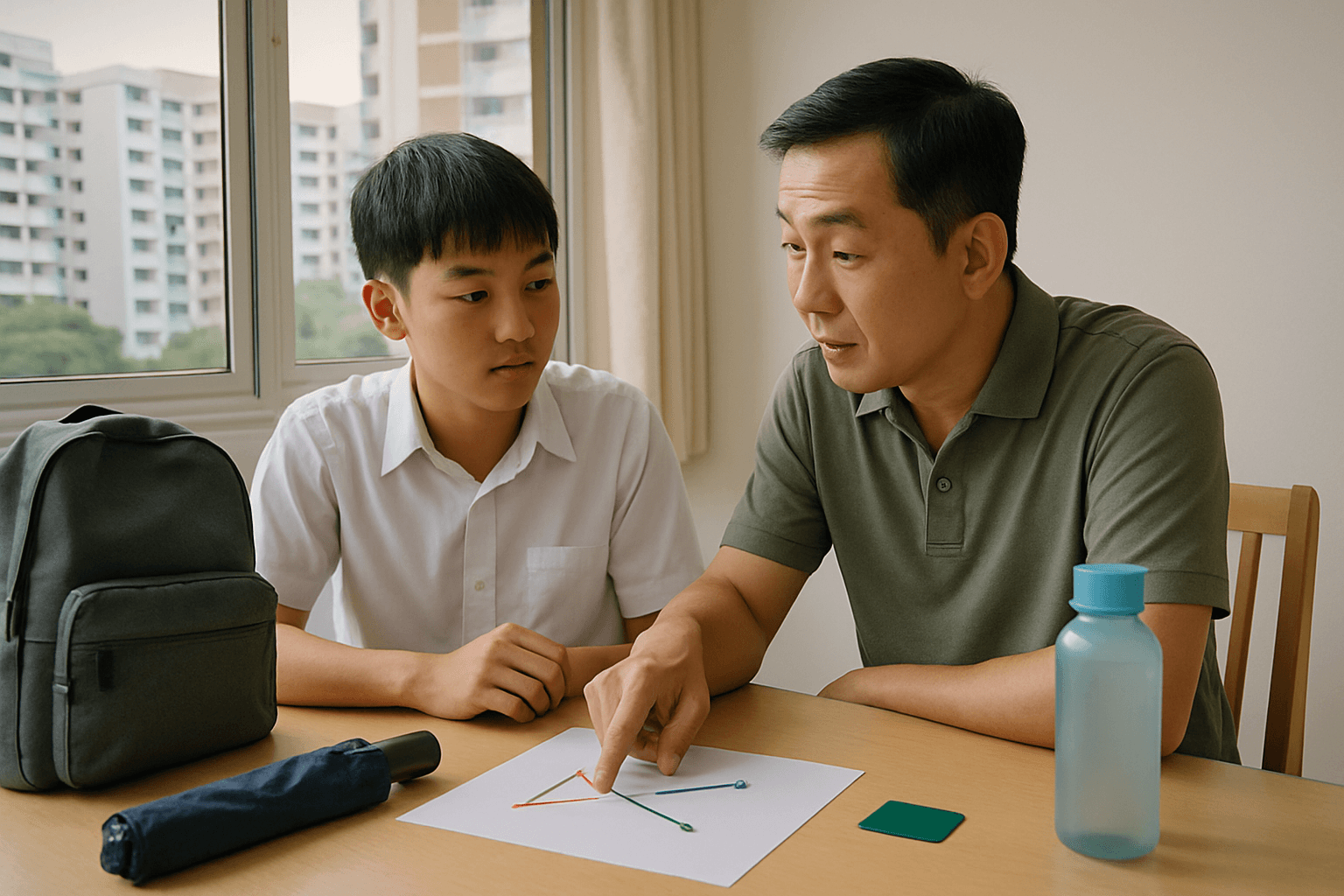
If your family relies on MRT and buses, the school journey is not a minor detail. It affects punctuality, energy, CCA participation, and how much time your child still has for dinner, homework, and sleep.
The practical way to judge a school commute is simple: measure the full route, test it at real school-going times, and weigh transport burden alongside academic fit and school culture. If you are still narrowing options, start with our PSLE AL Score in Singapore guide and secondary school shortlist guide, then compare which schools are realistic to reach every day.
What does a realistic secondary school commute by MRT or bus actually look like?
Measure the full door-to-door trip, not just how close the school is to an MRT station or bus stop.
A realistic commute is the full door-to-door journey, not the straight line on a map. Count the walk from home to the bus stop or station, waiting time, transfers, the ride itself, and the final walk from the stop or station to the school gate. Morning and afternoon should be treated as separate trips because crowding, weather, and pace can feel very different.
This is where many parents misjudge convenience. A school may be "near MRT" but still require a long station exit, a crossing at a busy road, and an uncovered walk to the gate. On paper, an MRT ride may look like 25 minutes. In practice, that can become 45 minutes once you add waiting, a line change, and the last walk. By contrast, a direct bus that takes 35 to 40 minutes may feel easier because your child boards once and gets off close to school. Think of this as a repeatability test, not a map test. For a broader overview, see PSLE AL Score in Singapore: What It Means, How It Works, and How It Affects Secondary School Choice.
School Bus Service for Secondary Schools
No need to use gothere. Just start up Google Maps on any phone, plug in your home address and destination, and it would tell you all the options you want to take to travel by MRT/Bus, or car, or even walk
What goes into choosing a suitable Secondary School
Saw this being shared in the parents groupchats. https://www.thewackyduo.com/2022/11/how-to-choose-secondary-school-guide.html https://i.imgur.com/fDkJSy6.png\"> https://www.thewackyduo.com/2022/11/how-to-choose-secondary-school-guide.html It's time to choose a secondary school. Choosing a secondary school is a completely different process than primary school. One tends to choose a primary school based on distance or affiliation. Picking a secondary school is a different ball game. Grades play a
How long is too long for a daily secondary school commute?
There is no official cutoff, so use a family benchmark and judge whether the route is still manageable on tired, rainy, or CCA-heavy days.
There is no official maximum commute time for a secondary school student. Many parents use about an hour by public transport as a rough comfort benchmark, but that is a practical yardstick, not a rule. The better question is whether the route is sustainable across a normal school week.
A child who leaves home early, reaches school on time, stays alert in class, and still has enough energy for homework may cope well with a 45- to 55-minute trip. The same child may struggle if that journey regularly stretches longer once rain, missed buses, or CCA are added. Time is only part of the picture. A 55-minute direct bus ride can be easier than a 40-minute trip with two transfers and a rushed final walk. If you are still comparing schools mainly by score range, use the transport lens together with our guides on how PSLE AL score affects secondary school posting and what PSLE cut-off points mean under the AL system. Insight: a workable commute is one your child can handle on a bad day, not just on a smooth day. For a broader overview, see How to Build a Secondary School Shortlist Using PSLE AL Score Targets.
What goes into choosing a suitable Secondary School
When I was studying in Temasek, I would study from 5:30am to 10pm. Took the bus home at 10+pm. Read my notes on the bus some more Come to think of it, I must have been crazy.
Transport for School-Going Kids
I was looking at the bus guide book, states that estimated time from CCK mrt to Queenstown mrt is 24 mins. Then change to bus 111 (about 4 stops). Shorter travelling time and cheaper than sch bus too.
Have More Questions?
Get personalized guidance on schools, tuition, enrichment and education pathways with AskVaiser.
Try AskVaiser for Free →What should parents check on the actual MRT or bus route?
Look at directness, transfers, crowding, the final walk to the gate, and how badly the route breaks if one service is missed.
Check five things closely: directness, transfer load, crowding, the last leg to school, and what happens if one ride is missed. A route with multiple transfers may look efficient in an app but feel fragile in real life, because one small delay can break the whole chain. A slightly longer direct bus can be the better everyday option if it removes stress.
Pay special attention to the final walk. A seven-minute walk sounds minor until it is uphill, unsheltered, or done in heavy rain with a large school bag. Also notice whether your child is likely to stand for most of the journey during peak hour. Standing on a crowded train for 25 minutes feels very different from sitting on a direct bus for 35. It also helps to think about school fit more broadly. Guides such as this KiasuParents article on evaluating schools beyond grades and this SmileTutor guide to choosing the right secondary school are useful reminders that transport should be part of the school-choice decision, not something you check last. For a broader overview, see How PSLE AL Score Affects Secondary School Posting.
Transport for School-Going Kids
Do you have service 76 or 43? If yes, then take any of these buses and transfer along Upper Paya Lebar Road for 28, 93 or 158. 2nd bus stop after it turns into Bartley Road is the Bartley MRT, right outside Maris Stella. Hope that helps.
Transport for School-Going Kids
hi parents, pls discuss all your transport related qns for your school going kids here. Need your help folks: I'm unable to find the circle line stations like bartley n marymount in this webi. :? http://www.sbstransit.com.sg/journeyplan/landmark.aspx does anyone know how to travel by bus from bartley station to still road?
How do you test whether the journey is really workable before choosing the school?
Test the route on a real weekday, in the same time window your child would travel, and include the trip home if you can.
Do a real weekday trial run during the same time your child would actually travel. A Sunday test is not enough. Try the morning route from home to the school gate, and if possible do the return trip around dismissal time or after a likely CCA end time. If your child will often carry sports gear or a heavier bag, bring those too.
Watch for the parts that create daily stress. Can your child follow the transfer without repeated prompting? Is the correct bus stop obvious on the way home? If one bus is missed, does the whole trip become rushed? Travel apps are useful for planning, but they often understate waiting, walking, and crowding. When you attend open houses or school visits, ask practical questions about dismissal patterns, CCA expectations, and how students usually travel, as suggested in The Straits Times' questions to ask when selecting a secondary school. For a broader overview, see What PSLE Cut-Off Points Mean Under the AL System.
What goes into choosing a suitable Secondary School
Hi there, Recently a relative asked me how I choosed my kid’s Secondary School and I kind of got a shock, I had no answer. It was simply just based on the results. My relative came then with a list of important factors that he thought would be helpful to help his kid cope with the stresses of school. I thought that I would help him make this post to help him make a better decision (the kid will be going into the Secondary School in next year). So here goes, considering grades what else should he
Choosing Secondary school
Hi, Wonder if anyone knows what happens in this Secondary School selection scenario : If there are 10 places left in School A and 20 pupils with EXACTLY the same PSLE score apply, how does MOE decide which 10 to take into the school. Does it matter in this case whether the child had put School A as the first choice? This impacts what schools to put as 1st and 2nd choice - whether the common advise of putting the dream school which is just out of range of the child’s mark is a wise thing to do. P
What commute problems do parents often overlook after school?
Do not judge a route by the morning alone; CCA days, fatigue, and weather often make the trip home the real test.
The return trip is often the harder one. By late afternoon, your child may be tired, hungry, carrying extra materials, or coming back after CCA with sports equipment or an instrument. Rain can slow the final walk, crowded buses can mean a long wait, and one missed connection can push arrival home much later than expected.
This matters because secondary school life does not end at dismissal. A route that feels fine at 7 a.m. may feel much longer at 5:30 p.m. after training or rehearsal. If your child reaches home at 7:15 p.m., there is still dinner, shower, homework, and sleep to fit in. Many parents compare schools based on how easy it is to get there in the morning. The more useful comparison is what time your child usually gets home on the busiest days. Morning speed matters, but afternoon sustainability matters more.
choosing secondary schools 2013
Sadly, there isn't a lot of good schools in this South area compared to the other areas ( had a pretty hard choosing my Secondary School last year because of this ) If your daughter can travel a bit more, you can consider these schools as well: 1) Fairfield Methodist School ( COP 239, previous year COP was 235 ) 2) Queensway Secondary School ( COP 214 ) 3) Queenstown Secondary School ( COP 200 ) Thank you!
Transfer to nearby Secondary School
Have shifted to Jurong West. Anyone have any idea how I can transfer my Sec 3 to nearby secondary school. Have approach a few school but all on waiting list. Any advice?
Is MRT or bus usually better for a secondary school commute?
MRT is often more predictable, while bus can be more direct; choose the route your child can repeat comfortably every school day.
Neither is automatically better. MRT is often easier to predict because train timing is steadier and the route is easier to learn once the child knows the transfers. That can help a new Secondary 1 student who values routine. But MRT routes can hide long station walks, crowded platforms, and line changes that make the journey feel longer than it looks.
Bus can be better when the route is direct. A one-seat bus ride from near home to near the school gate may beat an MRT trip that looks shorter on paper but includes a transfer and a ten-minute walk. On the other hand, buses can be more affected by traffic and stop crowding. The practical winner is not MRT or bus in general. It is the route with fewer moving parts, better shelter, and a more manageable trip home after a long day.
School Bus Service for Secondary Schools
From Little India MRT take what bus number to SCGS ? But wouldn't going to Little India MRT more troublesome, got to change train at Dhobby Ghaut again ? Tampines > City Hall > Dhoby Ghaut > Little India Vs Tampines > City Hall > Newton ?
Bus Services in Certain Secondary Schools? =|
hi helping hand why not u give crescent girls' sch a call to enquire abt their schbus services ?? i remembered when i was there at their openhouse yrs ago, (one of my choice sch, went there to looksee shd my gal t-score falls below 260) the gal who helped us ard the sch tour told me that some of her classmates took sch bus to sch, and one of them is residing in woodlands. dunno if there is any changes now.....
How can parents tell if their child is ready to commute independently?
Look for route memory, punctuality, calmness under small disruptions, and safe everyday habits, then build confidence with practice runs.
Readiness depends on both the route and the child. Look for basic signs that your child can manage the journey: remembering the route, noticing when the stop is approaching, keeping track of time, and staying calm if something small goes wrong. A punctual child who follows routines well may handle a one-transfer MRT trip quite smoothly. Another child may be academically ready for the school but still need more support with navigation and timing.
Practice helps more than many parents expect. Do a few accompanied runs before term starts, then let your child take the lead in reading signs and deciding when to tap out or get off. It also helps to agree on simple fallback actions: call home, ask station staff or a bus captain for help, or return to a familiar transfer point rather than guessing. Independent commuting is not just about knowing the route once. It is about being able to recover safely when the day does not go exactly to plan.
Preparing for Secondary School
Hi parents, For those who have children that are starting secondary school in the upcoming year, we have prepared 2 articles highlighting: How to prepare your child for the transition to secondary school ? How much independence should we allow teenagers / secondary school students in their studies ? Hope this is helpful and feel free to share your thoughts as well. Kind Regards, Educare Tutoring
All About Preparing For Secondary One
Do you guys have any links on how to choose a good secondary school? I only have this one https://teenagelab.com/how-to-choose-a-good-secondary-school/ Please share if you have
What mistakes do parents make when they compare schools based on transport?
The most common mistake is confusing a convenient-looking location with a commute your child can actually sustain every day.
The biggest mistake is treating map distance as proof that the commute will be easy. "Near MRT" does not always mean convenient, and a stronger school on paper is not automatically worth a route that drains your child every day. Parents also often underestimate the trip home after CCA, when fatigue, weather, and missed connections matter more than the morning estimate.
Another common mistake is deciding by reputation first and testing transport later. Broader parent discussions such as this KiasuParents piece on common secondary school dilemmas are a useful reminder that the best choice is usually the school your child can thrive in consistently, not the one that only looks best on paper.
What should parents check before shortlisting a school when public transport matters?
Use the same route test for every school so you are comparing realistic journeys, not guesses.
- ✓Compare full door-to-door time for each school, including walking, waiting, transfers, and the final walk to the gate.
- ✓Test the morning route and the after-school route separately instead of relying on one travel estimate.
- ✓Note how many transfers are needed and whether one missed bus or train causes a major delay.
- ✓Check whether walking segments are sheltered, safe, easy to follow, and manageable in rain or heat.
- ✓Observe peak-hour crowding and whether your child is likely to stand for most of the ride.
- ✓Estimate realistic home arrival time on CCA days, not just on regular dismissal days.
- ✓Look for backup options such as an alternative bus, a different station exit, or another reasonable route home.
- ✓Consider ongoing transport cost if one route is much longer or involves more transfers.
- ✓Judge your child's readiness honestly: route memory, punctuality, confidence, and ability to handle small disruptions.
- ✓Check the school booklet, school website, and open house information for programmes and after-school commitments that may affect travel.
- ✓Review transport together with academic fit by using [How to Build a Secondary School Shortlist Using PSLE AL Score Targets](/blog/how-to-build-a-secondary-school-shortlist-using-psle-al-score-targets) and the broader [PSLE AL Score in Singapore guide](/psle-al-score-singapore-guide).
Have More Questions?
Get personalized guidance on schools, tuition, enrichment and education pathways with AskVaiser.
Try AskVaiser for Free →