
Does Home Distance Matter in PSLE Secondary School Posting?
Why living near a secondary school helps the commute more than the posting outcome
No. In standard PSLE secondary school posting, home distance is not a general advantage parents should plan around. Focus first on PSLE AL score fit and your school choice list, then use distance as a practical commute and family-routine factor unless the current official instructions for a different route explicitly say otherwise.
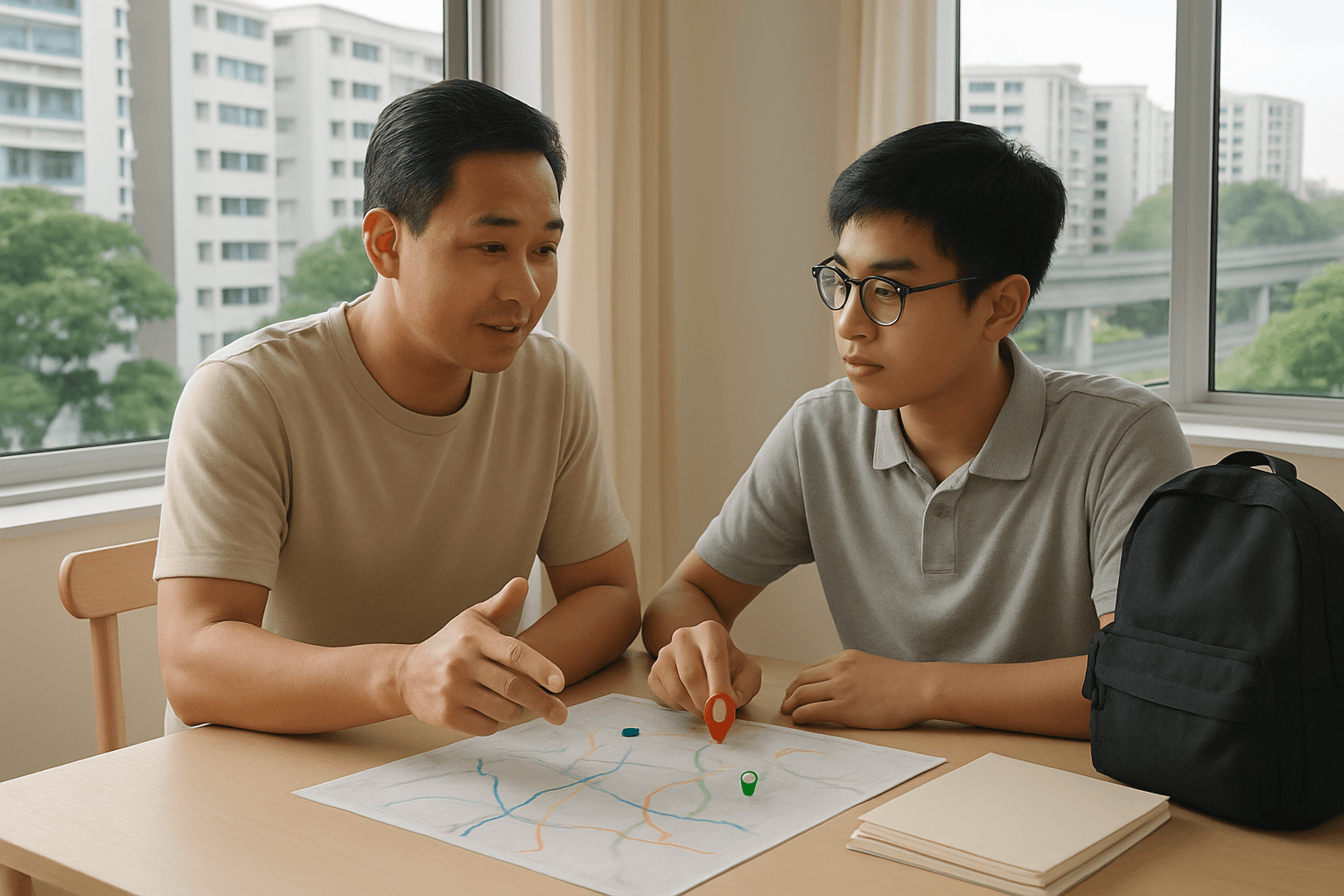
No. For the standard PSLE secondary school posting route, living closer to a school is not something parents should rely on for an advantage. Use distance to judge whether the commute is workable for the next four or five years, not whether the school becomes easier to get.
Short answer: does home distance matter in PSLE secondary school posting?
Usually no. Home distance is not a general advantage in PSLE secondary school posting, even though it may matter a lot for the daily commute.
For most parents, the practical answer is no. Living nearer to a secondary school does not automatically improve your child's posting chances, so it should not be treated as a strategy for getting into a preferred school.
What distance does change is daily life. A shorter trip can mean more sleep, less rushing in the morning, and an easier routine once homework, remedial lessons, and CCA start. Parents should think of home distance as a quality-of-life factor, not a shortcut in the posting process. For a broader overview, see PSLE AL Score in Singapore: What It Means, How It Works, and How It Affects Secondary School Choice.
Homeschool PSLE different from National PSLE?
Short answer to your question in title is \"YES\"!!!! I cannot find the detailed article but back in Dec 2008, the first batch of homeschoolers took PSLE and their scores were benchmarked at a lower level and only 19 out 26 kids met MOE's benchmark for passing PSLE. There was some debate from homeschooling parents why this was so unfairly treated... My simple thoughts would be \"MOE does not encourage homeschooling!\" So I believe during posting, there will be points taken off from this child. N
2016 PSLE Results & Secondary Posting Discussions
http://www.straitstimes.com/singapore/education/slight-dip-in-cut-off-points-for-popular-secondary-schools-despite-record-psle Slight dip in cut-off points for popular secondary schools despite record PSLE performance SINGAPORE - The minimum entry requirement for most popular secondary schools dropped slightly this year. This is despite the cohort's record performance at the Primary School Leaving Examination (PSLE) this year, with 98.4 per cent doing well enough to progress to secondary school
What should parents focus on before home distance?
Focus first on score fit and your choice list. Distance comes after that, not before it.
Start with realistic school fit, not the map. In practical planning terms, parents usually make better decisions by looking first at the child's PSLE AL score range and then at how they want to rank school choices. If you need a refresher, begin with our PSLE AL Score in Singapore guide, then read How PSLE AL Score Affects Secondary School Posting and What PSLE Cut-Off Points Mean Under the AL System.
A common mistake is to assume a nearby school becomes a stronger option simply because it is convenient. It does not. A school ten minutes away is still a weak choice if it is unlikely to match your child's score range. A school that is a little farther away may still deserve a place on the list if it is more realistic and a better fit for the child. If you want a parent-friendly external refresher on how PSLE scoring works, this KiasuParents overview of PSLE score calculation may also help.
First time parent: question of PSLE posting rule
@draakje said in First time parent: question of PSLE posting rule : Hi, The ranking order is a criteria for students with the same AL score… in this case, Student A with AL 9 should be considered before Student B with AL 10… You can try clarifying these questions with the chatbot here too https://schooladvisorsg.com/ask-sai Always refer to MOE websites first for guidance - https://www.moe.gov.sg/secondary/s1-posting
Homeschool PSLE different from National PSLE?
Can homeschoolers apply for DSA? Then the aplication will be at the schools' discretion without having to wait for psle results
Have More Questions?
Get personalized guidance on schools, tuition, enrichment and education pathways with AskVaiser.
Try AskVaiser for Free →When does home distance become relevant at all?
Distance only becomes relevant when the rules for that exact route say it does. Parents should not assume it helps by default.
Parents should only treat distance as relevant to posting if the current instructions for that specific route clearly say so. That is the safest way to think about it.
Many families get confused because they have heard a lot about distance in primary school admission or in other school-entry situations. That logic should not be carried over automatically to standard PSLE secondary posting. If you are dealing with a different route, such as DSA, an appeal, or a school-specific process, read that route's criteria as a separate exercise instead of assuming the standard posting logic applies.
A practical test is this: if someone says distance helps, ask which route, for which year, and based on which official instruction. If there is no clear answer, do not build your school list around that assumption. For a broader overview, see How to Build a Secondary School Shortlist Using PSLE AL Score Targets.
All About Measuring Home-School Distance
Distance is a factor when there is more applicants than places for a given phase
All About Measuring Home-School Distance
You can also check the home-school distance at this site http://www.elite.com.sg/
Common misconception: living closer does not mean a better posting chance
A shorter commute can help family life, but it should not be treated as a posting advantage.
The easiest way to remember this is simple: nearer is easier for daily life, not necessarily easier for posting.
Parents often confuse convenience with priority. A school near home may be easier to attend every day, but that does not automatically give your child an advantage in the standard posting process. For a broader overview, see What PSLE Cut-Off Points Mean Under the AL System.
Urgent question on secondary school posting
It does say students are posted on merit. See the 2nd page of your Choosing Your Sec Schools grey booklet. “students with a higher PSLE score will be posted to their school of choice before another student with a lower score”
2016 PSLE Results & Secondary Posting Discussions
What if it is the kid who wants to choose the farther school? DS is impressed by a sch 50mins away from our hse by MRT (DTL then CC line)....I'm a not sure, but he seems so passionate, should I dissuade him? We visited the school and it was like \"love-at-first-sight\" for DS, I like the sch myself, but it is the distance that I'm not sure....but now DS seems determined to put that sch as first choice. We visited other schools near our house, but this farther school is still his # 1 fav.....the
What parents often overlook when they choose the school nearest home
The nearest school is not automatically the best school. Check fit, programmes, support, and the real journey before you let distance decide.
A nearby school is only a good choice if it also suits the child. Parents sometimes focus on travel time first and only later realise the school may not offer the programmes, subject combinations, support structure, or CCA environment their child actually needs.
This shows up in real decisions. One family may pick the closest school and then discover their child has little interest in the available CCAs or struggles with the school's pace and culture. Another family may rule out a school that is farther away, even though it offers a stronger programme match and a direct train ride that is still manageable. There are also cases where a school looks near on paper but involves awkward bus transfers, so the actual morning journey feels longer than expected.
If you want a broader parent-oriented comparison framework, this guide from SmileTutor on choosing the right secondary school is a useful companion read. The key takeaway is that distance should narrow your options only after you have checked fit. For a broader overview, see What Happens After PSLE Results Are Released?.
2016 PSLE Results & Secondary Posting Discussions
My personal opinion is that distance is an important factor during considerations. We also do not want our kiddos to be too tired after school and spend hours travelling… Another important thing to consider is of cos our kiddos like that school that we choose. If they don’t like it, we force them and they will be more upset. That was wat happen last year for my DS. We are not successful in DSA. So we shortlist a few secondary schools and go for their Open Hse. I prefer Fairfield Meth and my DS d
When does a PSLE student start to choose secondary school?
Hi parents of children taking psle this year, u may find the following link info helpful. http://www.moe.gov.sg/education/admissions/secondary-one-posting/important-dates/
Should you choose a secondary school mainly because it is close to home?
Yes for daily logistics, no as a posting strategy. Use distance to judge sustainability, not admission advantage.
Choose with distance in mind, but for the right reason. Travel distance should help you judge whether a school is sustainable for your child over several years, not whether you think it improves posting odds.
The best comparison is not straight-line distance but real door-to-door travel. A school that takes twenty minutes on one direct bus may be easier than a school that takes fifteen minutes but needs two transfers and an exposed walk in the rain. Parents should also think about the journey home after CCA, whether the child can manage the route independently, and how the routine will feel on days when the child is tired.
If your child is already easily stressed or fatigued, daily logistics matter more than many parents expect. This Channel NewsAsia commentary on PSLE stress and anxiety is a useful reminder that small routine pressures can add up. Distance is worth considering seriously, just not as a posting hack.
2016 PSLE Results & Secondary Posting Discussions
XYZ1, nicnac, attempt impossible: Regarding distance from school, I agree with SpartanMum about discussing with DC. The most important factor is the child has to be the one who like the school. Then DC will be motivated to do well there, & go the extra mile (literary) For my DS, his priority is a school within walking distance. Hence it's either RI or CHS in Bishan. On the other hand, DS has 2 friends who did very well (270+/- type of t-score) stay in Bishan too, & could have entered RI, but 1 c
Homeschool PSLE different from National PSLE?
Discrimination is secondary only if these parents have the capabilities to continue homeschooling beyond primary school years or found an alternative education path like 2ppaamm. Otherwise they would have to consider mainstream secondary schools at some point in time 2ppaamm friend's kid was not posted to the secondary school of his choice although he qualifies. Even if some parents feel that homeschooling is best for their children during their formative years, this discrimination is usually su
What should parents focus on instead of trying to game distance?
Focus on realistic score fit, genuine preference, manageable commute, and backup choices you can live with.
Build a shortlist you can defend even if distance gives no extra help. Start with schools your child could realistically enter based on recent score patterns, then ask which ones your child would genuinely attend, and only after that compare the daily travel burden. Our guide on How to Build a Secondary School Shortlist Using PSLE AL Score Targets can help you structure that process, and PSLE AL Score Explained is useful if you need the scoring basics.
What parents often regret is not a slightly longer commute, but a weak-fit school choice made for convenience alone. For example, some families rank several nearby schools high because they seem practical, then later realise the child would have preferred a different environment or programme. A better rule is to choose schools you would still want even if your home address gave you no extra advantage at all.
2011 PSLE Discussions and Strategy
Even homeschooled children need to take PSLE ... certainly in national schools, the kids need to right? It's compulsory under MOE. Furthermore, it doesn't mean that with a DSA, the child WILL definitely do well enough. There are incidences of students who eventually get PSLE score below 200 and cannot make good their DSA offer. I have personally seen. Well, unless the child has a DSA offer to a school that has Normal stream as well, then maybe that is not too big an issue, but they still need to
2011 PSLE Discussions and Strategy
That's true. Secondary school subjects require a different set of skills too. You can do well in PSLE if you study hard, mug, memorise and do lots of worksheets. Not so straightforward to secondary school because you need thinking skills and time management. So it's not surprising that the tables are sometimes turned in secondary school.
If two children get the same PSLE score, does the child living nearer get the place?
Do not assume the nearer home gets priority. Unless the current official rules say distance is used in that situation, parents should not rely on it to break a tie.
Parents should not assume that. For standard secondary school posting, you should not build your plan around the idea that a nearer address will decide the tie unless the official instructions for that specific posting exercise clearly say so.
This is one of the biggest carryovers from primary school admission thinking, where distance is much more visible in parent discussions. In secondary posting, the safer response is not to guess how a tie might be broken, but to make sure your school choices are realistic and that you have backup options you would genuinely accept. If you want a clearer picture of what happens once results are out, see What Happens After PSLE Results Are Released.
2011 PSLE - Appeal for Sec School
Yes, priority is always given to affiliated students for all schools and the cut off point can be more than 20 points-40 points different as compared to non- affiliated students. So it is really good to get Primary sch with affiliated Sec sch. I also agree with you that PSLE score does not mean anything at all. With good score, you get to a better Sec sch but not necessary do well in Sec sch. I have seen too many cases like this.
2010 PSLE Discussion
Hi, Attended a parents' briefing at DD's sch recently. Was told by the Principal that MOE will computate PSLE aggregate scores up to 6 decimal places and the chances of 2 students scoring the exact marks are very slim. The Principal also confirmed that MOE will allocate sec schools by a student's aggregate score first, followed by the order of his/her choice of sch. In other words, MOE will work their way chronologically down the list of students, starting from the student with the highest aggre
A practical way to shortlist schools when distance matters for family life
Shortlist schools by fit first, then compare whether the commute is truly manageable for daily life.
The most workable method is to shortlist by fit first, then test the commute. Start with schools that look realistic from a score perspective. Narrow that list to schools your child would actually be willing to attend. Then compare the real travel pattern rather than just the postcode, including morning crowding, directness of route, likely journey home after CCA, and whether the routine still looks manageable when your child is tired.
This approach usually leads to better decisions than choosing the nearest school by default. One family may keep a school that is a bit farther away because it offers a programme the child is excited about and the route is direct. Another may drop a very near school because the fit is weak or because late CCA days would still be tiring. A third may realise that two schools have almost the same actual travel time even though one looks much farther on the map.
If you want to go deeper, pair this article with our PSLE AL Score in Singapore guide and How to Build a Secondary School Shortlist Using PSLE AL Score Targets. A simple rule to remember is fit first, commute second, rumours last.
Relocate & Skip PSLE. Gain entry to Sec Sch when back?
This website may be useful to you. http://www.moe.gov.sg/education/admissions/spers-sec/supplementary-exercise/
All About Measuring Home-School Distance
[Moderator's note: Topics merged.] I have recently encountered an incident regarding home to school distance. As this particular school left a few vacancies. So I have to be very careful to make sure that my house distance falls within 1km for Phase 2 Supp. When I went to the school, the admin girl said my house falls within 1 to 2km. I was disappointed and shocked as my house is just a few blocks away. I managed to find out the statelite distance online and shown that it is still within 1km, ev
Have More Questions?
Get personalized guidance on schools, tuition, enrichment and education pathways with AskVaiser.
Try AskVaiser for Free →