
What to Include in a DSA Arts Portfolio: A Practical Guide for Singapore Parents
How to choose and organise artwork, recordings, performance clips, and supporting evidence so schools can assess your child quickly
Most strong DSA arts portfolios include your child’s best recent work samples, a small amount of process evidence, the most relevant achievements, and brief specific teacher feedback. The aim is to show skill, consistency, and growth quickly, not to upload everything your child has ever done.
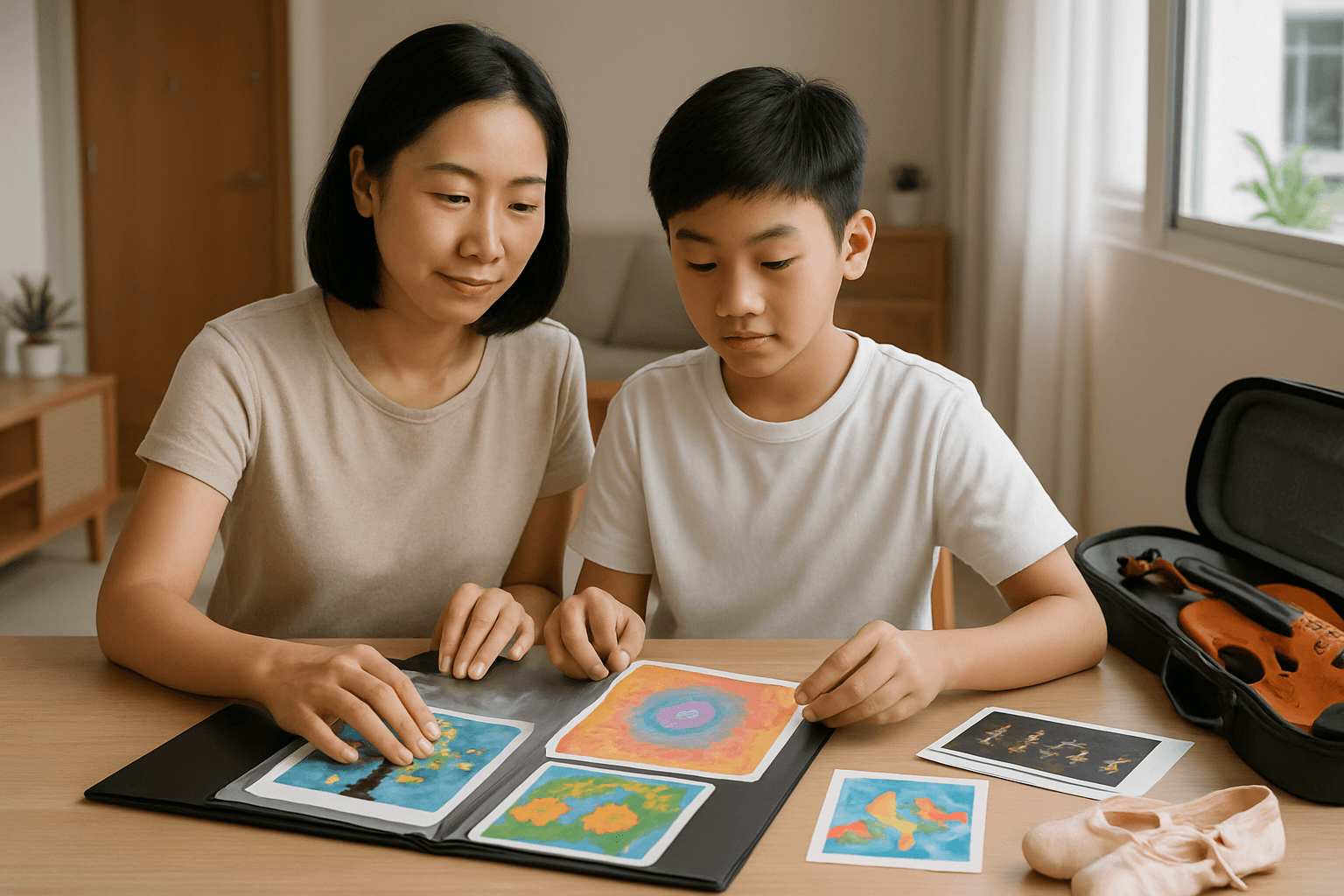
A DSA arts portfolio should help a school see three things quickly: what your child can do now, how seriously they have trained, and how they are improving. There is no single format used by every school, so the safest approach is to curate the strongest and most relevant evidence, then adapt it to each school’s instructions and arts area. If you want the wider context first, our Direct School Admission Singapore guide explains how DSA works from a parent’s point of view.
What is a DSA arts portfolio meant to show?
It should show direct evidence of skill, consistency, progress, and fit for the school’s arts area, not just a pile of awards.
A DSA arts portfolio should show assessable evidence, not just enthusiasm. Schools are trying to understand your child’s current skill level, how consistently they have worked at the art form, how they respond to training, and whether they are likely to contribute to and benefit from the programme. That matches MOE’s explanation that DSA-Sec schools consider talents and achievements, personal qualities, and academic suitability. For parents, the useful mindset is simple: think of the portfolio as proof, not promotion. A medal shows that something went well once. A strong work sample, paired with a short teacher note or a later piece that shows improvement, tells a school much more about ability, discipline, and potential. For a broader overview, see Direct School Admission Singapore: A Practical Parent Guide.
2009 DSA(Direct School Admission)
teachers testimonial and CCA teacher's testimonial. must prepare copies of past years' school results also. For art, can put in your art pieces in the portfolio. For writing, if you have published any books. articles, you can also put that in.
2010 DSA(Direct School Admission)
from what i've seen in this thread; the portfolio seems to include the pri sch exam results for p5, p6 (prelim), NSW exams (high distinction), competition (especially math olympiad, mathelympics), cca achievements (eg SYF gold medals) and testimonial from form teachers. the photocopies need to be certified by the pri school admin, i think. But i dunno if we need to submit the dsa application form with the portfolio to the school in person or just on-line entry of info, then submit the portfolio
What should we actually include in a DSA arts portfolio?
Start with strong work samples, then add a little process evidence, the most relevant achievements, and short specific teacher feedback.
Most strong portfolios combine four types of evidence. First, include the work the school can assess directly, such as artwork, music recordings, dance clips, drama scenes, or compositions. Second, add a small amount of process evidence, such as sketchbook pages, rehearsal footage, drafts, or practice work, so the reviewer can see how the child works and improves. Third, include the most relevant achievements, such as competitions, exams, recitals, showcases, or programme sheets. Fourth, add brief, specific feedback from a teacher or coach who knows the child’s work well. These are examples, not a universal checklist. If a school allows only a few uploads, prioritise evidence the school can judge with its own eyes or ears, then use certificates and comments as support. A helpful parent check is this: if you removed the awards page, would the portfolio still show clear ability? If yes, the foundation is probably strong. Before finalising anything, check the school’s own DSA selection details, because schools often publish talent-area instructions separately. For a broader overview, see How to Apply for DSA in Singapore.
🎨 Free eBook: How to Build a Strong DSA Visual Arts Portfolio – A Parent’s Guide from Experience
Hi Everyone I’m a parent who has guided both my daughters through the DSA Visual Arts process over the past few years — one of the most meaningful (and sometimes confusing!) experiences we’ve gone through together. Along the way, I realised that many parents like us often have the same questions: What kind of artworks should go into the portfolio? How do schools really evaluate DSA Visual Arts applicants? How early should we start preparing? So I’ve compiled what I learned into a free eBook — wr
School Of The Arts, Singapore
Dear parents, anyone out there whose children have successfully entered SOTA with a portfolio for DSA art? can you share what your child prepared in a portfolio? I chked out their website & I’m quite taken aback by the amount of stuff they have to prepare. My girl interested in art, thinking of SOTA for her. Any advice appreciated!! Thank u!
Have More Questions?
Get personalized guidance on schools, tuition, enrichment and education pathways with AskVaiser.
Try AskVaiser for Free →How should the portfolio differ for visual art, music, dance, and drama?
Use discipline-specific evidence: artwork for visual art, recordings for music, full-body clips for dance, and voice or scene work for drama.
The evidence should match what the school needs to assess. For visual art, that usually means finished pieces plus some development work, such as sketchbook pages, drafts, or experiments in different media. A portfolio of only one repeated style can feel thin unless the work is unusually strong, which is why range often matters. If your child is applying through visual art, these expert portfolio tips are a helpful reference for how selectors often think about variety, technique, and presentation. For music, the strongest evidence is usually audio or video that lets reviewers hear tone, control, accuracy, musicality, and confidence, supported by a short repertoire or training history. For dance, full-body video matters because schools need to assess movement quality, timing, posture, and expression. For drama, recordings should show voice, presence, expression, and the ability to sustain a role, whether through a monologue, scene excerpt, or stage performance. Insight line: match the evidence to the skill being judged. If the reviewer cannot see or hear the child’s ability directly, the portfolio is probably missing its most important part. For a broader overview, see What Talents Count for DSA Eligibility?.
School Of The Arts, Singapore
well i did audition and got in for the portfolio, choose those art pieces from 2yrs ago at most and during audi, u have to show the teachers there that u ARE capable! best of luck for your DD's audi!
School Of The Arts, Singapore
Mummy Dadeda Could you share a bit more about what SOTA students learn in visual arts? Sounds like its divided into drawing, painting, ceramics and sculpture ... are there more modules (?) than these, and what does each entail. Is there also further streaming of the art form in the upper levels, like specializing in some area? TIA.
How many items should we include without overwhelming the reviewer?
Choose a curated set of strong items that show ability and progress, and stop before the portfolio starts repeating itself.
Include fewer items than you first think you need, but make each one earn its place. Reviewers usually have many applications to go through, so the portfolio should help them understand your child quickly. Start with the strongest recent evidence, then add only enough to show consistency and progress. If a school gives a stated limit, follow that exactly. If no limit is given, stop when the next item feels repetitive rather than revealing. Six carefully chosen artworks with short captions usually say more than twenty similar photos. One polished solo clip, one ensemble clip, and a teacher note often say more than several near-identical recital recordings. Think of the portfolio as a highlight reel with context. Too little evidence can look thin, but too much can bury the strongest work. For a broader overview, see What Happens During a DSA Interview in Singapore?.
School Of The Arts, Singapore
Dear Lock, Have you gone to Sota's website , clicked under \"Admission\" and then proceed to \"Preparation for the Audition in Visual Arts\"? You would gain information of the profile of a Visual Arts student SOTA is looking for and all that technical preparations bit for the portfolio. There's this paragraph on \"We pay attention to imaginative, innocent..\" that might help you in your preparation of a home art folioto. Another thing you might want to take note of is that works submitted must b
School Of The Arts, Singapore
Hi parents of children who have applied or applying for Sota DSA in visual arts, is it a must to meet all the requirements of what to submit? For example my child do not have the dates of the art work neither does she have the sketches that lead to the artwork. Appreciate if you can share your experience, thanks.
How should we present performances, recordings, and artwork so they are easy to assess?
Use clear file names, logical order, short captions, and clean images or recordings, with the strongest work shown first.
Good presentation makes the reviewer’s job easier, and that affects how clearly your child’s strengths come across. Put the best work first, group similar items together, and use simple file names that tell the reviewer what they are opening, such as Alicia_Tan_Music_2025_PianoSolo or Alicia_Tan_VisualArt_2025_WatercolourStillLife. Keep captions short and useful: title or piece name, date, medium or role, and one sentence on what the item shows. For artwork, use clean scans or well-lit photos with a plain background. For videos, avoid shaky framing and make sure the child is visible or audible enough to assess properly. In a group dance, choir, band, or orchestra clip, clearly state where your child is positioned or what part they are performing, so the reviewer does not have to guess. If the platform allows links or uploads, test every file before submission. Parents often spend a lot of time collecting evidence but not enough time making it reviewable. Clear organisation is part of the portfolio’s strength, not just packaging.
School Of The Arts, Singapore
Look for Pibilotti Art as I went to find out info that they have experience in preparing students' portfolios for DSA to SOTA. There is a Pibilotti Art Studio at Chong Pang CC. Not related to Chong Pang CC. The husband teaches at Pibilotti at Chong Pang CC. The wife teaches at another Pibilotti at Pibilotti Art Studio is located at Blk 418 Yishun Ave 11 #01-393 S(760418). I visited the Chong Pang Pibilotti Art Studio personally and found out this info.
School Of The Arts, Singapore
Sorry, can't remember my dd2 art porttfolio as it was 5 yrs ago. I think it is written clearly in the application the different medium they needed, just follow them. Of course, you can bring something different to impress them. As for interview questions, it has never been a set questionaire. Just answer them confidently and enthusiastically in whatever they ask you and smile! All the best!!
What kind of teacher feedback or testimonial is actually useful?
Useful feedback is brief, credible, and specific about your child’s arts strengths, progress, and work habits.
The most useful teacher feedback is short, specific, and tied directly to the child’s work. One paragraph from the right adult is usually better than two pages of generic praise. A helpful note explains the adult’s relationship to the child, such as school music teacher, dance instructor, art enrichment teacher, or drama coach, and then comments on concrete things like improvement after correction, consistency in rehearsal, readiness for harder material, ensemble contribution, or growing independence. For example, a useful comment might explain that the student has moved from copying reference images to making stronger composition choices, or that the child now maintains timing and expression more reliably during group performance. A weak testimonial usually relies on broad phrases like talented, passionate, or has a good attitude without showing evidence. Insight line: testimonials should support the portfolio, not carry it. If your child is likely to face an audition or interview later, it also helps to prepare them to talk simply about their work and learning process, which we cover in our guide to what happens during a DSA interview in Singapore.
2010 DSA(Direct School Admission)
Hi clover18, you may like to read this pertaining to your query. http://www.kiasuparents.com/kiasu/content/sample-dsa-portfolio Cheers!
2010 DSA(Direct School Admission)
If I am not wrong, the DSA portfolio is more for the GEP students applying for DSA. For mainstream students, they just need to download the appln form from the school's website. Different schools have different requirements but generally, the photocopied result slips(pri 4 to 6 midyear) , cca and academic awards and achievements are definitely a must. Some schools require a personal statement by the child and teachers' recommendations. Actually some schools don't even ask for the certificates un
Should we include certificates, awards, and competition results?
Yes, include them, but use them to support stronger work samples and training evidence rather than replace them.
Yes, but use them as supporting evidence, not the centre of the portfolio. Certificates and results can show structured training, sustained participation, and external recognition. What they do not show on their own is how the child actually performs, creates, or improves. A violin exam distinction means more when it sits beside a recording. An art competition result becomes more useful when the submitted work is also shown. A drama workshop certificate helps more when paired with a clip that shows voice control or stage presence. Be selective. Include the most relevant and recent items, not every participation slip from years of enrichment. Parents sometimes worry if their child has limited awards. For arts DSA, that does not automatically mean the application is weak if the portfolio still gives strong direct evidence of ability and development. If you are still judging whether your child’s background is substantial enough for DSA at all, our guide to what talents count for DSA eligibility can help you assess that more realistically.
2008 DSA(Direct School Admission)
Hi Sally, You can check all about DSA via this website. http://www.moe.edu.sg/education/admissions/dsa-sec/ One advice is to start working on your child's portfolio detailing his academic achievements, CCA involvement, certificates attained (NSW, Math Olympaid), proof of community involvement, leadership positions etc.... All the best!
School Of The Arts, Singapore
VA is a very unique form, as in, a very personal sort of thing. What a teacher might like, another teacher might not. I do not suggest going to outside art schools to get a professional to prepare the portfolio. Art has to come from the heart itself, from the student's perspective. When my daughter prepared her portfolio years back, she brought along a craftwork animal she made at home with kitchen towels no less. She also brought along her sketch book - things she doodles at leisure. Along with
What do schools usually want to see beyond awards?
Beyond awards, schools often look for training history, discipline, improvement, and signs that your child can keep developing in the programme.
Many parents overestimate trophies and underestimate evidence of training, discipline, and growth. Schools often want to know whether the child is teachable, consistent, and likely to contribute meaningfully to the programme over time. That means process evidence can matter more than parents expect. In visual art, that might be sketchbook development, drafts, or before-and-after work showing stronger composition or colour control. In music, it could be recordings from different points in time that show improving tone, accuracy, or confidence. In dance and drama, rehearsal clips or programme notes can show commitment, ensemble experience, and readiness to work under direction. This is also why school research matters. Open houses and talent-area pages can reveal whether a programme values solo excellence, ensemble contribution, experimentation, or performance discipline most, and these questions to ask at secondary school open houses for DSA students can help you listen for the right clues. For a broader parent-facing view of how DSA selection works, Schoolbag’s DSA Q&A is also useful. Think of this as showing trajectory. A child who is clearly improving and actively training can be more compelling than a child with one isolated high point.
2009 DSA(Direct School Admission)
To add on, be prepared that interview panels may not even ask to look at your child's portfolio during interviews. They're more interested in how the child conducts himself/herself during the interview.
2010 DSA(Direct School Admission)
Joconde, not sure if I can help, but my son is doing a bachelor in fine arts. He was never trained in drawing. His only training is himself. Every month, I would buy him $5-10 worth of A4 paper, for photocopying kind. And lots and lots of pencil. He would draw every time he has time - and that's quite a bit. He started doing that since 4. In Primary school, the art lessons are practically useless for him, because they require different things, he is the creative kind, not the drawing by training
What are the most common mistakes in a DSA arts portfolio?
Avoid clutter, poor image or sound quality, vague captions, and padded submissions that hide your child’s actual strength.
The biggest problems are clutter and weak presentation. Parents often submit too many similar items, blurry artwork photos, poor audio, random file names, long captions that add little, or certificates without any actual work samples. Another common mistake is padding the portfolio with every workshop, minor participation slip, or old piece of work. That usually makes the child’s real strength harder to see. A smaller but cleaner portfolio is often stronger. There is also a discipline-specific trap to watch for: in visual art, repeating one style or subject too many times can make the portfolio feel narrow unless the work is exceptionally strong; in performance areas, clips that do not clearly show your child’s contribution can frustrate reviewers. Final check before submission: after a quick skim, can a teacher immediately tell what your child is good at and how they have grown? If not, trim and reorganise.
2010 DSA(Direct School Admission)
Schools don't specifically mention that GEP students need to submit portfolio while others don't need to. They would likely say that relevant documents to be submitted.
2010 DSA(Direct School Admission)
As promised, I've done up the dsa portfolio sample for parents who're interested. Pls click here. http://www.kiasuparents.com/kiasu/content/dsa-portfolio-sample
Have More Questions?
Get personalized guidance on schools, tuition, enrichment and education pathways with AskVaiser.
Try AskVaiser for Free →