
DSA Visual Arts Singapore: What Schools Look for in Portfolios
A practical parent guide to visual arts portfolios, technique, originality, and what schools usually expect.
For DSA Visual Arts Singapore, the strongest applications usually show good artwork, sketchbooks or process work, originality, consistency, and improvement over time. Many schools may also use interviews or practical tasks, so certificates can help, but the portfolio itself is usually the main proof of ability.
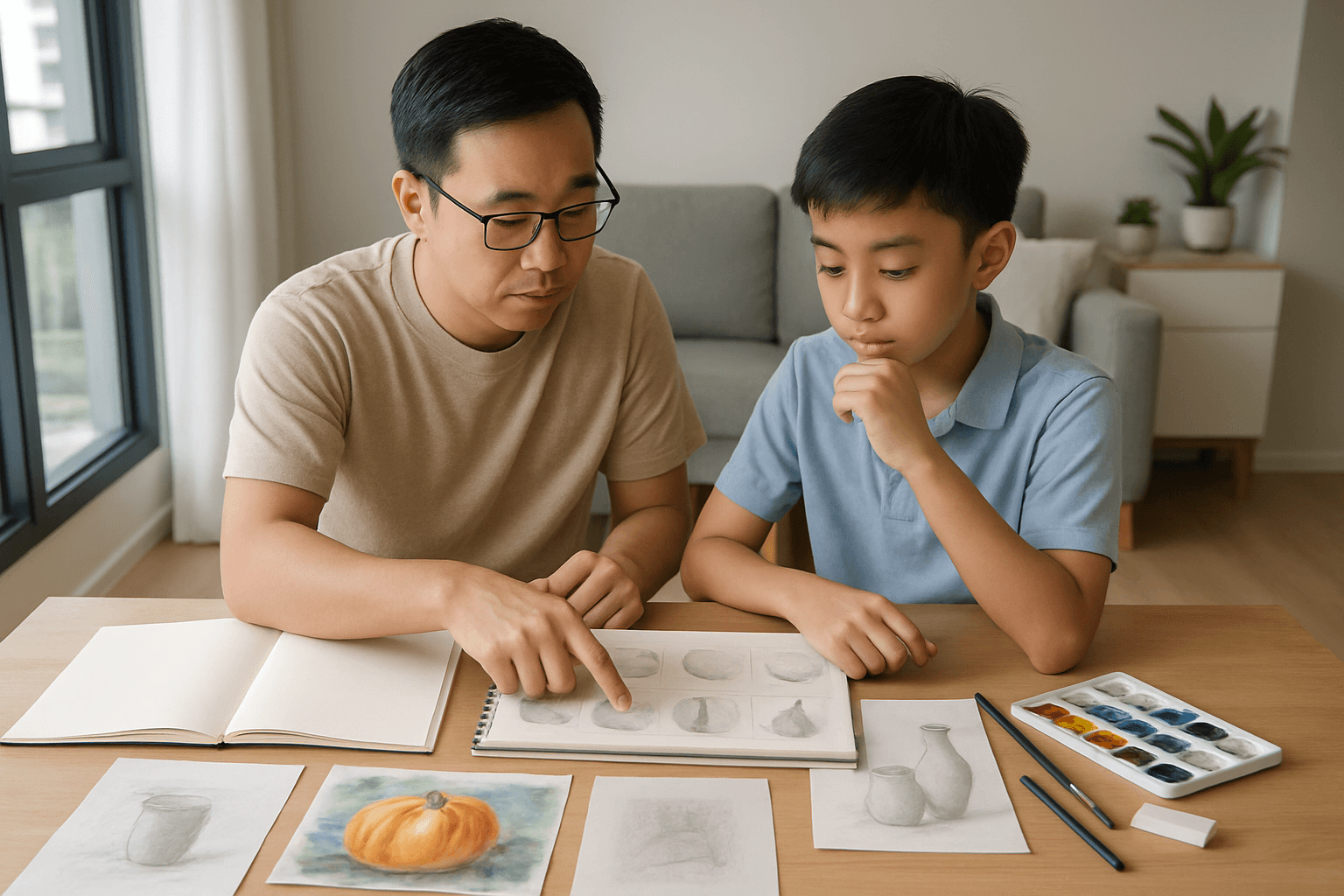
For DSA Visual Arts in Singapore, schools usually want evidence of real ability, not just interest. A strong application normally shows solid artwork, process work, originality, and growth over time. In simple terms, the portfolio should show how your child works and improves, not just a folder of attractive final pieces.
What is DSA Visual Arts in Singapore, and who is it meant for?
It is for students with clear, sustained strength in visual arts, not just a general interest in drawing.
DSA Visual Arts is a Direct School Admission pathway for students who have genuine strength in art and want to be considered for secondary school on that basis, not only by PSLE posting. According to MOE, schools use their own selection criteria and can consider talents, achievements, personal qualities, and academic suitability. In practice, this route is usually for a child who has already built a body of work that shows repeated effort, developing skill, and a clear interest in making art.
A simple way to think about it is this: DSA Visual Arts is usually for demonstrated ability, not casual interest. A child who enjoys drawing from time to time may love art, but a child who keeps sketchbooks, experiments with materials, revises work, and can explain what they are trying to do is closer to what schools are assessing. Depending on the school, the process may include a portfolio review, an interview, or a practical task.
A useful home check is whether your child would still make art without being told to. That does not guarantee success, but it often tells you whether the interest is deep enough for DSA. If you need the broader context first, start with our guide on Direct School Admission Singapore or the basics in What Is Direct School Admission in Singapore?.
School Of The Arts, Singapore
Mummy Dadeda Could you share a bit more about what SOTA students learn in visual arts? Sounds like its divided into drawing, painting, ceramics and sculpture ... are there more modules (?) than these, and what does each entail. Is there also further streaming of the art form in the upper levels, like specializing in some area? TIA.
2008 DSA(Direct School Admission)
Hi Sally, You can check all about DSA via this website. http://www.moe.edu.sg/education/admissions/dsa-sec/ One advice is to start working on your child's portfolio detailing his academic achievements, CCA involvement, certificates attained (NSW, Math Olympaid), proof of community involvement, leadership positions etc.... All the best!
What do schools usually look for in a DSA Visual Arts student?
Schools usually look for skill, commitment, personal qualities, and evidence that the child can keep improving.
Schools usually look for more than a nice-looking final piece. The broad lens is often artistic skill, commitment, personal qualities, and the potential to improve. That matches MOE’s description of DSA selection, and it also fits how schools and parent-facing resources describe the process in practice, including Schoolbag’s explanation of common DSA questions.
In a Visual Arts application, this often shows up in a few practical ways. One child may stand out for strong observation drawing, with careful attention to proportion, light, and texture. Another may be less polished but show thoughtful composition, curiosity with materials, and clear improvement over time. A third may impress because they take feedback seriously and can explain why they changed a piece after critique. These are different strengths, but they all suggest teachability.
What parents often miss is that schools are not only choosing the child with the prettiest art. They are also choosing a student they can train over the next few years. A strong portfolio therefore needs to show both current ability and future potential. Honest work, steady effort, and visible growth can be more persuasive than a portfolio that looks polished but narrow or generic. For a broader overview, see How to Apply for DSA in Singapore.
2010 DSA(Direct School Admission)
from what i've seen in this thread; the portfolio seems to include the pri sch exam results for p5, p6 (prelim), NSW exams (high distinction), competition (especially math olympiad, mathelympics), cca achievements (eg SYF gold medals) and testimonial from form teachers. the photocopies need to be certified by the pri school admin, i think. But i dunno if we need to submit the dsa application form with the portfolio to the school in person or just on-line entry of info, then submit the portfolio
2009 DSA(Direct School Admission)
teachers testimonial and CCA teacher's testimonial. must prepare copies of past years' school results also. For art, can put in your art pieces in the portfolio. For writing, if you have published any books. articles, you can also put that in.
Have More Questions?
Get personalized guidance on schools, tuition, enrichment and education pathways with AskVaiser.
Try AskVaiser for Free →How important is technique compared with originality and idea development?
Technique matters, but schools usually want to see personal ideas, experimentation, and development as well.
Technique matters, but schools usually want more than neat drawing alone. Technique shows control. It helps the school see whether the child can observe carefully, manage proportion, handle colour or shading, and work with discipline. Originality and idea development show something different. They show whether the child can think, experiment, and build work around a point of view rather than only copy what they see.
A realistic portfolio usually benefits from both. Observational drawings of everyday objects can show accuracy and patience. Colour studies can show experimentation rather than formula. A themed project built around birds, food, architecture, or neighbourhood scenes can show personal interest and idea development. A revised piece that improves after feedback can show maturity and trainability. A child who only copies reference images very well may still look limited if there is no sign of personal choices or development.
The simplest way to frame this is: technique proves control, originality proves thinking. Most schools are likely to value both. If your child mainly works in one familiar style, such as cartooning or anime-influenced drawing, that does not automatically weaken the portfolio. It becomes a problem only when every piece looks similar and the work does not also show observation, structure, or range. In that case, keep some of that style, but add pieces that show the fundamentals underneath it. For a broader overview, see What Happens During a DSA Interview in Singapore?.
2010 DSA(Direct School Admission)
Joconde, not sure if I can help, but my son is doing a bachelor in fine arts. He was never trained in drawing. His only training is himself. Every month, I would buy him $5-10 worth of A4 paper, for photocopying kind. And lots and lots of pencil. He would draw every time he has time - and that's quite a bit. He started doing that since 4. In Primary school, the art lessons are practically useless for him, because they require different things, he is the creative kind, not the drawing by training
🎨 Free eBook: How to Build a Strong DSA Visual Arts Portfolio – A Parent’s Guide from Experience
Hi Everyone I’m a parent who has guided both my daughters through the DSA Visual Arts process over the past few years — one of the most meaningful (and sometimes confusing!) experiences we’ve gone through together. Along the way, I realised that many parents like us often have the same questions: What kind of artworks should go into the portfolio? How do schools really evaluate DSA Visual Arts applicants? How early should we start preparing? So I’ve compiled what I learned into a free eBook — wr
What should a Visual Arts portfolio usually include?
Include finished work, process work, and a smaller selection that shows range, development, and how your child actually works.
A useful DSA Visual Arts portfolio usually includes finished work, process work, and examples that show range. There is no single national portfolio template that every school follows, so parents should first check each school’s DSA page and follow any specific submission instructions the school gives. After that, choose work that best proves the child’s actual ability and development.
Common examples include completed artworks, sketchbook pages, drafts, studies, media experiments, classroom assignments, enrichment pieces, and personal projects done outside school. These are examples, not guaranteed requirements. Process work matters because it helps the school see how the child thinks, revises, and improves. A portfolio made up only of final pieces can hide whether the child has depth or just one polished style.
Smaller is often better than thicker. Many parents add more work because it feels safer, but extra pieces can dilute the application if they are weaker or repetitive. The job of the portfolio is not to show everything the child has ever made. It is to show the clearest evidence of ability, range, and growth. For broad portfolio thinking, this parent-facing visual arts portfolio guide is useful as long as you treat it as general guidance, not a fixed DSA checklist. For a broader overview, see Is Direct School Admission Worth It For My Child?.
School Of The Arts, Singapore
Hi parents of children who have applied or applying for Sota DSA in visual arts, is it a must to meet all the requirements of what to submit? For example my child do not have the dates of the art work neither does she have the sketches that lead to the artwork. Appreciate if you can share your experience, thanks.
2010 DSA(Direct School Admission)
As promised, I've done up the dsa portfolio sample for parents who're interested. Pls click here. http://www.kiasuparents.com/kiasu/content/dsa-portfolio-sample
What kinds of work do parents often prepare for the portfolio?
Parents usually prepare strong school work, sketchbooks, personal projects, enrichment pieces, and relevant competition entries.
In real applications, parents often gather the child’s strongest school art pieces, art class work, personal projects, and any relevant competition submissions. These are common materials families prepare, not official requirements. The aim is not to prove that the child has been busy. It is to show clear evidence of ability, range, and genuine interest.
A practical mix might include a strong still-life drawing from school, sketchbook spreads that show rough ideas and revisions, a watercolour or mixed-media piece done at home, and one or two pieces from art enrichment if they reflect the child’s actual level. A competition entry or exhibition piece can also be included, but only if the work itself is strong enough to stand on its own.
One common mistake is choosing pieces mainly because they look neat, framed, or impressive in photos. Schools are usually trying to see the child, not the packaging. Work from enrichment classes can help, but be careful if the piece has been heavily corrected by a teacher. If the portfolio looks too adult-directed, it may raise more questions than it answers. For a broader overview, see Do You Need Top Grades for DSA in Singapore?.
2010 DSA(Direct School Admission)
If I am not wrong, the DSA portfolio is more for the GEP students applying for DSA. For mainstream students, they just need to download the appln form from the school's website. Different schools have different requirements but generally, the photocopied result slips(pri 4 to 6 midyear) , cca and academic awards and achievements are definitely a must. Some schools require a personal statement by the child and teachers' recommendations. Actually some schools don't even ask for the certificates un
School Of The Arts, Singapore
Dear parents, anyone out there whose children have successfully entered SOTA with a portfolio for DSA art? can you share what your child prepared in a portfolio? I chked out their website & I’m quite taken aback by the amount of stuff they have to prepare. My girl interested in art, thinking of SOTA for her. Any advice appreciated!! Thank u!
How can a parent show progression, not just pretty final pieces?
Use drafts, studies, and revised versions so the school can see improvement, not just finished outcomes.
Show work in sequences rather than as isolated outcomes. Progression helps schools see trainability, which matters because DSA is partly about whether the child can be developed further. A school may be more interested in a child who is clearly improving than in a child with one eye-catching piece but little evidence of growth.
In practice, progression can be shown by placing an early sketch beside a later revised version, or by showing a study page, a colour trial, and the final artwork together. A child who struggled with proportion in earlier figure drawings but improved across several pages is showing something valuable. A student who explores the same subject in pencil, ink, and paint is also showing growth, because the school can see experimentation and reflection rather than repetition.
Even a few well-chosen sequences can do more than many unrelated final pieces. Think of this as showing the child’s learning curve. If interviews are part of the process, the child should also be able to explain what changed, what feedback they used, and what they would improve next. Our guide on what happens during a DSA interview in Singapore can help you prepare for that conversation.
School Of The Arts, Singapore
Dear Lock, Have you gone to Sota's website , clicked under \"Admission\" and then proceed to \"Preparation for the Audition in Visual Arts\"? You would gain information of the profile of a Visual Arts student SOTA is looking for and all that technical preparations bit for the portfolio. There's this paragraph on \"We pay attention to imaginative, innocent..\" that might help you in your preparation of a home art folioto. Another thing you might want to take note of is that works submitted must b
School Of The Arts, Singapore
Look for Pibilotti Art as I went to find out info that they have experience in preparing students' portfolios for DSA to SOTA. There is a Pibilotti Art Studio at Chong Pang CC. Not related to Chong Pang CC. The husband teaches at Pibilotti at Chong Pang CC. The wife teaches at another Pibilotti at Pibilotti Art Studio is located at Blk 418 Yishun Ave 11 #01-393 S(760418). I visited the Chong Pang Pibilotti Art Studio personally and found out this info.
What mistakes make a Visual Arts portfolio look weaker than it really is?
Portfolios usually look weaker when they are repetitive, over-polished, missing process work, or too dependent on certificates.
The biggest mistakes are usually over-curating, over-polishing, and over-relying on proof that sits outside the work itself. A portfolio often becomes weaker when every piece looks similar, when there is no process work, or when the theme feels generic and disconnected from the child’s real interests. Another common problem is a narrow style repeated again and again without showing observation, structure, or experimentation. Certificates can support the case, but they cannot rescue weak or inconsistent work.
There is also a very practical mistake parents overlook: poor presentation of the work itself. If photos are dark, cropped badly, or make textures and details hard to see, the portfolio may underperform even when the art is decent. A good test is this: if you removed the awards page, would the artwork still make a strong case? If the answer is no, the portfolio probably needs better selection, not better packaging. Families also benefit from asking sharper questions at school open houses, as suggested in this parent guide on DSA open house questions.
2010 DSA(Direct School Admission)
Schools don't specifically mention that GEP students need to submit portfolio while others don't need to. They would likely say that relevant documents to be submitted.
2009 DSA(Direct School Admission)
Hi vlim or anyone, what is portfolio ? and what typically are included? Is CCA part of the portfolio? Is it for GEP student when they apply for DSA only? Any sample?
How should parents judge whether their child is a realistic DSA Visual Arts candidate?
A realistic candidate usually shows steady ability, long-term interest, and the ability to learn from feedback.
Look for consistent ability, sustained interest, and teachability rather than one excellent artwork. A realistic candidate usually makes art regularly, not only before competitions or application deadlines. The child usually has enough work to show a pattern, not just a highlight. They can often explain what they made, why they made it, and what they were trying to improve.
A simple comparison helps. One child may have a single competition result and a few polished class pieces, but no sketchbooks, no independent work, and little interest in feedback. Another child may have no major awards, but has years of regular drawing, a range of subjects, thoughtful studies, and visible improvement. The second child may actually be the stronger DSA Visual Arts applicant because the evidence is deeper and more sustainable.
Parents should also think about fit, not just entry. If your child gets in through art, will they be comfortable in a school where expectations may be more demanding and structured? Schools can also consider academic suitability, so it helps to read Do You Need Top Grades for DSA in Singapore? alongside How to Apply for DSA in Singapore. For the wider question of whether this route makes sense for your family, Is Direct School Admission Worth It For My Child? and this DSA readiness article are useful reality checks.
2009 DSA(Direct School Admission)
To add on, be prepared that interview panels may not even ask to look at your child's portfolio during interviews. They're more interested in how the child conducts himself/herself during the interview.
School Of The Arts, Singapore
My daughter is in SOTA for visual art. The portfolio should be about putting together stuff that your girl has been working on for the past few years. I would assume this is not a problem because I am also assuming that a child who is interested in art has been producing stuff for a few years now. The \"duty\" on the part of parents is to preserve the produced stuff diligently. I didn't follow the rules for portfolio; they wanted to see actual works. We saw candidates with actual works piled up
Will awards and certificates matter more than the portfolio?
No. They help as supporting evidence, but the portfolio is usually the core proof of ability.
No. Awards and certificates can help, but the portfolio is usually the main evidence of the child’s actual ability. Schools are trying to assess what the student can really do, how consistently they can do it, and whether they show the qualities the school wants to develop.
In practical terms, a child with no major awards but a strong portfolio can still be a serious applicant. If the work shows observation, range, process, and clear growth, that may be more persuasive than a stack of certificates attached to weak or repetitive art. One competition prize can strengthen the story, but it usually does not carry the whole application by itself.
Parents often overvalue certificates because they are easy to compare, while portfolio quality is harder to judge. A better question is this: if the school saw only the artwork and sketchbooks, would the application still look convincing? If yes, the certificates are useful support. If no, focus first on improving selection and evidence inside the portfolio.
2010 DSA(Direct School Admission)
Hi clover18, you may like to read this pertaining to your query. http://www.kiasuparents.com/kiasu/content/sample-dsa-portfolio Cheers!
2009 DSA(Direct School Admission)
Social Studies portfolio is submitted by ge kids in p6 and forms 20% of the yearend grades. But son's teacher only wanted a minimum of 2 artefacts from P6 for his ss portfolio, so I'm not sure why some schools are compiling 2 and a half years. :? If I remember correctly, GE kids must score at least 70% in SS to maintain their GE status. i.e., they get a scholarship to continue in IP schools. I don't think submitting the SS portfolio is required for dsa. Mainly the dsa portfolio would consist of
Have More Questions?
Get personalized guidance on schools, tuition, enrichment and education pathways with AskVaiser.
Try AskVaiser for Free →