
How Should Distance Affect Your Secondary School Choice After PSLE?
A practical way to weigh commute time, school fit, and your child’s energy under the PSLE AL system.
Distance should affect secondary school choice after PSLE because the daily commute shapes sleep, energy, punctuality, homework time, and how manageable school feels over several years. Under the PSLE AL system, the best choice is not just a school your child can enter, but one your child can handle consistently without chronic fatigue or family stress.
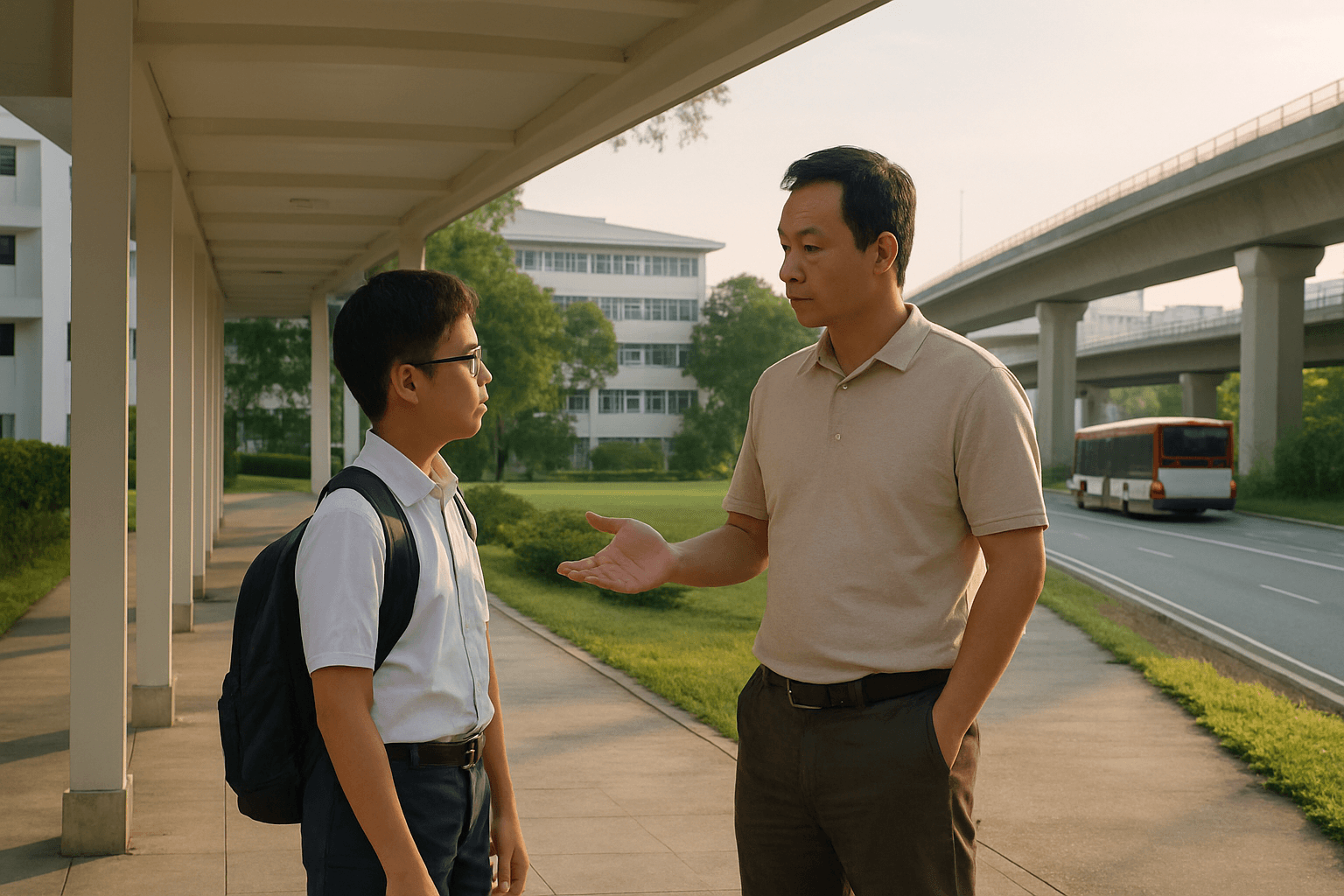
Yes, distance should matter when choosing a secondary school after PSLE. Under the PSLE AL system, parents usually start with schools their child can realistically enter, but the final choice also has to work in daily life. A school can be suitable on paper and still become a poor fit if the commute leaves your child tired, rushed, or dependent on constant family coordination.
Should distance matter when choosing a secondary school after PSLE?
Yes. Distance should be treated as a practical sustainability factor, not a small detail.
Yes. Distance should be treated as a sustainability factor, not a minor detail. A secondary school choice has to work on ordinary weekdays, on CCA days, and on the tired days when your child still has homework to finish. If the route is draining every day, even a school that looked like a good academic match can become hard to live with.
This matters because school choice is not only about getting in. It is also about what school life will feel like once Term 1 starts. A child on a short, direct route may still have time for breakfast, homework, and an earlier bedtime. Another child may attend a school with a stronger reputation but need to wake much earlier, make multiple transfers, and reach home late after CCA. On paper, the second school may look more attractive. In daily life, the first may be the better fit.
A useful way to think about it is this: distance is not just travel time. It is daily pressure. If the journey quietly makes every school day harder, it deserves a serious place in your shortlist. For a broader overview, see PSLE AL Score in Singapore: What It Means, How It Works, and How It Affects Secondary School Choice.
What goes into choosing a suitable Secondary School
Saw this being shared in the parents groupchats. https://www.thewackyduo.com/2022/11/how-to-choose-secondary-school-guide.html https://i.imgur.com/fDkJSy6.png\"> https://www.thewackyduo.com/2022/11/how-to-choose-secondary-school-guide.html It's time to choose a secondary school. Choosing a secondary school is a completely different process than primary school. One tends to choose a primary school based on distance or affiliation. Picking a secondary school is a different ball game. Grades play a
Choosing Secondary school
Hi, Wonder if anyone knows what happens in this Secondary School selection scenario : If there are 10 places left in School A and 20 pupils with EXACTLY the same PSLE score apply, how does MOE decide which 10 to take into the school. Does it matter in this case whether the child had put School A as the first choice? This impacts what schools to put as 1st and 2nd choice - whether the common advise of putting the dream school which is just out of range of the child’s mark is a wise thing to do. P
Why does distance matter more in secondary school than many parents expect?
Because secondary school days are usually fuller, longer, and less forgiving than primary school days.
Secondary school life is usually fuller and less forgiving than primary school life. Your child is adjusting to a new environment, more subjects, different teachers, and after-school commitments that can stretch the day. A route that seems acceptable when you imagine only the morning trip can feel very different once late dismissals and CCA are part of the week.
The hidden cost of distance is not just the time spent travelling. It is what that time pushes out of the day. A longer commute can shrink breakfast time, reduce decompression time after school, delay homework, and slowly erode sleep. That is why some parents only feel the strain later, when admission is already settled and the real issue is stamina. You can see this broader school-fit perspective in this Straits Times discussion on picking the right secondary school and this practical KiasuParents article on preparing for the primary-to-secondary transition.
What many parents overlook is the return trip. The morning journey is done with a rested child and a lighter bag. The trip home happens after lessons, sometimes after CCA, and often with less energy and more crowding. A long route that looks manageable at 6.45am can feel much harder at 6.30pm. For a broader overview, see How PSLE AL Score Affects Secondary School Posting.
Is PSLE so important?
PSLE is nothing once child goes to secondary school. BUT, it is the first major exam at the end of 6 arduous years of primary school…and much emphasis is placed on it. It’s my duty as a parent to see that my child has been sufficiently prepared for it…when I see that he has done his best, that is an accomplishment. After my son was done with his last paper 2 weeks ago (seems like eternity), my daughter’s P2 SA2 doesn’t seem that important. Don’t know if I’m being fair to say this…but I just do n
What goes into choosing a suitable Secondary School
Hi there, Recently a relative asked me how I choosed my kid’s Secondary School and I kind of got a shock, I had no answer. It was simply just based on the results. My relative came then with a list of important factors that he thought would be helpful to help his kid cope with the stresses of school. I thought that I would help him make this post to help him make a better decision (the kid will be going into the Secondary School in next year). So here goes, considering grades what else should he
Have More Questions?
Get personalized guidance on schools, tuition, enrichment and education pathways with AskVaiser.
Try AskVaiser for Free →How does the PSLE AL system change the school choice conversation?
It shifts school choice from score alone to a mix of score fit and practical fit.
The PSLE AL system helps parents start with realistic options, but it should not turn school choice into a score-only exercise. MOE explains that the PSLE scoring system uses achievement bands and is meant to help children focus on learning rather than fine score comparisons. In practical terms, parents should first shortlist schools their child can realistically enter, then narrow that list using fit, routine, and distance.
This matters because MOE also states that PSLE score ranges shown in SchoolFinder are reference points based on the previous year’s posting outcome. They help with shortlisting, but they are not promises. A school that looks within range may still be a weak final choice if the commute is draining, while a less talked-about school may be much easier to sustain day after day.
A simple way to use the PSLE AL system well is this: score fit gets a school onto the list, but practical fit decides whether it should stay there. If you want the score side explained more clearly first, see our PSLE AL Score in Singapore guide and How PSLE AL Score Affects Secondary School Posting. For a broader overview, see How to Build a Secondary School Shortlist Using PSLE AL Score Targets.
Has the new PSLE scoring system changed anything?
The new Al system : even more stressful ! Also, not everyone is keen to enter Secondary schools, by DSA route. Under existing old T-score system, for each PSLE subject paper, if majority of students find the paper tough, the T-score will be moderated / adjusted accordingly, based on overall P6 cohort performance. Also, due to trailing decimal points present, no two P6 candidates will end up with the same, identical T-score. Everyone’s T-score is unique. T-score entry into Secondary school Sec 1
Understanding the New PSLE Scoring System
Under the new PSLE scoring system, students’ performance in each subject is graded using Achievement Levels (ALs) ranging from AL1 to AL8, with AL1 being the highest. These levels are then summed to form the student’s overall PSLE score, ranging from 4 to 32, with a lower score indicating better performance. This change aims to differentiate students more clearly and reduce the fine differentiation that the T-score system previously emphasized. One of the key features of the new PSLE scoring sys
What counts as a manageable commute for a secondary school child?
A manageable commute is one your child can repeat without chronic tiredness or constant family strain.
A manageable commute is one your child can repeat for years without it constantly taking away sleep, meals, study time, or emotional energy. There is no single number that makes a route manageable or unmanageable. What matters more is the full door-to-door experience and how your child handles it on both normal days and longer school days.
Parents often make the mistake of judging only the map distance or the fastest app estimate. The better test is the whole routine. How far is the walk to the bus stop or MRT station? Is the route direct, or does it involve several transfers and waiting time? Does your child need to cross a busy interchange alone? How different will the trip feel when your child is carrying a heavier bag or coming home after CCA?
A route is usually more sustainable when it is predictable, fairly direct, and leaves enough room in the evening for dinner, homework, and rest. It becomes less manageable when the journey starts dictating the whole household routine. If the school day only works because a parent must frequently drive, escort, or rescue the schedule, that is a sign the commute may be harder to sustain than it first appears. For a broader overview, see What Happens After PSLE Results Are Released?.
When does a PSLE student start to choose secondary school?
Hi parents of children taking psle this year, u may find the following link info helpful. http://www.moe.gov.sg/education/admissions/secondary-one-posting/important-dates/
Using Secondary School material to prepare my PSLE kid
The Secondary English practice books in Popular vary considerably in style, content and quality. Secondary English is much tougher than Primary English. In Secondary English, students have to focus on comprehension and composition. A new aspect to comprehension is summary writing; this is something many students, especially in Secondary One, find enormously difficult. There is a large focus on vocabulary in comprehension. In compositional writing, there are many new genres and text types; studen
Is there an official commute-time cutoff for secondary school choice?
No. There is no official commute-time cutoff in the source material.
No fixed cutoff is provided in the source material. It is better not to wait for a magic number from MOE. The more useful question is whether the route is repeatable on ordinary school days and still reasonable on late days with CCA, remedial lessons, or school events. If the journey only feels manageable on a good day, it may not be manageable enough.
PSLE 2010 and Sec 1 2011 School Selection and COP
herein in this thread you can find the cut off points of most secondary schools for the PSLE score needed to enter the school as for what are the PSLE scores achieved by all the primary schools, it is hard to come by...you need to call the school to find out
When does a PSLE student start to choose secondary school?
for those without DSA offer, yes, after PSLE result for those applying via DSA, would have shortlisted the schools well before the DSA process begins, and must decide by late Oct, after PSLE exam, before result, which offer to accept; after which NOT eligible to choose school after the result of PSLE is released some kids may already have an idea what school they want from Pri 5 onward, some may have no idea, depending 100% on the parents
What signs show that a school is too far even if it looks like a good academic fit?
Look for fatigue, lateness, dread of the commute, and a home routine that keeps getting squeezed.
The warning signs usually show up in routine before they show up in grades. If your child would need to wake very early just to arrive calmly, come home so late that dinner and homework are pushed back, or rely on constant adult coordination to manage the route, the school may be too far for comfort. The issue is often not one dramatic problem but a steady build-up of tiredness.
Another common sign is that the commute becomes the part of school your child dreads most. You may notice resistance on CCA days, frequent rushing in the morning, or a child who seems flat by evening even before homework begins. Rainy days and long school-event days are especially revealing because they show whether the route still works when conditions are less ideal.
A school can also be too far if the home routine starts shrinking around it. When there is no real time to decompress, eat properly, or sleep at a sensible hour, the cost is no longer just distance. It becomes a quality-of-life issue for the child and often for the family too. Repeated lateness, constant fatigue, and a home schedule that always feels tight are not small inconveniences. They are practical warning signs.
Beyond AL/PSLE scores - Choosing Secondary School
Hi everyone, I’ve noticed a lot of discussions here about PSLE posting and how tough it can be to shortlist secondary schools — especially when trying to consider more than just the cut-off points. I recently built a free website called School Advisor SG that might be useful for parents going through this process. It helps you explore schools holistically, by combining publicly available data on: PSLE cut-off points (2024) Sports & CCA performance (from national competitions) Primary–secondary a
SOS - Advice needed for secondary school selection
Hi all Need urgent advice on secondary school selection for my boy who scored 234; we are thinking of the following schools in north area: 1. Xinmin Sec 2. Zhonghua Sec 3. Chung Cheng Yishun 4. Maris Stella High 5. Presbyterian High 6. Ang Mo Kio Sec Can anyone provide advice if the above choices make sense? Thanks in advance! :thankyou:
When is it worth choosing a farther school?
Choose a farther school only when the fit advantage is clear and the daily route is still workable.
A farther school can be worth choosing when there is a clear reason that genuinely benefits your child and the commute still remains workable. The benefit should be specific, not vague. A school culture that suits your child’s temperament, a programme your child is genuinely excited about, or a niche CCA that is hard to find elsewhere can justify more travel if the day still feels sustainable.
For example, a child who is highly motivated by a particular environment may cope well with a longer but direct journey if the route is simple and the child is comfortable travelling independently. Another child may do better in a school with a clearer support culture or a learning approach that fits better than nearer options. In those cases, distance is a tradeoff, but it may be a sensible one.
What usually does not justify a long commute on its own is prestige. If the main attraction is the school’s name while the daily routine looks exhausting, parents should pause. A farther school should offer a real fit advantage, not just stronger branding.
2014 PSLE - Final 6 Choices for 2015 Sec 1 School Selection
Some of last year’s selection of secondary school by parents after PSLE which might be useful.
What goes into choosing a suitable Secondary School
If Temasek JC is far while Crescent Girls’ Secondary school is nearer your house, then choose Crescent Girls. Travelling time, to and fro everyday, is crucial. I won’t want to tired my child, just because of travelling. Everyday, from Mon to Fri, your daughter has to stay back for Ccas, some Talent development programme or some project group / team work discussion. Thus, travelling distance + time, are important factors. Besides, Crescent Girls is a good Secondary school, too. Plus, u mentioned,
How can parents test whether a commute is realistic before making the final choice?
Do a realistic trial run during school-like hours, including the journey home after a late day.
Test the route the way your child would actually experience it. A weekend visit is useful for orientation, but it is not enough. If possible, try the morning journey at school-like hours and pay attention to crowding, walking segments, waiting time, and how stressful transfers feel. Then test the return journey as well, because the trip home after a long school day is often the harder one.
It also helps to imagine a real school week, not just the easiest day. A route that seems fine at midday may feel very different after CCA, during rain, or when your child is carrying a heavier bag. Some parents discover that their child manages the morning well but struggles much more with the late-evening return. That is exactly the kind of detail that should shape the final choice.
A common mistake is to judge only by travel app timing or by the parent’s own tolerance for commuting. Your child is the one repeating the route. Practical transition advice often centres on routine and independence, which is why Supporting your teen in secondary school can be a useful companion read. If you are still building the shortlist itself, our guide on How to Build a Secondary School Shortlist Using PSLE AL Score Targets can help before you test routes.
Homeschool PSLE different from National PSLE?
Discrimination is secondary only if these parents have the capabilities to continue homeschooling beyond primary school years or found an alternative education path like 2ppaamm. Otherwise they would have to consider mainstream secondary schools at some point in time 2ppaamm friend's kid was not posted to the secondary school of his choice although he qualifies. Even if some parents feel that homeschooling is best for their children during their formative years, this discrimination is usually su
Homeschool PSLE different from National PSLE?
Can homeschoolers apply for DSA? Then the aplication will be at the schools' discretion without having to wait for psle results
What is a simple way to balance distance, school fit, and your child’s stamina?
Ask three questions: can my child get in, can my child cope daily, and is the tradeoff worth it?
Use a simple three-question filter. First, can my child realistically enter this school under the PSLE AL system? Second, can my child cope with the route day after day, including CCA days and tired days? Third, is the school’s fit strong enough to justify the travel tradeoff?
This helps parents avoid two common mistakes. One is shortlisting by score alone and treating distance as an afterthought. The other is choosing the nearest school without thinking carefully about environment, programmes, and motivation. Most families need the middle ground, where admission chances, school suitability, and daily practicality are considered together.
If you need help with the score side of the decision, our guides on What PSLE Cut-Off Points Mean Under the AL System and What Happens After PSLE Results Are Released are good next reads. The key idea to remember is simple: the best school is not just the one your child can enter, but the one your child can sustain.
Using Secondary School material to prepare my PSLE kid
My boys are in Sec 1 and Sec 3 now. They never used any Sec school materials in their primary days and they did well enough to enter their dream school (an IP school). To prepare for PSLE, I signed them up for enrichment classes to stretch them a little beyond the school homework, but no 1:1 tuition. I think parents need not be too stressed about the need to use Sec materials for PSLE preparation. If the kids are already doing very well and keen to seek more challenges, there is no harm in stret
Using Secondary School material to prepare my PSLE kid
I think for many of the high scorers in PSLE this could be what they have done some coaches for languages esp EL & CL actually do exactly that - Pri 5 practise on Pri 6, and Pri 6 practise on sec sch stuff also, for example, some sec school actually uses sec 2 EL book for sec 1, and sec 2 uses book 3 etc and so on and so forth
Have More Questions?
Get personalized guidance on schools, tuition, enrichment and education pathways with AskVaiser.
Try AskVaiser for Free →