
How Far Is Too Far for a Secondary School Commute in Singapore?
A practical guide for parents weighing door-to-door travel time, transfers, fatigue, and after-school load.
There is no universal rule for how far is too far for a secondary school commute in Singapore. A commute becomes a concern when the full door-to-door trip regularly creates too much fatigue, punctuality risk, or time pressure for your child to manage school life well, especially once early mornings, CCAs, and homework are factored in.
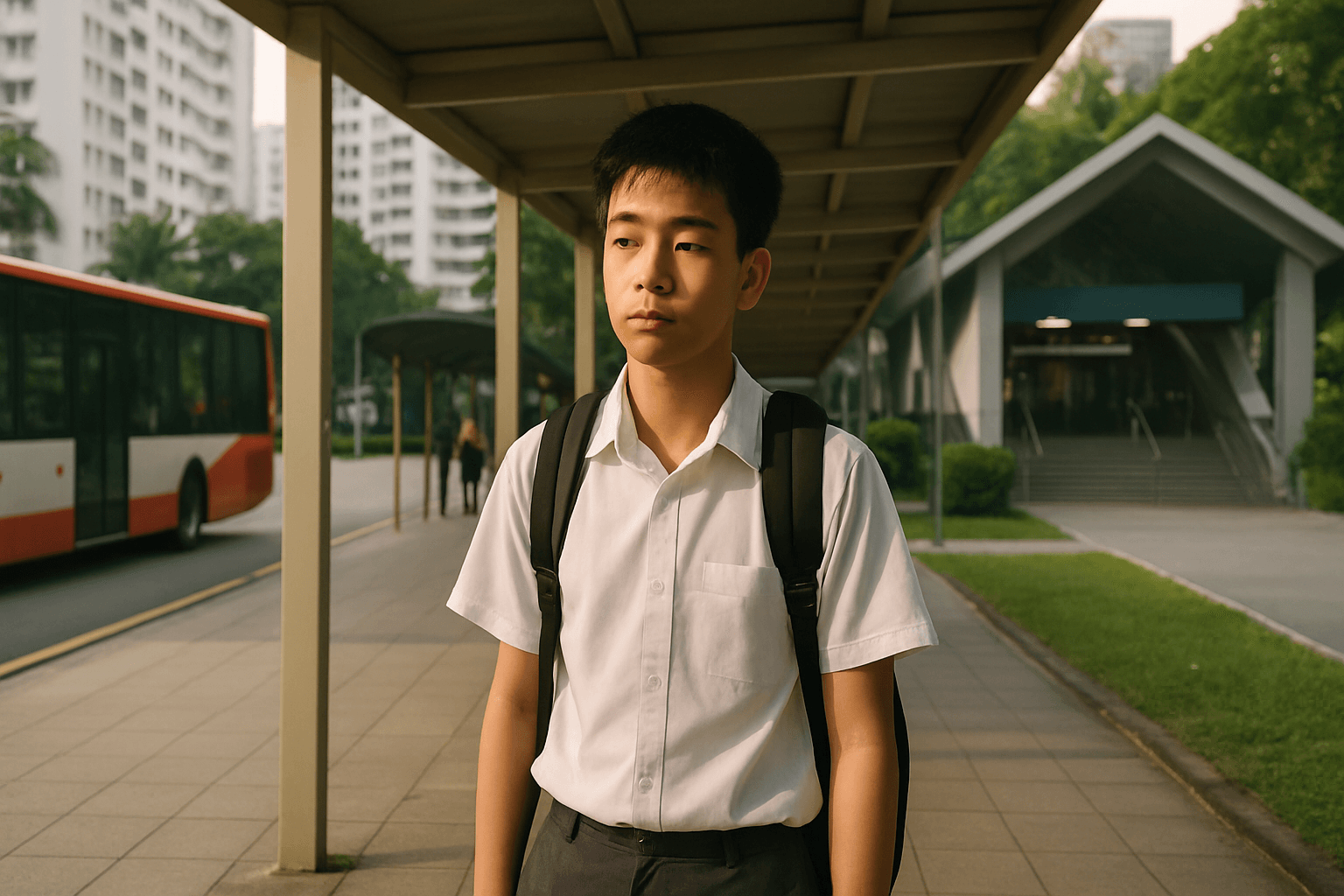
For most families, the real question is not how many kilometres away a school is. It is whether the daily trip is sustainable once you count walking, waiting, transfers, rain, crowding, and after-school commitments.
If you are choosing schools after PSLE, commute is one practical filter alongside school fit and posting realities. Our PSLE AL score guide and secondary school shortlist guide cover the wider decision. This page focuses on one narrower question: when a secondary school commute starts becoming too much.
What does “too far” mean for a secondary school commute in Singapore?
There is no fixed cutoff. A commute is too far when it regularly makes school, sleep, punctuality, or after-school routines harder than they need to be.
Too far usually means the commute is no longer just a journey. It starts shaping the whole school day. There is no official Singapore rule that sets a fixed distance or travel-time limit, so parents need a more practical test.
A commute is too far when it regularly takes away too much time, energy, or flexibility. In real life, that shows up as very early wake-ups, rushed mornings with little buffer, repeated lateness risk, late returns after CCA, or a child who gets home too drained to reset before homework. The key word is regularly. A route that works only on a smooth day is not a reliable route.
A useful parent shortcut is this: judge sustainability, not possibility. If the commute changes the school day more than the school itself does, it may be too far. For a broader overview, see PSLE AL Score in Singapore: What It Means, How It Works, and How It Affects Secondary School Choice.
What goes into choosing a suitable Secondary School
Saw this being shared in the parents groupchats. https://www.thewackyduo.com/2022/11/how-to-choose-secondary-school-guide.html https://i.imgur.com/fDkJSy6.png\"> https://www.thewackyduo.com/2022/11/how-to-choose-secondary-school-guide.html It's time to choose a secondary school. Choosing a secondary school is a completely different process than primary school. One tends to choose a primary school based on distance or affiliation. Picking a secondary school is a different ball game. Grades play a
How far is too far?
I think distance is pretty important especially for a primary one student. He or she will be too tired from the travelling. So is the parent who has to do the ferrying. THe time could be spent on other more meaningful activities. Best balance is try to get into the best school within 5km of your house. Of course, there is no such thing as best, i should say the most optimal and balanced one in terms of academic performance, environment etc. Balloting may be required but you at least stand a chan
Why is map distance a poor way to judge commute burden?
Map distance can mislead you. What matters is the full door-to-door trip, including walking, waiting, transfers, and how stressful the route feels at school hours.
Map distance is only a rough starting point because children do not travel in straight lines. They travel from the flat to the lift, from the block to the bus stop, through crowded stations, across interchanges, and from the nearest stop to the school gate.
That is why two schools that look similarly far away can feel completely different in daily life. A school that is farther on the map may still be easier if the route is one direct train ride and a short sheltered walk. A school that looks closer may feel heavier if it needs a feeder bus, one transfer, and a ten-minute walk from the station in the rain.
Parents also sometimes overvalue the phrase “near MRT.” That only tells you part of the story. If the first mile from home is awkward, or the station change is crowded and slow, the route can still feel tiring every day. The better measure is total door-to-door travel with real-life friction included. For a broader overview, see How to Build a Secondary School Shortlist Using PSLE AL Score Targets.
What goes into choosing a suitable Secondary School
When I was studying in Temasek, I would study from 5:30am to 10pm. Took the bus home at 10+pm. Read my notes on the bus some more Come to think of it, I must have been crazy.
Is Singapore’s education system too stressful?
Singapore is far from being too stressful compare to many other countries in Asia. Top schools in India are also very stressful and competitive.
Have More Questions?
Get personalized guidance on schools, tuition, enrichment and education pathways with AskVaiser.
Try AskVaiser for Free →What is a realistic secondary school commute time in Singapore for most families?
Use commute time as a heuristic, not a rule. Shorter direct routes are usually easier, while routes nearing an hour each way or feeling complex before that deserve much closer scrutiny.
There is no official benchmark, but a parent heuristic is still useful. Most families do better with shorter, direct commutes because they leave more room for sleep, CCA, and ordinary delays. A mid-length trip can still be manageable if it is simple and predictable. The more the route depends on a very early wake-up, multiple transfers, or a late return home several times a week, the more carefully you should question it.
A practical way to think about it is in bands rather than one hard limit. Some routes feel comfortable. Some are workable with planning. Some are technically possible but become a daily trade-off. Once the full journey starts pushing toward about an hour each way, or feels complicated even before it gets there, you are no longer judging convenience. You are judging stamina.
Minutes alone do not decide the answer. A 40-minute direct route can be easier than a 25-minute route with two transfers and a long unsheltered walk. When you are shortlisting schools, this is why commute should sit alongside fit and posting chance, not after them. Our guides on how to build a secondary school shortlist using PSLE AL score targets and how PSLE AL score affects secondary school posting can help you weigh those trade-offs together.
Malaysian coming S'pore for Secondary School Education
My daughter is from JB and started her education in singapore since Primary 1. I suggest that u first go to the ICA building to apply for a student pass in order to study in singapore. Are u considering to live in singapore or let her cross the causeway everyday? it would be very tiring to choose the latter. the cca's will be very long and by the time ur child reach home, ur child won't even have the energy to complete ur homework. futhermore, sec schs in woodlands area is not very good. My P6 d
Transferring Secondary School at Sec 2
Thank you very much to all parents here. Most of my information and learning about being a Singaporean mum is from here! I have read the above and understand that the following will be considered when looking to transfer school in Sec 2/3: 1. PSLE results (it should be around the same results as the school’s COP for eg) to enter St Nics you need 250, so your PSLE score should first and foremost be around there. We were Returning Singaporeans so my daughter didn’t sit for PSLE, instead SPERS-Sec
Which commute features make a route feel much longer than it looks?
Transfers, waiting time, crowding, and walking segments add hidden friction. They can make a short-looking route feel more tiring than a longer but direct one.
The parts that make a route feel heavy are usually not just extra minutes. They are the stress points inside those minutes. Transfers are a major one because each change adds stairs, waiting, platform crowding, and one more place where a small delay can snowball. Long first-mile or last-mile walks also matter more than parents often expect, especially in heat or wet weather.
A few common examples show the difference clearly. One child may spend 35 minutes on a single bus and arrive settled. Another may take only 30 minutes on paper, but the route includes a feeder bus, an MRT change, and a walk from the station to the school gate, so it feels harder every day. Another route may look simple because the school is near an MRT station, but the child still needs a crowded bus from home just to reach that station.
Judge the route on an ordinary bad day, not a perfect day. If one missed bus would cause panic, lateness, or a chain reaction through the morning, the route is less manageable than the app makes it look. For a broader overview, see What Happens After PSLE Results Are Released?.
Transfer to nearby Secondary School
Have shifted to Jurong West. Anyone have any idea how I can transfer my Sec 3 to nearby secondary school. Have approach a few school but all on waiting list. Any advice?
Time schedule & life of Secondary School
Hi daisyt, My girl is also in sec1 IP school. I remember you are staying in Woodlands. Does your daughter take public transport to school. My girl spends 2hour+ every day to and from school. Aiyoh, so stressful… She gets up at 5:30am and comes back home after 7, except Friday.
How do morning schedules and school start times change the answer?
A commute becomes harder when it forces a very early start or leaves no room for normal delays. Leave-home time and buffer matter more than station-to-station timing alone.
Morning timing often decides whether a commute is merely long or genuinely draining. The same route can feel reasonable for one child and exhausting for another depending on wake-up time, how quickly the child gets ready, and how much buffer exists before reporting time.
Parents sometimes look only at the bus or train segment and forget the full chain before arrival. The real question is what time your child must leave home to reach the school gate calmly, with enough margin for one ordinary hiccup. If a missed bus, slower lift, or rainy walk means immediate panic, the route is too tight even if the travel app says it is manageable.
A useful test is this: can your child arrive calm, not rushed, on a normal weekday? If the route leaves them sweaty, flustered, or dependent on everything going exactly right, it is not as manageable as it looks. If you need broad school-operation clarifications while comparing options, MOE's FAQ page can help, but commute suitability still has to be judged in real life. For a broader overview, see What PSLE Cut-Off Points Mean Under the AL System.
Info on morning assembly time for various secondary school
Since location and morning assembly time may be a factor that influence your selection for a school, can we have a compilation here on the starting time of all the various secondary school ?
What goes into choosing a suitable Secondary School
Hi there, Recently a relative asked me how I choosed my kid’s Secondary School and I kind of got a shock, I had no answer. It was simply just based on the results. My relative came then with a list of important factors that he thought would be helpful to help his kid cope with the stresses of school. I thought that I would help him make this post to help him make a better decision (the kid will be going into the Secondary School in next year). So here goes, considering grades what else should he
When does a long commute become a problem for sleep, focus, and mood?
It becomes a real issue when your child regularly loses sleep, arrives mentally tired, or has too little energy left for homework, revision, and normal recovery after school.
A long commute becomes a problem when the child is not just travelling longer, but functioning worse. The warning signs are usually practical rather than dramatic. Mornings get slower. Irritability increases. Homework keeps sliding later. The child reaches home flat after school and needs too long to recover before starting work.
This often becomes clearer on heavier weeks. A route that seemed acceptable in the first few weeks can start to bite once CCA, tests, consultations, and projects build up. During exam periods, the cost of the commute is not just time on transport. It is lost sleep, weaker focus in class, and less energy left for revision. A child who regularly falls asleep on the ride home is not automatically in trouble, but it does suggest the daily load is already high.
Parents sometimes read this as a discipline issue when it is really a bandwidth issue. If transport keeps draining the energy needed for lessons, revision, and normal emotional recovery, the commute is no longer neutral. It has become part of the academic and wellbeing picture.
Preparing for Secondary School
Hi parents, For those who have children that are starting secondary school in the upcoming year, we have prepared 2 articles highlighting: How to prepare your child for the transition to secondary school ? How much independence should we allow teenagers / secondary school students in their studies ? Hope this is helpful and feel free to share your thoughts as well. Kind Regards, Educare Tutoring
Time schedule & life of Secondary School
I am wondering how is the time schedule of your kids in sec school ? IP and non IP. I am a bit worried and lost. My girl in IP, sec 1 and she is like so busy everyday. Morning she has to wake up at 5:30am and I try to insist her to go to bed at 10pm for sufficient sleep. Every weekdays, she is always so busy, lots of homework and sometimes hardly has time to talk to her because don't want to disturb her. Monday after 3rd language, reach home about 7:45. Tuesday & Friday, after CCA, reach home ab
How do CCAs, tuition, and after-school activities affect what is manageable?
After-school commitments often turn a borderline commute into a tiring routine. Judge the route against your child's busiest realistic week, not the lightest dismissal day.
This is where many parents underestimate the real load. Secondary school is not just lessons ending in the afternoon. Once you add CCA, consultations, remedial lessons, tuition, or project work, the journey home matters as much as the journey to school.
A commute that feels acceptable on a light day can become tiring when your child stays back even twice a week. One student may manage a farther school because CCA is modest and the route is direct. Another may struggle with a similar travel time because CCA ends late, tuition starts soon after, and there is barely enough time to eat, bathe, and begin homework. Borderline routes are usually exposed by the busiest realistic week, not the easiest one.
A simple parent test helps here: picture the Wednesday or Friday that is already the fullest day of the week. If the commute still looks sustainable on that day, it is more likely to hold up over time. If it only works when nothing extra is happening, it is probably too optimistic. This matters most when you are balancing school fit against practical reality after results. Our guide on what happens after PSLE results are released can help place that decision in sequence.
Time schedule & life of Secondary School
Hi ct27, Thanks for the insight into your secondary/JC life. I agree with you about spending less time on unnecessary activities. That is to set the right priorities. Most Sec 1 and 2 students are adjusting to their new environment and peer pressure/influence or even parents interference sometimes clouded their judgement and decision making. I discuss with my son who decided after 3 months to drop his French when he experience difficulties in coping in a couple of his subjects due to his special
Moving to Singapore and looking for a good Secondary School
My son has gone through 3 international schools in Singapore, although none of those u mentioned. I am beginning to realize that the local system might be better for a child that is average and above. By local system, I do include the 3 local international schools - SJI (I have heard many good things about this school from separate sources), ACS International and Hwa Chong International. If your child excels in Math, all the more u should consider the local system. My son is slightly above avera
What should parents consider about safety and independence?
A good commute should be safe and simple enough for your child to manage confidently alone. Route complexity and your child's readiness matter as much as travel time.
A workable commute should be manageable not only in time, but in independence. Many secondary school students travel on their own, so the route needs to be simple enough for the child to handle safely and confidently without constant adult support.
That does not mean avoiding every busy route. It means being honest about readiness. Can your child remember transfer points, cross roads carefully, handle crowded platforms, and stay calm if a bus is delayed or a train is packed? A route with one clear transfer may be fine for a confident child, while a shorter but more confusing route may be harder for a child who is still building routine and confidence.
Independence is not just about age. It is about how much decision-making the trip demands every day. The simpler and more forgiving the route, the easier it is for your child to own it well.
Which Secondary School near Sengkang
As a student residing in Sengkang(like I’ve mentioned), I don’t really think that Nan Chiau High is good enough for crystal8135’s daughter.Her results are really good,if her DD could push her English results to the high 80s zone, I think she would do well for her PSLE. Around Sengkang, there isn’t really good secondary schools. I live near to Compassvale Secondary, Nan Chiau High School etc. But for me, I don’t think I wish to study in the schools around Sengkang. If there were a good school aro
Moving to Singapore and looking for a good Secondary School
We will be moving to Singapore soon with our kids. Our oldest is 12 and needs a solid International secondary school, as he is very bright and particularly talented in maths. So far we have applied to UWC, SJI International and SAS. Does anyone have info on these schools and their academic quality? We are looking for a school with a detailed reporting system, streaming in Maths and if possible English and a school ethos that drives children to excel within their potential. We do not want a schoo
How can parents test whether a school commute is workable before committing?
Do a real trial run at school hours and judge the route over more than one day. Test reliability, stress, and sustainability, not just travel speed.
- ✓Test the route at actual school-travel hours, not on a quiet weekend or mid-morning.
- ✓Measure the full door-to-door journey from home to the school gate, not just the MRT or bus segment.
- ✓Check both directions, because the trip home after a long day can feel very different from the morning ride.
- ✓Repeat the route more than once if possible so you can see whether timing and stress stay reasonable on an ordinary weekday.
- ✓Try to experience the route in less ideal conditions, such as rain, heavier crowding, or longer waits.
- ✓Notice how your child feels after the trip, not just whether the journey is technically possible.
- ✓Ask what happens if one bus or train is missed. If the answer is panic or immediate lateness, the route has very little buffer.
- ✓Treat route-planning apps as a starting point only. A route that looks fine on screen can feel very different at 7 a.m.
- ✓Compare the tested route against your child's busiest realistic week, including CCA, tuition, or consultations.
- ✓If the school is still attractive, name clearly what makes the extra travel worth it before you accept the commute as part of the choice.
When is a farther school still worth it?
A longer commute can be acceptable if the school fit is strong enough to justify the daily effort. Choose the farther school only when the extra travel has a clear payoff.
A farther school can still be the right choice if the fit is strong enough to justify the daily cost. That may be because the school suits your child's academic profile, subject interests, culture, or overall environment better than nearer options. The key is to be able to say clearly what the extra travel is buying.
Distance alone should not rule out a good-fit school. But parents should be honest about the trade-off. A farther school is worth it when the commute is a cost you can manage, not a constant strain your child has to overcome every day. If you are still weighing fit against posting realities, our guides on what PSLE cut-off points mean under the AL system and how PSLE AL score affects secondary school posting can help you compare options more sensibly.
Is going to a better school worth hour long travel times?
No, I don’t think so. My daughter is currently studying at Cedar Girls’ Secondary School and she has to travel 1 hr on public transport to reach there in the morning. I feel that if parents can take them to school, it would be alright to travel though. Every day when my daughter comes back she will feel very tired and not have the energy to do work and waking up too early may also make them want to sleep in the morning. If you still want to attend a better school, you can move house to near the
Good Secondary School In Yishun
Hi I need some advice urgently. 1.Can anyone kindly tell me is Chung Cheng High School in Yishun a good school? 2. Are the teachers there dedicated as in going extra miles to help students? 3. Compare Chung Cheng High School and Zhong Hua Secondary which is better. Many thanks
Have More Questions?
Get personalized guidance on schools, tuition, enrichment and education pathways with AskVaiser.
Try AskVaiser for Free →