
Secondary School Location in Singapore: How to Compare Travel Time and Daily Route
Judge convenience by the commute your child will actually repeat every school day.
The best way to compare secondary schools by location is to measure the actual door-to-door commute at school-hour timing and judge route quality, not just distance. Look at total travel time, number of transfers, walking at both ends, crowding, reliability, and whether your child can repeat the journey independently without arriving late, stressed, or exhausted.
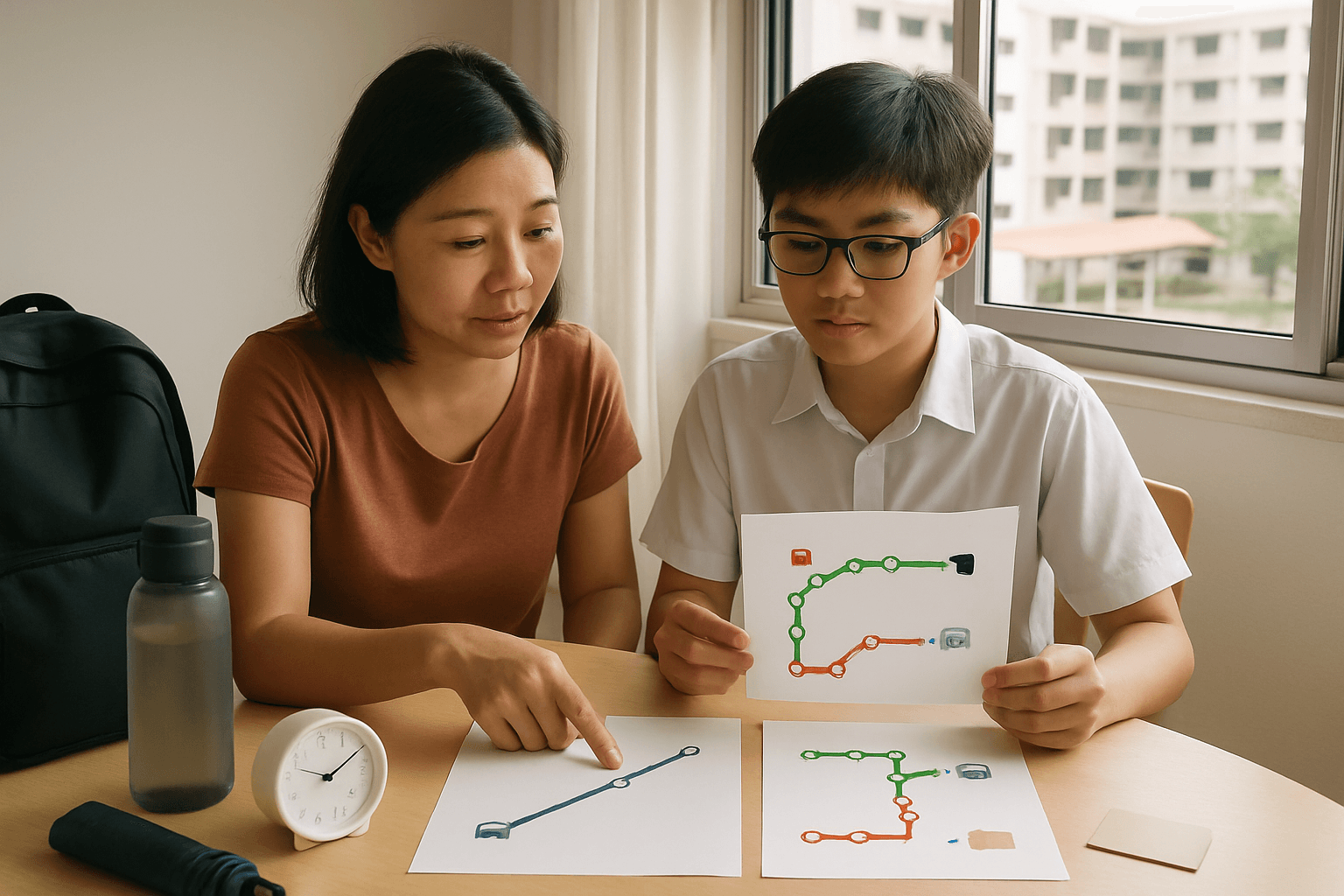
When parents compare secondary schools, location often gets reduced to one question: "Which school is nearest?" That sounds sensible, but it is often the wrong comparison.
For secondary school, the better question is: "Which journey can my child handle well, five days a week, on normal days and CCA days?" A school that looks close on a map can still mean a tiring commute with transfers, long walks, and peak-hour crowding. A slightly farther school may be easier if the route is direct, predictable, and simple enough for a Secondary 1 student to manage alone.
In short: do not compare pins on a map. Compare the daily route.
What should parents really compare when looking at a secondary school’s location?
Compare the full daily commute, not the school’s position on a map.
Parents should compare the full daily commute, not the school address. The useful question is not where the school sits on the map, but how the journey feels from home door to school gate. That includes the first walk to the bus stop or MRT station, waiting time, transfers, interchange walking, the final walk into school, and how manageable the whole route is on ordinary school mornings and on later CCA days.
A helpful way to think about it is this: a school is not convenient because it looks near; it is convenient because the journey is simple. That matters more in secondary school because children are expected to travel more independently. Parents also sometimes confuse this with primary-school distance rules. MOE’s home-school distance FAQ relates to primary-school distance categories and should not be treated as a secondary-school posting rule. If you are balancing commute with posting realities, our PSLE AL Score in Singapore guide is the broader starting point.
What goes into choosing a suitable Secondary School
Saw this being shared in the parents groupchats. https://www.thewackyduo.com/2022/11/how-to-choose-secondary-school-guide.html https://i.imgur.com/fDkJSy6.png\"> https://www.thewackyduo.com/2022/11/how-to-choose-secondary-school-guide.html It's time to choose a secondary school. Choosing a secondary school is a completely different process than primary school. One tends to choose a primary school based on distance or affiliation. Picking a secondary school is a different ball game. Grades play a
What goes into choosing a suitable Secondary School
Hi there, Recently a relative asked me how I choosed my kid’s Secondary School and I kind of got a shock, I had no answer. It was simply just based on the results. My relative came then with a list of important factors that he thought would be helpful to help his kid cope with the stresses of school. I thought that I would help him make this post to help him make a better decision (the kid will be going into the Secondary School in next year). So here goes, considering grades what else should he
Why straight-line distance is a poor way to judge school convenience
A school that looks close on paper can still be tiring if the route is indirect, crowded, or fragmented.
Straight-line distance hides the parts of the journey that usually make a commute tiring. A school can be only a few kilometres away and still feel difficult if the route needs an MRT transfer, a crowded interchange walk, and an unsheltered final stretch. Another school may be farther away on paper but easier in real life because there is one direct bus that stops near the gate.
This is why postal code proximity often misleads parents. Postal codes tell you where the campus is. They do not tell you how your child gets there. For a Secondary 1 student carrying a heavier bag, learning a new timetable, and adjusting to a new school routine, route friction matters more than raw distance. Long overhead bridges, multiple traffic-light crossings, confusing interchanges, and a bus stop that is technically nearby but not near the actual entrance can add more stress than parents expect.
Think less about kilometres and more about friction. Your child does not experience map distance. Your child experiences the route. For a broader overview, see How to Build a Secondary School Shortlist Using PSLE AL Score Targets.
What goes into choosing a suitable Secondary School
When I was studying in Temasek, I would study from 5:30am to 10pm. Took the bus home at 10+pm. Read my notes on the bus some more Come to think of it, I must have been crazy.
Transfer to nearby Secondary School
Have shifted to Jurong West. Anyone have any idea how I can transfer my Sec 3 to nearby secondary school. Have approach a few school but all on waiting list. Any advice?
Have More Questions?
Get personalized guidance on schools, tuition, enrichment and education pathways with AskVaiser.
Try AskVaiser for Free →How do you measure the actual door-to-door travel time?
Test the route at real school-hour timing and measure from home door to school gate.
Measure the journey the way your child would really take it. Start timing from your block or front door, not from the nearest station shown on a map. End at the school gate, not at the bus stop outside the campus. Include the walk to the first stop, waiting time, transfer time, platform or interchange walking, and the final stretch into school.
Check the route during the same morning window your child would normally travel, because peak-hour conditions can feel very different from an off-peak trip. If possible, test the trip home too, especially after CCA, when fatigue matters more and the route may be less straightforward. A transport app is useful for estimates, but it should be treated as a first pass, not the final answer. A real test run often reveals what the app cannot show clearly: whether the bus stop is packed, whether the interchange is confusing, whether the final walk feels too long in school shoes, or whether one missed connection makes the whole route stressful.
If you cannot do a full weekday test, do the next best thing: compare a few route options on an app, then verify the most likely one during an open house, a school visit, or a normal weekday morning. For a broader overview, see How PSLE AL Score Affects Secondary School Posting.
Malaysian coming S'pore for Secondary School Education
I also wan to send my daugther to Sgp for Sec 1 in 2010. Does anyone know how to 'map' the Msia school results to Sgp PSLE equivalent? She's from a premier Chinese language school in JB and though not in top class, but top 30% of school, and speaks v good English, I think. We have no T-score, no talented sports/music, so how do we get started?
Moving to Singapore and looking for a good Secondary School
We will be moving to Singapore soon with our kids. Our oldest is 12 and needs a solid International secondary school, as he is very bright and particularly talented in maths. So far we have applied to UWC, SJI International and SAS. Does anyone have info on these schools and their academic quality? We are looking for a school with a detailed reporting system, streaming in Maths and if possible English and a school ethos that drives children to excel within their potential. We do not want a schoo
What route features make a commute easier or harder for a Secondary 1 student?
Simple, direct, and predictable routes are usually easier for younger teens to handle alone.
For a younger secondary student, the easiest routes are usually simple, direct, and predictable. One long bus ride is often easier than a shorter journey with multiple changes because the child has fewer decisions to make and fewer places to go wrong. Routes with clear landmarks, fewer road crossings, shorter interchange walks, and a brief final walk to the gate also tend to be easier to repeat independently.
The harder routes usually have hidden complexity. A commute can become stressful if it depends on tight bus timing, includes a long underground transfer, requires crossing major roads, or ends with a walk that feels exposed in rain or afternoon heat. Even when the total travel time looks acceptable, the route may still be a poor fit if your child gets anxious about missing a stop, struggles to recover from disruptions, or needs frequent reminders about where to alight.
A useful test is whether the route is easy to explain in one sentence. "Take bus 123 and alight outside the school" is a very different daily experience from "Take the MRT, change lines, walk through the interchange, then catch a feeder bus and cross the overhead bridge.". For a broader overview, see What Happens After PSLE Results Are Released?.
Please advise secondary school in Yishun
There's also these school in Yishun area : NAVAL BASE SECONDARY SCHOOL 901 YISHUN RING ROAD SINGAPORE 768689 NORTHBROOKS SECONDARY SCHOOL 585 YISHUN RING ROAD SINGAPORE 768692 AHMAD IBRAHIM SECONDARY SCHOOL 751 YISHUN AVENUE 7 SINGAPORE 768928 NORTHLAND SECONDARY SCHOOL 3 YISHUN STREET 22 SINGAPORE 768578 CHUNG CHENG HIGH SCHOOL (YISHUN) 11 YISHUN ST 61 SINGAPORE 768547 ORCHID PARK SECONDARY SCHOOL 10 YISHUN STREET 81 SINGAPORE 768454
Transferring Secondary School at Sec 2
Thank you very much to all parents here. Most of my information and learning about being a Singaporean mum is from here! I have read the above and understand that the following will be considered when looking to transfer school in Sec 2/3: 1. PSLE results (it should be around the same results as the school’s COP for eg) to enter St Nics you need 250, so your PSLE score should first and foremost be around there. We were Returning Singaporeans so my daughter didn’t sit for PSLE, instead SPERS-Sec
How do you compare two schools with different travel patterns?
Choose the route your child can repeat reliably, not just the one that looks shortest.
Compare the route your child can repeat most consistently, not just the route with the lower minute count. For example, School A might take 45 minutes with one direct bus that stops near the gate. School B might look faster at 35 minutes but require an MRT transfer, a crowded interchange walk, and another 8-minute walk outdoors. On paper, School B wins. In daily life, many Secondary 1 students would cope better with School A.
It also helps to compare both the best-case and bad-day versions of the journey. A route that looks efficient may be fragile if a missed bus, train delay, or heavy rain turns it into a stressful chain reaction. By contrast, a slightly longer route can still be the better option if it stays predictable even when the morning is not perfect.
Some parents make this comparison more disciplined by giving commute ease a fixed share of the decision alongside academics, school environment, and CCA fit, an approach often discussed in parent decision guides such as this KiasuParents article on resolving secondary-school dilemmas. If you are already narrowing schools by likely posting range, pair this with our guide to building a secondary school shortlist using PSLE AL score targets.
choosing secondary schools 2013
Sadly, there isn't a lot of good schools in this South area compared to the other areas ( had a pretty hard choosing my Secondary School last year because of this ) If your daughter can travel a bit more, you can consider these schools as well: 1) Fairfield Methodist School ( COP 239, previous year COP was 235 ) 2) Queensway Secondary School ( COP 214 ) 3) Queenstown Secondary School ( COP 200 ) Thank you!
Moving to Singapore and looking for a good Secondary School
My son has gone through 3 international schools in Singapore, although none of those u mentioned. I am beginning to realize that the local system might be better for a child that is average and above. By local system, I do include the 3 local international schools - SJI (I have heard many good things about this school from separate sources), ACS International and Hwa Chong International. If your child excels in Math, all the more u should consider the local system. My son is slightly above avera
What daily life costs are affected by a longer school commute?
Longer travel time often eats into sleep, rest, homework time, and after-school flexibility.
A longer commute usually takes time from the parts of the day that are hardest to replace. The first cost is often sleep, because earlier departure means earlier waking. Then breakfast becomes rushed, mornings leave less room for delays, and there is less recovery time if the child starts the day already tired. After school, the same commute can reduce time for homework, revision, rest, and family routines.
The weekly effect is often what changes parents’ minds. A route that is 20 minutes longer each way adds more than three extra hours on the road across five school days. Once CCA, tuition, or enrichment is added, those extra minutes stop feeling small. This is one reason broader school-choice guides, such as The Straits Times’ list of questions to ask when selecting a secondary school, encourage parents to think beyond academics alone.
Watch for practical warning signs during trial runs or early school visits: your child is already rushing breakfast, looks drained by the end of the route, seems worried about transfers, or would reach home so late after CCA that homework and bedtime become compressed. Those are not minor inconveniences. They are signs that the commute may be too expensive in daily life.
Secondary Schools to choose around my location .. headache
It will be hard for someone to be able to comment on all these schools in great detail. Maybe you want to go to this URL http://app.sis.moe.gov.sg/schinfo/ to know these schools more and decide. You will find important info like last year's COP, CCAs, other achievements, etc. Hope this helps.
Time schedule & life of Secondary School
It’s very very normal to be stressed out … my worst results in my whole secondary school life was when I was in Sec 1 (looking back, I don’t understand HOW I could have done so badly since everything was much easier then lol) Ahh it’s okay! You’ll get used to it! (and honestly speaking, it really hinges on time management; after a while you’ll realize that you can just do a crap job for certain things and still get by but you’ll need to make sure others are perfect). Anyway, it’s better to be bu
Is there a fixed maximum commute time for secondary school in Singapore?
No. Use a child-fit test, not a supposed official cutoff.
No. There is no single official maximum commute time in the source material, so parents should not use a hard cutoff as if it were policy. Some families informally treat a journey of under an hour by public transport as still workable, but that is a common parent benchmark, not a rule, as reflected in practical commentary such as this KiasuParents guide.
A better test is this: can your child manage the route independently, arrive on time most days, and still have enough energy left for lessons, CCA, homework, and rest? If the commute regularly causes lateness, anxiety, or dependence on frequent lifts, it is too long for that child even if another family would accept it.
Singapore Secondary School short listing and historical cut off points
This is an online workbook to help you shortlist secondary schools during the S1 posting exercise after PSLE. You may shortlist secondary schools by cut off point, location, CCA and more: https://public.tableau.com/app/profile/sg.parent/viz/SingaporeSecondarySchoolSearch/Search This is another online workbook that lists out all secondary schools’ historical cut off points from 2021, when the AL system started: https://public.tableau.com/app/profile/sg.parent/viz/SingaporeSecondarySchoolHistorica
Choosing Secondary school
Hi, Wonder if anyone knows what happens in this Secondary School selection scenario : If there are 10 places left in School A and 20 pupils with EXACTLY the same PSLE score apply, how does MOE decide which 10 to take into the school. Does it matter in this case whether the child had put School A as the first choice? This impacts what schools to put as 1st and 2nd choice - whether the common advise of putting the dream school which is just out of range of the child’s mark is a wise thing to do. P
When is a farther school still worth considering?
A longer commute can make sense if the school is a clearly better fit and the route is still sustainable.
A farther school can still be worth considering if it is clearly a better fit and the route remains manageable. This usually happens when the school offers something meaningful that the nearer options do not, such as a programme your child is genuinely interested in, a learning environment that suits them much better, or a CCA they are likely to commit to seriously.
The key is to be honest about what the extra travel is buying. A longer commute can be reasonable if the child can still travel mostly independently, get home at a workable time, and sustain school life without constant adult rescue. It is less reasonable if the plan depends on a parent driving often, frequent last-minute pickups, or a fragile chain of transfers that only works on good days.
In other words, a farther school should win because it is meaningfully better for your child, not because the family is hoping the commute will somehow become easier later. To keep the choice grounded, first check posting realism through our guide to how PSLE AL score affects secondary school posting, then weigh broader fit factors using practical overviews such as this holistic secondary-school guide from SmileTutor and this KiasuParents article on evaluating schools beyond grades.
Which Secondary School near Sengkang
As a student residing in Sengkang(like I’ve mentioned), I don’t really think that Nan Chiau High is good enough for crystal8135’s daughter.Her results are really good,if her DD could push her English results to the high 80s zone, I think she would do well for her PSLE. Around Sengkang, there isn’t really good secondary schools. I live near to Compassvale Secondary, Nan Chiau High School etc. But for me, I don’t think I wish to study in the schools around Sengkang. If there were a good school aro
Which Secondary Schools?
Those at AMK, Yishun, Bishan, Yio Chu Kang and Sembawang. Besides those very good sec schools, which are the “NO NO” sec schools and the “Not Bad/Quite Good” sec schools and why? Thank you for your input and sharing.
What should you compare before shortlisting a secondary school by location?
Use a simple checklist to compare commute time, transfers, walking, reliability, and independence.
- ✓Measure the journey from home door to school gate, not from the nearest station on paper.
- ✓Check the route at the time your child would actually travel, and compare the trip home as well.
- ✓Note how many transfers your child must handle alone.
- ✓Compare walking time at both ends, including stairs, overhead bridges, and long interchange walks.
- ✓Notice whether the route is mostly sheltered or includes exposed stretches in rain or heat.
- ✓Pay attention to crowding, waiting time, and how reliable the route feels during school-hour timing.
- ✓Ask whether your child could recover calmly from a missed stop, delay, or route change without adult rescue.
- ✓Compare how the commute affects sleep, breakfast, homework, CCA timing, and evening energy.
- ✓Use these points as a practical shortlist tool, not as official admission criteria.
Have More Questions?
Get personalized guidance on schools, tuition, enrichment and education pathways with AskVaiser.
Try AskVaiser for Free →