
How to Plan for Late CCA Days When a Secondary School Is Far From Home
A practical Singapore parent guide to secondary school CCA commute planning, late pickup, safety, and backup options.
Plan a far secondary school CCA commute by testing the real end-to-home routine before term starts. Compare public transport, school bus if available, parent pickup, and one backup route, then judge the plan by total door-to-door time, safety, route complexity, and whether evenings still work for dinner, homework, and sleep.
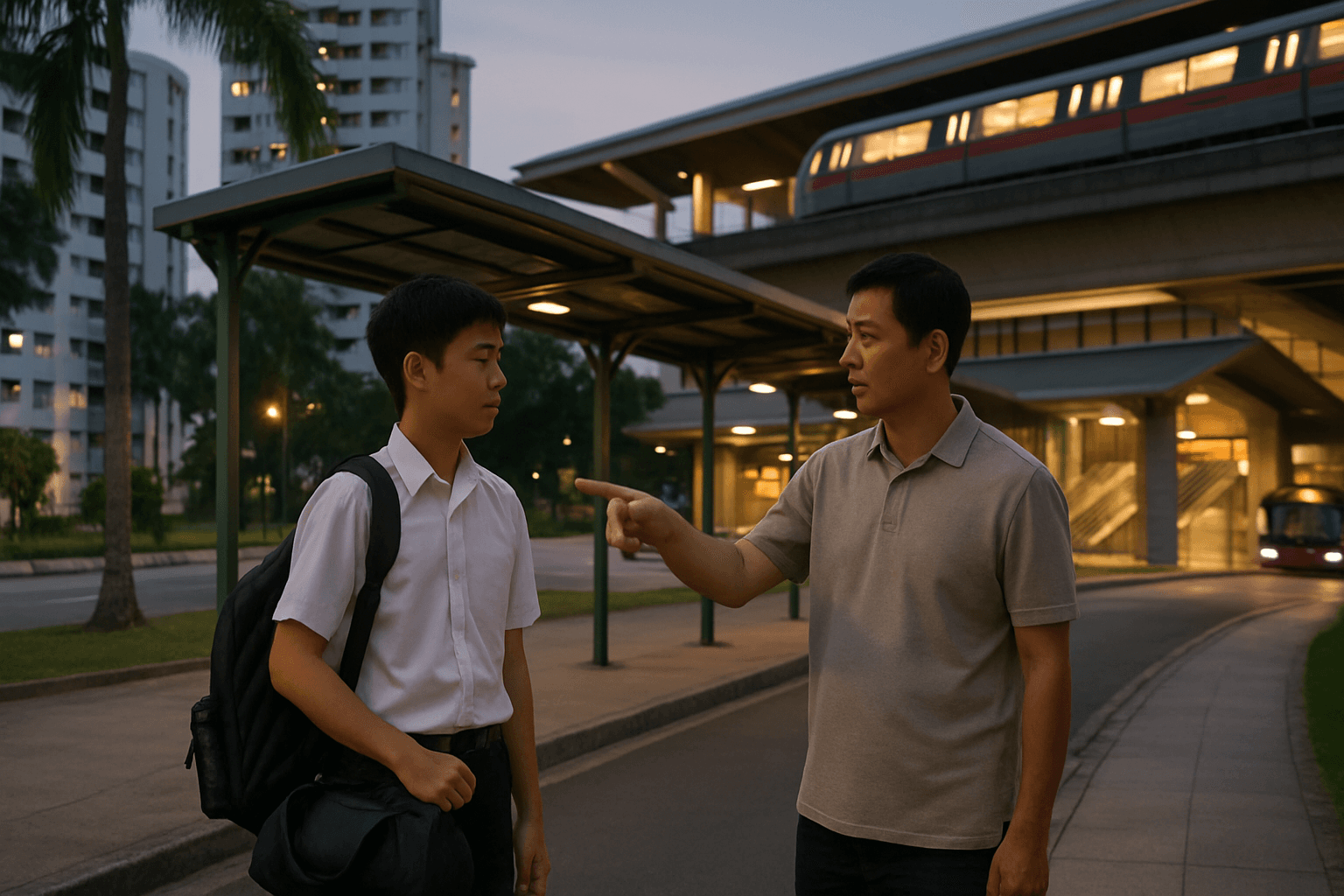
If a school is far from home, plan the late CCA day first. A workable school choice is one your child can repeat on ordinary weekdays: leave school, get home safely, eat, finish essentials, and sleep at a sensible time.
What is the real challenge when secondary school is far and CCA ends late?
Treat late CCA days as a full-evening logistics problem, not just a travel-time problem.
The main challenge is not distance alone. It is whether the whole evening still works after CCA ends, your child packs up, waits for transport, travels home, eats, showers, and prepares for the next day.
That matters because CCA is part of normal secondary school life, not just an occasional extra, as Schoolbag explains. So parents should not plan as if late days are rare exceptions. If the routine breaks down every week, the school may be a poor fit even if the academic match looks good.
Think in end-to-end time, not map distance. One direct MRT ride may be manageable even if the school is far away. A route that looks shorter on paper can be harder if it means walking out of school, catching a bus, changing lines, and then walking home tired with sports gear or an instrument case. What usually strains families is not the headline travel time. It is the hidden time between CCA ending and the child reaching home.
A useful way to judge it is simple: if the route fits the school timetable but breaks the home timetable, it is not truly manageable. For a broader overview, see PSLE AL Score in Singapore: What It Means, How It Works, and How It Affects Secondary School Choice.
How to balance CCA with academic
Don't think this only apply to secondary sch life. My nephew in SCGS primary has her CCA 5 days a week and she is only in P4
Secondary School CCA
so i went to some secondary schools open house, spoke to some CCA HOD. it seems that if i were to pick an external cca, I still need to pick a CCA in school. it does not replaces. that said, isnt that adding additional stress to the child whose interest lies outside what the school provides? again, not all schools provides common cca platform, some schools have more while others notably lesser.
How far is too far for a weekly CCA commute?
Judge a far commute by repeatability, fatigue, and route complexity, not by kilometres alone.
There is no fixed distance that is automatically too far. The better question is whether your child can do the same trip safely and calmly every week, including on tired days, rainy days, and days when they are carrying extra equipment.
Parents often focus too much on kilometres or app timings and too little on route complexity. A 55-minute direct train ride may be easier than a 40-minute journey with two transfers, a long wait for a feeder bus, and a final walk home in the dark. What matters is not just how long the route is on a good day, but how much goes wrong when your child is tired.
A practical test helps. Ask yourself whether your child could still manage the route after a hard training session, in wet weather, or after missing one connection. If the honest answer is no, the issue is not the school name or the map distance. The issue is repeatability.
A far school can work. But the commute must be sturdy enough for ordinary school weeks, not just possible during one school visit. For a broader overview, see How to Build a Secondary School Shortlist Using PSLE AL Score Targets.
CCA in Primary School - Advice needed
Hi, I am not sure if this is the right place to post this. I basically need some advice on CCA in P School and hope experienced parents out there can share your views. My son came home wanting to join the school band this week. He is currently in P2. The CCA will take up 2 afternoons every week. On these 2 days, if he joins, he will need to leave home by 6.40am and reach home only between 5-6pm. He will also need to manage his own lunches in school on these 2 days every week. The school commente
Secondary School CCA
Sometimes, you don't have a choice of CCA becos now schools conduct selection tests n if you don't qualify, then you are kicked into those non popular CCAs like UGs I remembered my colleague's son didn't have a CCA in sec school n his mum had to beg his teacher to give him 1 point. However, this boy is very academic, did so well in his O levels n went to a popular JC. In JC, I am not sure what CCA he took but becos again, he did so well in his A levels, he was offered a scholarship n he qualifie
Have More Questions?
Get personalized guidance on schools, tuition, enrichment and education pathways with AskVaiser.
Try AskVaiser for Free →Which secondary school CCA transport options should parents compare first?
Compare public transport, school bus, parent pickup, and a hybrid plan before choosing a default routine.
Start with the four realistic options most families actually use: public transport, school bus if available, parent pickup, and a hybrid plan. Compare them by total door-to-door time, reliability, cost, and how sustainable they are for the adults involved.
Public transport is often the cheapest and most flexible choice, and many students use it independently. The trade-off is fatigue. A route with crowded transfers can feel much harder after CCA than it does in the morning. School bus can be convenient, but parents should confirm whether it is available after late dismissal, where the drop-off is, and whether the timing still works after the activity ends. Those details differ by school, so it is safer to ask than assume.
Parent pickup is usually the simplest option from a safety and stress point of view, especially if your child is carrying bulky gear or finishes late. But it can quietly become the least reliable option if work schedules, younger siblings, or changing CCA timings make weekly pickup difficult. Many families only discover this after school starts.
A hybrid plan is often the most realistic. For example, your child might take public transport on normal CCA days, while a parent picks up on very late practice days, performance nights, or competition periods. The best default route is not the fastest route on a good day. It is the one your family can still carry out on a bad week. For a broader overview, see What Happens After PSLE Results Are Released?.
What goes into choosing a suitable Secondary School
Saw this being shared in the parents groupchats. https://www.thewackyduo.com/2022/11/how-to-choose-secondary-school-guide.html https://i.imgur.com/fDkJSy6.png\"> https://www.thewackyduo.com/2022/11/how-to-choose-secondary-school-guide.html It's time to choose a secondary school. Choosing a secondary school is a completely different process than primary school. One tends to choose a primary school based on distance or affiliation. Picking a secondary school is a different ball game. Grades play a
Secondary School CCA
choosing the right cca is crucial in secondary school. with more subjects to handle and also longer school hours, a demanding cca would require the child to stay back more often and that is excluding supplementary lessons. the debating club which daughter was keen in requires her to stay back 2x a week (3x if there is a competition). that is definitely no no. she is happy with media club. my son definitely inherited the IT gene from the father but more patient than him. if son doesn’t go into IT
How do you test a secondary school CCA commute before school starts?
Test the full route at real CCA timing, from school gate to home, before term starts.
Do a weekday trial run at the time your child would actually be travelling home after CCA. That gives you a far more honest picture than checking a route app at noon.
Start from the school gate, not just the nearest MRT station. Walk the real path your child would use, notice whether they need to cross busy roads, and time how long it takes to get from the school exit to the bus stop or train platform. Then complete the full trip home, including the last stretch from the stop to your block or gate.
Bring or simulate the kind of gear your child is likely to carry. A short walk feels different with boots, an art folder, or an instrument case, especially in the rain. Also look for small friction points parents often miss: crowded staircases, long interchange walks, uncovered walkways, and whether the final stretch home still feels comfortable after dark.
This matters because the move from primary to secondary school usually comes with longer days and more moving parts than many families expect. If you want a broader picture of that transition, SmileTutor's overview is a useful primer. Map distance tells you where the school is. A trial run tells you whether the routine works. For a broader overview, see How PSLE AL Score Affects Secondary School Posting.
CCA in Primary School - Advice needed
it's scary how we must relate CCAs to advantage in registering for secondary schools.... shouldn't we just let the kid do the CCA if he/she enjoys them even if they are not really good in it?
How to balance CCA with academic
What time do her classes end before CCA? Can she complete some if not most of her homework before CCA starts? Dh and I were both in competitive CCAs in JC+uni and we trained up to 4-5 times a week but we always managed to find time between classes or before training starts to study or do HW. My ds is in P4 and he's also training 3 times a week already. Since I can, I pick him up straight after sch at 1pm, take him home for lunch and HW and then drop him back at sch for training (4-6pm). Since he
Remember: the official CCA end time is not the time your child reaches home.
Plan around the full end-to-home timeline, not the stated CCA finish time.
Build in buffer for changing, packing up, dismissal, waiting, transfers, and small delays. On sports, performing arts, or event days, those extra minutes add up quickly. The timetable tells you when the activity ends, not when the school day truly ends.
Secondary School CCA
Think parents and kids choosing cca should know that for some cca, on top of regular cca hours,there are unofficial cca gatherings for morning runs, voice training, afternoon preps and whatever it takes to prep for the next sports meet or performing arts events and most often, nobody can skip these voluntary sessions. If commitment is really a concern,then parents should advise kids to stay on those clubs cca whereby the level of commitments are lower.
Secondary School CCA
not that I know of...correct me if i'm wrong. if cca it takes up too much time after school, I will step in. son stays back once a week for his club cca.
What should parents check about late dismissal timing and the trip home?
Check the real end-to-home timeline, including packing up, waiting, and occasional later days.
Ask what happens between “CCA ends” and “students leave”. Useful details include whether students need time to change, return equipment, wait for group dismissal, or move to another pickup point. On sports and performing arts days, that post-CCA time can be meaningful.
Also ask whether there are later days during competitions, performances, or extra training. These are school- and CCA-specific, so parents should not assume the ordinary weekly timing is the latest possible timing. A plan that works on a normal Tuesday may fail during busier periods if there is no backup.
This is also why it helps to think carefully before treating a demanding CCA as something your child can simply change later if the logistics become hard. MOE notes in its SP-CCA FAQ that students are generally encouraged to remain in the same CCA and withdrawal requests are considered case by case. The practical takeaway is not that change never happens. It is that parents should plan as if the chosen CCA may need to remain workable.
A better parent question is not just “What time does CCA end?” It is “On a normal day, what time can my child realistically start the trip home, and what are the later exceptions?”
Secondary School CCA
Some parents worry about time taken for CCA leaving sec sch kids no time for academic. Maybe just share some positive perspectives :- 1. Physical exercises keeps them sweating & maintains good body circulation, brings oxygen thro'out body & up to brains (they studied in primary science). They'll study better with good health & endorphins (esp for those who are happy & enjoys their CCA) 2. It helps build a good active habit, which I believe & hope stays with them lifelong. A sedantory lifestyle b
Secondary School CCA
But if your daughter is busy in a CCA with many after school activities, will she have time to finish her homework as well as study for tests/exams?
How can families decide between independent travel and parent pickup?
Choose independent travel only if the route is simple enough and your child can handle small disruptions calmly.
Do not use age as the only test. Use route simplicity, timing, and your child's response to small problems. A child may be responsible in school but still struggle with a two-transfer route after a long day when they are hungry and carrying gear.
A good readiness test is problem-solving. Ask your child what they would do if they miss a stop, cannot board the first train because it is crowded, have low phone battery, or face heavy rain at the final walking stretch. If they can explain a calm next step, independent travel may be realistic. If they freeze or rely on “I don't know”, pickup or more supervised practice is safer.
Many families do better with a phased transition than an all-or-nothing decision. For example, a parent might pick up for the first few weeks, then switch to meeting at the MRT station, and only later move to full independent travel once the route is familiar. That kind of conversation fits the broader Secondary 1 transition too, as KiasuParents notes.
If the route includes several transfers, an isolated waiting point, or a long final walk, parent pickup may still be the better default on CCA days even if your child travels independently on normal school days.
Secondary School CCA
This is interesting. Can help to share which school provides for compulsory 2 CCAs?[/quote] https://www.acsindep.moe.edu.sg/student-development/cca/
What goes into choosing a suitable Secondary School
If Temasek JC is far while Crescent Girls’ Secondary school is nearer your house, then choose Crescent Girls. Travelling time, to and fro everyday, is crucial. I won’t want to tired my child, just because of travelling. Everyday, from Mon to Fri, your daughter has to stay back for Ccas, some Talent development programme or some project group / team work discussion. Thus, travelling distance + time, are important factors. Besides, Crescent Girls is a good Secondary school, too. Plus, u mentioned,
What backup plan should you have if the bus is missed or trains are delayed?
Prepare a simple Plan B before school starts so one missed connection does not become a crisis.
- ✓Fix one backup route home and practise it once before term starts.
- ✓Choose one easy pickup landmark, such as a station control area or a specific taxi stand.
- ✓Save one backup adult contact who can respond if the main caregiver is unavailable.
- ✓Set one rule for missed transport, such as "stay at the station and call before moving".
- ✓Keep one low-battery plan, whether that means a power bank or memorising two key phone numbers.
- ✓Rehearse the Plan B when your child is calm, because a backup only works if they can still follow it when tired.
How do late CCA days affect homework, meals, and sleep?
Plan lighter evenings on CCA days because long commutes reduce time and energy for meals, work, and rest.
Late CCA days shrink the evening. By the time your child reaches home, they still need dinner, a shower, packing for the next day, and some homework or revision. If the commute is long, something usually has to give.
Most families cope better when they run a different routine on CCA days instead of forcing the same expectations every night. Common examples are a ready dinner, part of the school bag packed the night before, and a clear rule about what counts as essential work on late days. That is not lowering standards. It is realistic planning.
What parents sometimes read as poor attitude is actually fatigue. If your child regularly reaches home too tired to eat properly, starts homework very late, or cuts into sleep before the next school day, the route may be doable but not sustainable. KiasuParents' advice on supporting teens is a useful reminder that support in secondary school is often about routines and wellbeing, not just more academic input.
A helpful mindset is this: on CCA nights, protect the basics first. Food, recovery, and sleep are part of school readiness too.
Secondary School CCA
Yes...they must be academically good to make it to the school. Asked friend how her son manages...she told me he is very tired and near competitions, he has to stay back more often and still have to study for tests. Cca stand down just 1-2 weeks before major exams.
Secondary School CCA
I think the right CCA, despite the long hours, will actually help make school life so much more enriching. Yes, it might cut into studying time but at the end of the day it’s about balancing studies and sports/arts/UG. Sometimes, I think it’s ok to let go a little on the studies for the sake of CCA…not to the point of failing of course…maybe just settling for good not great in studies. Personal opinion only…
What should I talk through with my child before we choose a secondary school that is far from home?
Talk through the full weekly routine, including late dismissal, the trip home, backup plans, and whether the CCA they want is realistic with that commute.
Talk through the weekly routine in concrete terms, not just the school's reputation. What time might your child really leave after CCA? Who can pick up if needed? Can they manage the route if it rains, if they are carrying gear, or if the first plan fails? These details are what determine whether a far school still feels workable by March, not just during school selection.
It also helps to talk about CCA fit honestly. If your child is keen on a demanding sport or performing arts group, a long commute matters more than if they prefer an activity with lighter logistics. That does not mean you must reject every far school. It means you should weigh the school, the route, and the likely CCA together.
If you are still comparing options, our guides on PSLE AL Score in Singapore, how to build a secondary school shortlist using PSLE AL score targets, and what happens after PSLE results are released can help you narrow the shortlist first. MOE's page on Education and Career Guidance in schools is also a useful reminder that education choices should be informed and realistic, not driven by school name alone.
The clearest takeaway is this: choose the school with your child's whole week in mind, not only the classroom hours.
Secondary School CCA
My DD also has been selected for 2nd CCA art club (once a week). I encouraged her to join as she seems to be interested in arts. The Main CCA - still trying out. She had Robotics for primary school. Somehow this time around she seems to be interested in sports. Well for sports the criteria is to be selected by coach during the CCA trials. So its a wait and see. I wanted DD to join the uniformed groups. finally the choice belongs to kids. Just hope can balance CCA time and homework time. One good
Secondary School CCA
i still remember those ccas on saturdays…esp the uniform clubs. saturdays also burnt for those taking certain sports. hope daughter can get into a cca which is just once a week…otherwise she will be really stretched with supplementary lessons and cca in secondary school.
Have More Questions?
Get personalized guidance on schools, tuition, enrichment and education pathways with AskVaiser.
Try AskVaiser for Free →