
How to Rank Your Secondary School Choices Strategically in Singapore
A practical AL PSLE guide to balancing preference, fit, and backup options.
To rank secondary school choices strategically under AL PSLE, put schools in the order your child would genuinely choose them, then make sure the list includes a sensible mix of reach, match, and safer options. Past cut-off points help with planning, but fit, distance, programmes, support, school culture, and your child's willingness to attend matter just as much.
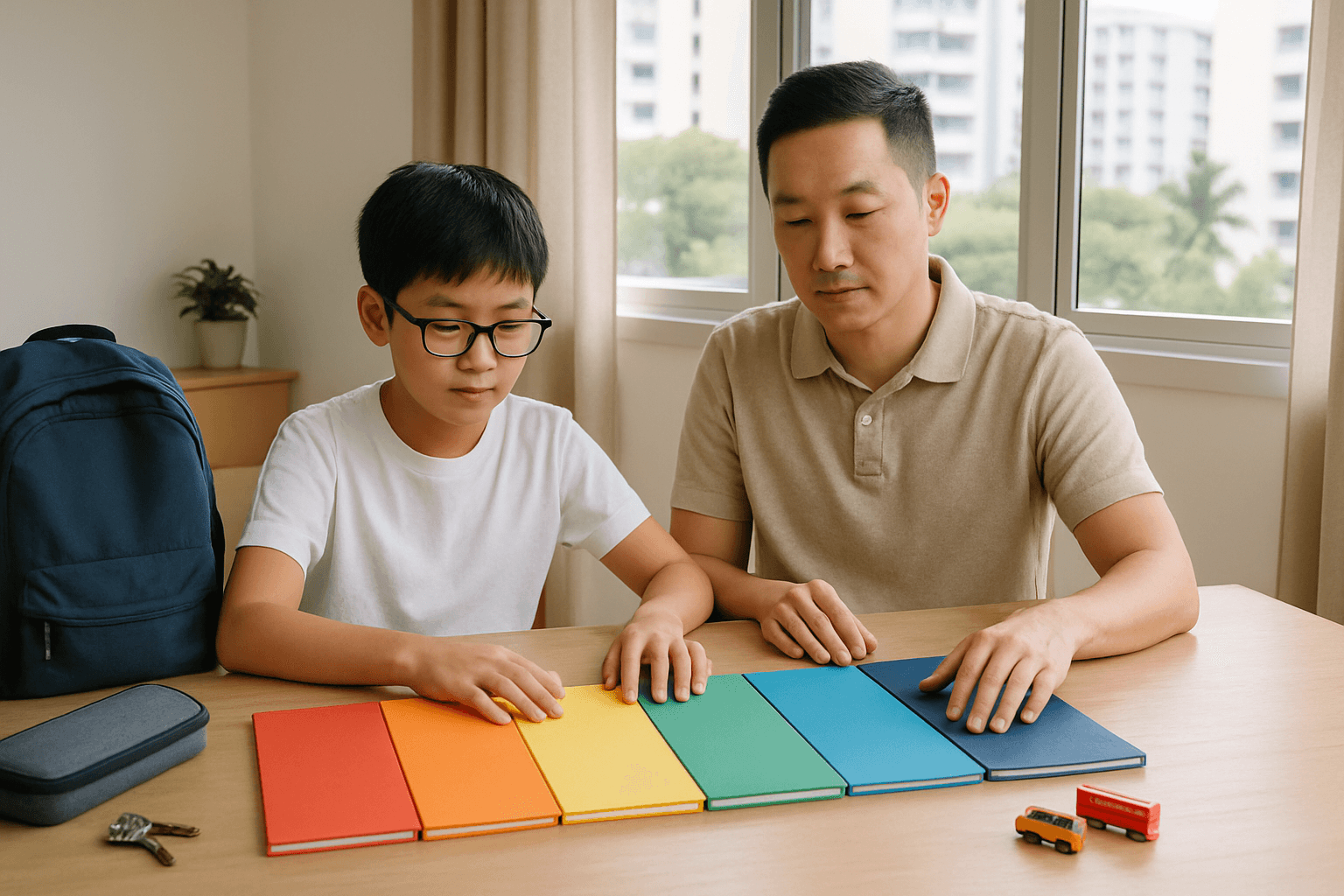
Rank your child's secondary school choices by genuine preference first, then pressure-test the full list for realism. A strong AL PSLE choice list is not the most ambitious one or the safest one. It is the one that gives your child a fair shot at schools they truly want while still protecting against poor fallback outcomes.
In practice, that means keeping the top choices honest, the middle choices realistic, and the last choices acceptable. This guide shows you how to do that without overreacting to cut-off points or filling the form with schools your child would not actually want to attend. If you want a quick refresher on the scoring system before ranking schools, start with our PSLE AL Score in Singapore guide.
What does it mean to rank secondary school choices strategically under AL PSLE?
Strategic ranking means ordering schools by real preference, then checking that the full list is realistic and livable.
It means putting schools in the order your child would truly choose them, while making sure the full list still covers realistic outcomes. Strategic ranking is not about trying to outguess the exact posting result. It is about avoiding two bad lists: one built on wishful thinking, and one filled with schools your family does not really want.
Most parents focus first on score range and past demand. That matters, but it is not enough. A school can look attractive on paper and still be a weak choice if the commute is draining, the pace feels wrong, or your child has no interest in the environment. The reverse is also true. A school that looks less selective may be the stronger long-term fit if your child would be more motivated and more settled there.
A useful way to think about this is simple: you are not just choosing a posting outcome, you are choosing a four-year daily routine. That is why fit, sustainability, and child buy-in matter alongside score planning. If you want context before ranking, our PSLE AL Score in Singapore guide explains the system, and Schoolbag's parent story on choosing a secondary school is a good reminder that suitability often matters more than prestige.
2011 PSLE Discussions and Strategy
r u sure dat is how d selection system works? I was under d impression dat d system selects in d following manner: 1. All those who makes d cut with their first choice goes thro; 2. Any balance vacancies r carried over to those putting dat school as second choice; 3. And so forth down to d sixth choice if any vacancies r left. d system differentiates a child's preference n selection dat way; otherwise makes no sense to ask a child to list his/her preference in order.
2011 PSLE Discussions and Strategy
I'm very certain that's how the selection process works. Check the S1 Posting book that was given to all P6 students on how the posting exercise works. It very clearly describes that all students are ranked and the ones who are ranked higher get priority over students who are ranked lower. I also attended a talk by MOE who gave details on how the selection exercise works.
Should you rank by preference or by likely admission chance?
Start with true preference, then use the rest of the list to balance ambition and risk.
Rank by genuine preference first, then use the rest of the list to manage risk. Your first few choices should reflect the schools you would most want if your child could get them, not the schools that merely feel safest.
What many parents get wrong is treating the form like a probability spreadsheet. They move a school up because it looks more attainable, even though it is not the school they would actually choose over the others. That can backfire emotionally. If the child ends up in that school, the family may realise too late that they were being cautious in theory but not thoughtful in practice.
A better test is this: if your child could attend either School A or School B, which would you honestly pick after considering culture, commute, programmes, and daily fit. Put that one higher. For example, if a well-known school is farther away but your child would actually prefer a nearer school with a stronger robotics CCA and a calmer environment, the nearer school should rank above it. Use historical cut-off points only to judge how much risk you are carrying, not to decide preference for you. Our guides on how PSLE AL score affects secondary school posting and what PSLE cut-off points mean under the AL system can help you separate posting mechanics from school choice.
What goes into choosing a suitable Secondary School
Saw this being shared in the parents groupchats. https://www.thewackyduo.com/2022/11/how-to-choose-secondary-school-guide.html https://i.imgur.com/fDkJSy6.png\"> https://www.thewackyduo.com/2022/11/how-to-choose-secondary-school-guide.html It's time to choose a secondary school. Choosing a secondary school is a completely different process than primary school. One tends to choose a primary school based on distance or affiliation. Picking a secondary school is a different ball game. Grades play a
Choosing Secondary school
Hi, Wonder if anyone knows what happens in this Secondary School selection scenario : If there are 10 places left in School A and 20 pupils with EXACTLY the same PSLE score apply, how does MOE decide which 10 to take into the school. Does it matter in this case whether the child had put School A as the first choice? This impacts what schools to put as 1st and 2nd choice - whether the common advise of putting the dream school which is just out of range of the child’s mark is a wise thing to do. P
Have More Questions?
Get personalized guidance on schools, tuition, enrichment and education pathways with AskVaiser.
Try AskVaiser for Free →How do reach, match, and safety schools work in secondary school choices?
Use reach, match, and safety as planning buckets so your list has ambition, realism, and acceptable backups.
Reach, match, and safety are informal planning labels that help you build a sensible list. They are not official MOE categories, but they are useful because they stop parents from making six versions of the same bet.
A reach school is one you would love if it works out, even if past patterns suggest it may be more competitive. A match school is one that looks more realistically aligned with your child's profile and the school's recent entry range. A safety school is one that looks lower-risk on paper and is still a school your child can accept without feeling resentful or defeated.
The important point is not the label itself. It is the spread. If every school on your list looks like a reach, the list may be too thin on protection. If every school looks ultra-safe, you may be leaving good opportunities unused. Many families find it practical to place one or two more ambitious choices near the top, several realistic middle options, and one or two lower-risk choices near the end. That is not a rule, just a useful balance check. If you are still building the longlist, our guide on how to build a secondary school shortlist using PSLE AL score targets can help before you decide the final order. For a broader overview, see What PSLE Cut-Off Points Mean Under the AL System.
How Do Secondary Schools Choose Their Students
Hi angel2005, Have you read the MOE booklet on choosing your secondary school that’s distributed to all P6 students? The booklet describes very clearly the process the S1 Central Posting Exercise. In brief, all P6 students will be ranked according to their PSLE scores. Each student has 6 choices. The MOE computer will consider the student ranked #1 first. They will give Student #1 the school of his choice. Next they will consider the student who’s ranked #2. And so on and so forth all the way to
What goes into choosing a suitable Secondary School
Hi there, Recently a relative asked me how I choosed my kid’s Secondary School and I kind of got a shock, I had no answer. It was simply just based on the results. My relative came then with a list of important factors that he thought would be helpful to help his kid cope with the stresses of school. I thought that I would help him make this post to help him make a better decision (the kid will be going into the Secondary School in next year). So here goes, considering grades what else should he
What should you consider besides cut-off points when ranking schools?
Use cut-off points for planning, but rank schools by fit, programmes, support, culture, and daily experience.
Look at fit, not just selectivity. A past cut-off point tells you something about demand in previous years. It does not tell you what it feels like to learn, travel, join a CCA, or cope with stress in that school.
When parents compare schools properly, they usually end up looking at school culture, learning pace, student support, subject options, niche programmes, CCAs, and values. Two schools with similar past entry ranges can still suit very different children. One may feel more academically intense and competition-driven. Another may feel more balanced, with stronger attention to settling students in, character development, or support for different learning profiles.
Open houses and school websites are useful when you ask practical questions instead of broad ones. Ask how Secondary 1 students are helped to adjust, how stronger students are stretched, what support exists when students are struggling, and whether the CCAs or programmes your child cares about are genuinely active. A child who loves STEM may value a strong robotics or applied learning environment. Another child may care more about a music culture, a team sport, or a school that feels steadier and less pressured. The Straits Times and Schoolbag's parent reflection both reinforce the same idea: the better school is often the one that suits the child, not the one that sounds most impressive. For a broader overview, see How to Build a Secondary School Shortlist Using PSLE AL Score Targets.
Singapore Secondary School short listing and historical cut off points
This is an online workbook to help you shortlist secondary schools during the S1 posting exercise after PSLE. You may shortlist secondary schools by cut off point, location, CCA and more: https://public.tableau.com/app/profile/sg.parent/viz/SingaporeSecondarySchoolSearch/Search This is another online workbook that lists out all secondary schools’ historical cut off points from 2021, when the AL system started: https://public.tableau.com/app/profile/sg.parent/viz/SingaporeSecondarySchoolHistorica
Beyond AL/PSLE scores - Choosing Secondary School
Hi everyone, I’ve noticed a lot of discussions here about PSLE posting and how tough it can be to shortlist secondary schools — especially when trying to consider more than just the cut-off points. I recently built a free website called School Advisor SG that might be useful for parents going through this process. It helps you explore schools holistically, by combining publicly available data on: PSLE cut-off points (2024) Sports & CCA performance (from national competitions) Primary–secondary a
How important is distance from home when making your ranking?
Treat distance as a real quality-of-life factor, not a tie-breaker you only think about at the end.
Distance matters enough to influence the order of your list. A long commute affects sleep, punctuality, homework time, mood, and how much stamina your child has left once CCA and assessments begin.
Parents often underestimate this because open houses are one-off events. A school can feel exciting for two hours on a Saturday and exhausting by the third week of term. The issue is not only the number of minutes on Google Maps. It is whether your child can sustain that journey five days a week, often with an early start and later dismissal on CCA days.
A simple reality check helps. Try the route during a weekday morning if the schools are serious contenders, and compare not just travel time but transfers, crowding, and how independently your child can manage it. If two schools are otherwise close in fit, the nearer one often gives your child more sleep and a smoother Secondary 1 transition. In real life, convenience is not a minor bonus. It is part of school fit. For a broader overview, see What Happens After PSLE Results Are Released?.
2011 Request for Advice on Selecting Secondary Schools
Aren't there top schools in different parts of Singapore? NUSH and ACSI in the West, RI in Bishan, SNGS in AMK, Dunman High & River Valley in the East and lots more other schools in the second tier? It's true that there is a concentration of good schools in Bukit Timah like SCGS, MGS, NJC, NYGH, RGS and HCI, but the other schools I mentioned above are just as good. Something to consider is that raised by contact21 - to allow neighbourhood schools to become full schools, thereby taking away the n
2011 Request for Advice on Selecting Secondary Schools
I guess there is a 'crack' in form of 'Affliation' which negates whole idea of 'Meritocracy'....If MOE really wants childern from neighbour schools a 'Chance' to move up ladder, then Affliation must be scrapped. Secondary School timing has to change to 8 AM reporting as a standard... Most of Top schools has reporting time as early as 7.15 AM. That's the reason( Even after scoring 245 above in PSLE) , childern from neighborhood school prefers Sec school near by... with Circle lines opening(Remain
How many ambitious, realistic, and safer schools should go on the list?
Most families need some stretch, some realism, and at least one or two backups the child can genuinely accept.
Aim for a balanced list, not a perfect formula. There is no official ratio for how many reach, match, or safety schools you should include, so the practical question is whether your list has enough spread to handle disappointment without becoming overly timid.
In many families, that means one or two more ambitious choices, a stronger middle of realistic options, and one or two lower-risk schools that the child would still willingly attend. That pattern works because it gives the child a shot at schools they really want without making the entire outcome depend on a narrow band of uncertainty.
What matters most is the quality of the bottom choices. Do not treat the last few slots as filler. If your child would strongly resist a school, that school is not a useful backup no matter how safe it looks on paper. If your shortlist is very narrow because of location, school type, or a specific programme, widen the list by one layer lower than your comfort zone rather than repeating the same risk profile several times. Some parents look at community summaries such as KiasuParents' secondary school ranking insights to understand broad past patterns, but those are best used as planning context, not as forecasts.
SOS - Advice needed for secondary school selection
Hi all Need urgent advice on secondary school selection for my boy who scored 234; we are thinking of the following schools in north area: 1. Xinmin Sec 2. Zhonghua Sec 3. Chung Cheng Yishun 4. Maris Stella High 5. Presbyterian High 6. Ang Mo Kio Sec Can anyone provide advice if the above choices make sense? Thanks in advance! :thankyou:
2011 Request for Advice on Selecting Secondary Schools
Hi all. I’m a primary six student this year and I got 260 for the PSLE. I also got a merit for my Higher Chinese. I have visited six schools and my choices are Njc, Dunman High, Nanyang Girls, Raffles Girls, Anderson, and Cedar Girls. Is there anyone who can give me some advice on the order of the schools? Thanks in advance.
What are the most common mistakes parents make when ordering secondary school choices?
Common mistakes include chasing prestige, overreading past cut-off points, and using backup choices your child would not accept.
The biggest mistakes are ranking by prestige alone, treating historical cut-off points like guarantees, underestimating commute, and keeping schools on the list that the child does not actually want. Another common error is letting friend groups drive the order when the school itself is not a good fit.
A useful rule is this: a list of impressive schools is not the same as a smart list. If you cannot honestly say, "We can accept this outcome," that school should not stay on the form.
When does a PSLE student start to choose secondary school?
Hi parents of children taking psle this year, u may find the following link info helpful. http://www.moe.gov.sg/education/admissions/secondary-one-posting/important-dates/
When does a PSLE student start to choose secondary school?
for those without DSA offer, yes, after PSLE result for those applying via DSA, would have shortlisted the schools well before the DSA process begins, and must decide by late Oct, after PSLE exam, before result, which offer to accept; after which NOT eligible to choose school after the result of PSLE is released some kids may already have an idea what school they want from Pri 5 onward, some may have no idea, depending 100% on the parents
How should you involve your child in the final ranking decision?
Give your child real input, but help them separate genuine fit from friends, reputation, and impulse.
Your child should have real input because willingness matters. The final list should not be a parent-only decision disguised as a family discussion.
A practical way to do this is to go school by school and ask, "Can you genuinely imagine yourself studying here every day?" That question is better than asking which school is "best." It surfaces reasons that actually matter once school starts. One child may care deeply about badminton, choir, or coding. Another may care more about a calmer atmosphere, a shorter trip, or not feeling overwhelmed in Secondary 1.
Parents still need to guide the discussion. If your child wants a school mainly because friends are going there, ask whether the school would still be attractive without those friends. If your child is focused on reputation, ask what specifically they like about the school beyond the name. You are looking for informed buy-in, not just excitement. Our guide on what happens after PSLE results are released can help you plan those conversations, and Schoolbag's reflection on PSLE results day is a useful reminder to keep the discussion calm and practical.
2011 Request for Advice on Selecting Secondary Schools
hi, not sure if anyone asked this before, pls redirect me to relevant posts if so. I was wondering if your child scores high 250s in PSLE, how would you make a decision between NJC and Dunman High (not taking into consideration location of the school). Thanks for any feedback !
2011 Request for Advice on Selecting Secondary Schools
Dear all, I am a P6 student this year and I am currently studying in a neighbourhood school. I got 260 for prelims and I was third in class. My target for PSLE is 275 and I aspire to get into RGS. My considerations are: 1) Raffles Girl’s School 2) Nanyang Girls’ School 3) National Junior College 4) Cedar Secondary School I live in Ang Mo Kio so transportation is a problem. I have financial problems with the school fees and other necessary fees too. Many people tell me that Nanyang is better than
What is a simple step-by-step method to finalise the order before submission?
Shortlist, compare, remove weak fits, and submit only when every choice is defensible.
- ✓Put each shortlisted school into a reach, match, or lower-risk bucket first.
- ✓Recheck every school for fit, commute, programmes, CCAs, and school culture.
- ✓Remove any school your child would strongly dislike attending.
- ✓Move the school you genuinely prefer above the school that only looks better on paper.
- ✓Make sure the middle of the list contains realistic options, not only dream schools.
- ✓Make sure the last one or two choices are still acceptable outcomes, not token placeholders.
- ✓Ask your child and one parent to explain in one sentence why each school is on the list.
- ✓Submit only when the order feels honest, balanced, and manageable for the next few years.
Have More Questions?
Get personalized guidance on schools, tuition, enrichment and education pathways with AskVaiser.
Try AskVaiser for Free →