
Nanyang Primary School in Singapore: A Practical Parent Guide
Address, school type, Chinese language fit, transport access, and the key checks parents should make before shortlisting.
Nanyang Primary School is a government-aided, co-educational primary school at 52 King's Road, Singapore 268097, near Farrer Road MRT and several bus routes. Chinese is the listed mother tongue offering in the supplied school information, while labels such as SAP, autonomous status, or GEP should be verified on the current official school profile before you shortlist it.
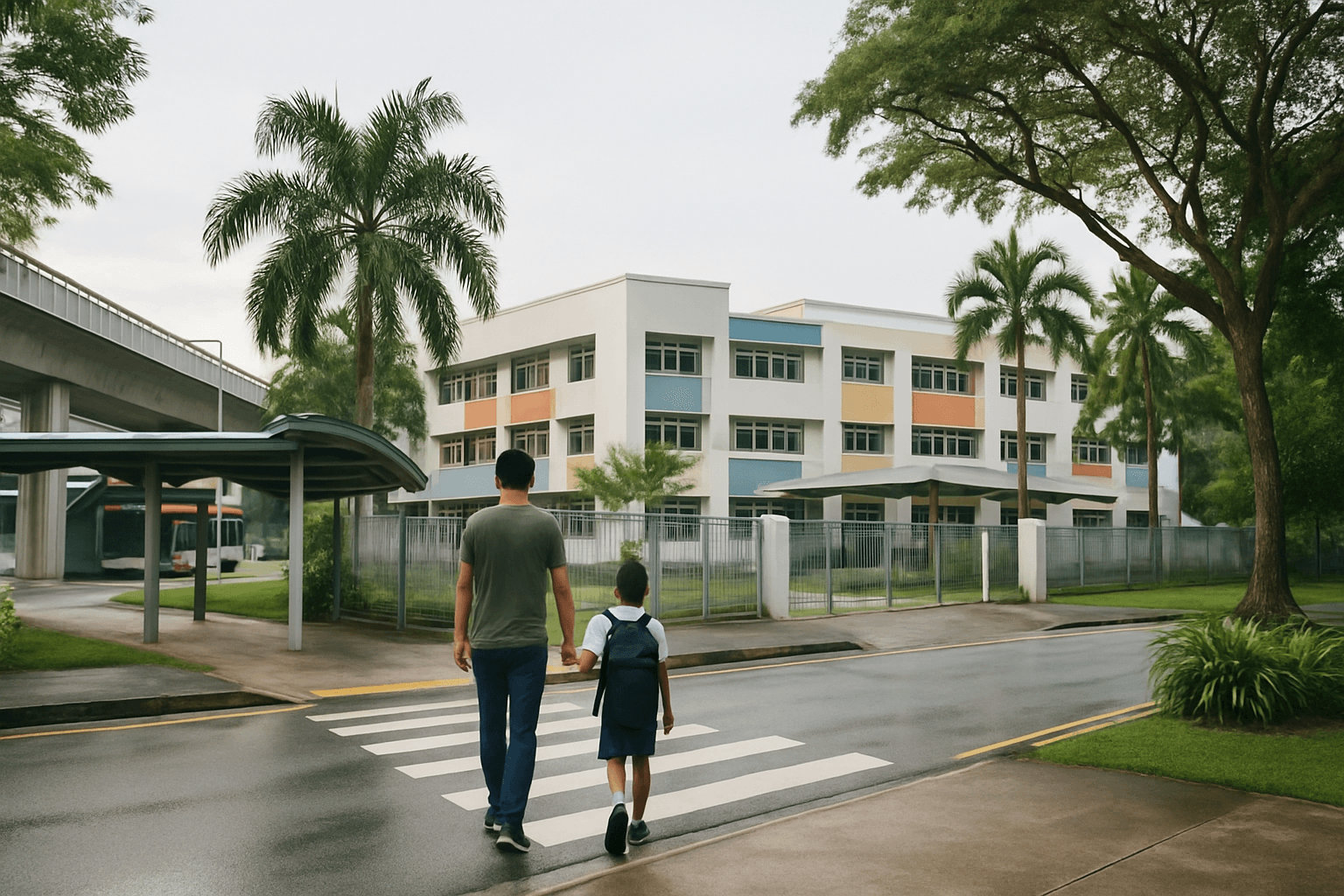
Nanyang Primary School is a government-aided, co-educational primary school at 52 King's Road, near Farrer Road MRT. If you are considering it for Primary 1, focus first on the factors that affect daily life: commute, language fit, school type, and any programme labels you still need to verify.
What is Nanyang Primary School, and what should parents know first?
Nanyang Primary School is a government-aided, co-educational primary school at 52 King's Road. Parents should first check commute, language fit, and day-to-day practicality before being swayed by name recognition.
Start with the confirmed basics. Nanyang Primary School is a government-aided, co-educational primary school at 52 King's Road, Singapore 268097. For most parents, that is enough to decide whether the school belongs on the longlist. The next step is not to chase reputation, but to ask whether the school works for your family's daily routine, language goals, and Primary 1 registration strategy.
A simple way to think about it is this: shortlist by fit first, prestige second. If you are still comparing several options, our Primary Schools in Singapore guide gives a broader framework for judging commute, school type, and family logistics.
Nanyang Kindergarten
Nanyang kindy has no affiliation to nanyang pri (not allowed by MOE). Being in Nanyang Kindy, you will have opportunities to know the “nanyang school family” - ie, concerts, events, etc. You will get to meet the board members, etc. When you attend school concerts, you will meet other parents (from nanyang pri & girls). As such, you MAY have a better chance to become parent volunteer at Nanyang Pri. Nanyang Kindy arranges “trips” to Nanyang Pri where the students get to see how Nanyang Pri “opera
Nanyang Primary
I wish to enroll my kids in Nanyang Primary. I use to attend Nanyang primary many years ago. But having graduated many years ago, I wonder what has changed... 1. Can anyone tell me what the teacher to student ratio is in Nanyang Primary now? Rough figures say from primary 1 to primary 6? 2. How receptive is the school to parents feedback and involvement? And how often do you get to meet the teacher to discuss the progress of your child at school? 3. Is there an open day that we can visit the sch
Where is Nanyang Primary School, and is the commute practical?
Nanyang Primary School is at 52 King's Road near Farrer Road MRT, with several listed bus routes. Parents should test the real school-day journey, not just the map location.
The school is at 52 King's Road, Singapore 268097. The nearest MRT station listed is Farrer Road MRT Station, and the listed bus services are 66, 67, 74, 93, 151, 153, 154, 156, 157, 165, 170, 171, 174, 186, 852, 855, and 961.
That transport list is useful, but it is only the starting point. A route that looks easy on paper can still be tiring if your child needs a long walk, a transfer, or a crowded morning bus. Parents usually make better decisions when they test the full door-to-door trip, including the walk from the station or stop, the rain scenario, and the return trip for pick-up or after-school care. You can do a quick route check on OneMap and a traffic-based sanity check on Waze.
A useful parent rule: easy access on a map does not always mean easy school mornings. For a family on a direct bus route, the school may be very workable. For a family needing two transfers and a caregiver handoff, the same school can become stressful very quickly. For a broader overview, see Ai Tong School in Singapore: A Parent Guide.
Nanyang Primary
Is Nanyang Primary walkable from Farrer Road or Tan Kah Kee mrt? I just got an invitation approval for the alumni. Thinking hard whether is better to choose a nearby primary sch or Nanyang. If its walkable from Farrer Road Mrt it will be great, as i believe driving there everyday sure jam.
Nanyang Primary
Anyone knows any school bus service from simei/tampines to Nanyang primary? Couldn't find any so far
Have More Questions?
Get personalized guidance on schools, tuition, enrichment and education pathways with AskVaiser.
Try AskVaiser for Free →What kind of school is Nanyang Primary School?
It is a government-aided, co-educational primary school. If session timing matters for your childcare plan, confirm the current arrangement directly instead of assuming it from older summaries.
Nanyang Primary School is confirmed as a government-aided, co-educational primary school. In practical terms, that tells parents more about the school's place within Singapore's mainstream system than about whether it is automatically the right fit.
Government-aided and co-ed are useful descriptors, but they are not decision-makers by themselves. What matters more is how that school environment matches your child and your family routine. Some parents are also specifically looking for session information because it affects childcare and work arrangements. Research sources describe the school as single-session, but if that point matters to your planning, it is worth confirming directly on the current official profile before relying on it. For a broader overview, see Anglo-chinese School (primary) in Singapore: A Parent Guide.
Nanyang Primary
Hi i3mum NYPS is a single session school. Kids need to be in school by 7:20am for assembly/silent-reading. Classes finish around 1:15pm (P1/P2). Enrichment classes are held daily - normally 2pm - 3:30/4pm. This is not compulsory. CCAs are normally on Thu/Fri/Sat - depending on what you choose/get selected for. Thu/Fri CCAs are from 2pm - 4/5pm. CCAs for P1/P2 are not compulsory.
Nanyang Kindergarten
Hi octbride, Nope Nanyang Kindy is not affiliated to Nanyang Primary. Your child is in which level now? I've queue my youngest one since 2nd Jan 2009 for a spot for next year N1, but have not heard anything from them yet. guess i may have to forget it liao...
What language offering is listed for Nanyang Primary School?
Chinese is the listed mother tongue offering. If language fit is one of your main reasons for considering the school, confirm the current language profile directly and ask what that means in day-to-day school life.
Chinese is the listed mother tongue offering in the supplied school information. For parents, the practical question is not just what appears on a school listing, but whether the school's language environment matches what you want for your child.
If your family values stronger Chinese exposure, this is a useful signal that the school may be worth a closer look. If you are trying to understand the school's language emphasis in more detail, the school's Chinese Language page may help. At the same time, do not assume that one listing tells you everything about language options, enrichment, or subject pathways. If language fit is a major reason you are considering the school, ask directly what a typical student's Chinese learning experience looks like and whether that lines up with your child's needs.
Nanyang kindergarten - anyone staying in the East?
I have two kids at Nanyang Kindergarten and we used to live in the East. It was difficult to get a car pool system as most of the students live close by the school. Finally we hired a private driver to send the kids to school daily. We have a helper and one of the grandparents accompany the kids to school. We did this for about 1 year in 2009 before moving to the school vicinity. The traffic on PIE or ECP tend to be very bad during morning peak hours. It can take between 25 minute to an hr to ge
Nanyang Primary
Your son studying in another country overseas, now ? Give the school a call. School is the best person, to advise you. If got vacancy - school may ask your son to sit for P3 tests (Sg MOE standard), test his proficiency level, in all P3 subjects. P3 (English, Maths, Science, Chinese) - To ascertain if he can join at P3 or lower level. As Nanyang primary is a SAP school, standard of Chinese is high. Besides, the waitlist to enter Nanyang is very long. Those kids who got balloted out during P1 reg
Is Nanyang Primary School SAP, autonomous, or linked to GEP?
Those labels are commonly repeated online, but they are not confirmed in the supplied official details here. Verify them directly before using them in your decision.
Treat those labels as verification items, not assumptions. Secondary sources often describe Nanyang Primary School that way, but the basic official details provided here do not confirm them. If those labels are important to your shortlist, check the current MOE SchoolFinder profile or ask the school directly before relying on them.
Nanyang Kindergarten
Well, they share the same Board, values & motto, and they have some combined activities together. But if you are talking about priority to go to Nanyang Primary School, then sorry, no,....
Nanyang Primary
Hello everyone, I would like to know why Nanyang Primary is such a popular school? There is no affiliation for the boys, and the affiliation to NYGH is not particularly good. Just wanted to know as my husband is an alumni, and we are in the midst of deciding which school to send our daughter to. Nanyang undeniably produces top performing students. But it is no secret that the stress levels are off-the-charts as well! Am genuinely interested to know what makes this school stand out, and why? Woul
Who is Nanyang Primary School likely to suit?
It may suit families who want a co-ed primary school with workable transport access and a strong reason to prioritise Chinese language fit. It is less likely to suit families whose weekday routine is already stretched.
Nanyang Primary School is most likely to suit families looking for a co-educational primary school in this part of Singapore, with workable access by MRT or bus and a meaningful interest in Chinese language fit. It may be especially attractive to parents who are comfortable prioritising language environment and school profile over simply choosing the nearest school.
A realistic example is a family living near the Circle Line or along a direct bus route, where the commute stays manageable even on ordinary weekdays. Another is a family that strongly values a Chinese-oriented school environment and is willing to accept a slightly longer journey for that fit. The caution is just as important: if your household already depends on tight morning timing, after-school care, or multiple caregivers, the better-known school is not always the easier school.
If you are comparing popular options, it can also help to read our Ai Tong School guide and Anglo-Chinese School (Primary) guide with the same lens: commute, language environment, and routine fit.
What should parents compare before shortlisting Nanyang Primary School?
Use a practical shortlist check: real travel time, walking route, language fit, session fit, caregiver logistics, and any distance-related registration considerations.
- ✓Check the real door-to-door journey on a school-day morning, not just the postal code.
- ✓Test the walk from Farrer Road MRT or the nearest bus stop with a child in mind, including rain and peak-hour conditions.
- ✓Confirm whether Chinese as the listed mother tongue offering matches your child's language needs and your family's goals.
- ✓If session timing affects childcare or work arrangements, verify the current session structure directly with the school.
- ✓Think through normal drop-off and pick-up logistics, including what happens when the usual caregiver is unavailable.
- ✓Compare Nanyang Primary School with nearby alternatives on daily convenience, not reputation alone.
- ✓If home-school distance could matter to your registration planning, read MOE's home-school distance FAQ early rather than leaving it to the last minute.
What do parents often overlook when considering Nanyang Primary School?
Parents often over-focus on the school name and under-plan the weekday routine. Morning transport, caregiver backup, and after-school logistics usually matter more than people expect.
The biggest blind spot is treating a school profile like a label instead of a routine. Parents often spend too much time on popularity and too little time on ordinary Wednesday mornings. The overlooked questions are usually very practical: who handles drop-off, what happens in heavy rain, how long the walk feels for a young child, and whether the same plan still works when one caregiver is unavailable.
Another common mistake is assuming that a well-known school will naturally suit any child who can get in. That is rarely true. A strong paper fit can still be a poor daily fit if the commute is long, the child tires easily, or after-school arrangements are fragile. The useful insight is simple: a school has to work in real life, not just in your registration spreadsheet.
How can parents verify the latest Nanyang Primary School details?
Use the school's phone, email, website, and MOE SchoolFinder page to confirm any detail that affects your shortlist, especially session timing, language fit, and programme labels.
Use the school's direct channels when a detail affects your decision. The listed telephone number is 64672677, the listed email is nyps@moe.edu.sg, and the official website is nyps.moe.edu.sg. You can also cross-check the current school profile on MOE SchoolFinder.
When you contact the school, ask the questions that actually change your shortlist decision: current session arrangement, language-related details, programme labels you have seen repeated online, and any practical guidance on access or school-day logistics. Parents often ask very broad questions and get broad answers back. You will usually get a more useful response if you ask about the specific point you need to confirm.
Have More Questions?
Get personalized guidance on schools, tuition, enrichment and education pathways with AskVaiser.
Try AskVaiser for Free →