
Pei Chun Public School Singapore: A Practical Parent Guide
What parents should know about Pei Chun Public School's school type, Toa Payoh location, single-session setup, SAP status, and Chinese-language fit before shortlisting it.
Pei Chun Public School is a government-aided, co-ed, single-session SAP primary school in Toa Payoh. It is most likely to suit families who want a stronger Chinese bilingual environment and can manage the daily commute.
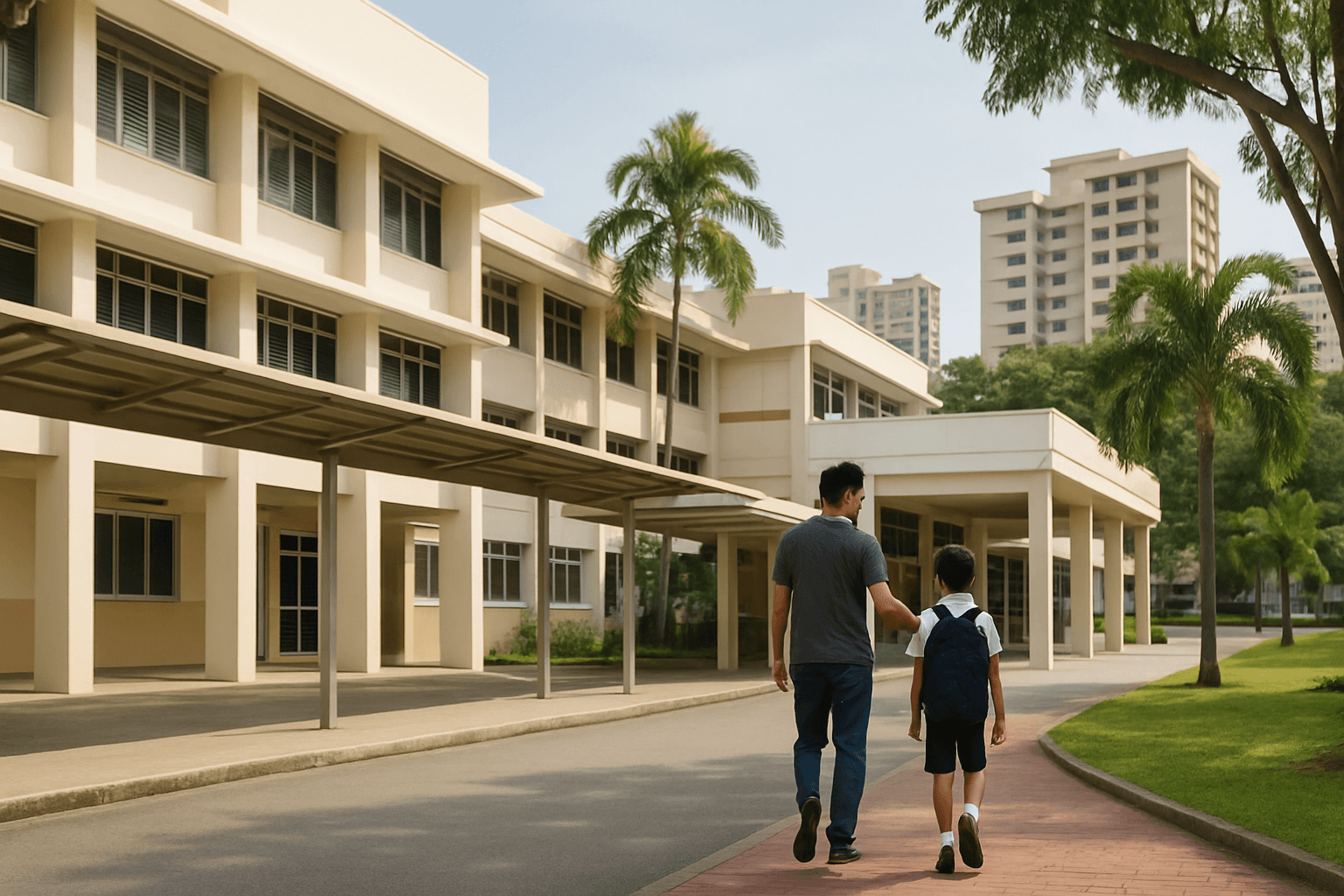
Pei Chun Public School is a government-aided, co-educational, single-session primary school in Toa Payoh with SAP status and a strong Chinese bilingual identity. If you are starting your shortlist, use this page to answer three practical questions quickly: whether the commute works, whether an SAP Chinese-leaning environment suits your child, and whether the school day fits your family's routine. For a broader overview of how to compare schools, start with our Primary Schools in Singapore guide.
What is Pei Chun Public School in Singapore?
Pei Chun Public School is a government-aided, co-ed, single-session SAP primary school in Singapore with a strong Chinese bilingual identity.
Pei Chun Public School is a mainstream primary school in Singapore. In practical parent terms, it is best understood as a government-aided, co-educational, single-session school in Toa Payoh with Special Assistance Plan (SAP) status and a visible Chinese bilingual identity. That tells you two useful things early: it sits within the mainstream MOE system rather than the independent-school track, and its school culture is more Chinese-language-focused than a typical non-SAP option. Parents sometimes over-read the SAP label. The better way to read it is this: SAP signals stronger Chinese language and cultural emphasis, not that the school is automatically right for every child. For a broader overview, see Primary Schools in Singapore: A Practical Parent Guide.
Pei Chun Public
Information on how pupils of Pei Chun fare in PSLE is published in the school annual every year. PSLE 2011 is in page 20 of 2012 school annual, PSLE 2010 is in page 3 of 2011 school annual, PSLE 2009 is in page 8 of 2010 school annual and PSLE 2007 is in page 15 of 2008 school annual. No mention of PSLE 2008 in 2009 annual. Not sure whether 2012 PSLE results will be published in 2013 school annual. From the school honour roll outside the school office, PSLE top scorer at Pei Chun range between 2
Pei Chun Public
This is the Parents' Networking Group for Pei Chun Public Once you have gotten your child in this school, come introduce yourself to other parents in this school and network with each other. Share tips, on-going news and alerts and discuss issues pertaining to the school.
Where is Pei Chun Public School located and how easy is it to get there?
The school is at 16 Lorong 7 Toa Payoh. For parents, the key check is the real weekday door-to-door journey, not just the map distance.
Pei Chun Public School is at 16 Lorong 7 Toa Payoh, Singapore 319320. For most parents, the real question is not the address itself but whether the school is workable at 6.30am to 7.30am and again at pickup time. Practical route references from mapping tools include Toa Payoh MRT, Braddell MRT, and buses such as 232, 57, and 230, but treat those as planning guides rather than official school transport information. A school that looks central on the map can still feel inconvenient if drop-off involves traffic, a long walk, or an awkward handoff to grandparents or a helper. The most useful test is a live one: time the full journey on a normal weekday, including parking, waiting, and pickup. You can cross-check the school's location on MOE SchoolFinder and use Waze directions for a more realistic sense of the route. For a broader overview, see Ai Tong School in Singapore: A Parent Guide.
[Toa Payoh] Primary Schools
FYI, for those who are interested in Pei Chun … Pei Chun Public School will hold at the current First Toa Payoh Secondary School site located at 580 Toa Payoh East S(319133) from January 2017 to December 2018 during the school’s upgrading. The school will remain double session while at the holding site.
[Toa Payoh] Primary Schools
Stick back to pei Chun, your alma mater. Phase 2c chij Toa Payoh - Singapore citizen kids need to ballot, within 1 km. risky ! Once you withdraw from 2a pei chun - Whatever outcome is your balloting for 2c ij Toa Payoh - You can't go back pei chun anymore. The moment you withdraw from pei chun, your seat is given immediately to next child on waiting list, for eager admission into pei Chun. Last year (2012) phase 2c balloting results:- http://www.kiasuparents.com/kiasu/forum/viewtopic.php?f=5&t=4
Have More Questions?
Get personalized guidance on schools, tuition, enrichment and education pathways with AskVaiser.
Try AskVaiser for Free →Is Pei Chun Public School a government, government-aided, or independent school?
It is a government-aided mainstream primary school, not an independent school.
Pei Chun Public School is a government-aided primary school. That means it is part of Singapore's mainstream school system and should not be confused with an independent school. Parents sometimes treat this label as a ranking signal, but it is more useful as a comparison tool. Once you know the school type, the bigger questions are usually daily ones: can your family handle the commute, does the school's language identity suit your child, and does the school routine work with your care arrangements? School type matters, but fit matters more. For a broader overview, see Anglo-chinese School (primary) in Singapore: A Parent Guide.
Is Pei Chun Public School co-ed, single-session, and suitable for my family routine?
Yes. It is co-ed and single-session, which usually makes daily planning simpler, but you still need a realistic after-school plan.
Yes. Pei Chun Public School is co-ed and single-session. Single-session means students attend in one school session rather than a morning and afternoon split, which usually makes family planning simpler. For working parents, one predictable rhythm is easier to coordinate with student care, school bus timing, enrichment classes, or a grandparent pickup arrangement. The main benefit is predictability, not the removal of logistics. Parents sometimes hear "single-session" and assume the routine will take care of itself. In practice, you still need a clear plan for what happens after dismissal and who is responsible on days when schedules change.
Pei Chun Public
Hello parents, does anyone knows if Pei Chun is single session for Primary 1 now or will be in the near future? :? Thanks.
Pei Chun Public
hi Just to share, we used to stay in CCK and enrolled in Pei Chun as my DH was an old boy and he felt a brand name school is best. Our 2 neighbours with kids the same age too enrolled in various brand name schools becos of this belief. Time is King After P3 we all MOVED HOUSE. This is becos the commute became too tiring for parents, also as kids move to upper primary the after school activities become too much to juggle transport wise. The afterschool care centre near Pei Chun (highly recommende
What mother tongue or language offering does Pei Chun Public School provide?
Pei Chun Public School is strongly associated with Chinese language and bilingual education. Parents should judge not just the formal language offering, but whether their child fits a more Chinese-leaning school environment.
The school's public profile is strongly associated with Chinese language, bilingual education, and Chinese cultural heritage. Public sources used for this guide point to Chinese as the main mother-tongue focus, with Higher Chinese also mentioned in school-related information, but parents should confirm the latest language details on the official school site before deciding. The bigger decision question is usually not the exact label on the timetable. It is whether your child and home routine fit a more Chinese-leaning environment. A child who already hears Mandarin at home may settle in differently from a child with very little exposure. Parents sometimes assume SAP means "only for children already strong in Chinese". That is too simplistic. A better test is whether your family wants stronger Chinese exposure and can support it consistently. The school's heritage page gives useful context on how it presents that identity.
Pei Chun Public
I have two girls in Pei Chun, one just completed her PSLE. I recalled when my first girl went to PCPS she did not speak a word of Chinese, she had A for PSLE in Chinese. I guess the shool is a good environment to pick up Mandarin, even though I understand that most students speak to each other in English.
Pei Chun Public
Pei Chun primary is a SAP school : the only Mother tongue taught in this school is Higher Chinese from Primary 1 onwards, no Tamil Tamil is offered only in non-SAP primary schools.
Does Pei Chun Public School have SAP, autonomous, or gifted status?
SAP status is supported by the available public profile. Autonomous and GEP status are not indicated here.
Yes for SAP. Do not assume that also means autonomous or Gifted Education Programme status. Those are different labels, and they are not indicated in the public profile reviewed for this guide. If you are shortlisting by school labels, treat Pei Chun as a mainstream SAP primary school with stronger Chinese-language and cultural emphasis. The school's SAP English Language page is a useful reference for how it presents that identity.
What kind of parent or child is Pei Chun Public School likely to suit best?
Pei Chun is a practical shortlist for families who want a manageable Toa Payoh commute, a single-session routine, and a stronger Chinese bilingual environment.
Pei Chun is most likely to suit families looking for three things at once: a Toa Payoh location, a single-session routine, and a school identity with stronger Chinese bilingual emphasis. That can work well for parents who already value Mandarin exposure at home, want a structured mainstream primary school, and do not want an overly complex daily commute. For example, a family living in central Singapore or along the North-South Line may find the location workable, while a family travelling from far west or east may feel the cost of that commute every school day. It may be a weaker fit if you prefer a less language-defined school culture or if your child is likely to struggle without steady home support in Chinese. A school can look strong on paper and still be wrong for the daily reality of your family. If you want comparison points, our Ai Tong School guide and Anglo-Chinese School (Primary) guide show how a different school identity can change the shortlist.
Pei Chun Public
Hi all I am an ex-pupil of Pei Chun and will be registering my girl for P1 next year. I like the emphasis of the school on Chinese and discipline. However, I am staying in Punggol, quite far away. I am not sure if it is worth sending my girl to a school this far away everyday. Will like to know if Pei Chun is as good as it used to be when I was schooling. How is the school culture? Are parents satisfied with the school? How have the psle results been the past few years? Thanks!
Pei Chun Public
There are a no of student care around Pei Chun. Opposite the main gate along Lor 7, there is one at the HDB block where Sheng Siong is located. There were a few other enrichment centres which Pei Chun engage to run their enrichment programmes in the same centre. Then opp the side gate along Lor 6, there is a PCF one at blk 44 or 46 and another private one at blk 49. I always see the staff from blk 49 walking the kids to school in the afternoon.
What should parents check before shortlisting Pei Chun Public School?
Check five things before shortlisting: commute, dismissal plan, language fit, school-type expectations, and current official details.
- ✓Time the full journey on a normal weekday morning and again at pickup time. A short map estimate can feel very different once traffic, parking, and walking time are included.
- ✓Check who will handle dismissal and what happens after school. Single-session is simpler than split-session, but you still need a workable plan for student care, grandparents, school bus, or enrichment.
- ✓Be honest about language fit. If your child has little Chinese exposure at home, think about whether your family is ready to support homework, reading, and confidence in a more Chinese-leaning environment.
- ✓Compare it as a mainstream government-aided SAP school, not as an autonomous or gifted-track option. This helps you shortlist for fit rather than label.
- ✓Use the official school site and MOE profile to confirm current programme details, contact information, and any open house or admissions-related updates before making a final shortlist.
How can I contact Pei Chun Public School to confirm details?
Use the official school website and MOE SchoolFinder listing to get the latest contact details and confirm current information directly with the school.
The safest way is to use the official Pei Chun Public School website and its MOE SchoolFinder listing. Those should point you to the latest phone number, email, and school contact channels. This matters because contact details, open house information, and programme pages can change over time. If you are asking about current language offerings, school hours, or admissions-related events, confirm directly with the school rather than relying only on third-party listings.
Have More Questions?
Get personalized guidance on schools, tuition, enrichment and education pathways with AskVaiser.
Try AskVaiser for Free →