
Should You Choose a School Near Your Child’s Caregiver or After-School Care?
A practical Singapore guide to pickup, supervision, commute, fatigue, and backup plans.
Usually, yes. If a caregiver or after-school care setup is responsible for your child on most school days, school location should be judged partly by that routine. In practice, the stronger choice is the one that keeps pickup reliable, keeps the child’s day manageable, and still works when there is rain, late dismissal, or a last-minute disruption.
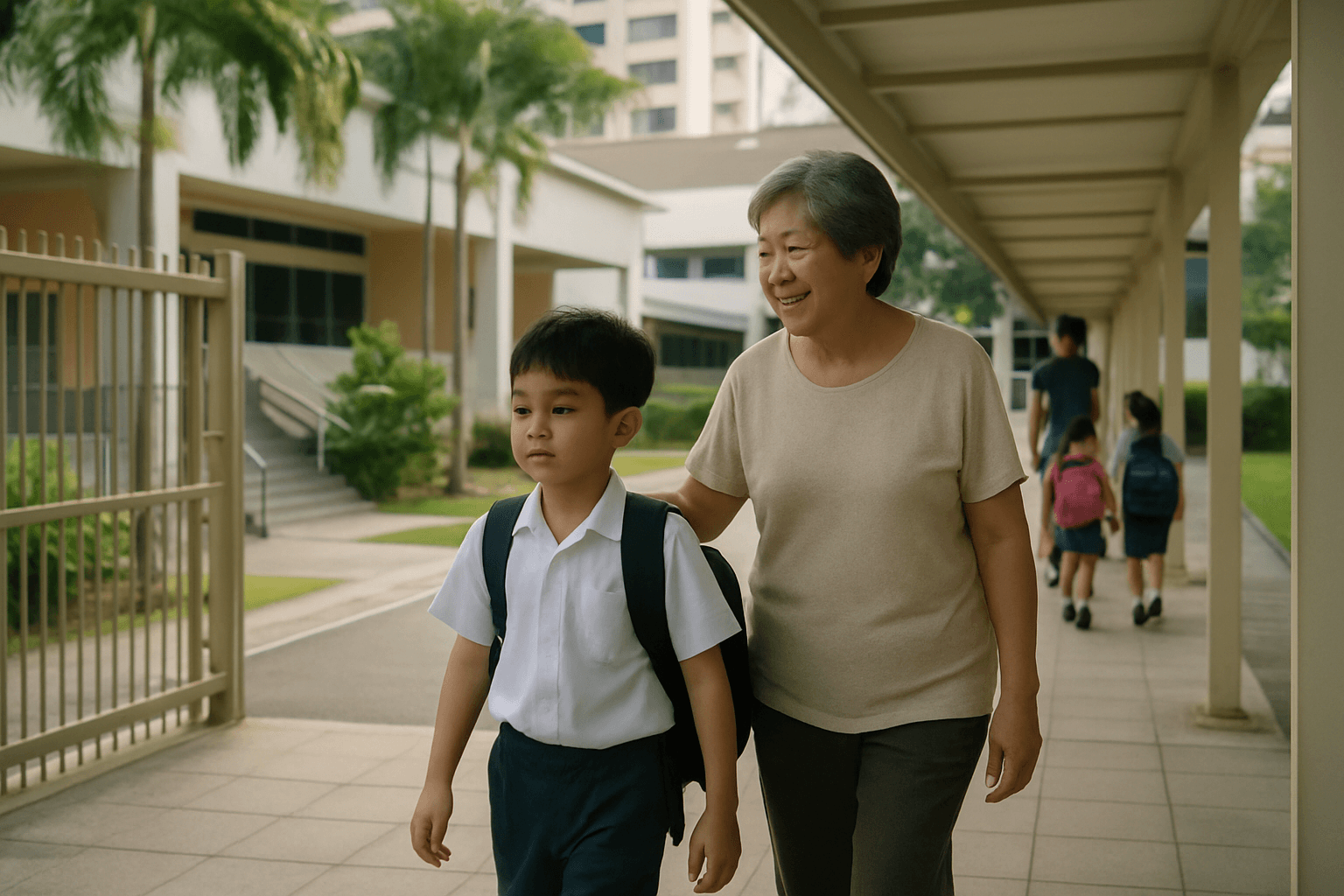
If someone other than you handles your child after school on most weekdays, that arrangement should influence school choice. The real question is not which school looks nearest on a map, but which option makes pickup, supervision, and backup coverage work on normal days and on difficult ones.
Should you choose a school near your child’s caregiver or after-school care?
Yes, if that caregiver or student care setup handles your child on most weekdays. Choose the location that makes pickup, supervision, and backup coverage most reliable.
Usually, yes, if that caregiver or after-school setup is doing real work every school day. When the same adult or student care arrangement is responsible for pickup, supervision, meals, homework time, and keeping your child safe until you are available, proximity deserves real weight.
The most useful rule is simple: choose the option that makes the whole afternoon routine reliable, not just the morning drop-off. A school can seem convenient on paper and still be a poor fit if no one can collect the child consistently after lessons. This matters even more in primary school, where children are less able to manage long transfers, unclear handoffs, or repeated last-minute changes on their own.
Think of school fit as a family system, not just a school decision. If your child goes to a grandparent’s home every afternoon, or to student care beside the school almost every day, that support arrangement is part of the school fit. The right location is usually the one that keeps the child settled quickly after dismissal, with the fewest weak links. For a broader overview, see PSLE AL Score in Singapore: What It Means, How It Works, and How It Affects Secondary School Choice.
Home or After School Care?
I opt for after school care as my girl will just play with her toys when she reaches home from school. At least, if she has done all her homework during after school care, she can relax once she gets home. Of course as parents, we still need to monitor her progress in school and even her time at after school care. So, I would consider schools with a good after school care programme.
School-based Student Care or Community-based Student Care?
School-based student care centres are able to work closely with schools to align and integrate programmes, said Education Minister Heng Swee Keat. Currently, most children are spending more time in their schools because of CCAs and single-session school hours. Is it a wise move to keep the children in school even after school hours? As parents, how do you feel about the idea of a school-based student care service? Would you want your children to spend most of their time in school? http://i49.tin
When is choosing a school near the caregiver the smarter move?
Choose nearer to the caregiver when that person handles most pickup or supervision and needs the route to stay short, simple, and predictable.
A school near the caregiver is usually the better choice when that person is the backbone of the daily routine. If a grandparent does pickup four or five days a week, a helper escorts the child home every afternoon, or a relative supervises until evening, a shorter and more predictable route reduces stress for everyone.
This matters most when the caregiver is older, does not drive, has health limits, or is already caring for another child. A route that requires long walking, crowded transfers, or uncertain waiting can look manageable in January and feel exhausting by March. A grandparent may be happy to help but still struggle with repeated rainy-day pickup. A helper may cope well with one direct route but find a two-transfer journey much harder when also managing a younger sibling or household timing.
The practical test is frequency. If your child goes straight to the grandparents’ home almost every day, school proximity to that home may matter more than shaving a few minutes off a parent’s morning commute. If the caregiver only steps in once a week, location around that caregiver usually matters much less. A good insight line is this: if one adult carries the routine, design around that adult’s route. For a broader overview, see How to Build a Secondary School Shortlist Using PSLE AL Score Targets.
Stay at Home Child or After School Care Student?
Hi, In a dilemma at this point in time. My maid is taking care of house (so far, this maid is still good), DS1 attending P1 next year (am session). So the question is: Should I get maid to bring him home? Or, should I leave DS1 in After School Care? What do you think is the better option? Pointers to consider: - if child at home, maid cannot do funny things like befriending other maids or invite people to come into house - if child in after school, maid won't be able to do funny things to DS1 if
After school care VS maid at home
Hi, I am thinking to hire a maid to take care of children at home after school. Any advice which option is better for children - send to after school care or with maid at home?
Have More Questions?
Get personalized guidance on schools, tuition, enrichment and education pathways with AskVaiser.
Try AskVaiser for Free →When does after-school care near the school matter more than the caregiver’s location?
Choose around the school and student care when student care is the main weekday supervision plan and no caregiver is handling daily dismissal.
After-school care near the school matters more when student care is your main supervision plan and no caregiver is doing daily pickup. This is common for working parents who need reliable coverage until late afternoon or evening, especially when grandparents or helpers are not consistently available during dismissal hours.
In Singapore, student care is widely used for primary school children and often includes supervision, meals, homework support, and a structured environment. Parent guides such as KiasuParents’ overview of student care centres and SmileTutor’s tips on choosing a student care centre are useful for seeing what families commonly compare. The main point is not that every centre is the same, but that a nearby and well-matched centre can solve the biggest daily question: who is with your child after school, where, and until when.
This is often the better anchor if your child will go from school to student care almost every day. For example, if both parents work full time and the child needs supervision until 6pm, a school with a convenient student care arrangement may be easier than depending on a relative who is only available on some days. If the caregiver only takes over in the evening, the real afternoon base is student care, not the caregiver’s home. In that situation, keep the school-to-care transition as simple as possible.
To leave or not to leave P1 child in after school care
I feel that it depends on the after school care. I feel that is better then wasting time at home doing nothing and squeeze everything on weekend. But only if the after school care is good. I seen alot of smalls after school care, no space, not enough food, no place to rest…
Childcare or no Childcare?
Hi princesskaris, Wow, this type of question very difficult to answer. Because actually it really depends on what you want! Because yes, for kindy, you will really need the home-support to be able to fetch your girl home. For a CCC, you can opt to put her there for longer hours. If you ask me, my 2-cents worth of opinion would be to put her to the kindy which is much nearer to you since it would be the first time she is going to school is it? Then when she is older you can decide whether to chan
What hidden costs do parents often overlook: commute, fatigue, and timing?
Distance affects more than travel time. It changes your child’s energy, your caregiver’s strain, and how well the routine survives delays and bad weather.
Distance is not just about transport time. It affects your child’s energy, the caregiver’s burden, and how much margin your family has when the day does not go exactly to plan.
A common mistake is planning around the earliest lesson end time only. In practice, dismissal can be affected by school-based activities and after-school programmes. MOE notes that after school hours include weekday hours outside curriculum time and school-run after-school programmes. For parents, the takeaway is simple: do not build your routine around the most optimistic timing.
The hidden friction usually shows up in small daily losses. A child who spends too long travelling after school may reach home or student care already tired, which then affects homework, dinner, and bedtime. A grandparent may be willing to collect the child, but repeated waiting in heat or rain can wear them down. One extra transfer may sound minor until it becomes the reason pickup runs late every week.
Bad-weather days are the best stress test. So are late-dismissal days, enrichment days, and weeks when a caregiver is slightly unwell. If a plan only works when everyone is punctual and the weather is good, it is probably weaker than it looks. The best routines have some slack built in.
How far is your kid's childcare from your home?
It depends on a few factors: Do you have a car? Who will be fetching them from school? If it’s someone who is working, will they have to rush? What if it is raining? What are the alternatives? My childrens’ childcare is a 5 minute drive as usually my husband will drive them in the morning and my f-i-l, who also drives, will fetch them. There is also a direct bus if my maid needs to fetch them. If we didn’t have a car I probably would have compromised on the childcare which is 5 minute’s walk awa
Childcare or no Childcare?
How old is your child now? If you’re planning to return to the workforce and your parents are not the main caregiver then the CCC is your only choice apart from employing a domestic helper. If you need to go over your parents’ place for dinner every day then by all means the CCC should preferably be near them and if you can manage your own dinner with your husband and child/children and you are definitely able to fetch before 7pm, then a CCC near your home might be more practical. If your parent
How do you compare a school near home versus a school near the caregiver?
Compare which location removes the most weekday friction after dismissal, not which one sounds more convenient in theory.
Compare the two options by asking where the daily friction really sits. A school near home may be better if parents handle most pickup, home is the main afternoon base, and the routine still works when work runs late. A school near the caregiver may be better if that caregiver is doing the real weekday support and can manage the route much more easily than the parents can.
The most useful comparison is not theoretical convenience but full-week reliability. Picture a normal week first. Where does the child go after school, who meets the child, how long is the wait, and how many handoffs happen before the child is settled? Then picture a difficult week. What happens if there is heavy rain, a late school activity, a parent meeting, or a caregiver who wakes up unwell? The stronger choice is usually the one that still works with less scrambling.
A practical way to decide is to map both routines from dismissal to dinner. If the school near home only works because a grandparent must take two buses every afternoon, that option may be more fragile than it first appears. If the school near the caregiver adds a slightly longer morning trip but removes a stressful afternoon handoff every day, it may be the better long-term fit. For a broader look at school-location trade-offs, KiasuParents’ guide to choosing a primary school near you is a useful companion. If you are also thinking ahead to later school choices, our PSLE AL Score in Singapore guide covers how logistics fit into a wider shortlisting process.
After school care VS maid at home
Hi chng, If possible I would prefer not to put the kids at home with a maid. Putting them in after sch care will allow them to interact and socialise with other children too.
Advice On School Student Care or Nanny
Both of my DCs were in school-based student care throughout the 6 years in Primary school. As zac's mum has mentioned, there are not many upper primary kids in student care and the supervising staff may not be the nicest of people. Meals provided may not be all that delicious and there may even be some compulsory activities such as nap-time or group games that they have to attend. It can be a pretty noisy environment so self-discipline and focus will be important. The pros are that it is a conve
What should you check before relying on grandparents, helpers, or relatives for school pickup?
Check consistency, route difficulty, stamina, and backup cover, not just willingness.
- ✓Can this person do pickup consistently on most school days, not just during the first few weeks?
- ✓Can they handle the actual route comfortably, including walking, stairs, crowded buses, or waiting at the school gate?
- ✓If the caregiver is elderly, have you thought realistically about heat, rain, mobility, and how tiring repeated pickup may become over a full year?
- ✓If the caregiver is a helper, does she also need to manage a younger sibling, household errands, or another fixed duty at the same time?
- ✓If the caregiver is a relative, is their work schedule stable enough for regular dismissal timing and occasional changes?
- ✓Can this person cope with late dismissal, a delayed parent, or a school day that ends later than expected?
- ✓Does your child know clearly where to wait, who is collecting them, and what to do if the caregiver is late?
- ✓Is there a backup adult who can step in quickly if the usual caregiver falls ill, has an appointment, or cannot leave home?
- ✓Have you tested whether the arrangement still works on rainy days and not just in the easiest conditions?
- ✓Are you relying on willingness alone, or have you checked whether the caregiver has the stamina and routine space to keep doing this month after month?
What should you check before choosing after-school care near the school?
Look for timing fit, a clean school-to-care handoff, and routines that match your child’s actual afternoon needs.
- ✓Does the centre’s daily timing actually match your child’s dismissal pattern, including days with different end times?
- ✓Is the centre close enough to make the school-to-care transition simple for a younger primary school child?
- ✓Who takes responsibility once school ends, and is that handoff process clearly explained?
- ✓What does a normal afternoon look like, and is there enough structure for supervision, rest, homework, and meals?
- ✓Are meals or snacks included, and does that fit your child’s routine rather than leaving them hungry through the afternoon?
- ✓How is homework handled: quietly supervised, actively guided, or mostly left to the child?
- ✓What happens if a parent or caregiver is late for pickup?
- ✓How does the centre handle rainy days, school schedule changes, or a child who is upset or unwell?
- ✓Can your child cope with the daily transition from school to student care, or do they become overtired by too many moves in one afternoon?
- ✓During a visit, can the centre show you a real routine and answer practical questions clearly, instead of relying only on broad promises?
- ✓For comparison ideas, broad overviews such as KiasuParents’ student care guide and [SmileTutor’s checklist for choosing student care](https://smiletutor.sg/star-tips-on-choosing-the-best-student-care-centre-for-your-child/) can help you know what to ask.
When is school transport worth paying for?
Pay for transport when it removes a fragile part of the routine and makes the afternoon reliably workable.
Transport is worth paying for when it removes a daily stress point you cannot solve another way. The right comparison is not simply transport fee versus no transport fee. It is transport fee versus repeated driving, repeated taxi use, caregiver strain, or a pickup routine that keeps breaking.
This can make sense in several common situations. If both parents work and the afternoon handoff is the hardest part of the day, paid transport may be cheaper than constant schedule disruption. If a grandparent can supervise at home but cannot comfortably travel to school every day, transport can let that caregiver help without carrying the most tiring part of the routine. If the child would otherwise go through multiple handoffs between school, caregiver, and home, one reliable transport leg may simplify the whole system.
Transport should still be treated as a practical arrangement, not a guaranteed cure. Availability, route timing, and service details can differ by school or provider, so ask about the exact part of the day you are trying to fix. If transport removes one high-friction handoff and makes the rest of the afternoon stable, the monthly cost may be worth it. A useful rule of thumb is this: pay for transport when it buys reliability, not just convenience.
Childcare or no Childcare?
My personal choice I tend to prefer kindy. 3- 4 hours daily for the child to interact & pick up interpersonal skills Then supplement with enrichments outside kindy hours. Depending on the child’s interest, can be drawing, ballet, music or academic ones such as abacus, phonics Childcare center is usually a last resort, when there isn’t any other reliable or suitable caregiver to bring the child to/fro kindy or babysit outside kindy hours
Do you fetch your secondary schooling child?
I send my kids to school everyday. I will pick them up (even the Sec school one) if they have CCA/supp or anyday they have to stay back in school … saves commute time and I get to bond with them … if timing is not right, they’ll have to take public transport.
What do most parents get wrong about caregiving logistics?
Parents often plan for the smooth day, not the day when timing, weather, or adults go wrong.
The biggest mistake is planning for the ideal day instead of the hardest workable day. Most routines look fine when lessons end on time, the weather is good, and every adult is available. The real test is rain, a late school activity, a sick caregiver, a delayed parent, or a child who is already tired.
A simple rule helps: the best logistics plan is the one that still works when the day goes slightly wrong. If your arrangement survives bad weather and bad timing without panic, it is probably strong enough for the school year.
Childcare or no Childcare?
Heyya again ksfor kids, Now that its established... you will benefit from more time to yourself for the work-from-home arrangement, you may consider a good half day childcare programme. I get your drift on the \"cold\" childcare thing... cos i've been to many and they are indeed depressing places to be in AND work in, for that matter. Yup, pls do not rush into a decision. Esp since you must've done a fantastic job with them for the last 5 years. \"cold\" places are one thing... \"cold people\" a
Childcare or no Childcare?
Hi. For my 2 cents worth, I tried out childcare ( the little skool house international) for my 18 month old. He refused to eat in school as well. He is used to eating semi-pureed food and being fed with a spoon while watching TV. Not ideal but I had to leave my maid to handle him while at work. He was ok when he could see me for first 2 days. I only left him at the CC for half day. The next few days when my hubby drove the maid to pick my kid up at noon - they could hear him crying form outside
Have More Questions?
Get personalized guidance on schools, tuition, enrichment and education pathways with AskVaiser.
Try AskVaiser for Free →