
Can HAP Students Still Join Mainstream Classes in Singapore?
Yes. HAP usually sits alongside regular primary school life rather than replacing it. What matters most is how the school builds the timetable.
Yes. HAP students can still join mainstream classes. HAP is usually an extra layer of challenge within ordinary school life, such as differentiated work, enrichment sessions, or selected pull-out lessons, not a guaranteed separate track. The exact arrangement depends on the school, so parents should ask for the actual timetable rather than rely on the programme name alone.
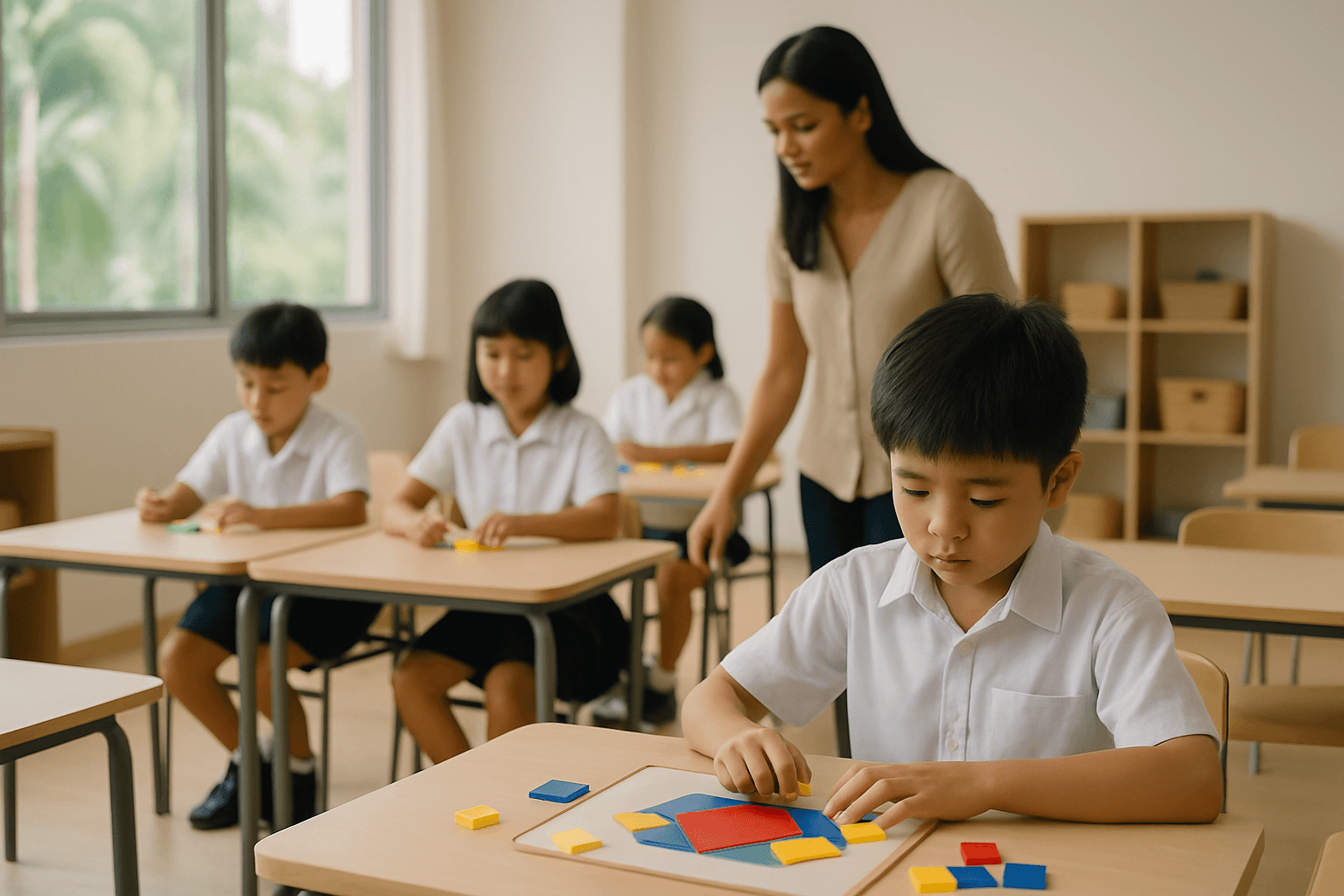
Yes. A child in the High Ability Programme, or HAP, can still remain in mainstream classes.
For most parents, the real question is not whether HAP exists, but how it is run in your child’s school. In practice, HAP is usually an added layer of challenge alongside regular primary school life, not a full-time separate track. That is also why parents often mix it up with the older GEP model. This guide explains what HAP usually looks like, how it differs from GEP, what to ask about workload and timetable, and what it does not guarantee later on.
Quick answer: Can HAP students still join mainstream classes?
Yes. A child in HAP can still stay in mainstream classes because HAP does not automatically mean a full-time separate track.
Yes. HAP does not automatically mean full-time separation from mainstream classes.
The most useful way to think about the High Ability Programme is as added stretch for a child who needs more challenge, not as a separate school identity. A child may still belong to a regular class, follow the usual school routines, and spend most of the day with classmates while receiving extra challenge in certain parts of the timetable.
What changes from school to school is how that stretch is delivered. One school may keep the child in class and give deeper tasks there. Another may run small-group enrichment for selected subjects. Another may occasionally pull pupils out for a higher-level lesson and then send them back to the main class. If you are trying to understand what HAP really means for your child, ask for the weekly arrangement, not just the programme label.
Insight line: the label tells you less than the timetable. For a broader overview, see Gifted Education Programme (GEP) in Singapore: A Parent's Guide.
drop HCL in primary school but choose SAP sec
Thanks for the info. I'm aware of the 'bonus points', but my child's overall results is just so so, by dropping HCL hopefully she will be able to focus more on the 4 core subjects, although i very much wanted her to do HCL..
[Hougang] Primary Schools
HIPS is a SAP school which means compulsory Higher Chinese starts from P1, then in P5, the kid can choose to drop Higher Chinese and do normal Chinese if he/she finds it difficult to manage. At SAP schools, all students must do Higher Chinese and no other mother tongues are available. Some non-SAP schools offer Higher Chinese from p2 (for those good in Chinese). Only diff is that in a SAP school, you get to do Higher Chinese even if your Chinese sucks, while at a non-SAP school, you must do well
What is the High Ability Programme in Singapore primary schools?
HAP is best understood as extra academic stretch for children who need it, not as a status label or a separate school track.
In plain language, HAP is for children who seem to need more academic stretch than the regular classroom usually provides. The point is deeper learning, not prestige.
Parents sometimes hear "high ability" and assume it means a child has been moved into an elite lane. That framing is not very useful. A better way to read it is as support for stronger learners who may benefit from greater depth, more complex thinking, or more independent work. MOE has also been emphasising broader talent development and multiple pathways, as reflected in the 2023 MOE press release and the 2024 MOE Committee of Supply response.
That is why many parents find HAP easier to understand when they stop asking whether it is "better" and start asking whether it is the right amount of stretch for their child. If you want the wider context, our Gifted Education Programme (GEP) in Singapore: A Parent's Guide explains how the older gifted model fits into the bigger picture. For a broader overview, see GEP vs High Ability Programme in Singapore: What’s the Difference?.
Hwa Chong Institution (High School)
1: Yes, in the new system all the special programmers are in Ispark except Bicultural Studies Programme (BSP), which is in Ortus. 2: No, as some kids have other commitments like AEP, MEP etc or they want to focus more on their CCA 3: You will be given priority if you meet all the criteria in Sec 2. For SMTP, this is A1 for Math, Science and English, MSG< 2. However, most people that enter do not meet all the criteria, namely the A1 for English. This just means you will not be the first cut. 4: Y
Hwa Chong Institution (High School)
If I am not wrong if a child who choose sec school with SPGE (currently in most IP and selected sec school eg CHS and SJI) and be put in the same class with primary school GE students means he/she is qualified for GE programme in sec school. Not sure if RI put all primary GE students in one class and at the same time add on with some selected primary mainstream pupils at sec 1? And how did they do it ? base on t-score? Do they have a more \"enriched\" curriculum for those classes? sry ... :offto
Have More Questions?
Get personalized guidance on schools, tuition, enrichment and education pathways with AskVaiser.
Try AskVaiser for Free →How does HAP usually fit into the mainstream school day?
In many schools, mainstream schooling stays central and HAP is added through differentiated work, enrichment sessions, or selected pull-out lessons.
For most families, mainstream school life remains the base. The child still has a form class, regular classmates, assembly, recess, CCA, and the normal rhythm of primary school. HAP is then fitted into that week in a way the school thinks works for its pupils.
A realistic setup might look like this: the child stays with the main class for most lessons but joins a small-group enrichment session once or twice a week for deeper discussion or problem-solving. In another school, the child may stay in the same classroom but receive more open-ended work while classmates do the standard task. In another, a small group may be pulled out for a subject block and then return to class after that. These are common real-world examples, not fixed national rules.
The practical questions parents often overlook are simple but important. If your child leaves class for enrichment, what work is missed? Is it removed, reduced, or expected to be completed later? If the school differentiates within the classroom, will your child be comfortable doing visibly different work from friends nearby? If the pace is faster, how much independent follow-up is expected at home?
A strong question at school briefings is: "For which parts of the week is my child learning with the main class, and for which parts is the work different?" That answer usually tells you more than the HAP label itself. For a broader overview, see Why Singapore Is Moving from GEP to HAP.
HMT in SAP schools
The following SAP schools (O Level stream), higher chinese is not compulsory for lower sec. It's depend on students' interest and results - nan chiau, anglician high, maris stella, chij st nick. Wonder what about nan hua?[/quote]IMO this is more of the difference in definition of protecting the students well-being in learning. The retention of the policy to have an entry test in schools such as Nan Chiau, Anglican High, St Nicks is more to ensure that the students' language standard are taken ca
GEP Student admit to Mainstream Secondary School
Such case is possible. The GEPers can opt to go to 'IP' track and also the 'O' track. These schools offer 'IP' track for GEPers : (1) Anglo-Chinese School (Independent) (2) Dunman High School (3) Raffles Instituition (4) Raffles Girls' School (Secondary) (5) Hwa Chong Institution (6) Nanyang Girls' High School (7) NUS High School of Maths & Science These schools offer 'O' track for GEPers : (1) Anglo-Chinese School (Independent) (2) Catholic High SChool (3) Methodist Girls' School (4) Singapore
How is HAP different from GEP?
GEP and HAP are different. GEP is the older, more visibly separate gifted model, while HAP is usually discussed as more integrated with mainstream schooling.
HAP and GEP are not the same thing, even though parents often use the terms loosely.
GEP is the older model many parents still remember when they think about gifted pupils. It was more visibly associated with selected schools and a more distinct programme identity, which is one reason families still assume that any high-ability programme must remove a child from mainstream life. HAP is better understood as a broader high-ability provision that is usually discussed as more integrated with regular school experience.
This difference matters because it changes what parents should ask. If you are thinking about GEP, you may focus on formal selection stages, designated schools, and a more clearly separate learning environment. If you are thinking about HAP, the better questions are about delivery within the child’s current school, how much timetable separation there is, and whether the child still feels anchored in the regular class.
If you want the fuller comparison, read GEP vs High Ability Programme in Singapore: What’s the Difference?. You can also read Why Singapore Is Moving from GEP to HAP and What Is the Gifted Education Programme in Singapore? for background.
Insight line: GEP is not just "HAP with a different name." The structure parents should expect is different. For a broader overview, see How Do I Know If GEP Is a Good Fit for My Child?.
All About GEP
GEP curriculum covers the same content areas as those in mainstream but is extended in breath and depth. And GEP students will sit for the same PSLE and proceed to IP or O level, just like mainstream students. Sounds quite like IP, where students are exposed to an enriched curriculum but also learn the same syllabus and sit for the same A level exam as mainstream students. Or A level students taking H3 subject with extended contents but only the standard syllabus H2 content results will count to
All About GEP
The top 5 % of the 1st round GEP test goes into the 2nd round Out of those in the second round, about 1/5 will make it to be the selected GEP students, hence the GEP cohort is about 1% of the overall cohort I believe the schools have certain details of performance of the 1%, and the 4% who made the 2nd round but not selected. School will use the data to form the top class and second top class (mainstream). Some GEP schools have started the High Ability class which are formed by these 4% candidat
How are children selected for HAP, and what should parents expect?
Treat HAP selection as school-specific. Ask what evidence was used, how the timetable works, and how the school reviews whether the fit remains right.
There is no single official HAP selection template in the source material provided, so parents should not assume every school uses the same process. The practical next step is to ask how your child’s school identifies pupils who need more stretch.
What we can say safely is that some MOE high-ability and talent programmes do use a combination of portfolio quality and teacher recommendation, as shown on MOE’s page on GEB special programmes. In a primary-school HAP context, schools may also look at classroom performance, teacher observation, work quality, or school-based screening, but parents should treat those as common possibilities rather than guaranteed national rules.
Three questions usually give the clearest picture. Ask what evidence the school used to decide your child needs more challenge. Ask whether HAP means in-class differentiation, separate enrichment sessions, or both. Ask how the school reviews fit over time, especially if the child later finds the pace either too easy or too stressful.
Parents also commonly mix up HAP selection with the older GEP pathway. If what you actually want to understand is GEP testing, GEP Selection Process in Singapore: Stage 1 and Stage 2 Explained is the more useful read.
[Hougang] Primary Schools
Hi surftec25 My friend didn’t want HIPS when I suggested it (she heard negative reviews). She chose to send her kid to Hougang Primary after much research. But if you want a SAP environment then can consider HIPS. HIPS is currently at its holding site at AMK.
[Hougang] Primary Schools
I am so glad to meet you here again. You are right, we live so near. I compared websites for the both school and feel HPS is better. But HIPS focus chinese culture that is what I want. We only have one chance to register for Primary school.?
Does HAP mean a tougher workload or a different curriculum?
HAP usually means greater depth, complexity, or pace. It does not automatically mean a totally different syllabus, but it can still feel more demanding.
Usually, HAP means deeper or more demanding learning, not necessarily a completely different syllabus. The aim is stretch, not simply more worksheets.
In practical terms, parents may notice tasks that are less straightforward and more open-ended. A Maths activity may ask for multiple methods instead of one standard route. An English task may require stronger inference, richer discussion, or more independent reading. A project may involve research, comparison, or explanation rather than simple recall. Some children enjoy this because it feels more interesting. Others find it tiring because the work asks for sustained thinking, not just fast answering.
The better parent question is not only "Will it be harder?" but "What kind of harder is it?" A child who dislikes repetitive practice may actually prefer deeper work. A child who feels secure only when answers are neat and certain may struggle more, even if they are academically capable.
At home, the signs are often subtle. Your child may spend longer on one task, need more planning, or come home mentally tired even without a huge pile of homework. If you want a broader comparison with regular primary school experience, GEP vs Mainstream Primary School: What Is Different? and What Is the GEP Workload Like? can help you picture what "more challenge" often feels like in practice.
Additional Programs for High Ability Kids
Hi, (1) Nope, they use the same textbooks as mainstream HCL (at least for nhps) (2) Oh, I was told. P5 compre questions, for instance 解释短语意思,选短文题目并找出支持答案的理由, are discussed from ~P4 Term 2 onwards (3) Teacher provides a beginning much like a 完成作文,then based on a spin the wheel result, the class continues the story individually, using collaborative google tools. So, if your spin wheel result is an object, you'd read what others have contributed, think of an object, & weave it into the story. (4) N
H1 maths and H2 maths
H1 and H2 have the same depth but H2 has wider breadth than H1. This means that in terms of difficulty H1 is equivalent to H2, but there are more topics covered in H2 than in H1. Quoted from MOE website: An H1 subject is equivalent to half of an H2 subject in terms of curriculum time. However, the intellectual difficulty and rigour of an H1 subject is comparable with the H2 subject.
Is HAP suitable for every strong pupil?
No. Strong academics alone do not make HAP the right fit; readiness, temperament, independence, and social comfort matter too.
No. A child can be academically strong and still not benefit from HAP at a particular stage.
Suitability is about more than marks. A child who likes depth, asks big questions, and enjoys figuring things out independently may thrive with extra stretch. Another child may score very well but become anxious when work is less structured, when answers are not obvious, or when expectations rise. A third child may enjoy challenge academically but dislike being separated from friends, even for short pull-out sessions.
A common parent mistake is to treat HAP as proof of ability rather than as a question of fit. That usually creates pressure. A more useful lens is this: does the programme help my child stay curious and engaged, or does it mostly add stress and self-consciousness? If your child is highly perfectionistic, already overloaded, or unusually upset by comparison, a gentler setup may sometimes be healthier even if they are capable.
If you are unsure whether your child needs a more specialised environment at all, Is My Child Gifted or Just Advanced? and How Do I Know If GEP Is a Good Fit for My Child? are useful next reads. The labels differ, but the fit questions are very similar.
Insight line: fit matters more than label.
GEP Student admit to Mainstream Secondary School
Some just cannot fit into certain school system. Knew of this kid...probably GEP and HCL...went to HCI (think it was still chinese high before the rebranded). Did ok in Yr1...but HCL went downhill from Yr2...affect his other subjects performance too. Left HCI without a proper cert at Yr4 (?) and went to UK to do high school and uni. Last heard he was doing very well, with scholarship etc and double degree.... So sometimes not doing well academically may be just coz cannot fit into certain cultur
Can I don't take HMT in SAP school eg Anglican high?
I wish to enrol my child to Anglican high and just need some confirmation: My child is not takig HMT in primary, so it is true that she need not take HMT in SAP sch? So these school do have normal chinese? Anyone with information about lifestyle in Anglican high might like to share with me. Thanks.
Important nuance: ask about the weekly timetable, not just the HAP label
Do not judge HAP by the label alone. Ask how the school actually runs it from week to week.
A child can be in HAP and still spend most of the day with the mainstream class. Another child in a different school may have noticeably more pull-out time. That is why parents should ask to see the real weekly arrangement, which subjects are affected, how missed work is handled, and whether the child’s main class placement stays central. The programme name alone does not tell you enough.
[Hougang] Primary Schools
Hello , My son is due for P1 registration this July. We are thinking of Hougang Primary school as it is quite nearby. Since your kids have been in the school for quite sometime now, would like to have your opinion about the school. My son had some language delays growing up, but now got a green signal from the doctor that he can join mainstream. We are looking for a school that would respect every child’s differences. Understanding teachers who prefer to explain than scold and shout. Can we find
[Hougang] Primary Schools
[/quote]Hi, thanks for pointing out. Mistake on my part. If your child's PSLE score allows him/her to go other schools, will you still stay on at HISS? Quote you an example. There was a boy who studied in Maris Stella Primary and his PSLE score was high enough for him to move on to Victoria School instead of going to Maris Stella High (Sec). I also know of a girl from PLMGS (Pri) whose PSLE score was high enough to go Dunman High instead of staying on behind in PLMGS(Sec). If the child PSLE scor
How can parents support a child in HAP without adding extra pressure?
Support your child by keeping routines steady, watching for stress, and focusing on whether the challenge feels healthy rather than impressive.
The most helpful support is usually ordinary and consistent. Keep routines stable, protect sleep, and avoid turning HAP into a family status project. Children usually cope better with academic stretch when home still feels calm and predictable.
It also helps to ask better questions. Instead of asking only whether your child is doing well, ask whether the work feels interesting, whether they still feel comfortable in class, and whether the challenge feels manageable or draining. A child who says "It is hard but fun" is in a very different position from a child who says "I am scared to get things wrong." Both may be performing well, but only one is likely to be thriving.
Practical support matters too. If your child misses class for enrichment, help them organise catch-up work without turning evenings into a second school day. If the programme uses projects or open-ended tasks, teach simple planning habits such as starting earlier and breaking work into smaller parts. If friendships seem affected, ask how your child feels socially rather than assuming that being grouped with other strong pupils will automatically solve that.
When parents want ideas for school questions, community resources such as this KiasuParents article on what to ask at a GEP briefing can still help frame the conversation, even though HAP is not the same as GEP. The key is to focus on your child’s actual experience, not on other families’ expectations.
Can child care reject hyper active or dyslexia student?
not sure about CC, but for enrichment centres, they have all the right to remove any kid due to disruption of class - read the enrolment/registration booklet for details. instead of asking for expulsion of special needs kid, maybe you can seek the management’s opinion on how can they ensure that adequate steps are in place to ensure safety of students and that special needs and normal kids can co-exist together. sometimes (not all times, i qualify), some hyper kids need a lot of space, have big
How to coach and support your GEP child?
Dear parents, I may be guilty of being too sanguine. But from my personal experience of the program, I say Chill. When your child qualifies for the GEP, you should know upfront that the variability of his outcome in life is greatly reduced, and in fact skewed towards a positive outcome. The purpose of an education is to prepare our children for life. Rather than getting more worried about how difficult the academic program is, you should worry less about their final outcome. Let me share some em
What happens after primary school for a child who was in HAP?
There is no guaranteed special progression route just because a child was in HAP. Use it as one part of your child’s learning profile, not as a promise of future placement.
Being in HAP does not by itself guarantee a special secondary-school route. Parents should treat it as a primary-school learning arrangement, not as a promise about later placement.
This is another area where confusion with GEP is common. Families sometimes assume that once a child is identified for high-ability support, the child is automatically being channelled into a clearly defined future pathway. The source material here does not support that kind of guarantee. What HAP may do is help a child build stronger thinking habits, confidence with challenge, and clearer evidence of academic strengths. Those can be useful later, but they are not the same as a guaranteed route.
A practical conversation with the school can still help. Ask whether teachers document the child’s strengths in a way that may help with later school choices, whether the school offers any transition guidance, and what type of secondary-school environment may suit your child next. Some children will want a school that continues to stretch them strongly. Others may do better in a more balanced setting where they are not defined by one programme.
The best long-term mindset is simple: choose the next school for fit, not because you think HAP must lead somewhere special. If you are still comparing pathways, our Gifted Education Programme (GEP) in Singapore: A Parent's Guide can help place HAP within the wider picture.
[Hougang] Primary Schools
What about your registration chances? Which school will stand a better chance? I believe places in HIPS will be taken up by phase 2C. Impression that HIPS is a better bet though.
School Placement Exercise for returning S'porean children
Hi ! I think the teacher mentioned that it was based on his overseas school results in grade 5/6. I’m not sure how they judge there . We didn’t have any local school results . We are currently in a local school for immersion cos they consider us as non mainstream students. Apparently non PSLE students are considered non mainstream. Just unsure now if we still have to take the SPERS if DSA is already granted for non mainstream students.
Have More Questions?
Get personalized guidance on schools, tuition, enrichment and education pathways with AskVaiser.
Try AskVaiser for Free →