
GEP vs High Ability Programme in Singapore: What’s the Difference?
A practical parent guide to selection, school life, workload, school placement, and what changes after Primary 6.
GEP and Singapore’s newer higher-ability approach differ in four practical ways: when children are identified, whether support is centred in designated schools or in the child’s own school, how separate the learning environment feels, and how much disruption it creates for family life. Legacy GEP uses a Primary 3 selection exercise and leads selected pupils into a distinct programme from Primary 4. The newer model allows later identification from Primary 4 to 6 and is designed to widen access through school-based support and additional modules. For parents, the key question is not which label sounds better, but which setup gives the child enough challenge without adding avoidable stress.
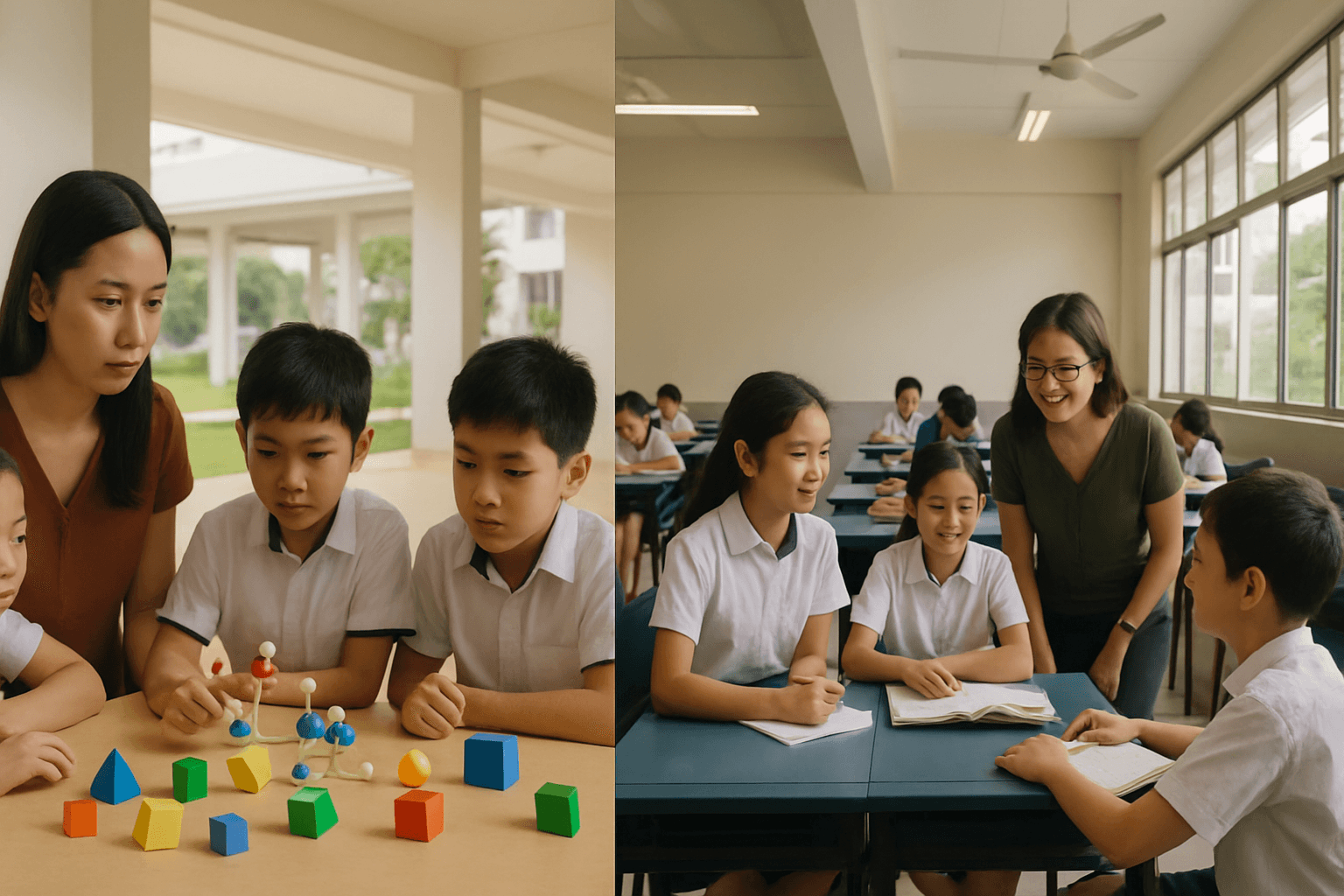
The short answer is no: GEP and the newer higher-ability approach are not the same thing. GEP is Singapore’s older, more centralised gifted primary track. The newer direction is broader and more school-based, with support for higher-ability pupils happening more often in their own schools and through additional modules when needed.
If you hear parents say “HAP”, treat it as shorthand rather than a fixed official MOE label. For most families, the real decision is simpler: does your child need a more separate gifted setting, or can your child be stretched well without changing schools and routines?
What are GEP and the High Ability Programme in Singapore?
GEP is Singapore’s older gifted primary track. The newer higher-ability approach is broader and more school-based, so stronger learners can be stretched without joining one separate programme.
GEP is MOE’s long-running programme for intellectually gifted primary pupils. Under the legacy model that most parents know, children are identified through a Primary 3 exercise and selected pupils join the programme in Primary 4. If you want the older model explained in more detail, our Gifted Education Programme (GEP) in Singapore: A Parent's Guide and What Is the Gifted Education Programme in Singapore? are good starting points.
When parents say High Ability Programme or HAP, they are usually referring to Singapore’s newer direction for supporting stronger learners more broadly. MOE’s official language still centres on gifted education and, more recently, strengthening support for higher-ability learners. In practice, this means the policy is shifting more than the label.
The simplest way to think about it is this: GEP was built as a dedicated lane for a small selected group. The newer approach is built to spot and support more strong learners in more schools, with less need to move a child out of their own school setting.
GEP Preparatory Program
Having checked with parent chatgroups, here is my humble assessment of the TOP 3 GEP Preparatory Program specialists . EduCHAMPS academy https://www.theeduchamps.com/gep-preparation-class-2/ • 2 branches – Novena and Katong. • 6 to 10 students per class • Known for following a patented Advanced Brain Training and 5 ‘A’s Method to bring out the full intellectual potential in students • 100% passed the GEP Screening test (1st round). 68% passed the GEP Selection test (2nd round) and got into the P
GEP Preparatory Program
Good morning Angelight, Gifted Education Programme (GEP) is not a PSLE preparatory program. As stated in MOE’s website that Ministry has recognized that children have varying abilities, it’s not a sound practice to give every child the same education and to expect him/her to move at the same pace as his/her peers. Those intellectually gifted children need high degree of mental stimulation. Normally, intellectually gifted children are very inquisitive, fast learners and with very high level of re
GEP vs HAP: what is the main difference in purpose and structure?
GEP is more centralised and separate. The newer higher-ability approach is more distributed, with support happening in a child’s own school and through extra modules where needed.
The main difference is where the stretch happens. Under the older GEP model, a small selected group enters a dedicated programme with a more distinct learning environment and peer group. Under the newer higher-ability approach, the aim is to support more strong learners through their own schools first, with extra modules or additional stretch when needed.
That changes a child’s daily life. Under legacy GEP, the programme itself is the centre of the experience. Under the newer model, the school remains the centre and the stretch is layered on top of normal school life. A child may keep the same classmates, school routine, and CCA schedule, while still getting richer work or extra learning opportunities.
The real shift is not just the name. It is where and how the stretch happens.
For parents, that changes the decision lens. The question is usually not, “Which label is better?” It is, “Does my child need a more separate environment, or would strong school-based stretch already be enough?” A child who values stability may do well staying put. A child who thrives on constant intellectual pace and a like-minded peer group may benefit more from a distinct setting. For a broader overview, see GEP Selection Process in Singapore: Stage 1 and Stage 2 Explained.
GEP and IQ
To me GEP is about if you have it, you nurture it. There is a certain advantage in putting a child in GEP, if she has what it takes. First, you have more resources in the education system dedicated to educating the child. Second, the academic road is somehow smoother. The GEP label helps somehow. I once asked one of my GEP students to ask her teacher how GEPPers do traditionally in PSLE. She came back with the report that they have had people who got B in PSLE math so far. While most do get A*,
All About GEP
Based on the following criteria: 1. Are you already in that GEP school; 2. Do you already have a sibling in that GEP school; 3. Distance from the GEP school; 4. The type of school the child was from (SAP, mission, or single-gender school) which is similar to the GEP school; The large majority gets their first choice. You yourself have to decide whether HCL is for your child. I think there are some schools that cannot drop HCL. Not sure whether this is still true. All the GEP schools now practice
Have More Questions?
Get personalized guidance on schools, tuition, enrichment and education pathways with AskVaiser.
Try AskVaiser for Free →How does selection work, and how does a child get into GEP or the newer programme?
Legacy GEP uses a two-stage Primary 3 selection exercise. The newer model can identify children later, from Primary 4 to 6, using teacher observations and students’ work as well as formal assessment.
For the current GEP pathway, selection starts in Primary 3 and takes place through a two-stage exercise. Selected pupils then join the programme in Primary 4. If you want the legacy pathway explained step by step, see GEP Selection Process in Singapore: Stage 1 and Stage 2 Explained.
The newer higher-ability approach is broader and less tied to one early entry point. MOE has said it will identify pupils at multiple junctures from Primary 4 to Primary 6, using a more holistic view that includes teachers’ day-to-day observations and students’ work, not only a one-time screening exercise.
In real life, that means different children can be noticed in different ways. One child may stand out because she consistently asks unusual questions and handles abstract ideas well. Another may not shine in a timed test at Primary 3 but later show strong reasoning, originality, or independence in class projects. A third may score very highly but still need more time before a more demanding setting is a good emotional fit.
A common parent mistake is to treat selection like something to game. It is usually more useful to watch how your child responds to difficulty, ambiguity, and independent work than to chase more drilling. A child who only does well when the task is predictable may need a different kind of support from a child who actively leans into hard, messy work. For a broader overview, see How Do I Know If GEP Is a Good Fit for My Child?.
All About GEP
Hi NJmom, Congratulations to your child being selected for the selection test! Which means your dd is among the top 4000 P3 student in Singapore. That's some recognition! So far from what I have found out, the GEP programme are a course designed to cater for a different group of students, for those intellectually gifted kids. Thus, the learning concepts and assumptions are completely different from our main stream. There will be alot of research work and like what fairy has mentioned in her post
GEP 2012 - Screening & Selection
GEP in Singapore is an academic program, from my point of view, is a program that throw the kids into reality much earlier as they needs to do things at high ability, high speed, independently as well as cohesively as a group. I would think a kid with very strong character will be able to survive better than the norm kids nowadays that depends a lot on parents/tutors.
What do children actually experience in school under each programme?
GEP usually feels more separate and intensive, with a selected peer group and more independent work. The newer model is meant to keep more of the child’s school life intact while still adding stretch.
Under legacy GEP, school life usually feels more separate. Children are taught in a selected peer group and often experience faster pacing, more discussion-based learning, more independent thinking, and more open-ended tasks. The difference is not only academic. It is also social and cultural, because teachers can assume a different level of readiness across the class.
Under the newer higher-ability approach, the experience is designed to be more integrated into normal school life. A child may stay in the same school community while receiving stronger in-school stretch and, in some cases, additional modules after school or beyond the school level. That can reduce disruption, but it may also feel less like joining a separate track and more like layered challenge within a familiar setting.
This is where daily reality matters more than the programme name. One child may love the pace and intellectual peer group of a more specialised setup. Another may enjoy the challenge but become drained by a longer commute, later end time, or constant comparison with very strong classmates. A third may do best when stretched in selected pockets while keeping a familiar class routine.
A programme can be academically right and still be practically wrong if the child is exhausted by the routine. When you compare options, ask what the child’s actual week will feel like, not just what the programme is called. For a broader overview, see What If There Is No GEP School Near Our Home?.
All About GEP
I think this is a different program. Ha ha... I find the high ability non-gepers even more kiasu and tensed than the gepers... why har?
All About GEP
Well to me, GEP is a programme to further stretch and nurture the 'higher ability' kids. It is a programme to see how far can these group of students be stretched and of course those kids who are able to cope well will be those that are able to benefit from this programme the most. As at for Primary School Leaving Exam, it is to test how well P6 students have understand the school education syllabus and how well they have prepared for it.. ..nevertheless also the student academic ability..
How do the curriculum and workload compare with mainstream primary school?
GEP and higher-ability work are meant to stretch thinking through more depth and independence. The difference from mainstream is usually complexity and open-endedness, not just more worksheets.
The key point is that GEP is designed as enrichment, not simply acceleration. MOE’s enrichment model makes clear that the programme is not just about doing mainstream content earlier. It keeps the same broad content areas but extends them in breadth and depth.
For parents, that usually means the work feels different rather than just heavier. In English, a child may be asked to consider multiple valid interpretations instead of looking for one model answer. In Math or Science, the child may need to explain patterns, justify reasoning, or design approaches rather than repeat a memorised method. That can be harder for a child who scores well in standard tests but prefers certainty and routine.
Compared with mainstream primary school, GEP or higher-ability work may involve less repetition and more thinking stretch, but that does not automatically mean endless homework. Some children find it energising because the work is more interesting. Others find it tiring because they cannot rely on speed, memorisation, or formulaic answers. If you want a closer look at daily demand, What Is the GEP Workload Like? and GEP vs Mainstream Primary School: What Is Different? are useful next reads.
A practical test is this: do not ask only whether your child can do harder work. Ask whether your child can do less predictable work without shutting down. For a broader overview, see Why Singapore Is Moving from GEP to HAP.
All About GEP
GEP curriculum covers the same content areas as those in mainstream but is extended in breath and depth. And GEP students will sit for the same PSLE and proceed to IP or O level, just like mainstream students. Sounds quite like IP, where students are exposed to an enriched curriculum but also learn the same syllabus and sit for the same A level exam as mainstream students. Or A level students taking H3 subject with extended contents but only the standard syllabus H2 content results will count to
GEP Preparatory Program
GEP curriculum covers the same content areas as those in mainstream but is extended in breath and depth. And GEP students will sit for the same PSLE and proceed to IP or O level, just like mainstream students. Sounds quite like IP, where students are exposed to an enriched curriculum but also learn the same syllabus and sit for the same A level exam as mainstream students. Or A level students taking H3 subject with extended contents but only the standard syllabus H2 content results will count to
Which schools have GEP, and does school placement change the experience?
School placement matters a lot. Legacy GEP has historically been concentrated in designated schools, while the newer model is meant to keep more children in their own schools and reduce the need for a transfer.
Historically, GEP has been concentrated in a small set of designated primary schools rather than across every school. That is one reason the older model could affect family logistics so strongly. If a child’s current school was not part of that setup, the legacy pathway could mean changing schools in order to join the programme.
The newer higher-ability direction is meant to reduce that disruption by developing stronger support across all primary schools, while also offering additional opportunities beyond the child’s home school when needed. Reporting by TODAY helps show how different this is from the older, concentrated model.
For many families, school placement matters as much as programme design. A child who travels much longer every day may sleep less, have less time to unwind, and become less resilient even if the academic fit is good. On the other hand, a child who can stay in a familiar school while still receiving meaningful stretch may sustain the experience better over two or three years.
If you are comparing options, do not ask only which school offers the programme. Ask what the weekly routine will actually look like, whether support is in-school or after school, and how much travel your child can realistically absorb. If this is your main concern, What If There Is No GEP School Near Our Home? is the most relevant next read.
All About GEP
The top 5 % of the 1st round GEP test goes into the 2nd round Out of those in the second round, about 1/5 will make it to be the selected GEP students, hence the GEP cohort is about 1% of the overall cohort I believe the schools have certain details of performance of the 1%, and the 4% who made the 2nd round but not selected. School will use the data to form the top class and second top class (mainstream). Some GEP schools have started the High Ability class which are formed by these 4% candidat
All About GEP
Parents that pay thousands of dollars to try to get their children into GEP: Yes, GEP is a coveted programme. Yes, GEP allows your dd/ds to be able to have a higher chance of getting into an IP school. But bear in mind that the programme is immensely challenging. Your child will have to juggle tonnes of projects and lots of HW and at the same time prepare for the all-important PSLE. And if you PUSH for your child to get into GEP by loads of tuition classes, ask yourself: Will he/she be cope? Wil
What are the advantages of GEP or the newer higher-ability approach, and what are the trade-offs?
The benefits are deeper learning, stronger stretch, and sometimes better peer fit. The trade-offs are pressure, logistics, and the possibility that a bright child still may not enjoy that environment.
The main advantage is better intellectual fit for some children. A child who is regularly under-stretched in a standard classroom may benefit from deeper discussion, more complex work, and peers who think at a similar pace. For the right child, challenge can reduce boredom and increase motivation.
The trade-offs are real. More stretch can mean more pressure, more self-management, and less comfort with routine answers. If the programme requires a school transfer or longer travel, family life can also become more tiring. Some children enjoy the challenge but dislike the constant comparison with equally strong classmates. Others look ideal on paper but actually prefer a broader, less intense school experience.
Parents often over-focus on the upside and under-estimate the fit question. Being selected does not prove the environment will suit the child, and not joining does not block a child from doing well later. A good fit usually looks like healthy stretch: the child works hard but stays curious, recovers after a difficult week, and still has room for normal life. A poor fit often shows up as dread, perfectionism, or constant exhaustion.
If you are weighing this seriously, How Do I Know If GEP Is a Good Fit for My Child? and Is GEP Better Than Mainstream Primary School? are the best follow-ups.
The simplest insight is this: the best programme is not the most impressive one. It is the one your child can grow in without being depleted by it.
Is GEP really necessary?
Is GEP really necessary? If it’s designed to cater to kids with special needs, yes. If the intention is to groom leaders or specialists in a developing country to raise the quality of the human resource, yes. But Singapore has progressed beyond this need. Unfortunately, the GEP is used as a guaranteed passport to an elite education. This is the grand prize that pushes all parents to overdrive. So much is invested in so few, and these few are given the best tools and resources. And at the end of
All About GEP
Personally I think if your child qualify for GEP, then why not? I am skeptical about the effectiveness of the prep program for GEP but let’s say your child qualify for GEP without any prep program, the more you should let he or she undergo the GEP program. My reason is simple and straightforward. I think the ability and potential of each child is different. That is why not everyone can achieve the same results in any given examination. Some will score better than the rest no matter how. The GEP
What should parents do if their child is selected, or seems high-ability but is not selected?
Support the child, not the label. Whether selected or not, focus on fit, wellbeing, and how your child handles challenge rather than chasing status.
Start with the child’s needs, not the label. If your child is selected, try to understand the actual school week before getting carried away by the offer. Parents commonly find it useful to ask about the style of work, how much independent learning is expected, whether support exists if the child struggles, and what the routine means for sleep, travel, and family time. Those questions are not about doubting the programme. They are about checking fit.
If your child is not selected, do not turn that result into a verdict on intelligence. A child can be very able and still not be identified through one pathway or at one age. In the newer model especially, later identification and school-based stretch matter more than many parents realise.
What you can do next is watch for patterns. Does your child ask unusually probing questions, get bored by repetitive work, enjoy solving problems alone, or become anxious when work is less structured? A practical conversation with teachers often helps more than speculation at home. Useful questions include whether your child seeks challenge or avoids it, whether boredom shows up as laziness or misbehaviour, and whether the child can recover after making mistakes.
If you are unsure whether you are seeing giftedness, high performance, or simply early advancement, Is My Child Gifted or Just Advanced? can help you think about it more clearly.
Your job is not to manufacture a gifted profile. It is to notice the kind of environment in which your child learns best and stays well.
All About GEP
Hi Atan, First and foremost, you need to understand what the gep programme involves. If, after you have found this out, you think your child is cut out for it, can benefit from it and will thrive in it, you can next ask yourself whether you want to leave it to effectiveness of the testing or \"help\" your child along in getting selected. Having said this, please remember that we live in an imperfect world where testing is not 100% accurate. If you do not know what the programme entails, my sugge
All About GEP Schools
I feel that the GEP system does not necessarily benefit children with a higher IQ. The most successful people career wise don't seem to be GEPers. This holds true whether you consider successful in terms of who earns the most money, are at the top of their field, or have achieved the most scientific breakthroughs etc. I have lived overseas for some time and in some countries, the \"gifted\" are simply allowed to skip levels and attend higher levels. Sometimes if they are good in a certain field,
What happens after Primary 6, and does GEP affect secondary school placement?
Treat GEP or the newer higher-ability pathway as support during primary school, not as a guaranteed route to a particular secondary outcome. The lasting gains are usually habits, confidence, and subject interest.
The safest way to think about this is that GEP and the newer higher-ability pathway are primary-level support models, not permanent labels. Official updates focus on how primary pupils are identified and supported; they do not frame these programmes as a guaranteed special route after Primary 6.
That means parents should be careful not to treat participation as a long-term badge or a shortcut to future outcomes. What often carries forward more usefully is not the label but the learning habit. A child may leave primary school more comfortable with open-ended questions, more confident handling difficult work, or more deeply interested in particular subjects. Those are real benefits, but they are not the same as a guaranteed secondary advantage.
In practical terms, it helps to ask a different question. Instead of asking, “Will this programme open doors later?” ask, “Will this experience help my child become more curious, resilient, and ready for future challenge?” That is a better decision lens than trying to use primary gifted education as a status marker.
If you want the policy context behind this shift, Why Singapore Is Moving from GEP to HAP is the most useful next read.
All About GEP
GEP Status in Secondary Levels 1.What happens after the primary GEP? After Primary 6, retention of the GEP status and promotion to the next level of gifted education is based on: ■performance in the GEP from Primary 4 to 6, including a pass in Social Studies ■attitude towards work and the enrichment programme ■performance at the PSLE 2.What percentage of the Primary 6 GEP pupils meets the criteria for retaining the GEP status? Each year approximately 99% of the pupils meet the criteria. For more
GEP Preparatory Program
What are the advantages of being a GEP student? Will children be able to have a direct school admission? If the syllabus is the same and they all need to do well in PSLE to obtain a place in a good secondary school.
Does not getting into GEP mean my child is not gifted?
No. A child can be very able without being selected through one pathway, and one screening result does not define your child’s potential.
No. Not every high-ability child is identified at the same age or through the same format, and giftedness is not the same as always being the best exam scorer.
Some children are strongest in reasoning, curiosity, or unusual patterns of thinking rather than in every test format. A child can be very able and still look uneven on paper. That is one reason non-selection should not be treated as proof that a child is ordinary.
It also helps to separate high ability from high polish. Some children perform brilliantly in structured tests because they are well prepared and confident with familiar formats. Others show more originality or depth once work becomes less scripted. The newer higher-ability approach matters here because it allows schools to look at teacher observations and students’ work over time, not only one screening point.
The better question is not, “Did my child get the label?” It is, “What kind of challenge helps my child learn more deeply without losing confidence?”
GEP 2012 - Screening & Selection
GEP and PSLE (or exams) are two totally different things. A kid can score well in exams if you just let him/her do thousands of assessment books. In Singapore, paper qualifications are good. That is why many people will go down this route and there is nothing wrong with it. Doing well in exams is important for all students in Singapore, be it in primary or in university. However, to be gifted is something different. You cannot simply force someone to be gifted. Which is why the GEP screening tes
GEP 2012 - Screening & Selection
Hello Parents, may be u like to ask yourself this question, \"Why GEP?\" Is it really prestigious to hv kids in GEP? I hv a P5 gepper at home, I certainly do not feel any prestige. Infact, I feel she is no different from any other 11 year old. Do geppers enjoy any special privilege? Other than the small class size and a more enriched & challenging curriculum, I really do not see any other differences between GEP & mainstream. The curriculum is designed for the so called \"Intellectually Gifted\"
Have More Questions?
Get personalized guidance on schools, tuition, enrichment and education pathways with AskVaiser.
Try AskVaiser for Free →