
Is GEP Better Than Mainstream Primary School in Singapore?
A practical comparison of pace, depth, peer group, workload, and child fit.
GEP is only better when it matches the child. Children who are consistently under-challenged and enjoy harder, less repetitive work may do better in GEP, while children who thrive with steadier pacing, clearer structure, and a broader social mix may do better in mainstream primary school.
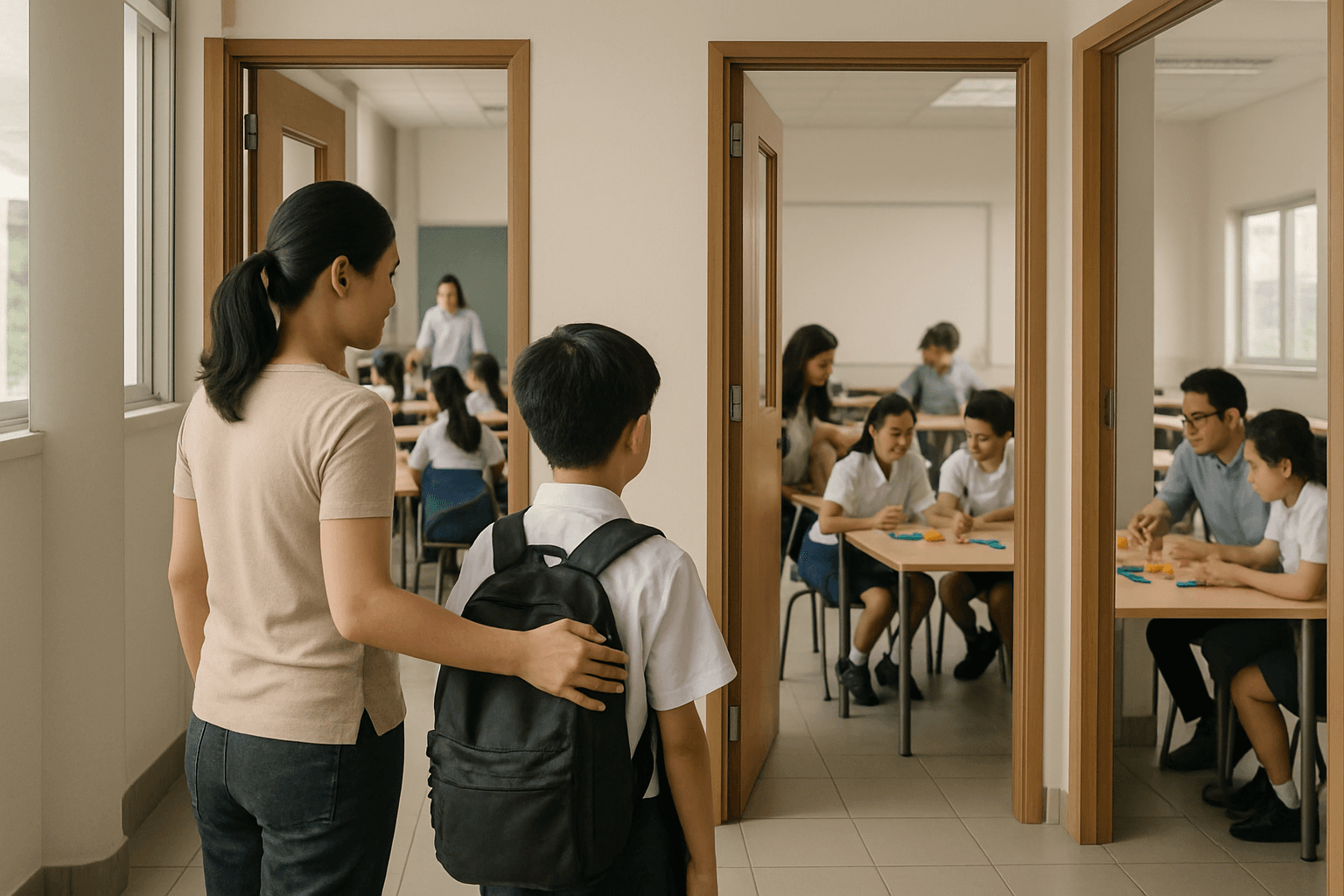
No, GEP is not automatically better than mainstream primary school. It is a more selective learning environment that can suit children who need faster pace, deeper work, and more independent thinking. For other children, mainstream offers the better balance of structure, breadth, and wellbeing. This guide compares both routes in plain English so you can judge fit, not status.
What is GEP, in plain English?
GEP is a programme for children who need more challenge than a typical mainstream primary class usually offers.
In plain English, GEP is for a smaller group of primary school children who are ready for more challenge than a typical mainstream class usually provides. It is generally associated with faster pace, deeper thinking, less repetition, and work that expects more independence. That does not make it a better version of school for every child. It means it is designed for a different learning need.
This is the first thing many parents misunderstand. GEP is not a "better child" label. A child can be bright, capable, and thriving in mainstream school without needing GEP. If you want the broader context, start with our main guide to the Gifted Education Programme in Singapore or our explainer on what GEP is. The right mental model is simple: think pace and depth, not prestige.
All About GEP
As what discussed in the thread, more than once, GEP does not garantee success in life and PSLE, it is just another programme in school, you may call it enriched or advanced.
All About GEP
I don’t see how good GEP is. Mainstream pupils perform almost the same as GEP pupils.
Is GEP better than mainstream primary school?
No. GEP is not automatically better; it is only better when it matches the child's learning needs and temperament.
No, not automatically. GEP is better only when the child genuinely needs and enjoys a faster, deeper, and more demanding learning environment. For many children, mainstream primary school is the better place to learn well and stay balanced.
A practical way to compare the two is to ask what your child needs in order to stay engaged. Some children are repeatedly under-challenged, finish routine work quickly, and come alive when tasks are difficult and open-ended. For them, GEP may feel relieving rather than stressful. Other children do well with a steadier pace, clearer teacher scaffolding, and the social mix of a regular class. Those children are not getting a lesser education. They may simply be in the environment that suits them better.
Parents often make one common mistake here: they treat selectivity as proof of superiority. That is not a safe assumption. Primary school decisions work better when you ask, "Where will my child learn best day to day?" rather than, "Which label sounds stronger?" If you are comparing options beyond the old stream language, the useful question is GEP versus mainstream primary school, not just "GEP vs normal stream.". For a broader overview, see How Do I Know If GEP Is a Good Fit for My Child?.
All About GEP
I don't see the GEP programme as \"die-die must accept\" if selected. If the child thinks he will be happier in mainstream, studying at the pace he's used to, why not? He'll probably top mainstream and that might boost his ego and confidence far more than if he were but one of a few hundred similarly very bright students. He'll eventually end up in a good IP secondary school too. That said, GEP is a very good programme for the ones who are suited to it and more importantly, those who display a p
All About GEP
GEP Status in Secondary Levels 1.What happens after the primary GEP? After Primary 6, retention of the GEP status and promotion to the next level of gifted education is based on: ■performance in the GEP from Primary 4 to 6, including a pass in Social Studies ■attitude towards work and the enrichment programme ■performance at the PSLE 2.What percentage of the Primary 6 GEP pupils meets the criteria for retaining the GEP status? Each year approximately 99% of the pupils meet the criteria. For more
Have More Questions?
Get personalized guidance on schools, tuition, enrichment and education pathways with AskVaiser.
Try AskVaiser for Free →How is GEP different from mainstream primary school in pace, depth, and workload?
GEP usually moves faster, goes deeper, and asks for more independent thinking than a typical mainstream class.
In broad terms, GEP usually moves faster, goes deeper into ideas, and expects more independent thinking than a mainstream class. A mainstream class often spends more time on consolidation, practice, and making sure the whole class is secure before moving on. A GEP-style classroom is more likely to reduce repetition and spend more time on complex questions, discussion, and non-routine tasks.
For parents, the most useful distinction is this: the workload difference is often about cognitive demand, not just quantity. It is not only "more homework." It is work that may be harder to start, harder to explain, and less predictable. A child may be asked to compare ideas, interpret texts more deeply, solve unfamiliar problems, or justify an answer instead of just giving it.
That matters because children react differently to this kind of demand. One child may love the challenge of a problem with no obvious first step. Another may be academically strong but feel drained when there is less structure and fewer clear methods to follow. If your child likes difficult puzzles, reads beyond the worksheet, or keeps thinking about a problem after class, the extra depth may be energising. If your child prefers step-by-step guidance and reassurance, the same environment can feel tiring. If workload is your main concern, our guide on what the GEP workload is like goes into more detail. A useful shorthand is this: GEP often replaces repetition with complexity. For a broader overview, see GEP Selection Process in Singapore: Stage 1 and Stage 2 Explained.
All About GEP
Juz to clear my doubts... If GEP syllabus are set at a higher standard compared to mainstream, then can we assume that, whatever topics (whether Math, Science, Chinese etc) that r covered in mainstream, will also be covered in Gep, the difference is they r taught more in depth wif some additional topics that mainstream do not cover. Eg. For math, some topics r secondary level (shared by some parents here), same for English(sec std), then Geppers shd find PSLE easier, or score reasonably well rig
All About GEP
GEP curriculum covers the same content areas as those in mainstream but is extended in breath and depth. And GEP students will sit for the same PSLE and proceed to IP or O level, just like mainstream students. Sounds quite like IP, where students are exposed to an enriched curriculum but also learn the same syllabus and sit for the same A level exam as mainstream students. Or A level students taking H3 subject with extended contents but only the standard syllabus H2 content results will count to
What is the peer group like in GEP compared with mainstream classes?
GEP usually offers a more academically similar peer group, which can help some children feel more understood and challenged.
The peer group in GEP is usually more academically similar, and that can change the classroom experience a lot. In a mainstream class, a strong learner may often finish first, answer quickly, or feel that the lesson pace is slow. In a more selective group, that same child may finally meet classmates who think just as quickly, ask unusual questions, and challenge each other's ideas.
For some children, this is one of the biggest benefits. They become more talkative, more willing to debate, and more engaged because they no longer feel like the odd one out. Parents sometimes notice that a child who seemed bored or quiet in a regular class becomes far more animated in a group of intellectual peers.
There is a tradeoff. Comparison pressure can rise. A child who was used to being "the top one" may suddenly feel average, and not every child handles that shift well. Some become healthier and more humble. Others become anxious or discouraged. That is why the better parent question is not simply, "Will the peer group be stronger?" It is, "Will my child feel stretched in a healthy way, or unsettled in a way that affects confidence?". For a broader overview, see What Is the GEP Workload Like?.
All About GEP
I think that if she is keen then she should try. If she does not like it, can transfer back to mainstream. Heard that a GEP kid in DS school did transfer back to P5 mainstream early this year. For DS, it has been a difficult though enriching journey. In P4, he failed a test for a particular subject (which was alarming) and was not doing as well in another subject. We ended up enrolling him for enrichment classes, something that we might not have done if he had remained in mainstream. Fortunately
All About GEP
Hi. When dd was offered GEP, I was not for joining. My (weird ? lazy?) thinking was if she stays in mainstream she'd probably be able to breeze through & hv a stressless childhood (except for chinese, she does not attend any enrichment -- really lots of time to play). But dd decided to join GEP after some careful deliberation. What surprises me is how relaxed dd is this yr. She is aware that she is not likely to top the std like last time and is perfectly fine with it. Though her math is no wher
How does GEP selection work, and how hard is it to get in?
GEP is selective and meant for a small group of children, but parents should focus on fit rather than admission as a status goal.
At a high level, GEP selection is meant to identify a small group of children who show strong readiness for advanced work. It is selective, but parents should resist turning that into a prestige race. The more useful question is not "How do I maximise my child's chances?" but "Does my child actually thrive in this kind of environment?"
Because current details can change, avoid relying on old forum summaries or parent-memory versions of the process. If you want an official starting point, check MOE's FAQ, and for a parent-friendly overview, see our guide to the GEP selection process. If your school runs a briefing, questions about how your child handles open-ended work, difficult questions, and teacher observation can be more useful than asking only about admission odds.
In real life, children who seem more suited to GEP are often the ones who enjoy difficult questions, spot patterns quickly, stay curious even when work is hard, and do not need constant prompting to think further. For example, one child may happily wrestle with an unfamiliar problem for twenty minutes. Another may score well on standard tests but dislike ambiguity and shut down when there is no clear method. Those are different profiles, and parents should treat them differently. For a broader overview, see GEP vs High Ability Programme in Singapore: What’s the Difference?.
All About GEP
From what i understand from the briefing, Gep is not the stepping stone for DSA nor a ticket to post Gep classes. If the child qualifies for IP school (via DSA or PSLE scores), the child would hve to compete for post GEP secondary places with all mainstream students on its merit. Selection criteria via various IP schools differ. I believe that if Gep students can get through IP school n meet 70% benchmark during primary Gep, the IP schools would very likely to give them a place. Having said that
All About GEP
Parents that pay thousands of dollars to try to get their children into GEP: Yes, GEP is a coveted programme. Yes, GEP allows your dd/ds to be able to have a higher chance of getting into an IP school. But bear in mind that the programme is immensely challenging. Your child will have to juggle tonnes of projects and lots of HW and at the same time prepare for the all-important PSLE. And if you PUSH for your child to get into GEP by loads of tuition classes, ask yourself: Will he/she be cope? Wil
What is the difference between GEP and the High Ability Programme?
They are not the same. GEP is the older selective programme, while high-ability support is moving toward a broader school-based model.
Parents should not treat GEP and the High Ability Programme as interchangeable. In simple terms, GEP is the older selective model that many parents still recognise, while the broader direction for high-ability support appears to be moving toward more school-based provision. That means one old label is no longer the only lens parents should use.
This matters in practice because some parents still speak as though there is only one recognised route for a highly able child. Current policy signals suggest the picture is broader than that. MOE's 2021 announcement and 2024 update are useful for understanding that direction.
The practical takeaway is straightforward: ask what support for advanced learners a school actually provides now, not just whether it carries a label you recognise from older discussions. For more detail, read our comparison of GEP vs High Ability Programme and our explanation of why Singapore is moving from GEP to HAP.
GEP Preparatory Program
GEP curriculum covers the same content areas as those in mainstream but is extended in breath and depth. And GEP students will sit for the same PSLE and proceed to IP or O level, just like mainstream students. Sounds quite like IP, where students are exposed to an enriched curriculum but also learn the same syllabus and sit for the same A level exam as mainstream students. Or A level students taking H3 subject with extended contents but only the standard syllabus H2 content results will count to
All About GEP
The top 5 % of the 1st round GEP test goes into the 2nd round Out of those in the second round, about 1/5 will make it to be the selected GEP students, hence the GEP cohort is about 1% of the overall cohort I believe the schools have certain details of performance of the 1%, and the 4% who made the 2nd round but not selected. School will use the data to form the top class and second top class (mainstream). Some GEP schools have started the High Ability class which are formed by these 4% candidat
What are the main advantages of GEP, and which schools offer it?
The main advantages are faster pace, deeper learning, and a better chance of meeting similarly strong learners; school names matter less than the actual learning environment.
The real advantages of GEP are usually faster pace, deeper work, and a stronger chance of finding intellectual peers. For a child who is consistently under-challenged, that can mean less boredom and more meaningful engagement. Some children do not need "more work" so much as work that is less repetitive and more interesting. In that situation, GEP can be a good fit.
Parents often assume the biggest advantage is prestige. It usually is not. The more valuable benefit is that school may finally match how the child learns. A child who keeps asking unusual questions, enjoys non-routine problems, or gets restless after mastering standard work may feel more settled in a classroom that expects more from them.
On the school question, be careful with older fixed lists repeated online. Many parents still refer to the historical GEP schools, but the safer approach now is to verify current provision directly through school briefings, open houses, and current MOE information rather than rely on old posts. If you are comparing schools, ask what advanced learners actually experience during normal lesson time, not just what the brochure headline says. Useful prompts include whether students get open-ended work, how teachers stretch fast learners, and what happens when a child is strong in one subject but not all. This primary school open house guide can help you prepare better questions. If there is no traditional GEP school near you, our guide on what to do if there is no GEP school near home may help you compare realistic alternatives.
All About GEP
1. more challenging curriculum 2. smaller class size If your child is grossly underchallenged in mainstream, GEP would be good for him
Is GEP really necessary?
These are not inconsequential privileges. The privileges of smaller class size, better teachers and resources have more impact than that of DSA access. Given the same quality of teaching, many non-GEP students would make it into IP schools just by PSLE t-score. This is why some GEP schools spill the GEP resources over to the top 2 classes in mainstream. In the past, drilling was important and GEP curriculum held no advantage at PSLE. At present, with inquiry-based learning and out of textbook le
Who is GEP suitable for, and how can parents support the decision?
GEP usually suits children who are consistently ahead, curious, and comfortable with hard, open-ended work; mainstream may suit children who need more routine, balance, or a broader social mix.
GEP tends to suit children who are not just academically ahead, but also genuinely curious, comfortable with challenge, and able to work with less hand-holding. A stronger fit often looks like a child who asks unusual questions, enjoys difficult puzzles, keeps thinking after others stop, and does not mind that the answer is not obvious right away.
A weaker fit can look different. Some children get high marks mainly through practice, routine, and clear structure. They may still be very capable, but tire quickly when work becomes open-ended or feel unsettled when they are no longer the strongest in the room. That does not make them less able. It means the learning environment may matter more than the label.
Parents can support the decision by observing the child's response to challenge in daily life. When something is genuinely hard, does your child light up or avoid it? Do they enjoy thinking deeply, or mainly enjoy being right quickly? Ask teachers for specific observations rather than broad praise. One useful question is, "When my child finishes routine work early, what do they do next?" Another is, "How do they respond when there is no obvious method?"
Also remember that mainstream plus appropriate stretch can already be enough for some children. If your child is learning well, emotionally steady, and still getting meaningful challenge through school or carefully chosen enrichment, that may already be a good answer. If you want to think through fit more carefully, read How Do I Know If GEP Is a Good Fit for My Child? and Is My Child Gifted or Just Advanced?.
All About GEP
Hi all, I’ve been reading up on GEP lately but ultimately quite new at this. Suppose a P2 child is in an academically-inclined, CCA-weak neighbourhood school (one of the more popular and consistently oversubscribed ones) but unfortunately his/her personality suits better in a school that are both academic (child loves learning and has been getting good feedback from teacher) and strong in CCA particularly in sports (as the child loves sports and has been doing 4 types of sports since young with
All About GEP
I read many interesting concerns on the GEP ... Let me share some of my thoughts on these ... Why force your kids to a GEP if she /he is meant for it. Don't believe those crap training centre ..Let nature take it course My daughter is in P6 GEP at RGPS and had just completed her PSLE like all other 50K kids in her cohort. She is now enjoying herself with her fellow P6 GEP at the Sentosa UnderWater World. She was posted to RGPS from CHIJ Pri (Toa Payoh) in 2008. As a child , she was always more s
What myths do parents often get wrong about GEP?
The biggest myth is that GEP automatically means a better child, a better school experience, or a better future.
The biggest myth is that GEP automatically means better child, better school, or better future. It does not. GEP is not a trophy, not proof that a child will succeed later, and not the right destination for every strong student. Another common mistake is to assume that high marks alone mean a child will enjoy a faster, deeper, more competitive environment. Some do. Some do not. A child can be very capable and still be better off in mainstream school. Better fit beats better label.
Is GEP really necessary?
Just an observation on my part and from my SIL who is a very senior teacher in an elite secondary school in Singapore. GEPers are more then willing to mix with their mainstream school mates given the opportunity. The problem, which becomes more pronounced in secondary school when the segregation slowly disappear and they are in the same class are: 1. Mainstream students ostracize the GEPers and do not want to mix with them. Calling them wierd or names. I was really surprise when SIL told me this
Is GEP really necessary?
Is GEP really necessary? If it’s designed to cater to kids with special needs, yes. If the intention is to groom leaders or specialists in a developing country to raise the quality of the human resource, yes. But Singapore has progressed beyond this need. Unfortunately, the GEP is used as a guaranteed passport to an elite education. This is the grand prize that pushes all parents to overdrive. So much is invested in so few, and these few are given the best tools and resources. And at the end of
What happens after Primary 6 if my child is in GEP?
GEP does not guarantee a particular secondary school outcome or future success. It is one part of the child's learning journey, not the final result.
After Primary 6, GEP should be seen as one part of your child's story, not a guarantee about the next chapter. It does not lock in one outcome, and parents should be careful not to treat it as a prediction of later success. Secondary school options still depend on a wider mix of factors, including the child's academic profile, interests, school choices, and how they have developed over time.
Some children who thrive in GEP continue to prefer demanding academic environments. Others move into a range of secondary pathways and do well there too. The practical point is that GEP is not a lifelong sorting label. It is simply one primary school experience.
This is also why it helps not to think in older stream terms. Singapore's secondary landscape is broader and more flexible under Full Subject-Based Banding, and MOE's overview of the secondary school experience under Full SBB shows why parents should avoid assuming that one primary label secures everything later. The better approach is to choose the primary environment that fits your child now, rather than one you hope will guarantee a future result.
All About GEP
To add on to my earlier reply, what is the end goal of a primary school education? If it is a high PSLE score that you’re looking for, then mainstream education might better prepare a child for it. I find that the end goal of GEP isn’t the student’s PSLE score. It’s the process of learning, the journey, the exploration into out-of-syllabus work, the freedom to express and question, to conduct independent research… Most definitely a lot of this isn’t immediately relevant to PSLE, but it is intere
All About GEP
Thanks for sharing all your thoughts, analysis of the GEP.. Before the GEP briefing, we were 50-50 on letting our DS into the GEP (he of course is stubborn about staying on in his current school) After the GEP briefing, we decided to let our DS stay in the mainstream school and not entering the GEP program. Reason are several : 1) There are not many successful GEP cases showcased (apart from interviews of ex GEP students who are now in the profession of prosecutor and another one as director in
Have More Questions?
Get personalized guidance on schools, tuition, enrichment and education pathways with AskVaiser.
Try AskVaiser for Free →