
Do Certificates and Awards Help in DSA?
What DSA awards actually show, what schools care about more, and how to present a focused portfolio
Yes. In DSA, certificates and awards are most useful when they support a clear case for talent in the relevant area. Schools also look at training history, auditions or trials, interviews, school results, and teacher or coach feedback, so awards strengthen an application rather than decide it on their own.
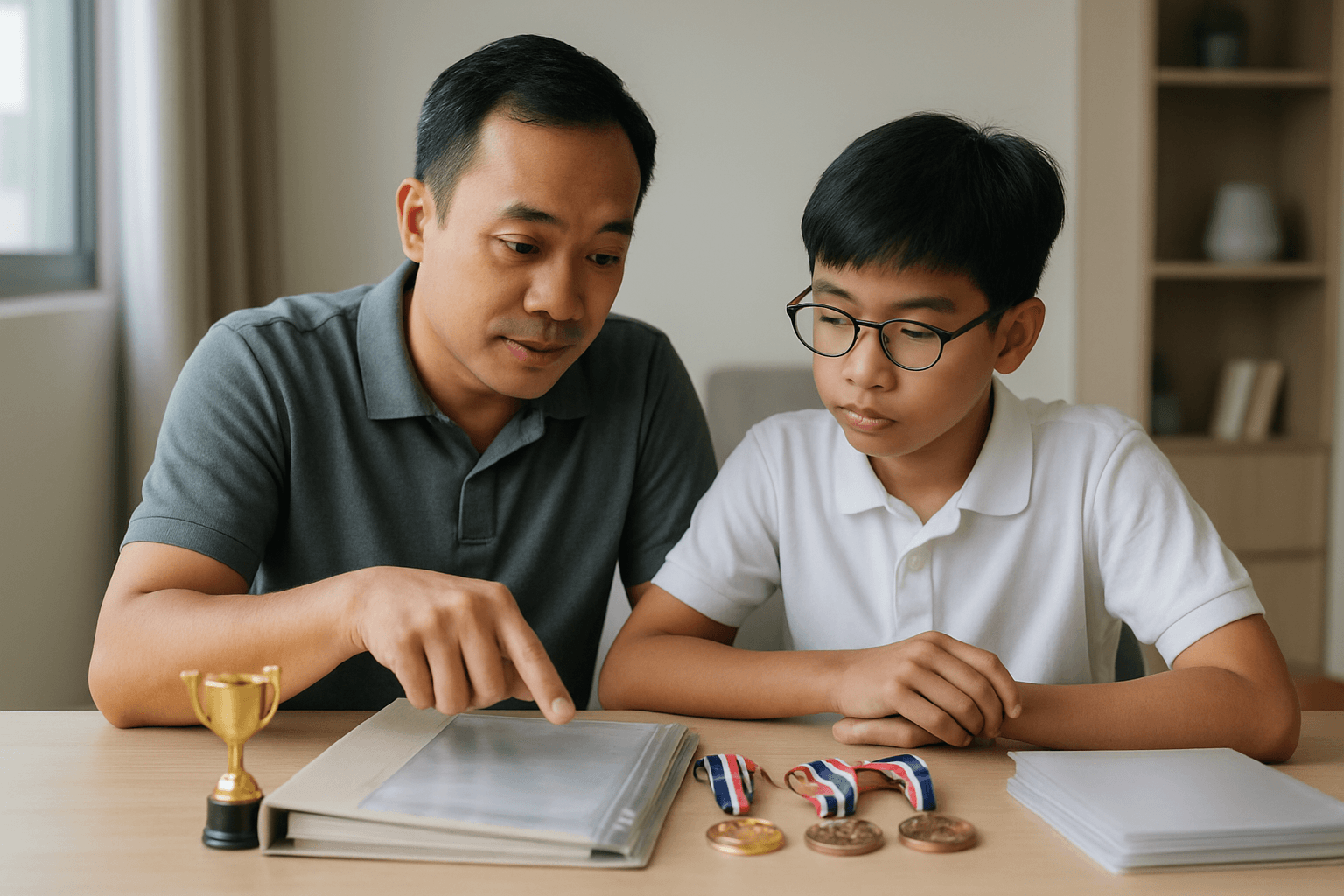
Certificates and awards can help in DSA, especially when they match the exact talent area your child is applying under. But schools usually look at more than trophies. In practice, DSA is about aptitude, commitment, current ability, and fit with the programme, not just collecting accolades. If you are new to the process, start with our broader guide to Direct School Admission Singapore.
Do certificates and awards help in DSA, or are they just a bonus?
Yes. Awards can strengthen a DSA application, but they usually support the case rather than make it on their own.
They do help, but mainly as supporting evidence. MOE says DSA-Sec looks at interests, aptitude and potential beyond PSLE results, so a certificate can strengthen a case when it clearly relates to the talent area. But schools do not choose students based on trophies alone. They may also look at school results, interviews, trials, auditions, and other evidence of current ability and fit, as noted in MOE’s DSA FAQ. The simplest way to think about it is this: a certificate proves something happened; it does not fully show how well the child performs now or how ready they are for the school’s programme. For a broader overview, see Direct School Admission Singapore: A Practical Parent Guide.
Should DSA be scrapped?
I think it is a matter of: 1. How much you really want to enter that institution? 2. How much you like that CCA in order to perform well all the time? If you really want something, you will make it happen for yourself despite all trials along the way. If you are really good in the CCA, it should be a breeze to be contributing. If you cannot answer the above 2 questions sufficiently to convince yourself, do not DSA, it means commitment and this requires one to put in great responsibilities.
Should DSA be scrapped?
Ykiasu.. What makes you think that DSA does not involve hardwork? Have you or your DS/DD been through DSA before?[/quote]DSA is just a different acceptance into the school. For PSLE, you study hard and you do well in your academic performance. But some pupils may not do well in exams but excel in competitions, Olympiads, Sports, Aesthetics, which DSA provides as a platform to enter the school. Plus, to go through DSA is not an easy process, you have to sort out the necessary certs etc. and prepa
Which DSA awards and certificates are most useful?
The best DSA certificates are closely tied to the talent track and show level, progress, or sustained performance.
The most useful certificates are the ones that match the exact DSA talent area and show depth. For example, a graded music result, a clear competition ranking, or a performance record is usually more useful for a music or performing arts application than an unrelated enrichment certificate. For sports, school team selection, competition results, or evidence of playing at a stronger level usually says more than a generic participation award. Parents should look for documents that show level, progression, repeated recognition, or sustained involvement. A slim portfolio with a few strong, relevant items is often better than a thick file of mixed achievements. In DSA, relevance usually beats quantity. If you are still working out whether your child’s strength fits a recognised route, our guide on what talents count for DSA eligibility can help.
Re: DSA 2025
Improving school-based talent programs, collaborating with community centers to provide reasonably priced training, and emphasizing assessments on potential rather than polished abilities are some ways to make DSA more accessible. https://www.straitstimes.com/singapore/direct-school-admission-must-be-accessible-to-all-students-chan-chun-sing bitlife @trulyarise said in Re: DSA 2025 :
All about DSA into Junior Colleges
bbbay, your Upper Sec son/daughter can always try DSA into RI/Hwa Chong. No try, no gain. Whether can get in or not, will depend on how competitive his (her) batch is, in terms of the quality of other competitors inside the same age group, from the same batch, and for the same domain that your son/daughter is applying for.
Have More Questions?
Get personalized guidance on schools, tuition, enrichment and education pathways with AskVaiser.
Try AskVaiser for Free →What do schools usually look for besides awards?
Schools usually assess aptitude, commitment, current ability, and fit with the programme, not just paper achievements.
Schools usually look for the child as a whole, not just the certificates. That can include academic readiness, interview performance, auditions or trials where relevant, training history, teacher or coach feedback, and whether the child can cope with both the school’s academic demands and the talent commitment. This is why some children with fewer awards still look strong: their application shows steady training, good support from a coach, and a convincing match with the programme. A common misunderstanding is thinking schools only ask, “What has this child won before?” They are also asking, “Can this child keep up, contribute, and grow in our setting?” In areas with trials or auditions, current performance can matter more than an older award because it shows the child’s present standard. If you want the academic side explained more clearly, read Do You Need Top Grades for DSA in Singapore? and What Happens During a DSA Interview in Singapore?.
2009 DSA(Direct School Admission)
teachers testimonial and CCA teacher's testimonial. must prepare copies of past years' school results also. For art, can put in your art pieces in the portfolio. For writing, if you have published any books. articles, you can also put that in.
2009 DSA(Direct School Admission)
You can apply for DSA via Academic or Sports domains. Obviously, if you apply under Academic, they would need to see your performance and certificates in order to gauge your ability. Students who apply under Sports DSA are asked very different questions.
Can a child still get DSA without many awards?
Yes. A child with few awards can still be competitive if the rest of the evidence clearly shows talent, consistency, and commitment.
Yes. A child can still be competitive if there is other strong evidence of aptitude and commitment. One child may have trained seriously for years but only started competing recently, so the medal count is low even though the skill level is clear. Another may come from a primary school with fewer competition opportunities but perform strongly in a school trial or audition. Another may not have a headline prize but has been consistently selected for performances, school representation, or higher-level groups. The key is to tell a clear story of development instead of apologising for a thin award list. Ask: what best shows my child’s current level, consistency, and potential? If the answer is a coach’s note, a training record, a recent performance, or strong school representation, lead with that. This is also why DSA should be considered carefully rather than treated as the default route. Our article on whether DSA is worth it for your child may help with that decision. For a broader overview, see What Happens During a DSA Interview in Singapore?.
2009 DSA(Direct School Admission)
Give your child the opportunity to try DSA but ensure they have realistic expectation and not to depend on DSA to gain entry into the choice school. From my understanding with parents who tried DSA CCA with various school, each school has its own criteria, expectation and preferred sports for DSA application including quota. The competition among students depends on the number of applications. If the student was awarded medal in National Level sports and the sport is a niche or preferred sport o
2009 DSA(Direct School Admission)
To say that one should prepare for DSA as early as Pr 2 is true to the extent that parents should ensure that all relevant certs relating to participation in competitons etc should be kept properly, so that when time comes in P6 it won’t be a mad scramble to locate them. Also if the child has a talent in a certain area eg. sports, music, dance, arts and there is an intent to pursue that option further, then it would be useful to also start “building” on that talent from Pr 2. Other than certs et
How should parents choose which certificates and achievements to include?
Include the most relevant, recent, and decision-useful evidence. Do not pad the portfolio with documents that do not support the DSA track.
Choose the items that best explain your child’s suitability, not the items that simply make the folder look thicker. A useful way to sort the documents is to separate them into core evidence and background evidence. Core evidence directly supports the DSA track and helps the school understand level, improvement, or sustained involvement. Background evidence may still be positive, but it should not crowd out the stronger material. Recent and relevant usually beats old and impressive-looking. A certificate from two months ago in the exact talent area is often more useful than a glossy award from several years ago in an unrelated area. It also helps to think school by school. If your child is applying under sports for one school and performing arts for another, the portfolio should not look identical. A focused set of documents is easier for admissions teams to scan quickly and remember. If you still need the bigger process map, our guide on how to apply for DSA in Singapore explains the overall flow, while MOE’s DSA application page gives the official overview.
Are STEM DSA preparation programs really useful?
Been hearing quite a bit about STEM DSA preparation programs lately and how some parents managed to get their kids into top schools through the STEM DSA route. These days, many enrichment schools (in3labs, School Of Robotics, Empire Code, Logic Coders etc) offer courses to help students build their DSA portfolios through coding or robotics projects, but I’m wondering if they actually make a real difference compared to learning independently. Would love to hear from parents whose kids have gone t
Certified true copies for DSA help!
Just go to yr son's sch admin office and they will get someone to do it for you. Dun need principal. If u hv further queries wrt dsa, u can always post yr under the dsa thread. http://www.kiasuparents.com/kiasu/forum/viewtopic.php?f=48&t=157
What are examples of strong DSA achievements?
Strong DSA achievements usually show depth, progression, and real performance in the same area as the application.
There is no official universal list of approved achievements, so treat these as common examples rather than fixed requirements. Strong examples usually include representing the school in competitions, graded results that show progression over time, sustained participation in a talent programme or CCA, leadership or key roles within the activity, invitations to perform or compete at a higher level, or a clear record of improvement over several years. What makes these useful is not just the certificate itself but the pattern behind it. A single participation slip may say very little. Repeated selection, rising grade levels, stronger competition exposure, or visible growth tells the school much more. Think pattern, not pile.
General Observation about DSA
Hi, My impression is that girls are less successful in DSA than boys. Do you observe the same ?
Dsa
Frankly, to stand a chance for DSA AG you will need level 3+ or level 4 is better. Reason is NSG (inter school) competition for secondary level starts from level 4. It is very hard or almost impossible to reach level 4 from level 1 in 1-2 years. Even if you go in to secondary school by t-score, please check with the school if they are willing to take recreational AG students for CCA (due to injury risk).
What is the biggest mistake parents make with awards in a DSA portfolio?
The biggest mistake is assuming more certificates automatically mean a stronger DSA application.
They treat quantity as more important than fit. A long stack of unrelated certificates can make the portfolio look unfocused and can hide the strongest evidence. The better question is not “How many documents do we have?” but “Which documents best prove this child’s suitability for this DSA track?” Schools usually respond to a clear pattern of ability, commitment, and potential, not a pile of paper.
Should DSA be scrapped?
My incident happened many years ago. There may well be some guidelines now. There was a charity drive 1 week after competitions which required the children's CCA skills. The CCA hours after exams were set down by the Teacher and 2 parent volunteers. The Principal stepped in to make these more reasonable. No... the contract did not state hours of training. As for academic KPIs, CCA awards are also very important. Schools must deliver holistically on all the measurables. Hence, the school is very
How many DSA schools did you apply to?
Why go the DSA route if kids are definitely going to do well in psle? Is DSA about using cca to get to the sec school? Am I missing something here?
How can parents make a portfolio stronger if the child has few awards?
Focus on evidence of growth, consistency, and current level through training records, testimonials, and recent relevant activity.
Start by showing consistency and growth in a way the school can understand quickly. In real life, that may mean presenting a short training history, a coach or teacher testimonial, recent participation even without a prize, meaningful roles in the activity, or evidence that the child has moved to a higher level over time. A child who has trained regularly for several years and is now performing at a solid standard may still present a credible case, especially if the application also shows good commitment and a clear match with the school. One practical way to do this is to help the school see a timeline: where the child started, what level they reached, what they are doing now, and why that fits the programme. The goal is not to hide the missing awards. It is to show that the child is active, improving, and likely to benefit from the opportunity. If your family is planning around outcomes as well as application strength, it also helps to understand how DSA fits into the Secondary 1 posting process.
🎨 Free eBook: How to Build a Strong DSA Visual Arts Portfolio – A Parent’s Guide from Experience
Hi Everyone I’m a parent who has guided both my daughters through the DSA Visual Arts process over the past few years — one of the most meaningful (and sometimes confusing!) experiences we’ve gone through together. Along the way, I realised that many parents like us often have the same questions: What kind of artworks should go into the portfolio? How do schools really evaluate DSA Visual Arts applicants? How early should we start preparing? So I’ve compiled what I learned into a free eBook — wr
General Observation about DSA
Hi Lizawa, How about selecting just one school which your dd is keen on to try for DSA? The process isn't taxing if it's just for one school. There's no harm trying. Aside from preparing her portfolio and the online application, you really only need to go through a test and interview, depending on the school you apply for.
Should I submit every certificate for DSA?
No. Submit the certificates that best support the talent area, unless the school specifically asks for a wider set of documents.
No. A curated portfolio is usually stronger than an overstuffed one. Include the certificates and achievements that most clearly support the DSA track, especially those that show ability, progression, sustained involvement, or meaningful recognition in the same area. If you are unsure, sort your documents into two groups: items that directly support the application, and items that are merely nice to have. Keep the second group as backup unless the school asks for broader documentation. This helps the school see the strongest evidence quickly instead of digging through unrelated papers.
2009 DSA(Direct School Admission)
For Sports DSA, it’s important to check if your child’s CCA is in the DSA list of sports of the school you’re applying for. I had a friend whose daughter was an athlete and she intended to apply through athletics DSA. However that year, the school of her choice was NOT looking to take in athletes via DSA, although they had done so in previous years. Something to take note of.
2008 DSA(Direct School Admission)
Hi Sally, You can check all about DSA via this website. http://www.moe.edu.sg/education/admissions/dsa-sec/ One advice is to start working on your child's portfolio detailing his academic achievements, CCA involvement, certificates attained (NSW, Math Olympaid), proof of community involvement, leadership positions etc.... All the best!
Have More Questions?
Get personalized guidance on schools, tuition, enrichment and education pathways with AskVaiser.
Try AskVaiser for Free →