
How DSA Fits Into Secondary 1 Posting in Singapore
A clear guide to how DSA and the normal Secondary 1 route work together, and why most families still need a backup plan.
DSA is an early admission pathway that runs in parallel with the normal Secondary 1 posting process. Your child still takes PSLE. If your child secures and takes up a DSA place, they usually do not join the normal posting exercise, apart from limited options such as Third Language or multiple Posting Group choices. If DSA does not work out, your child continues through the usual posting route.
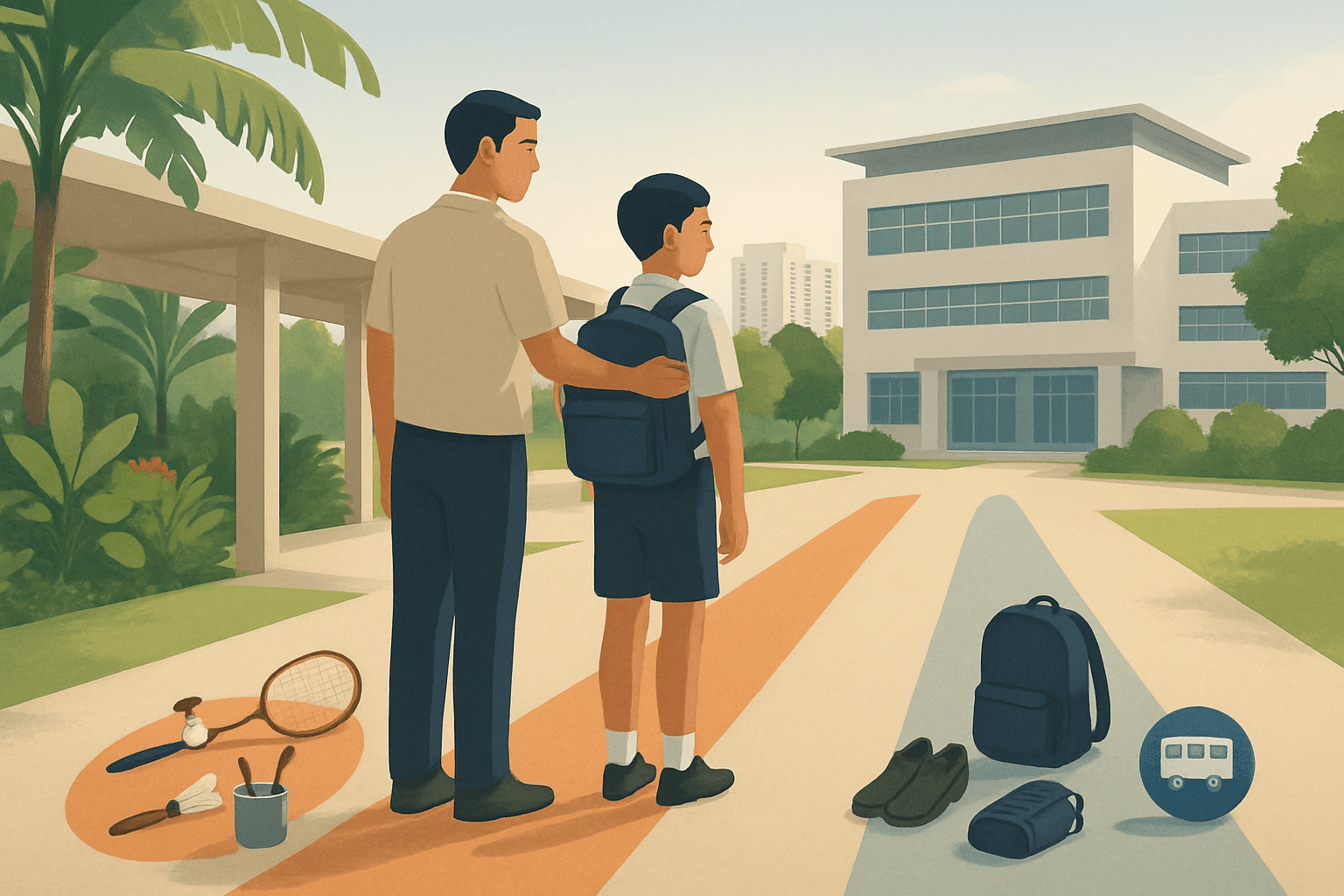
If your child is applying for DSA, you still need to understand the normal Secondary 1 posting route. DSA happens earlier and can secure a place based on talent and school fit, but your child still takes PSLE, and most families should keep a backup plan until the DSA outcome is fully secured. This guide explains the sequence, the commitment points, and what parents should do if DSA works out or does not.
What is the simplest way to understand how DSA fits into Secondary 1 posting?
DSA is an early admission route based on talent and fit. Secondary 1 posting is the main route after PSLE, so DSA runs alongside it rather than replacing it from the start.
Think of DSA as an early route into a specific school, while Secondary 1 posting is the main route after PSLE. Under MOE's DSA-Sec overview, Primary 6 pupils can apply to certain secondary schools before PSLE based on interests, aptitude, and potential. Secondary 1 posting is the broader allocation process that most students go through after their PSLE results.
For parents, the key idea is timing. DSA runs alongside the normal route at first. It does not replace Secondary 1 posting the moment an application is submitted. Until a DSA place is actually secured, the normal posting route should still be treated as the live plan.
A practical example: a child who is strong in badminton, choir, debate, or leadership may try DSA because those strengths are easier to show than exam scores alone. If the application does not lead to a place, the child still continues through the usual PSLE-to-secondary process. If you want the broader picture first, our Direct School Admission Singapore guide explains how the full pathway works.
2009 DSA(Direct School Admission)
Hi all, Thanks for the info. So from what I gather, schools that offer DSA does not mean that they only have IP. Also, DSA is just a means of getting into secondary school besides using the PSLE results.
2009 DSA(Direct School Admission)
I have been trying to understand what DSA and IP is all about and am afraid that I am still quite clueless. What exactly is the purpose of doing all the additional stuff like Maths Olympiad etc. Is it so that one can have a better portfolio to get into a secondary school via DSA? Is getting into the secondary school via DSA an end in itself? i.e. merely to bypass the PSLE results? Or is it to get into the IP so that we can bypass the O Levels? Does DSA mean that the child will be on IP? I am qui
If my child applies for DSA, do we still need to think about Secondary 1 posting?
Yes. Applying for DSA does not remove your child from the normal route; only a successful DSA admission usually does.
Yes. Applying for DSA does not remove your child from the normal system. Your child still takes PSLE, and the key difference is between applying for DSA and actually being admitted through DSA.
This is where many parents get caught out. An application is only an attempt, not a secured school place. In practical terms, the sequence is simple: your child applies for DSA, still sits for PSLE, and then moves into one of two paths. If your child does not secure a DSA place, the family continues with the normal Secondary 1 posting route. If your child is successfully admitted through DSA-Sec, your child generally does not take part in the normal Secondary 1 posting. MOE states this clearly in its DSA-Sec FAQ.
There is one nuance worth knowing. Successful DSA-Sec students who are eligible for the Third Language programme, or who are eligible for more than one Posting Group, may still exercise those limited options during the school choice submission period. That is not the same as joining the full posting exercise. It is a narrow choice inside an already secured DSA outcome.
A good rule of thumb is this: applying for DSA does not take you out of posting, but successful DSA admission usually does. For a broader overview, see Does a DSA Rejection Affect Normal Posting?.
How many DSA schools did you apply to?
You may look at the All About DSA thread http://www.kiasuparents.com/kiasu/forum/viewtopic.php?f=48&t=157 or http://www.moe.edu.sg/education/admissions/dsa-sec/ While for the intention and selection criteria, you may look up secondary schools that offer DSA as each of them has a different one. List of schools offering DSA http://www.moe.edu.sg/education/admissions/dsa-sec/participating-schools/
How many DSA schools did you apply to?
Why go the DSA route if kids are definitely going to do well in psle? Is DSA about using cca to get to the sec school? Am I missing something here?
Have More Questions?
Get personalized guidance on schools, tuition, enrichment and education pathways with AskVaiser.
Try AskVaiser for Free →What happens if my child gets a DSA offer before Secondary 1 posting results are out?
A DSA offer can secure the school early, but it may still come with PSLE-related conditions and usually leads to a real commitment to that school.
A successful DSA outcome can settle the school question early, but parents should not assume it is unconditional. MOE's DSA-Sec press release notes that a DSA Confirmed Offer still requires the student to opt for the school during the school preference submission period and achieve a PSLE score that qualifies the student for a Posting Group offered by the school.
In plain English, that means two things. First, the family still has to complete the required step to take up the place. Second, the child still needs a PSLE result that matches a posting pathway the school can admit for. Parents should not assume every school offers every Posting Group, so it is important to read the offer details carefully.
This is also the point where commitment becomes real. Once the successful DSA route is taken up, the child is generally expected to attend that school rather than continue comparing schools through normal posting. That is why practical questions matter before you commit. Can your child manage the travel time? Is the talent area something your child genuinely wants to continue for the next few years? Does the school's culture fit your child, not just the CCA or programme?
A useful parent insight is this: a DSA offer is not a placeholder. If your family would hesitate to accept the school in real life, sort that out early. For more on the commitment side, see Is a DSA Offer Binding? What Parents Commit To.
2009 DSA(Direct School Admission)
If your child is waitlisted or has a confirmed place in a school during DSA, he will be given a DSA School Preference Form in October, during which he can indicate his choice of school. Say for example your son was offered waitlist in School A and has no other confirmed offers. He can then indicate School A in his Form if he chooses to. This form must be submitted in October. When his PSLE results are released, he will be informed if he was successful in getting a place in School A. If he is not
2010 DSA(Direct School Admission)
If you accept the DSA offer, your kid will not be able to participate in S1 posting. So he/she has to appeal to the school he wants to go after the S1 posting results are out. There is no guarantee he can go to the appealed school even if his PSLE score may above the COP of the school. So far I have seen a few cases in 2009 (2010 sec 1) and most of them have been successful in their appealing. But please be prepared for the \"stressful\" period while waiting for the appealed result.
What happens if DSA is unsuccessful?
Your child still takes PSLE and goes through the normal Secondary 1 posting process.
If DSA does not work out, your child still takes PSLE and continues through the normal Secondary 1 posting process. For most families, that is the most important reassurance.
An unsuccessful DSA application is not a penalty track. It does not block your child from getting a secondary school place through the standard route. In practice, the family simply shifts attention back to the usual posting decisions after PSLE.
What matters next is how quickly you refocus. Instead of replaying the rejection, update your backup school list and think about overall fit. For example, if your child aimed for one school mainly because of its basketball programme but did not get in through DSA, your next shortlist may focus on schools that are still a good match for commute, school culture, subject options, and available CCAs.
The right mindset is simple: DSA is one path, not the whole journey. If you want that issue explained directly, read Does a DSA Rejection Affect Normal Posting?. For a broader overview, see How to Build a Backup Secondary School List When Applying for DSA.
2016 PSLE Results & Secondary Posting Discussions
From http://www.ifaq.gov.sg/MOE/apps/fcd_faqmain.aspx?TOPIC=8351#FAQ_59426 \t If I am successfully admitted to a secondary school via the Direct School Admission - Secondary (DSA-Sec) Exercise, can I participate in the centralised Secondary One Posting Exercise? If you are successful in the DSA-Sec Exercise, you will be informed of the school that you have been admitted to. Since this place has already been reserved for you, you will not be allowed to participate in the Secondary One Posting Exe
2010 DSA(Direct School Admission)
What schools is your child aiming for? Remember, your child MUST want to do the DSA and go thru the process. Do not force your child to go for certain schools. Respect your child. That's v important, so that you don't waste time in an already very busy PSLE year - apply for a school, get offer, then in the end, your child don't really want it? I've heard many of such.
Can parents plan for DSA and Secondary 1 posting at the same time?
Yes. For most families, the sensible approach is to pursue DSA while keeping a realistic Secondary 1 posting backup plan.
Yes, and for most families that is the safest way to plan. DSA and Secondary 1 posting overlap enough that parents should think in two tracks, not in all-or-nothing terms.
That means pursuing DSA if the school and talent-area fit are genuine, while still keeping PSLE preparation steady and researching realistic posting schools. Families who treat DSA as the only plan often end up stressed twice: once while waiting for the outcome, and again if the application does not work out.
A more useful way to frame it is preferred path versus backup path. Backup schools are not pessimism. They are basic planning. For example, a child applying through DSA for visual arts may still need parents to compare likely posting schools by travel time, school culture, subject offerings, and overall suitability. If DSA succeeds, you commit with clearer eyes. If it does not, you are not building a school list in a panic.
If you are deciding how much attention to give each path, our guides on DSA vs PSLE and how to build a backup secondary school list can help you plan more realistically.
2008 DSA(Direct School Admission)
Hi Sally, You can check all about DSA via this website. http://www.moe.edu.sg/education/admissions/dsa-sec/ One advice is to start working on your child's portfolio detailing his academic achievements, CCA involvement, certificates attained (NSW, Math Olympaid), proof of community involvement, leadership positions etc.... All the best!
2009 DSA(Direct School Admission)
Don't worry, there are a lot of people who did not go thru DSA and yet still can get into the top schools thru PSLE.
What should parents prepare while waiting for DSA and posting outcomes?
Prepare for quick decisions by checking school fit, family commitment, and backup options before the outcome arrives.
Prepare for fast decisions, not just hoped-for outcomes. Families often spend too much energy hoping for one result and too little time getting ready for either result.
Start with school fit, not school reputation. Read each target school's published DSA talent areas and selection details carefully, then compare them with your child's real profile. Common parent checks include commute time, expected training or programme load, whether the school offers the subjects your child may want later, and whether your child actually likes the school's environment after visiting it.
It also helps to decide family boundaries before the pressure arrives. If a DSA place comes through, would you truly accept it? If your child is shortlisted for trials or interviews, how much preparation is reasonable without letting PSLE work slip? These are easier conversations before results come in than after.
One practical mistake to avoid is treating interviews and trials as the whole game. They matter, but so does readiness to decide quickly once the school moves. If interview invitations start coming in, our DSA interview guide can help you prepare calmly.
2010 DSA(Direct School Admission)
Invariably at each year's open houses, such questions are asked and answered wrt vacancies By the way, the admission is based on merit and exceptional ability demonstrated, not to fill a quota Each independent schools has their own selection criteria, a desire to maintain a certain type of culture and environment, hence each school is unique and all their vacancies will be filled by the time of S1 posting. The DSA process can be viewed as a form of training for the kids - go strive for what you
2010 DSA(Direct School Admission)
DSA is not that time consuming. Essentially there are just the following steps, for most schools: 1. Online application: Have your results and awards on hand for easy reference. 2. Preparation of portfolio: Photocopy and certify your results, awards, certificates etc as required by the school. Check with the school for their requirements. 3. Submission of portfolio to school: Some schools ask you to bring it with you during the interview, some schools require you to submit it before the intervie
What is the biggest misunderstanding parents have about DSA?
The biggest mistake is thinking DSA is a guaranteed shortcut that replaces PSLE or the rest of the admission process.
Many parents treat DSA as a shortcut that makes the rest of the admission process irrelevant. That is the wrong mental model. Your child still takes PSLE, a successful DSA outcome may still have conditions, and successful DSA students generally cannot keep shopping around through the normal Secondary 1 posting exercise. Application is not admission, and admission is not a free option to compare later.
2010 DSA(Direct School Admission)
Hi, I hope someone can enlighten me on DSA. I've completely no idea what it is. :? How does it work and is it related to CCA ? My boy is in P4. Thanks in advance.
2008 DSA(Direct School Admission)
One of the reasons why we decided to apply for DSA is because the independent schools can admit up to 50% of cohort through DSA. The remaining 50% vacancy are left for students going in through PSLE scores. So as a \"kiasu\" parent, want to maximise the chance. My son felt the DSA tests and interview \"drained up all his brain juices\". After spending 6 hours on all the tests and interview, he went home so tired and slept for the whole day. :lol:
How should families decide whether DSA is worth pursuing?
Pursue DSA when your child has a clear strength, the school fit is strong, and your family is comfortable with early commitment if an offer comes through.
DSA is usually worth pursuing when the child's strength is real, visible, and sustained, and when the school's talent area clearly matches that strength. It is less worth pursuing when the application is driven mainly by school brand, parent anxiety, or the hope that DSA will make PSLE unimportant.
In practical terms, a child with years of consistent training, competition experience, performance work, leadership responsibility, or strong school-based involvement is usually in a stronger position than a child applying on a last-minute hunch. Fit matters as much as talent. A sporty child may like one school's training culture but struggle with a long commute. A child with performing arts ability may still prefer to keep options open if the interest is real but not yet strong enough for an early commitment.
A helpful insight line is this: DSA works best when the child's profile is obvious without heavy packaging. If the family has to stretch weak evidence, rush a portfolio, or spend so much time preparing that PSLE work starts slipping, that is usually a sign to lower the priority. If you want a broader parent-oriented reality check, this KiasuParents overview is a useful starting point, but school websites and MOE guidance should still be your final reference.
If you are still deciding, these follow-up guides may help: Is Direct School Admission Worth It For My Child?, What Talents Count for DSA Eligibility?, and Do You Need Top Grades for DSA in Singapore?.
2008 DSA(Direct School Admission)
[quote]How will we be able to tell which sports is favored by a particular school under DSA? Is such info published?[/quote] Yes, each school has its own preference and they are normally published on the schools' websites. DSA is not only for Sports or Music talents, if your child is good academically throughout the years (esp P4 - P6), then, you can also try for DSA at some of the top schools. Each school has their own entrance tests and interviews. Independent schools can take in up to 50% of
2010 DSA(Direct School Admission)
My personal experience on DSA, think twice before you accept. We decided to try DSA route because our daughter’s performance is not consistent and she is in the range of above average. We gathered that should would get anywhere between 240-260. We saw our niece went through a bad experience when she got 240+. Where the girl can only be happy to be in the next best range, as the top ranges 255++. And staying in Bt Timah and wanting her to waste little in travel time means that her risk is high to
What is a sensible parent checklist when DSA and Secondary 1 posting overlap?
Use a simple two-track checklist so you stay ready for either a DSA outcome or the normal posting route.
- ✓Confirm that your child has a genuine DSA talent-area fit, not just a hopeful interest.
- ✓Read each target school's published DSA selection details carefully and note what the school is actually looking for.
- ✓Keep PSLE preparation steady, because DSA does not remove the need to sit for PSLE.
- ✓Build a realistic backup list for normal Secondary 1 posting, including commute, school culture, and general fit.
- ✓Decide in advance whether your family would truly accept a DSA place from each school applied to.
- ✓Track interviews, school communications, and the school preference submission step so nothing important is missed.
- ✓If a DSA outcome is successful, read any conditions carefully, especially where Posting Group eligibility is mentioned.
- ✓If DSA does not work out, shift quickly back to the normal posting route instead of losing time second-guessing the result.
Have More Questions?
Get personalized guidance on schools, tuition, enrichment and education pathways with AskVaiser.
Try AskVaiser for Free →