
DSA Music Singapore: What Schools Look For in Auditions, Instruments and Repertoire
A practical parent guide to music DSA preparation, from instrument fit and audition tasks to repertoire choice.
For DSA Music in Singapore, schools are usually trying to answer one question: can this child perform well enough to grow in our music programme? In practice, live performance readiness matters most, supported by suitable repertoire, stage comfort, relevant musical experience, and a family that is ready to honour the commitment if an offer is made.
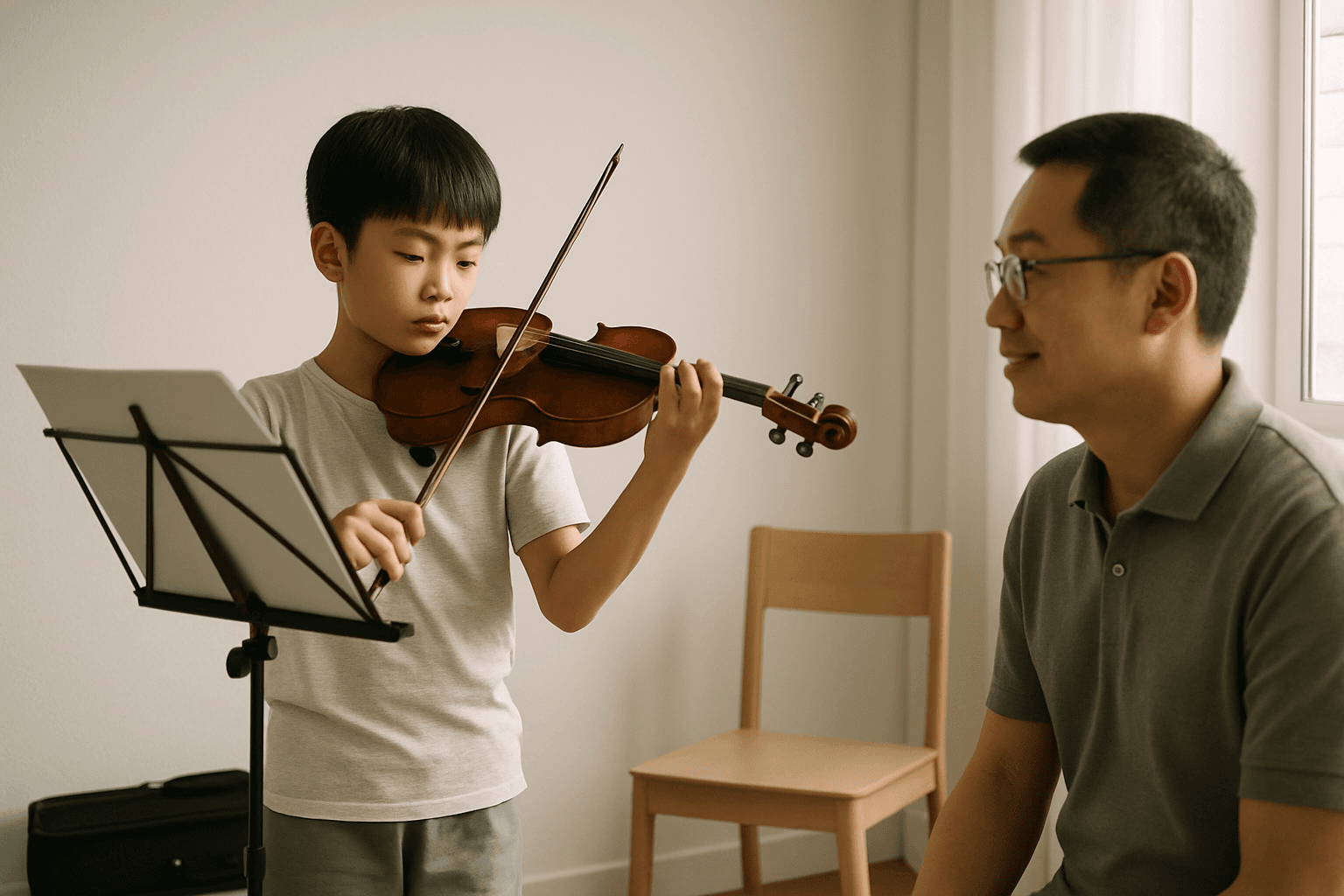
DSA Music in Singapore is for students who want to apply for secondary school based on musical talent and potential before PSLE results are released. For parents, the key question is usually not whether a child likes music, but whether that child can perform reliably in an audition and whether the school is a realistic fit if an offer comes.
There is no single music audition format used by every school. MOE explains that shortlisted applicants may be asked to attend interviews, auditions, or trials, and that selection processes differ across schools. Use this guide as practical preparation advice, then confirm the exact requirements on each school’s DSA page before applying.
What is DSA Music in Singapore, and who is it really for?
DSA Music is a pathway for students to seek secondary school admission based on musical talent and potential before PSLE results are released.
DSA Music is a talent-based route for students who want to seek secondary school admission before PSLE results are out. If you are new to the overall process, start with our main guide to Direct School Admission Singapore. In practical terms, it is for children whose musical ability and potential are strong enough to be assessed live, not just described on paper.
That distinction matters. Enjoying piano, violin, singing, or weekly lessons is not the same as being ready for DSA. A DSA-ready child can usually prepare pieces consistently, take feedback, perform in front of others, and stay functional under pressure. Think of DSA Music as a live suitability check, not a reward for many years of lessons.
DSA - Choir
A quick search online shows a few schools with Choir DSA. You can take a look and maybe do a bit more research/exploring online for more info: SOTA http://www.sota.edu.sg/Admission/AuditionPrep/DSASecTransferInternational/MusicPrep/tabid/815/Default.aspx Nan Hua ttp:// http://www.nanhuahigh.moe.edu.sg/cos/o.x?c=/wbn/pagetree&func=view&rid=1062952 Bukit Panjang Govt High School http://www.bpghs.moe.edu.sg/dsa/directschadmin.htm (Vocal recital / Theory requirement at approximately Grade 5 of ABRSM
2010 DSA(Direct School Admission)
DSA means direct school admission via special talents such as sports and music. Gep also consider a talent, if a mainstrem child do very well in any of the academic subject, participates in various activities or competition also consider a talent. keep the record well, you need them to fill up the forms. there are children apply dsa thru Eng, Maths, Science, Chinese. Maths is the popular one, the chances is slim. Sports and music talents, you should participated in school cca, join competitions,
What do schools usually evaluate in a DSA Music application?
Schools usually evaluate live musical ability and audition readiness more than lesson history alone.
Schools usually want evidence of real musical readiness, not just lesson history or a long list of certificates. In a music audition, panels commonly look for secure technique, steady pulse, control of tone or sound, reasonably accurate notes and entries, musical phrasing, and the ability to keep performing when nerves show up.
A useful parent rule is this: certificates support the story, but the audition proves it. A child with strong exam results but unstable tempo, frequent restarts, or obvious panic may look less ready than a child with fewer paper achievements but a cleaner, steadier performance. Schools may weigh these factors differently, but the core question is usually the same: can this child sound reliable in the room? For a broader overview, see What Talents Count for DSA Eligibility?.
Chinese Orchestra DSA
DSA requirement for individual instruments are usually stated on the website - alternatively go for their Open House and ask. Depending on the instruments, most are looking for at least a grade 3. But with so many kids having Grade 8-9 at P6, the bar is \"invisibly' raised
Chinese Orchestra DSA
Should be able to. Just look at the individual schools' DSA webpages. All these information is easily searchable online - the links I'm listing below are just from my Google Search - you can do the same. NYGH - look under Chinese Orchestra http://www.nanyanggirlshigh.moe.edu.sg/wbn/slot/u2906/2013%20-%20Direct%20School%20Admission/FAQ%20DSA2013.pdf DHS - look under DSA Performing Arts. http://www.dunmanhigh.moe.edu.sg/administration/direct-school-admission/dsa-domain-criteria/ Although for DHS -
Have More Questions?
Get personalized guidance on schools, tuition, enrichment and education pathways with AskVaiser.
Try AskVaiser for Free →Which instruments, voice types, or musical backgrounds are commonly considered?
There is no single accepted-instrument list, so the better question is whether your child’s musical background fits the school’s actual programme.
There is no universal official list that applies across all schools, so parents should start with each school’s own music programme. In real applications, common examples often include piano, strings, woodwind, brass, percussion, voice, choir, concert band, orchestra, or other structured music backgrounds where the school has a relevant programme. These are examples only, not guaranteed options.
A practical fit check is this: do not ask only whether your child plays an instrument. Ask where your child would realistically contribute in that school. A choir-trained child may fit better in a school with a strong choral culture. A wind player may make more sense where concert band is central. Even a capable pianist is not automatically a natural fit everywhere if the school’s music life is built mainly around band or choir. MOE’s overview of music programmes and subjects helps parents understand the broader landscape, while our guide on what talents count for DSA eligibility can help if you are still deciding whether music is the right DSA category. For a broader overview, see How to Apply for DSA in Singapore.
Chinese Orchestra DSA
Hi parents I have been reading about DSA experiences but thought if any parent can share specifically for Chinese Orchestra DSA. My son is very interested in his instrument and would like to apply to Sec schs in the East (e.g. Dunman, Anglican, Chung Cheng, Victoria etc) to continue his CCA. Unfortunately, his academic is not so strong (70-80 marks on average). Just want to understand how to increase his chances in getting DSA offer? Other than SYF participation, is it a must to get NAFA graded
2010 DSA(Direct School Admission)
DSA via CCA has to be the CCA that the school is focused on, which is usually stated in their DSA info pack. Perhaps Chinese Orchestra could be classified under Music ?
What should my child prepare for the audition?
Expect a live performance, a short discussion, and possibly extra audition or trial tasks depending on the school.
Prepare first for a live performance, then for a short conversation and possible follow-up tasks. MOE says shortlisted applicants may attend interviews, auditions, or trials, but each school sets its own format. For music DSA, parents should be ready for three likely elements: the child performing a prepared piece or pieces, answering simple questions about their music background, and showing that they can respond calmly to directions.
The panel may not just listen passively. In some schools, they may ask the child to restart a section, begin from the middle, adjust tempo or dynamics, or explain prior ensemble experience. Some schools may also include musicianship checks such as scales, rhythm clapping, sight-reading, or a short group task, but these should be treated as possible elements rather than universal rules. Most parents spend too much time polishing notes and too little time practising interruptions. The stronger test is whether your child can settle quickly, start cleanly, and keep going. For the wider application process, see our guides on how to apply for DSA in Singapore and what happens during a DSA interview in Singapore.
2009 DSA(Direct School Admission)
Hi, My gal would like to try DSA using Wushu for the following school which they do have wushu as CCA: 中正总校 Anglican High Dunman High Nanyang Girls’ High River Valley High Anyone has experience in with these school using DSA ? What questions or preparation needed for the audition ? :? Thanks.
School Of The Arts, Singapore
My boy has dsa confirmed fm Sota-Music. Can any parent (music mep) share how the kid are performing and also how do they allocated teacher. Can we get our own music teacher??
How should families choose repertoire for DSA Music?
Choose repertoire that shows control and musical range, not just the hardest piece your child can attempt.
Choose repertoire that lets your child sound convincing, not repertoire that only looks impressive on paper. The best audition piece is not always the hardest exam piece. If difficulty leads to rushed tempo, uneven tone, shaky intonation, or visible tension, the piece is probably working against the child rather than for them.
When the school allows more than one piece, a common strategy is to prepare contrasting repertoire that shows different strengths. A slower or more lyrical piece can reveal tone, phrasing, breath control, or line. A piece with more movement or articulation can show rhythm, agility, and energy. For singers, one song may highlight diction and sustained phrasing, while another shows character and pulse. The goal is not to show everything. It is to show control. Choose pieces your child can start confidently, sustain musically, and recover from if a small slip happens. Before finalising anything, check the school’s own guidance on timing, accompaniment, style, or whether memorisation is expected. For a broader overview, see Is a DSA Offer Binding? What Parents Commit To.
2009 DSA(Direct School Admission)
singalion wrote:[quote]Hi, I am new to this forum - I realise there has been a lot of discussion on DSA here - my daughter is in P5 now - she has been with her school choir -performed at SYF, won gold with honors and such, she has also taken the choir exam this year - results not out yet - can anyone advice which schools she can apply for DSA next year? Thanks so much[/quote]ok, I have heard that Nan Hua Secondary has DSA for choir but not too sure about others. Actually you can go into the MOE
2009 DSA(Direct School Admission)
Hi, Need advice from experienced parents. My kids are only P1 and P2 but I wanted to understand more about DSA as I don’t want it to be something that we understand too late and missed the boat. My P2 girl joins the school band for CCA. She has a keen interest and she is continuing to do so in P3. I was just wondering if she eventually continues with school band and manage to perform in those school events, etc… (think their school band is quite reputable and won awards). Can we eventually use t
Does ensemble, band, choir, or performance experience help?
Yes. It helps because it shows stage comfort, discipline, and the ability to perform with others.
Yes, especially when it shows habits that matter in school music settings. Choir, concert band, orchestra, recitals, school concerts, community performances, and competitions can all strengthen an application if they show that the child has rehearsed seriously, followed direction, and performed in front of others.
This matters because schools are rarely looking only for private lesson progress. They are usually trying to identify students who can join and contribute to school music life. A child who watches a conductor, enters on cue, learns parts steadily, and keeps going during a live performance may be easier for a school to develop than a child with higher solo exam results but little ensemble discipline. Parents often overfocus on exam grades and underuse performance history. A short, relevant record of choir participation, concert appearances, or ensemble work can help the panel understand the child’s background, but it works best as support for a good audition, not as a substitute for one. At a broader level, this fits the purpose of DSA as a pathway that recognises talent beyond exam performance alone, as discussed in this CNA commentary.
2010 DSA(Direct School Admission)
Is it true that for DSA, the affiliation cut off point will apply? Are there any watchouts if we want to try under music DSA in the future eg. school band? Are there any thing that need to be achieved to support that? Those additional stuff like strong in chinese S&D will that help? Sorry, I am very very green to this area. Kids only in P3 and P2 but wanted to plan ahead.
DSA - Choir
Thanks for your reply. Music has a very wide scope. So what does it encompass when a school mentions “Music” as an avenue for DSA? What is the requirements? Do you need to have certs to prove you proficiency or is just being in a school choir sufficient? In the case of choir for example, how is the child’s proficiency ascertained? Thank you.
What do parents commonly misunderstand about DSA Music?
The main misunderstanding is thinking DSA Music is decided by prestige, grades, or certificates rather than live fit and genuine commitment.
The biggest mistake is treating DSA Music as either an easy shortcut or a process decided mainly by paper credentials. Strong academics do not prove musical readiness, and a high music exam grade does not guarantee a convincing audition. Just as importantly, not every applicant needs to be a child prodigy. Many schools are looking for students who are musically solid, teachable, and ready to contribute.
Another common mistake is choosing schools by name first and fit second. Commute, rehearsal load, music commitment, and the child’s willingness to stay involved all matter. That is especially important because MOE makes clear that accepting a DSA offer is a commitment. If you would hesitate to honour that commitment, do not apply there just to keep options open.
2009 DSA(Direct School Admission)
Don't worry, there are a lot of people who did not go thru DSA and yet still can get into the top schools thru PSLE.
2009 DSA(Direct School Admission)
DSA is not equivalent to IP. IP is a prog offered in certain sec schs which do not require its students to sit for O levels, ie it is a “thru train prog” from Sec 1 to JC2 where they then sit for A levels. That is not to say that it’s automatic promotion to each level regardless, they still hv sch based exams etc with minimum pass requirements etc. DSA is offered by several sec schools, where diff schools will have diff areas of “talent” they are looking for. Generally if the DSA offer received
How can parents tell if a child is genuinely audition-ready?
A child is usually audition-ready when they can perform securely, recover from mistakes, and stay composed in front of other people.
A child is likely audition-ready when the performance is repeatable, not just impressive on a good day. Look for signs that hold across different practice sessions: steady pulse, dependable entries, a reasonably secure run from start to finish, and the ability to continue after a missed note or phrase. If your child only plays well after several restarts, heavy prompting, or repeated calming, that usually means readiness is not there yet.
A mock audition is one of the best tests. Ask the child to walk in, settle themselves, announce the piece if needed, and perform once through without stopping. Then ask one or two simple questions about the piece or their music background. If the child can keep the shape of the performance together even when slightly nervous, that is a strong sign. If a small slip causes the entire piece to collapse, more preparation time may be wiser. Readiness is repeatability under pressure.
2008 DSA(Direct School Admission)
[quote]How will we be able to tell which sports is favored by a particular school under DSA? Is such info published?[/quote] Yes, each school has its own preference and they are normally published on the schools' websites. DSA is not only for Sports or Music talents, if your child is good academically throughout the years (esp P4 - P6), then, you can also try for DSA at some of the top schools. Each school has their own entrance tests and interviews. Independent schools can take in up to 50% of
2008 DSA(Direct School Admission)
Hi Sally, You can check all about DSA via this website. http://www.moe.edu.sg/education/admissions/dsa-sec/ One advice is to start working on your child's portfolio detailing his academic achievements, CCA involvement, certificates attained (NSW, Math Olympaid), proof of community involvement, leadership positions etc.... All the best!
How should a child prepare in the final weeks before a DSA Music audition?
In the final weeks, focus on stabilising the actual audition performance and making the process feel familiar.
In the final weeks, good preparation becomes narrower, not bigger. The goal is to make the chosen performance more stable, not to add harder repertoire or keep changing interpretation. Focus on the opening bars, endings, tempo stability, breathing or posture, and the transitions where confidence tends to wobble.
Full mock runs usually help more than extra theory work at this stage. Ask the child to perform for family, a teacher, or a small audience without stopping. Record a few complete takes so they can hear whether nerves affect tempo, tone, diction, or pacing. Rehearse what to do after a mistake so recovery becomes automatic instead of emotional. Practical details also matter more than parents expect. Make sure the instrument is in working order, accompaniment arrangements are settled if needed, sheet music is organised, and the child knows how to enter, greet the panel, settle, and begin. A familiar routine lowers panic.
School Of The Arts, Singapore
Dear Parents, I am planning to DSA my DS for yr2020 intake. He is good in violin and has some experience. Can someone help how to prepare student profile for DSA application? Any samples from successful candidates?
School Of The Arts, Singapore
You still have to go thru auditions. Apply thru student affairs direct and they will arrange for auditions, either in March or June. You will have to attend the chosen school until informed date. They will definitely ask for reasons why you did not apply during TA period. You will come in as transfer students. Best to ask student affairs direct for updated info.
My child is strong in music but not academically top-tier. Is DSA Music still worth trying?
Yes, if your child is truly ready for the audition and the school is a good fit. DSA Music should be treated as a real pathway, not a guaranteed shortcut.
Yes, potentially. DSA exists so schools can consider talent and potential beyond academic ranking. But it only makes sense if your child is truly audition-ready and the school is one your family would genuinely accept.
A practical way to decide is to test two things together. First, can your child give a credible live performance under pressure? Second, can your child cope reasonably well with the school’s wider environment, expectations, and commute if a place is offered? If the answer to both is yes, DSA Music may be worth pursuing even without top academic results. If the music is promising but still too unstable in performance, it may be better to treat DSA as one option rather than the main plan.
Be selective with applications. The MOE FAQ explains that families can indicate up to 3 school choices and 3 talent areas in the DSA-Sec Portal, with up to 2 talent areas for the same school. Use those choices on realistic fits, not just aspirational names. For a fuller decision framework, read our guides on whether top grades are needed for DSA, how to build a backup secondary school list, and DSA vs PSLE: which route parents should prioritise.
2009 DSA(Direct School Admission)
My neighbour’s child is a Music talent and managed to got into the top school of Singapore thru Music DSA. However, the child could not cope academically after getting into the school. A year later, the child has been seen wearing a neighbourhood school uniform … I could also see happiness on his face.
2009 DSA(Direct School Admission)
I’d rather not say which school but it is one of the top schools in Singapore. If you’re really strong in the sports the school is keen on, it is much easier to get in via sports than through academics for DSA. I have a few friends whose children all got in via Sports DSA.
Have More Questions?
Get personalized guidance on schools, tuition, enrichment and education pathways with AskVaiser.
Try AskVaiser for Free →