
DSA Transport Planning in Singapore: A Practical Guide for Parents
How to test the commute, plan CCA pickups, and build a backup routine before accepting a DSA place
Good DSA transport planning in Singapore means testing whether the commute is sustainable, confirming the school's real dismissal and CCA routine, choosing a transport setup your family can maintain, and putting a backup pickup plan in place for delays or emergencies. If the arrangement works only on a smooth day, it is not ready yet.
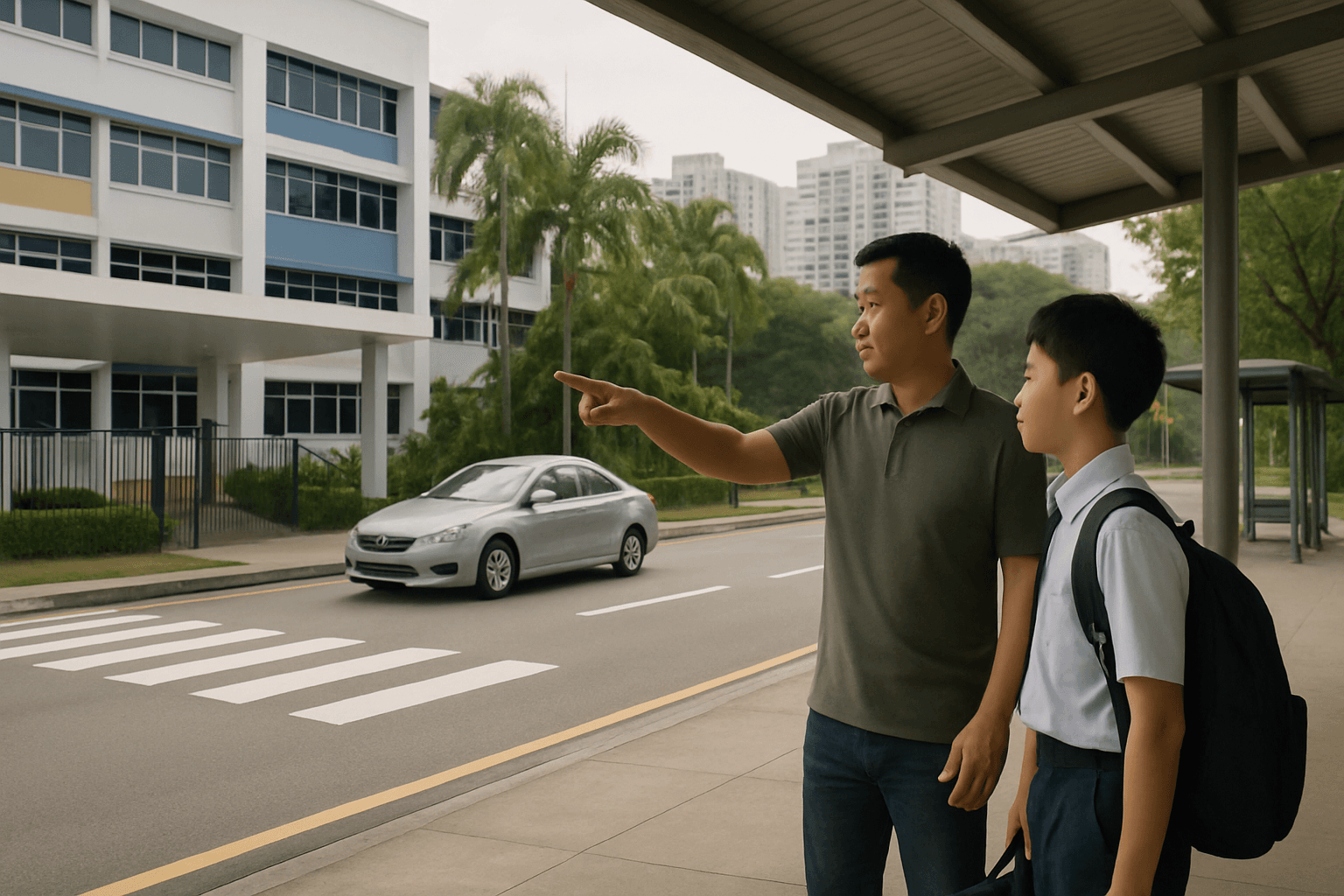
DSA transport planning means checking whether the school can fit into your family's real weekday routine before you commit. The route may look manageable on a map, but the actual decision depends on reporting time, dismissal flow, CCA days, rain, traffic, and who takes over when a parent is delayed. The best school is not only the one your child likes. It is the one your family can run safely and consistently every week.
What does DSA transport planning actually mean for parents?
It means planning the full weekday system around the DSA school place, including the commute, CCA days, pickup routine, and backup arrangements when plans change.
DSA transport planning means deciding whether your family can run the whole school routine safely and consistently, not just whether your child can physically reach the campus. It covers morning reporting time, ordinary dismissal, CCA days, where your child waits after school, and what happens when the planned adult cannot pick up on time.
Parents often treat this as a route question. In practice, it is a family systems question. A school may be 35 minutes away on paper, but the arrangement may still fail if your child has to leave home too early, make multiple transfers, or wait a long time after CCA for an adult whose work schedule changes often.
A useful test is to answer four questions clearly. How does your child get to school on normal days. How does your child get home on normal days. Who handles late days. What does your child do if the plan changes suddenly. If any of those answers are still vague, the DSA decision is not fully planned yet.
Think about transport before you commit, not after. If you are still weighing the bigger DSA route, start with our main guide to Direct School Admission Singapore.
2009 DSA(Direct School Admission)
thanks for sharing the experience on transfering even after taking up dsa offer. may i ask what is the sequence of steps? after accepting dsa offer but the psle results were above the COP for another IP school, what to do next? do we need to contact the IP school first if they allow the transfer and then contact the DSA school to be released? Thanks in advance for reply.
2008 DSA(Direct School Admission)
Hi Sally, You can check all about DSA via this website. http://www.moe.edu.sg/education/admissions/dsa-sec/ One advice is to start working on your child's portfolio detailing his academic achievements, CCA involvement, certificates attained (NSW, Math Olympaid), proof of community involvement, leadership positions etc.... All the best!
How do you judge whether the school commute is realistic before accepting a DSA place?
Test the route like a real school week, with buffer for crowding, rain, waiting time, transfers, and your child's energy after long days.
Judge the commute as a normal weekday routine, not as a one-off trip on a quiet day. The most useful measure is door-to-door time, including walking, waiting, transfers, traffic, school-gate congestion, and the extra drag of wet weather.
A common parent mistake is relying on map timing alone. A route that looks like 35 minutes can stretch much longer once your child walks to the bus stop, waits for a bus, changes lines, and joins the crowd entering school. The return trip can feel harder because it comes after lessons, training, or CCA.
If possible, do a realistic test. Check how early your child would have to wake up, how crowded the route feels near reporting time, and whether the journey still seems manageable after a long school day. If the school is strong for your child's talent area but the commute leaves them tired before training even starts, that is part of school fit too.
If you cannot do a physical trial run, build the route on paper in real detail. Count the walk to the station, transfer points, waiting time, likely pickup congestion, and what happens if it rains. Compare the easy version of the route with the bad-day version. Parents often discover that the problem is not distance itself, but friction: one extra transfer, one exposed walk, or one pickup that depends on a parent leaving work exactly on time.
A good question is not "Can my child get there?" It is "Can my child and my family do this five days a week without it becoming a constant stress point?" If you are weighing that trade-off more broadly, our article on whether DSA is worth it for your child can help.
2008 DSA(Direct School Admission)
One of the reasons why we decided to apply for DSA is because the independent schools can admit up to 50% of cohort through DSA. The remaining 50% vacancy are left for students going in through PSLE scores. So as a \"kiasu\" parent, want to maximise the chance. My son felt the DSA tests and interview \"drained up all his brain juices\". After spending 6 hours on all the tests and interview, he went home so tired and slept for the whole day. :lol:
2009 DSA(Direct School Admission)
If your child is waitlisted or has a confirmed place in a school during DSA, he will be given a DSA School Preference Form in October, during which he can indicate his choice of school. Say for example your son was offered waitlist in School A and has no other confirmed offers. He can then indicate School A in his Form if he chooses to. This form must be submitted in October. When his PSLE results are released, he will be informed if he was successful in getting a place in School A. If he is not
Have More Questions?
Get personalized guidance on schools, tuition, enrichment and education pathways with AskVaiser.
Try AskVaiser for Free →What transport options do Singapore parents usually use for DSA students?
Common arrangements are school bus, parent pickup, public transport, private-hire rides, carpooling, or a mixed setup that changes by day.
Most families use one of five broad arrangements: school bus if available, parent drop-off and pickup, public transport, taxi or private-hire rides, or carpooling with another family. Many families end up with a mixed model rather than one fixed option.
School bus can be the simplest arrangement when the school offers it and the route covers your area. The trade-off is flexibility. Pickup points and timing may not match your ideal routine, so parents should confirm the actual route pattern instead of assuming the service will fit. Parent drop-off and pickup gives the most control, but it becomes fragile when both parents work long hours, travel often, or cannot absorb daily traffic delays.
Public transport can work well for a secondary school student who is calm, independent, and travelling on a straightforward route. It usually becomes less comfortable when the route needs several transfers or involves a long unsheltered walk. Taxi or private-hire rides are useful as a backup or for selected late days, but they are usually costly as an everyday plan. Carpooling can help a lot, but only when both families agree clearly on timing, backup coverage, and what happens if one child has a schedule change.
A realistic setup is often hybrid. For example, a child may take the school bus in the morning, use MRT after CCA with a parent meeting them at a nearby station, and use a private-hire ride only when heavy rain or overtime disrupts the usual plan. Another family may drive on training days and let the child travel independently on shorter academic days. The best option is usually the one that still works when the week is messy, not the one that looks most convenient on a good day. For a broader overview, see Is a DSA Offer Binding? What Parents Commit To.
2008 DSA(Direct School Admission)
Hi, Not sure how many parents here have P6 children. But the online system provided by MOE is an avenue for the students to register their preference online, after they are offered a confirmed place or on the school’s waiting list through the school’s DSA exercise. To apply for DSA, you still need to apply directly with the secondary school. The best is still call up the secondary school you are interested in to apply for DSA and ask for the procedure.
2010 DSA(Direct School Admission)
What schools is your child aiming for? Remember, your child MUST want to do the DSA and go thru the process. Do not force your child to go for certain schools. Respect your child. That's v important, so that you don't waste time in an already very busy PSLE year - apply for a school, get offer, then in the end, your child don't really want it? I've heard many of such.
What should you ask the school about dismissal, CCAs, and transport support?
Ask for the school's real operating routine: reporting time, dismissal flow, CCA timing, waiting points, late-pickup procedure, and any bus or transport support.
- ✓What time do students usually report on regular days, and are there earlier reporting days for certain programmes or activities?
- ✓What time does the school day usually end on normal days, and how much later do CCA days commonly run?
- ✓Where do students usually wait for pickup after school or after CCA?
- ✓If a parent or caregiver is delayed, what is the school's usual procedure?
- ✓If there is a school bus service, which areas do the routes generally cover and who should parents contact for details?
- ✓Are there common transport arrangements that current families use even if these are not school-run?
- ✓Are students allowed to leave on their own after dismissal or CCA, and are there any school-specific sign-out or reporting expectations?
- ✓For students taking public transport, are there known congestion or safety pinch points around the school gate?
- ✓On wet-weather days, school events, or competition periods, does pickup usually become more difficult or later than usual?
Do not assume every DSA school handles transport the same way
School bus routes, pickup procedures, and after-school routines can differ a lot, so confirm the school's own system before you commit.
There is no single MOE-wide DSA transport model. Bus availability, pickup points, dismissal flow, and late-day routines can differ from school to school, so base your decision on that school's actual practice rather than on what another family experienced elsewhere. For a broader overview, see How DSA Fits Into the Secondary 1 Posting Process.
2009 DSA(Direct School Admission)
Hi all, Thanks for the info. So from what I gather, schools that offer DSA does not mean that they only have IP. Also, DSA is just a means of getting into secondary school besides using the PSLE results.
2010 DSA(Direct School Admission)
There're parents who wrote about their successful appeal for transfer in this thread. So I guess, you need patience to go thru the many pages here plus loads of persistence to chase after the schools!
How do you plan for after-school pickup when parents are working or delayed?
Assign a primary pickup person, a backup adult, and a fixed waiting instruction so a late workday does not turn into a school-gate scramble.
The safest approach is to build a named pickup system, not a loose understanding. One adult should be the default pickup person for each day type, another adult should be the backup, and your child should know exactly where to wait and what to do if nobody arrives on time.
This matters most on ordinary weekdays. One parent may handle most pickups but often get delayed by meetings. Another may travel for work. A grandparent, helper, aunt, uncle, or trusted family friend may be able to step in, but only if the arrangement is discussed early and not treated as an informal possibility. A plan is reliable only when everyone involved knows which days they may be called, how much notice they usually get, and where the child will be waiting.
A practical way to do this is to plan by day type rather than by hope. For example, regular school days may default to independent travel, CCA days may default to parent pickup, and exam-period afternoons may need a different arrangement because work schedules tighten. Parents often overlook that the fragile part of the plan is not the school day itself but the handoff between school, transport, and home.
If caregiving is shared across households, agree on the routine before the school choice is locked in. The Ministry of Education notes in its DSA-Sec FAQ that parents with joint custody or separated parents need to come to a common agreement for DSA-Sec school preference submission. In practice, that agreement should also cover daily transport, late pickups, and who takes responsibility on CCA days.
Some schools also have active parent communities. The examples shared on Schoolbag show how school-based parent networks can exist and sometimes help with practical support or local advice. Treat that as extra support, not as your core transport plan.
carpooling in Singapore
1. in google you can find alot of carpooling information http://www.google.com.sg/#hl=en&sugexp=les%3B&gs_rn=1&gs_ri=hp&cp=5&gs_id=e&xhr=t&q=carpool&pf=p&tbo=d&output=search&sclient=psy-ab&oq=carpo&gs_l=&pbx=1&bav=on.2,or.r_gc.r_pw.r_qf.&bvm=bv.1355534169,d.bmk&fp=3dbda5d9fe5f1096&bpcl=40096503&biw=1280&bih=856 2. Check with driver / negotiate 3. Same as 2.
Singapore Secondary School short listing for DSA
This is an online workbook to help you shortlist secondary schools for DSA. You may shortlist secondary schools by DSA, location and more: https://public.tableau.com/app/profile/sg.parent/viz/SingaporeSecondarySchoolSearchDSA/Search Please view these workbooks from a computer and not mobile device (may not not display in full). Will work towards updating them yearly.
What backup plans should every DSA family have in place?
Have a reachable backup adult, a fixed waiting point, and simple instructions for delays, late dismissal, and other common disruptions.
Every family needs a normal plan and a bad-day plan. The bad-day plan covers the situations that create panic when nobody has thought them through in advance: traffic jams, overtime, sudden illness, a cancelled meeting, heavy rain, or a child being released later than expected after an activity.
A practical backup plan usually includes a second adult who is genuinely reachable, one fixed waiting location the child already knows, and a simple contact routine. For example, your child may be told to wait only at the general office, security post, or another agreed point, and to message or call after a set period if no adult has arrived. If your child carries a phone, keep the rule simple. If not, a contact card with key numbers still helps.
Independent-travel families need backup planning too. A child who normally takes MRT home should know what to do if they miss a stop, their phone battery runs low, or a parent sends a late change of plan. Another common scenario is the CCA day that ends later than expected, leaving the child tired, hungry, and standing in the rain with no next step clearly agreed.
The goal is not to prepare for every possible problem. It is to remove guesswork under stress. A good backup plan makes the first safe action obvious.
Re: DSA 2025
Making DSA accessible may involve enhancing school-based talent programs, partnering with community centers for affordable training, and focusing assessments on potential rather than polished skills. Subsidies for external training could support underprivileged students. https://www.straitstimes.com/singapore/direct-school-admission-must-be-accessible-to-all-students-chan-chun-sing https://basketballstars-game.io Delays in the DSA 2026 thread might reflect efforts to refine policies and prioriti
2009 DSA(Direct School Admission)
There is a discussion on DSA here: http://www.kiasuparents.com/kiasu/forum/viewtopic.php?t=157
How can you make transport safer and less stressful for a child who travels independently?
Teach the route, rehearse mistakes and changes in advance, and set simple check-in rules so your child knows what to do when something goes off-plan.
Independent travel works best when it is taught in stages. Walk or ride the route with your child first, then let your child lead parts of it while you observe, and only later shift to full independence when the routine feels steady. Independence is trained, not assumed.
Teach the practical details, not just the destination. Show your child the correct exit, bus stop, transfer point, and sheltered place to wait. Rehearse what to do if they board the wrong bus, miss a stop, cannot find the usual meeting point, or see that the route home is suddenly disrupted by rain or an event. Keep the rules simple enough to remember under stress: stay in a public place, contact home first, and do not invent a brand-new route without informing the family.
A few small habits reduce a lot of friction. Keep stored fare available. Charge the phone before school. Agree on one or two check-in moments, such as a short message when leaving school and another on reaching home. If your child is usually confident but tends to shut down when tired, practise the route after a long day too, not only on a calm weekend morning.
The jump to secondary school can feel large even when the route is manageable. Community reading such as this KiasuParents article on preparing for primary to secondary school can give useful parent perspective, but the more important step is still route practice in real conditions.
2009 DSA(Direct School Admission)
I know of this centre called Achievers Learning Centre at Jurong East (65697773) conducting DSA courses in the last few years. Seems to be the only one in Singapore can do it. Also quite successful in placing P6 kids to the top IP schools. Some of you may want to find out more…
2009 DSA(Direct School Admission)
Hi. Maybe put this as a topic in Chit chat? Not everyone comes in here. Eh..what is DSA?
What mistakes do parents commonly overlook when planning DSA transport?
Parents often underestimate the real weekday load, forget to plan around CCA timing, and assume backup adults or carpools will always be available.
The biggest mistake is treating transport as an admin issue instead of a school-choice issue. Parents may spend a lot of time thinking about programme quality, talent fit, and reputation, then leave the daily logistics for later. By then, they may realise that the commute is long, CCA days run late, or the pickup plan depends on too many last-minute favours.
Another common mistake is underestimating weekday friction. Families often judge a route by distance instead of total effort. A school that seems only slightly farther away may require one more transfer, a longer walk in the rain, or a much earlier wake-up time. Those details affect sleep, homework, mood, and stamina, not just travel time.
Parents also sometimes overestimate backup help. A grandparent may be willing but not available every week. A helper may be able to help nearby but not across an unfamiliar route. A carpool may work until one child's schedule changes. Good plans respect the limits of support instead of assuming goodwill equals availability.
One more overlooked factor is CCA load. Secondary school choice is not just about academics, and many families already weigh school fit and co-curricular opportunities when choosing schools, as reflected in wider discussions such as this Straits Times article on choosing the right secondary school. For DSA families, that matters even more because the very strength that attracts you to the school may also create later dismissal and a heavier transport routine.
2010 DSA(Direct School Admission)
Hi q131271, Have you checked out the DSA thread http://www.kiasuparents.com/kiasu/forum/viewtopic.php?t=157 ?
2010 DSA(Direct School Admission)
:oops: there're many other experienced and knowledgeable parents out here. I'm sure they'll help too nearer the dsa period.
How should families decide if the DSA opportunity is worth the transport burden?
A DSA place is worth the transport burden only if school fit and daily family logistics both remain workable over time, not just on ideal days.
The decision comes down to two questions that deserve equal weight. Is the school a strong fit for your child, and can your family sustain the daily logistics without constant strain. A school can be excellent on paper and still be the wrong choice if the journey is long, pickup is uncertain, or the routine depends on several fragile handoffs every week.
A practical test is to picture an ordinary Wednesday, not offer day. Who gets your child there. What happens after CCA. What happens if it rains. What happens if one adult is stuck at work. If the plan still looks calm and clear, the school may be manageable. If the plan works only when every person and every timing falls into place, that is a warning sign.
This does not mean every farther school is a bad choice. Some families can support a longer route because the journey is direct, the child is mature, and the backup system is solid. Others may reasonably decide that the cost in time, sleep, stress, and coordination is too high. Families usually cope better with a school that fits real life than with a dream school that creates daily exhaustion.
If the transport plan feels fragile now, it usually feels harder during exams, rainy months, and busy work periods. If you are finalising a DSA decision, read this alongside our guides on what parents commit to when accepting a DSA offer, how DSA fits into the Secondary 1 posting process, and the main Direct School Admission Singapore guide.
2010 DSA(Direct School Admission)
My personal experience on DSA, think twice before you accept. We decided to try DSA route because our daughter’s performance is not consistent and she is in the range of above average. We gathered that should would get anywhere between 240-260. We saw our niece went through a bad experience when she got 240+. Where the girl can only be happy to be in the next best range, as the top ranges 255++. And staying in Bt Timah and wanting her to waste little in travel time means that her risk is high to
2010 DSA(Direct School Admission)
Invariably at each year's open houses, such questions are asked and answered wrt vacancies By the way, the admission is based on merit and exceptional ability demonstrated, not to fill a quota Each independent schools has their own selection criteria, a desire to maintain a certain type of culture and environment, hence each school is unique and all their vacancies will be filled by the time of S1 posting. The DSA process can be viewed as a form of training for the kids - go strive for what you
Have More Questions?
Get personalized guidance on schools, tuition, enrichment and education pathways with AskVaiser.
Try AskVaiser for Free →