
DSA Travel Time in Singapore: How Far Is Too Far?
A practical guide for parents deciding whether a secondary school commute is realistic before applying for or accepting a DSA place.
For most families, a DSA commute is only reasonable when the full door-to-door trip, including walking, waiting, transfers, and peak-hour strain, is sustainable over several years. A longer route can still be worth it, but usually only when the school is a genuinely stronger fit for your child and the routine still works on late days, not just on ideal ones.
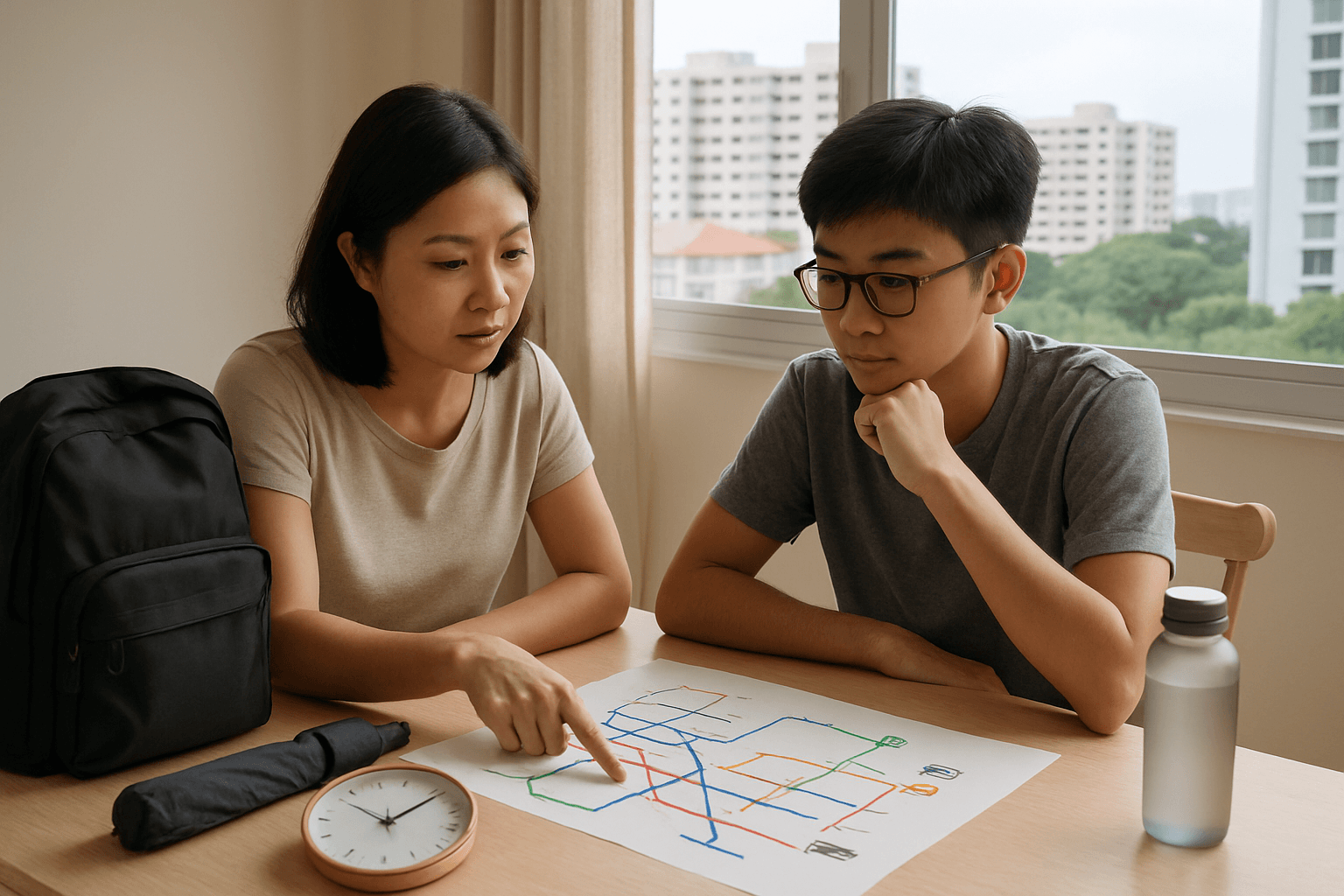
There is no fixed answer to how far is too far for a DSA school. The better question is whether your child can handle the journey on ordinary school days, again and again, without the commute slowly eating into sleep, energy, and family routine.
What does “too far” really mean for DSA travel time in Singapore?
There is no universal cutoff. A DSA school is too far when the daily journey repeatedly drains your child or disrupts family life, even if the route looks manageable on paper.
There is no official minute cutoff that makes a DSA school commute acceptable or unacceptable. In practice, a school is too far when the journey is technically possible but hard to sustain in real life. That usually shows up as rushed mornings, frequent lateness, chronic tiredness, late dinners, less homework time, or a child who starts the week fine and ends it drained.
Think of this as a sustainability question, not a map question. A 40-minute direct MRT ride may be easier than a 25-minute route with two bus transfers, exposed walking, and unreliable waiting time. A 55-minute trip can still work for some students if it is predictable and low-stress, while a shorter but more fragmented route can feel worse every day.
Parents also tend to judge the commute by a best-case day. DSA decisions should be based on an ordinary Tuesday, not a one-off smooth trial. Possible is not the same as sustainable. If you are still weighing the wider decision, start with Direct School Admission Singapore: A Practical Parent Guide.
How many DSA schools did you apply to?
Why go the DSA route if kids are definitely going to do well in psle? Is DSA about using cca to get to the sec school? Am I missing something here?
How many DSA schools did you apply to?
You may look at the All About DSA thread http://www.kiasuparents.com/kiasu/forum/viewtopic.php?f=48&t=157 or http://www.moe.edu.sg/education/admissions/dsa-sec/ While for the intention and selection criteria, you may look up secondary schools that offer DSA as each of them has a different one. List of schools offering DSA http://www.moe.edu.sg/education/admissions/dsa-sec/participating-schools/
How should parents measure travel time properly?
Measure the commute door to door, not station to station. Include walking, waiting, transfers, and the trip home after a full school day.
Use door-to-door timing, not the fastest route shown on an app. The useful number starts when your child leaves home and ends when they actually reach the school building or classroom area. That means counting the walk to the bus stop or MRT, waiting time, transfers, crowding, traffic variation, and the final walk after reaching the school gate.
The return trip matters just as much as the morning trip. A route that feels acceptable before school can feel very different after lessons, training, or a long CCA day. Parents often forget to count the tired walk home from the station, the extra 10 minutes caused by one missed bus, or the difference rain makes when a route involves outdoor walking.
A simple rule helps here: if you did not time the walking and waiting, you did not really time the commute. Use route planners only as a starting point, then test the route during the same hours your child would actually travel. For a broader overview, see Is Direct School Admission Worth It For My Child?.
Singapore Secondary School short listing for DSA
This is an online workbook to help you shortlist secondary schools for DSA. You may shortlist secondary schools by DSA, location and more: https://public.tableau.com/app/profile/sg.parent/viz/SingaporeSecondarySchoolSearchDSA/Search Please view these workbooks from a computer and not mobile device (may not not display in full). Will work towards updating them yearly.
2010 DSA(Direct School Admission)
Hi everybody! i’m newbie here hehehe… i had just done the DSA NSUHS For sec 3 yesterday. oh my god! have to agree the math one was very very very difficult! the science was tricky but most i could do (esp. the physic). Oh i think I’ll not be shortlisted for interview. i’m an indonesian who interested in studying in singapore. i’ll try the RI DSA for foreigner in around sept. or october (i forgot) after registering the aeis. I’LL also try the acsi DSA. by the way, is the math and science RI Or ac
Have More Questions?
Get personalized guidance on schools, tuition, enrichment and education pathways with AskVaiser.
Try AskVaiser for Free →What travel time range is usually still realistic for most students?
Shorter is easier, moderate can still work, and long commutes usually need stronger reasons. The route’s stress level often matters as much as the number of minutes.
There is no official range, but many families find it useful to think in broad buckets rather than fixed rules. A shorter door-to-door commute usually feels easier because it leaves margin for delays, sleep, and after-school changes. A moderate commute can still work well if the route is direct, the child is fairly independent, and the school does not regularly run late. Once the journey becomes long, the school usually needs to be a clearly stronger fit to justify the daily cost.
As a practical family benchmark rather than an official rule, around 20 to 30 minutes one way often feels relatively light when the route is simple. Around 35 to 45 minutes can still be workable for many secondary students, especially with few transfers. When you get close to or beyond an hour each way, parents should test the routine carefully, because late days can turn into very long out-of-home days. For example, a child who leaves early, stays back for training, and gets home after 7pm may have very little space left for dinner, showering, revision, and sleep.
The same number can feel very different in practice. A 30-minute direct bus ride may be easier than a 25-minute bus-MRT-bus route. A 45-minute MRT trip with sheltered walking may still feel better than a shorter route that depends on unreliable buses. The burden is not just in the minutes. It is in the friction. For a broader overview, see Is a DSA Offer Binding? What Parents Commit To.
2010 DSA(Direct School Admission)
DSA is not that time consuming. Essentially there are just the following steps, for most schools: 1. Online application: Have your results and awards on hand for easy reference. 2. Preparation of portfolio: Photocopy and certify your results, awards, certificates etc as required by the school. Check with the school for their requirements. 3. Submission of portfolio to school: Some schools ask you to bring it with you during the interview, some schools require you to submit it before the intervie
2010 DSA(Direct School Admission)
My personal experience on DSA, think twice before you accept. We decided to try DSA route because our daughter’s performance is not consistent and she is in the range of above average. We gathered that should would get anywhere between 240-260. We saw our niece went through a bad experience when she got 240+. Where the girl can only be happy to be in the next best range, as the top ranges 255++. And staying in Bt Timah and wanting her to waste little in travel time means that her risk is high to
Which students cope better with longer commutes?
Children with stronger stamina, independence, and routine discipline usually handle longer commutes better. Children who already struggle with mornings or fatigue usually feel the cost much earlier.
Students who usually cope better with longer travel are the ones who can manage routine without heavy parental prompting. They wake up reasonably well, keep track of belongings, handle crowded buses or MRT rides calmly, and recover their energy after a demanding day. They are also more likely to understand what the school commitment actually involves, rather than simply liking the idea of the school.
A child who is already often rushed in the morning, loses items easily, tires quickly, or needs a lot of support to get out the door may struggle more than parents expect. The same goes for children whose evenings are already full because of tuition, therapy, religious classes, or caregiving responsibilities at home. Independence lowers friction. Motivation helps, but motivation does not replace sleep or stamina.
A common parent mistake is to assume the child will just get used to it. Some do. Some do not. The more reliable test is not what your child promises now, but how they already handle early mornings, crowded travel, and long days. For a broader overview, see How to Build a Backup Secondary School List When Applying for DSA.
Is going to a better school worth hour long travel times?
Yes, I agree. My ds now takes about 45 mins by MRT & bus one-way, but because he is so happy and excited to be in an SAP/IP school, he enjoys going to school and makes effort to participate in activities/projects and learn about the school's culture & values. He comes home and tells me what happens in school and I see him practicing some of the values that the school teaches. I'm so happy to see him change and develop so quickly. However, my dd's school is a 5-min walk away - She does not like t
2009 DSA(Direct School Admission)
Hi. Maybe put this as a topic in Chit chat? Not everyone comes in here. Eh..what is DSA?
What parts of school life make travel harder than parents expect?
CCA, consultations, remedials, and event days are what usually make the commute harder than expected. The return trip after a long day is often the real stress test.
The hidden strain usually comes after lessons, not before them. CCA training, rehearsals, consultations, remedials, project meetings, competitions, and event days can turn a commute that seemed manageable into repeated late-evening returns. Even if the published dismissal time looks fine, the real school day often does not end there.
This matters especially for DSA students because the strength that helped them enter the school may also come with heavier after-school commitments. A student admitted through sport may have multiple training days. A music or performing arts student may face rehearsals and performance periods. A debate or leadership student may have extra preparation or event days. The morning trip may look acceptable, but the same trip after a physically or mentally demanding day can feel very different.
What parents often miss is not just travel time, but travel timing. A route that works on ordinary lesson days may break down once there are several late days each week. If you are assessing whether the school itself is worth that extra load, Is Direct School Admission Worth It For My Child? and What Talents Count for DSA Eligibility? can help frame the tradeoff. For a broader overview, see How to Apply for DSA in Singapore.
2008 DSA(Direct School Admission)
One of the reasons why we decided to apply for DSA is because the independent schools can admit up to 50% of cohort through DSA. The remaining 50% vacancy are left for students going in through PSLE scores. So as a \"kiasu\" parent, want to maximise the chance. My son felt the DSA tests and interview \"drained up all his brain juices\". After spending 6 hours on all the tests and interview, he went home so tired and slept for the whole day. :lol:
2010 DSA(Direct School Admission)
Altho' some schools do set a certain criteria that is above 200. eg. friend's son was set 220 for his dsa under sports. And another was set 225 for dsa under performing arts cca (and this boy actually didn't make it, so couldn't make good his dsa in the end and went to another school).[/quote]I think the tscore required by the DSA offer for sports and arts as mentioned above are mild. In the first place if the child is really that weak, is it wise for the child to be in the midst of all the rest
How does a long commute affect sleep, homework, and family routines?
A long commute usually eats into sleep and evening bandwidth first. If it pushes dinner, homework, and bedtime too late, the school may not be sustainable even if your child likes it.
This is usually the real tradeoff. Travel time is not taken from empty space. It usually comes out of sleep, meal timing, homework bandwidth, recovery time, and the family evening routine. If a child leaves home very early, returns tired, eats late, and still has to revise or prepare for the next day, the school may be a good fit on paper but a poor fit in daily life.
A common pattern is easy to miss at first. The first few weeks feel exciting, the child pushes through, and the commute still seems worth it. Then bedtime slips later, mornings get rougher, and weekends start becoming recovery time rather than rest or family time. A student with a long commute and evening tuition may cope for a while, but the routine can become fragile quickly. Another child may have no tuition but still struggle because dinner timing, younger siblings, or pickup arrangements leave very little margin.
Parents sometimes overlook the cost of the backup plan too. Even if public transport is the main mode, repeated taxi or ride-hail trips on rainy or late-dismissal days can add up. The best way to think about the commute is this: it taxes the least flexible parts of the day first. If morning and evening margins are already thin, a school that is merely possible may become a daily source of strain.
2010 DSA(Direct School Admission)
when went to sumbit DSA for like 10 min cant sleep for 1/2 night imagine spending like 8 hours there :faint:
carpooling in Singapore
1. in google you can find alot of carpooling information http://www.google.com.sg/#hl=en&sugexp=les%3B&gs_rn=1&gs_ri=hp&cp=5&gs_id=e&xhr=t&q=carpool&pf=p&tbo=d&output=search&sclient=psy-ab&oq=carpo&gs_l=&pbx=1&bav=on.2,or.r_gc.r_pw.r_qf.&bvm=bv.1355534169,d.bmk&fp=3dbda5d9fe5f1096&bpcl=40096503&biw=1280&bih=856 2. Check with driver / negotiate 3. Same as 2.
When is a long commute worth it for a DSA school?
A long commute is usually worth considering only when the school is a clearly better fit for your child’s talent, pathway, or environment. It is much harder to justify when the main draw is reputation.
A longer commute is most defensible when the school is an unusually strong fit, not just a well-known one. That could mean a talent pathway nearby schools do not offer in the same way, a school culture that genuinely suits your child, or an environment where your child is likely to stay engaged for years. In those cases, the extra travel may be a conscious tradeoff rather than a mistake.
Prestige alone is a weak reason. A more famous school name does not cancel out daily fatigue. If the main attraction is reputation, parents should be careful, because the strain of the commute can quietly erode the benefit. By contrast, if your child has a clear strength, understands the commitment, and is genuinely excited by the programme itself, a longer route may deserve serious consideration.
A useful test is this: if the school were less famous but offered the same fit, would we still accept the commute? If the answer is no, the appeal may be brand more than fit. If the answer is yes, you may be looking at a tradeoff that is worth making. You can compare that broader decision in Is Direct School Admission Worth It For My Child?.
2010 DSA(Direct School Admission)
You have to look at the conditions in the DSA offer letter. Most schools would take in as long as it's above either 188 (MOE express cut-off point) or 200(most schools' express stream cut-off), depending on which they set. Some schools do set their own internal cut-off for DSA. Eg. my boys' school's secondary section set the cut-off as 225, so I saw that there were boys who still didn't make it in in the end as they got less than that for PSLE. Another friend's son who had DSA under sports to an
2008 DSA(Direct School Admission)
Hi Sally, You can check all about DSA via this website. http://www.moe.edu.sg/education/admissions/dsa-sec/ One advice is to start working on your child's portfolio detailing his academic achievements, CCA involvement, certificates attained (NSW, Math Olympaid), proof of community involvement, leadership positions etc.... All the best!
What practical tests can parents do before applying?
The best test is a real peak-hour dry run. Check both directions, stress-test the weak points, and compare the result with your child’s actual routine rather than hopeful estimates.
Do a real route trial before treating the school as a serious option. Test the morning route on a normal school-day schedule and, if possible, test the return journey at a time that resembles a late dismissal or CCA day. Watch not just the total minutes, but also how much walking is involved, whether transfers are stressful, how crowded the route feels, and how your child behaves at the end of it.
It also helps to test the weak points. What happens if one bus is missed, the MRT platform is packed, or it starts raining halfway through the trip? If the route is only acceptable when everything goes right, it is probably less robust than it looks. If the plan depends on a parent driving several times a week, treat that as part of the real commute, not an occasional backup.
After the trial, compare the route with your child’s current bedtime, morning readiness, and evening routine. If the commute still looks workable, then move on to How to Apply for DSA in Singapore and read Is a DSA Offer Binding? What Parents Commit To before accepting any place. For general official school-system questions, MOE's FAQ page is a useful starting point, but commute suitability itself is usually a family judgment rather than a fixed rule.
2010 DSA(Direct School Admission)
Date of DSA test among the various school may coincide. Such as HCI phase II DSA test date and NUSH camp date. Can experience parents pls advise anyway to work around such situation, if not have to give up one. what if the one which we choose to attend turn up to be unsuccessful?
2010 DSA(Direct School Admission)
you either choose, or inform the school (the one that's 'lesser' in your preference list) and see what their reply is. generally, they may ask your child to come at a different time/date.
What is the mistake most parents make when deciding on DSA travel time?
The common mistake is falling in love with the school before stress-testing the commute. Reverse that order.
They choose the school first and only later try to force the commute to fit. That usually leads to optimistic assumptions about stamina, after-school timing, and family logistics. A good school that is too hard to reach can become a bad daily experience.
The better sequence is to test whether the route is sustainable first, then decide whether the school is still worth pursuing. If you are unsure, keep a realistic fallback by building a broader list through How to Build a Backup Secondary School List When Applying for DSA.
2010 DSA(Direct School Admission)
What schools is your child aiming for? Remember, your child MUST want to do the DSA and go thru the process. Do not force your child to go for certain schools. Respect your child. That's v important, so that you don't waste time in an already very busy PSLE year - apply for a school, get offer, then in the end, your child don't really want it? I've heard many of such.
2009 DSA(Direct School Admission)
thanks for sharing the experience on transfering even after taking up dsa offer. may i ask what is the sequence of steps? after accepting dsa offer but the psle results were above the COP for another IP school, what to do next? do we need to contact the IP school first if they allow the transfer and then contact the DSA school to be released? Thanks in advance for reply.
Have More Questions?
Get personalized guidance on schools, tuition, enrichment and education pathways with AskVaiser.
Try AskVaiser for Free →