
What Does the GEP Non-Verbal Reasoning Test Assess?
A plain-English guide to the pattern recognition and visual logic this GEP test is trying to measure.
GEP non-verbal reasoning assesses how a child recognises patterns, tracks visual changes, and solves unfamiliar problems using shapes, symbols, and spatial logic rather than mainly language. It is best understood as a signal of reasoning style, not a complete measure of intelligence, school potential, or GEP fit.
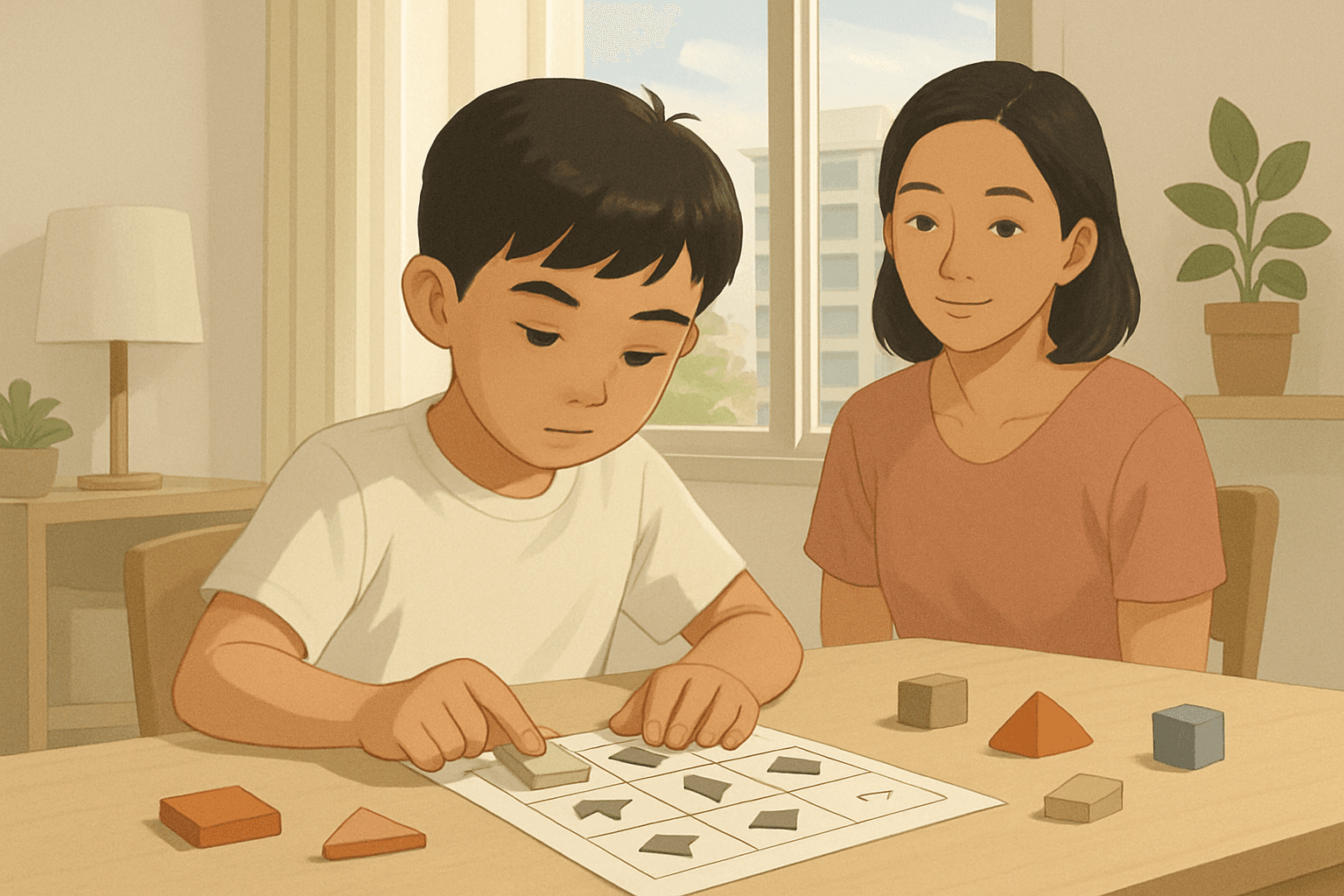
The GEP non-verbal reasoning test assesses pattern recognition, visual-spatial logic, and problem-solving using shapes, symbols, and sequences rather than mainly words. In plain English, it asks whether a child can notice the rule in visual information and apply it to a new question. For parents, the bigger point is this: a strong score can show a useful reasoning strength, but it does not by itself tell you whether GEP is the right long-term fit.
What does the GEP non-verbal reasoning test assess?
It assesses pattern recognition, visual-spatial logic, and problem-solving using shapes, symbols, and sequences rather than mainly words.
It assesses how a child spots rules in visual information without relying mainly on words. Typical questions ask the child to work out what comes next in a shape sequence, which figure does not follow the same pattern, or how a figure changes after a rotation, flip, shading change, or combination with another shape.
The point is not recalled syllabus content. The point is whether the child can infer a rule from what is on the page and apply it accurately. A simple way to think about it is this: it is a visual logic test. The question is less "Have you been taught this before?" and more "Can you figure this out now?" That is why strong classroom performance does not always translate directly to strong non-verbal reasoning performance. For a broader overview, see Gifted Education Programme (GEP) in Singapore: A Parent's Guide.
All About GEP
Hi GEP Parent - What does the GA I and II entail? Are these verbal or non verbal reasoning? Any help will be appreciated.
GEP Assessment Books
you are right. They are NOT Common test questions. But GEP Selection Tests questions. on his website, under \"Features of the book\" costs $800, it states clearly - Consists of 6 booklets and a total of 300 questions for both GEP screening & selection test (English, Mathematics and General Ability) Better prepare the intellectual depth of students in the GEP Screening test and GEP Selection test. Addresses the practical needs of parents and students by incorporating both higher-level thinking an
Why does GEP use non-verbal reasoning in selection?
It helps identify children who can think flexibly and solve unfamiliar problems, not only children who are already strong in ordinary classwork.
Because GEP is not only looking for children who do well on familiar schoolwork. It is also trying to identify children who can notice structure quickly, infer rules, test possibilities, and stay flexible when there is no taught method to copy. That matters in a programme built for pupils who may need more depth, faster pace, and more open-ended thinking.
This is also why results can surprise parents. A child with consistently strong class marks may struggle when the question style is unfamiliar. Another child who is less impressive on language-heavy work but strong in construction toys, visual puzzles, or pattern games may do better than expected. Insight line: the test is trying to see how your child thinks when the question is new. That broader focus on applying reasoning to unfamiliar problems also fits Singapore's wider emphasis on problem-solving, which MOE highlighted in its PISA 2022 summary. For a broader overview, see GEP Selection Process in Singapore: Stage 1 and Stage 2 Explained.
GEP 2012 - Screening & Selection
Right now, it’s only first round. From years of observation, Students who make it are the ones who generally do well academically in schools, perhaps the top 5-10%. But we also see a minority of students with average performance in class scoring well to get into the second round. The second round testing for GEP is another question. The questions are specially crafted to test a student’s creativity in thinking and problem solving skills. They want to attract students who think out of the box, wh
GEP and IQ
Just curious. What do you mean by \"verbal assessment\"? What is it? How does it work? Is there a link to any examples?
Have More Questions?
Get personalized guidance on schools, tuition, enrichment and education pathways with AskVaiser.
Try AskVaiser for Free →How is non-verbal reasoning different from verbal reasoning and regular school tests?
Verbal reasoning depends more on language, while non-verbal reasoning depends more on visual logic and pattern sense. Regular school tests usually lean more on taught content and methods.
Verbal reasoning leans more on language. A child usually needs to understand vocabulary, read carefully, and work through relationships expressed in words. Regular school tests often check what has been taught and whether the child can apply known methods correctly. Non-verbal reasoning strips away much of that language support and asks the child to solve the problem through visual analysis instead.
That is why a strong reader may still find non-verbal reasoning unfamiliar. The child may read beautifully but not immediately see how shapes rotate or how two visual rules are changing at once. The reverse can also happen. A child who is average in composition but strong in tangrams, block patterns, mazes, or visual puzzles may show strong non-verbal thinking. If you want the broader context, our main guide to the Gifted Education Programme in Singapore explains what GEP is trying to provide beyond ordinary classroom achievement. For a broader overview, see GEP vs High Ability Programme in Singapore: What’s the Difference?.
GEP and IQ
To me GEP is about if you have it, you nurture it. There is a certain advantage in putting a child in GEP, if she has what it takes. First, you have more resources in the education system dedicated to educating the child. Second, the academic road is somehow smoother. The GEP label helps somehow. I once asked one of my GEP students to ask her teacher how GEPPers do traditionally in PSLE. She came back with the report that they have had people who got B in PSLE math so far. While most do get A*,
All About GEP
I believe that the General Ability portion of the GEP selection tests carries the most weight. And also your overall score of GA, Math and English papers. You'll find that among the GEP students, some are not so strong in Math but are very strong in English. Some are very strong in Math, less so in English. And of course there are those who are extremely good in both Math and English. However, Band 2 in P2 Math isn't very good and I would think that even the GEP kids who aren't that strong in Ma
How does the GEP selection process work in Singapore?
GEP selection is a broader process, and non-verbal reasoning is one useful indicator within it rather than the whole decision.
At parent level, the key thing to know is that GEP selection is broader than one question type. Non-verbal reasoning is one part of a wider effort to identify pupils who may benefit from a different pace and depth of learning. So one strong or weak performance should not be treated as a full verdict on your child.
Parents often lose time trying to reverse-engineer every detail from old parent memories. A more useful approach is to separate two questions: could my child handle this assessment style, and would my child actually enjoy the programme if selected? For current official process information, MOE's FAQ page is the safest starting point. For a parent-focused overview of how to think about the pathway, see our guide on the GEP selection process in Singapore. For a broader overview, see What Is the GEP Workload Like?.
GEP 2011 - Screening & Selection
More details fm MOE website: Selection Process In August, Primary 3 pupils in Singapore schools have the opportunity to take the GEP Screening Test, comprising 2 papers: English Language and Mathematics Approximately 4000 pupils are shortlisted to sit the GEP Selection Test in October, comprising 3 papers: English Language, Mathematics and General Ability Schedule for 2011 GEP Screening Test: 24 Aug 2011 GEP Selection Test: 18 and 19 Oct 2011 Invitation to join GEP: End November 2011 How many pu
All About GEP
The Singapore GEP has always claim that the selection is not an IQ Test. So they will not sleect based on IQ. The purpose of GEP is to train future leaders for Singapore .. I think So the ability to understand and solve problem is pretty important. That's why Social Studies is 5th subject in GEP and they will have to pass it.
What does a child need to do well in non-verbal reasoning?
The key skills are spotting patterns, comparing shapes accurately, staying calm with unfamiliar questions, and working efficiently without becoming careless.
A child usually needs to notice patterns accurately, compare visual details carefully, and hold several changes in mind at the same time. That can include seeing that a shape is rotating, the number of sides is increasing, or shading alternates in a fixed order. It also helps if the child can abandon a wrong first guess and try a better rule without panicking.
Most parents underestimate the balance between speed and accuracy. One child may work out the rule correctly but too slowly. Another may be quick but careless because the child notices only one changing feature when there are actually two. A third child may have the ability but freeze because the format feels strange. Insight line: fast helps, but flexible thinking matters more.
All About GEP
There are 2 rounds of GEP screening test. Please make sure your kid knows P1 to P3 material well for Round 1. About 4,000 kids will then be selected for Round 2. Round 2 questions will be much more difficult. Speed is quite important for Round 2 - students complained “time not enough”. Some questions can be difficult, must know when to “give up” a question and move on.
All About GEP
E3, Your child is in P4 right? For P4, it is about patterns ie finding the nth term. For P4, it is simple nth term, no quadratic equations. For the investigative papers, most GEP students will get full marks, and if not full marks, usually due to careless mistakes. The teachers will be giving them practice papers to do before the actual test so you don't have to worry too much about it.
How can parents support a child appropriately?
Keep support light, confidence-building, and low-pressure. The goal is familiarity with question style, not heavy coaching.
The most useful support is light familiarisation, not hard drilling. Let your child see pattern, shape, and sequence questions early enough that the format does not feel alien. Short sessions often work better than long ones. A few puzzle questions on a weekend, a tangram activity, a block design challenge, or a simple "what rule do you see?" game can do more than a long, tense practice session. These are examples of low-pressure exposure, not official GEP materials.
One especially useful habit is asking the child to explain the pattern out loud. If your child can say, "It turns each time and the shading alternates," that tells you there is real reasoning happening. If the child mostly guesses, adding more worksheets may only add frustration. Watch the emotional temperature as well. If practice leads to dread, tears, or shutdown, the support has gone too far. The goal is comfort with unfamiliar questions, not fear of getting them wrong. The broader principle is similar to mainstream exam advice in The Straits Times: preparation should build readiness, not pressure.
All About GEP
Saw this on MOE site regarding GEP: “Test preparation activities are not encouraged as these could inflate the scores, which may then not reflect your child’s actual potential. Students who are not ready to handle the rigour and demands of the GEP will: Struggle to cope with the enriched curriculum. Experience stress that could impact their self-esteem and cause them to lose confidence.” I suppose the selection is to identify natural ability. If selected naturally, we can accept the child has th
All About GEP
[/quote]God, we get it. No need to scorn us. Are you going into the GEP? Seriously, the exam papers are confidential. You can't actually get them on the market. Being from the GEP I can tell you it's essentially the same as mainstream papers, with the exception of math investigation papers --- that would be pre-algebra. That paper is kept strictly confidential and even parents can't see it. It's something like an IQ test, judging your ability to see patterns (similar to GAT test during selection
What are the most common myths and misconceptions about GEP non-verbal reasoning?
It is not simply a maths test, a speed test, or a perfect measure of intelligence.
Three myths cause the most confusion. First, it is not just maths in picture form; many maths-strong children still struggle when there is no taught procedure. Second, it is not only a speed test; quick guessing often does worse than slightly slower but accurate reasoning. Third, it is not a full intelligence test or a promise of GEP success. A child can reason well on paper and still find the programme's writing load, pace, or social fit tiring. Fast helps. Flexible thinking matters more.
Is GEP really necessary?
There are 2 camps here. One believes that GEPers are smart but may not do well in exam and the other is GEPers are smart and should do well in exam. I am from the 2nd camp. Go to RI (not that HCI don’t have but no personal knowledge) and it is easy to find many notorious GEPers who don’t do normal school works but will ultimately do well at A-level. My own kid who is not a GEPer has an estimated T-score of only 250 at school prelim, woke up after that and was only behind 3 GEPers in her school a
Is GEP really necessary?
Hi 2ppaamm, just curious - when children sit for the GEP entry papers, are they IQ score communiated to the parents? those who made it to GEP?[/quote]The GEP tests do not test for IQ scores.
How does GEP compare with High Ability Programme and mainstream schooling?
GEP, HAP, and mainstream are not the same route. The useful comparison is fit, pace, and learning style, not label.
For most parents, the practical comparison is not about prestige but about learning environment. GEP is best understood as a more specialised pathway for pupils identified as needing greater stretch. Mainstream schooling remains the default route for most children and can still serve very able pupils well, especially when the child has strong teaching, suitable enrichment, and enough room to grow outside the formal programme.
Parents also often blur GEP with the High Ability Programme, but they should not assume the terms are interchangeable in every current discussion. The safer approach is to treat them as related but distinct ideas, then read current framing carefully. Our guides on GEP vs High Ability Programme and why Singapore is moving from GEP to HAP unpack that distinction. Insight line: the right question is not "Which label sounds stronger?" but "Which setting will help my child learn well without burning out?"
All About GEP
Personally I think if your child qualify for GEP, then why not? I am skeptical about the effectiveness of the prep program for GEP but let’s say your child qualify for GEP without any prep program, the more you should let he or she undergo the GEP program. My reason is simple and straightforward. I think the ability and potential of each child is different. That is why not everyone can achieve the same results in any given examination. Some will score better than the rest no matter how. The GEP
All About GEP
Well to me, GEP is a programme to further stretch and nurture the 'higher ability' kids. It is a programme to see how far can these group of students be stretched and of course those kids who are able to cope well will be those that are able to benefit from this programme the most. As at for Primary School Leaving Exam, it is to test how well P6 students have understand the school education syllabus and how well they have prepared for it.. ..nevertheless also the student academic ability..
Which schools have GEP, and what happens after primary school?
Availability matters, but so do commute, school culture, and the kind of secondary environment your child will want later.
Parents naturally want to know where the programme is available, but school names alone do not settle the decision. Even when a programme option exists, daily commute, school culture, and your child's stamina still matter. A demanding academic setting paired with a long journey can turn a good-fit school on paper into a draining experience in real life.
After primary school, there is no single automatic next step that suits every child. The more useful question is what kind of secondary environment fits this learner now. Some children want continued stretch, independence, and fast-paced discussion. Others cope academically but feel drained by constant intensity and do better in a strong mainstream setting with room to grow more steadily. Think beyond the badge. Ask what kind of day-to-day school life your child is likely to enjoy and sustain.
All About GEP
All students in P3 will have the opportunity to sit for the GEP screening test, which is the first round. Of these, those selected will sit for the GEP selection test which is the second round.
All About GEP Schools
Hi, The first round of GEP test, all schools will encourage students to take the test. If child manage to get in 2nd round, they will be inform by school.
Is GEP suitable for every strong child?
No. Some strong children thrive in GEP, while others are better served by mainstream school plus targeted enrichment.
No. Ability alone is not enough. A child may have the reasoning ability to do well in assessment and still dislike the day-to-day experience of a more intense programme. The possible benefits of GEP are real: more depth, more intellectual stretch, and peers who may enjoy similar kinds of thinking. But those benefits come with trade-offs, including heavier reading and writing demands, faster pace, more open-ended work, and a learning environment that can feel more pressurised for some children.
A useful parent test is simple: does your child become energised by hard questions, or mainly relieved when they are over? A child who pursues ideas beyond the worksheet, tolerates mistakes, and recovers well from challenge may be a better fit than a child who looks strong only when work is predictable. If you are unsure what kind of learner your child is, this KiasuParents article on knowing your child's strengths can be a helpful reflection prompt, though it is not an official MOE source. For a more grounded fit check, our guides on what the GEP workload is like, GEP vs mainstream primary school, and how to tell if GEP is a good fit for your child can help you make a calmer decision.
All About GEP
Zakashi, Screening test marked by school. Selection test marked by MOE. Top 1% of the entire P3 cohort offered GEP. There is no reserved list to GEP. You can be stronger in one, but you must be strong on both. The GEP programme is very rigorous. The student would not be able make it she/he is not strong on both. Hence GEP emphasis on English, Maths and does well in general ability questions.
All About GEP
Hi Can anyone please enlighten me abt the GEP slection test . Do all the schools have the GEP selection tests for all Children in P3? or is it only selected schools have the GEP tests? Thank You
Have More Questions?
Get personalized guidance on schools, tuition, enrichment and education pathways with AskVaiser.
Try AskVaiser for Free →