
GEP vs Mainstream in Singapore: What Is the Real Advantage for Your Child?
A practical parent guide to classroom stretch, peer fit, workload, selection changes, and what matters after primary school.
In a GEP vs mainstream comparison, GEP's real advantage is deeper, more independent learning and a stronger intellectual peer fit for children who are genuinely underchallenged in mainstream. Mainstream is still a strong choice for many bright children because it can offer clearer structure, a broader peer mix, less intensity, and strong long-term outcomes without the same level of academic stretch.
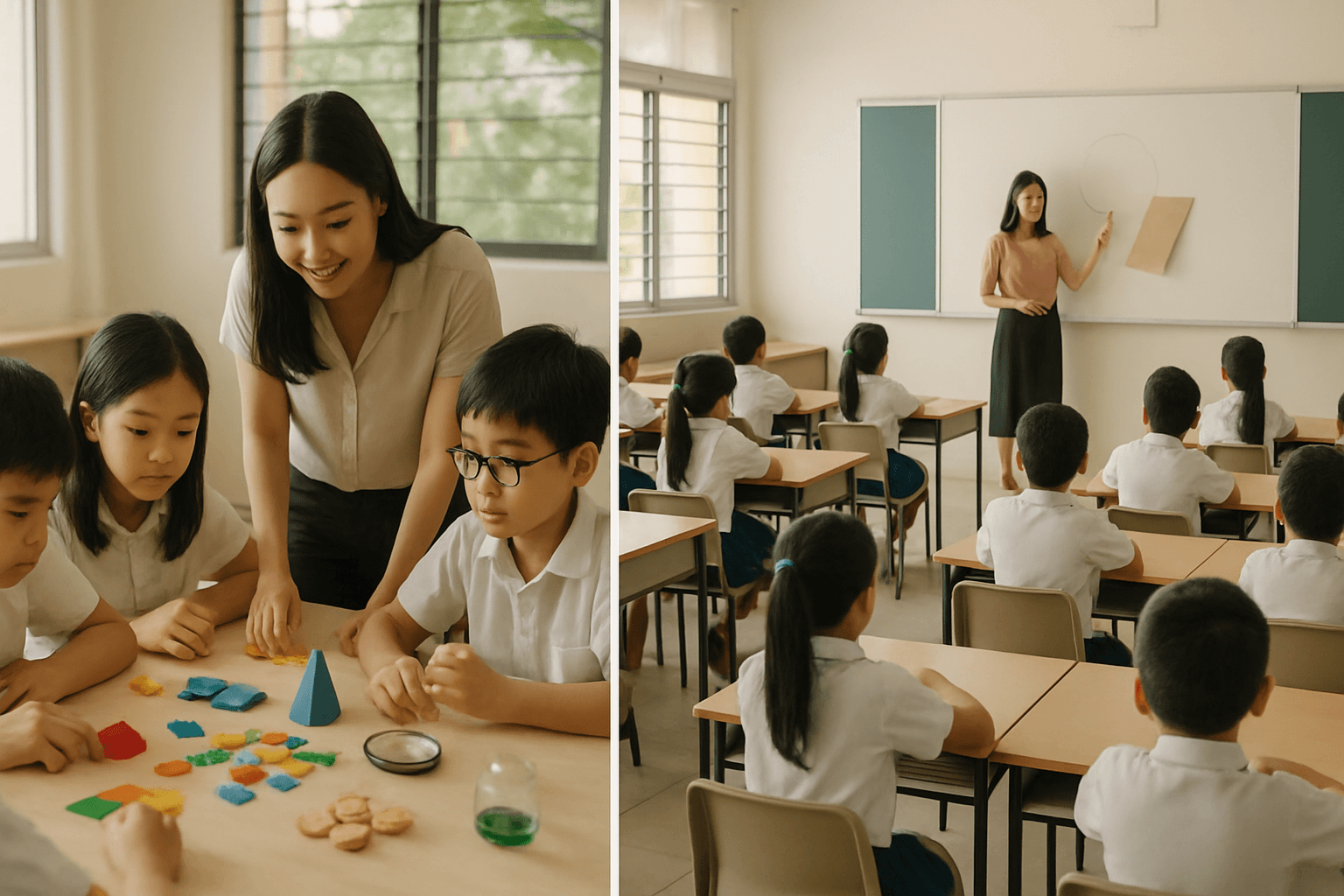
The real advantage of GEP is not status. It is learning fit. For a child who learns unusually quickly, craves deeper discussion, and is consistently underchallenged in a regular class, GEP can offer a better day-to-day experience than mainstream. But it is not automatically the better primary school route for every strong student.
That matters even more now because Singapore is broadening support for higher-ability learners across primary schools, and the current form of GEP is being phased out. So the better parent question is not whether GEP sounds more impressive. It is whether your child needs that specific mix of pace, depth, independence, and peer environment.
What is GEP in Singapore primary schools?
GEP is MOE's primary-school programme for intellectually gifted pupils. It offers deeper and richer learning than a typical mainstream class, although the current model is now being replaced by broader higher-ability support across schools.
The Gifted Education Programme, or GEP, is MOE's programme for intellectually gifted primary school pupils. In plain English, it is meant for children whose learning needs are not fully met by the usual classroom pace and depth. MOE describes it as an enrichment model, not an acceleration model. That means the goal is not simply to rush ahead of the syllabus, but to explore ideas more deeply, broadly, and independently within the same broad content areas.
That distinction helps parents compare GEP with mainstream more accurately. Think of GEP as more stretch, not just more work. A child may still study English, Maths, Science, and Mother Tongue, but the tasks, discussions, and expectations can feel quite different from a regular class. If you want the official framing, MOE's GEP overview and explanation of the enrichment model are the best starting points, alongside our parent guide to GEP.
Parents should also keep the current context in mind. MOE announced in 2024 that support for higher-ability learners will be broadened across all primary schools, and the current form of GEP will be discontinued. So when you compare GEP and mainstream today, the useful question is less about one label and more about what kind of learning support your child actually needs.
All About GEP
U don't seem to get the pt. No one ever said anything abt advantages of being in either this or tt. GEP is catered to kids who need a different track of education. Tt's all. Note the word NEED. get it? At lower pri, my DS' form teacher felt her hands are tied, cos of the limited resources n time, to help pursue his passion n to accelerate at his pace. She advised us to wait for the GEP tests. When he got in (w/o training), he was so relieved tt he could free himself from the slow pace. He was de
All About GEP
1. more challenging curriculum 2. smaller class size If your child is grossly underchallenged in mainstream, GEP would be good for him
What is the main difference between GEP and mainstream learning?
The main difference is depth and learning style. GEP stretches thinking further and expects more independence, while mainstream usually offers a steadier pace, more scaffolding, and a broader classroom fit.
The biggest difference is not the list of subjects. It is how learning is pitched. In GEP, the same broad curriculum areas are extended through greater depth, more complexity, more open-ended tasks, and a classroom environment that expects students to think more independently. In mainstream, teaching is designed for the wider cohort, so the pace is usually steadier and the amount of guidance and reinforcement is often higher.
A simple way to think about it is this: mainstream aims for strong coverage and clear progression, while GEP aims for stronger stretch within that progression. A mainstream pupil may spend more time practising a skill until it is secure. A GEP pupil may be asked to compare methods, justify reasoning, explore exceptions, or produce a more original response.
This is also where many parents compare the two routes unfairly. GEP is not a prize version of primary school. It is a more specialised classroom experience. For some children, that extra depth is exactly what keeps them engaged. For others, the strength of mainstream is precisely its structure, steadier rhythm, and broader mix of classmates. If your child is already learning well, staying curious, and not showing signs of underchallenge, mainstream may be the better fit rather than the lesser option. For a broader overview, see How Do I Know If GEP Is a Good Fit for My Child?.
All About GEP
From what I heard, GEP is more on different approach of teaching... result mostly on the long term based... One of my DD teacher told me that differences for his DS (GEP) and DD (non-GEP) are as below: 1. PSLE - DD did better than DS 2. University - DS got First Class Honour compare to DD which is Second Class Honour...
All About GEP
Hi. When dd was offered GEP, I was not for joining. My (weird ? lazy?) thinking was if she stays in mainstream she'd probably be able to breeze through & hv a stressless childhood (except for chinese, she does not attend any enrichment -- really lots of time to play). But dd decided to join GEP after some careful deliberation. What surprises me is how relaxed dd is this yr. She is aware that she is not likely to top the std like last time and is perfectly fine with it. Though her math is no wher
Have More Questions?
Get personalized guidance on schools, tuition, enrichment and education pathways with AskVaiser.
Try AskVaiser for Free →What are the real advantages of GEP for a child?
GEP's real advantages are stronger academic stretch, more open-ended learning, and a peer group that often suits a fast and curious learner better. These benefits matter most when the child is genuinely underchallenged in mainstream.
For the right child, the biggest advantage is relief from underchallenge. A child who constantly finishes early, asks questions far beyond the lesson, or gets disengaged by repetitive work may finally feel properly stretched in GEP. That can improve motivation because school starts to feel interesting again, not just easy.
The second advantage is peer fit. When a child is surrounded by classmates who also process quickly, enjoy difficult questions, and are comfortable discussing ideas in depth, the classroom can feel more natural. A child who loves puzzles, debate, reading widely, or making unusual connections may feel less isolated and more understood.
The third advantage is the type of learning. GEP often gives more room for inquiry, discussion, and creating a finished piece of thinking rather than only reproducing the expected answer. One child may thrive when asked to compare multiple solutions to a Maths problem. Another may enjoy researching a topic beyond the textbook. Another may simply benefit from lessons that assume genuine curiosity instead of repeated drill.
But the benefit is real only when it solves a real problem. If a child is happy, challenged enough, and progressing well in mainstream, the extra stretch may not improve the overall school experience. In other words, choose GEP because the child needs the environment, not because the programme sounds selective. If you are still weighing that fit, how to know if GEP is a good fit for your child and whether GEP is a better fit than mainstream are useful next reads. For a broader overview, see GEP Selection Process in Singapore: Stage 1 and Stage 2 Explained.
Is GEP really necessary?
These are not inconsequential privileges. The privileges of smaller class size, better teachers and resources have more impact than that of DSA access. Given the same quality of teaching, many non-GEP students would make it into IP schools just by PSLE t-score. This is why some GEP schools spill the GEP resources over to the top 2 classes in mainstream. In the past, drilling was important and GEP curriculum held no advantage at PSLE. At present, with inquiry-based learning and out of textbook le
All About GEP
I don’t see how good GEP is. Mainstream pupils perform almost the same as GEP pupils.
How has GEP selection worked, and what should parents understand now?
GEP traditionally used a selective Primary 3 identification process for entry in Primary 4, but MOE is now moving toward broader higher-ability support across primary schools. Parents should focus less on one gateway and more on fit and available support.
Historically, GEP selection has involved a two-stage identification exercise around Primary 3, with selected pupils joining the programme in Primary 4. That high-level structure is still useful to know because it shows what GEP was designed to be: a selective route for a small group of pupils whose learning needs were judged to be different from the mainstream classroom. Public reporting has often described the intake as about 1 percent of each cohort, which is helpful as a broad sense of scale rather than a fixed annual promise.
What matters now is that parents should not plan as if that older model will remain unchanged. MOE announced a broader approach to support higher-ability learners across all primary schools, including school-based programmes and after-school modules, rather than relying only on one narrow pathway. You can see that shift in MOE's press release on strengthening support for higher-ability learners and CNA's summary of how the GEP model has evolved.
For parents, the practical takeaway is simple. Do not think only in terms of clearing one selection hurdle. Think about where your child will actually get the right amount of stretch, support, and daily sustainability. If you want the older process explained in more detail, our GEP selection guide covers the traditional model, but it should be read together with the newer policy direction. For a broader overview, see What Is the GEP Workload Like?.
All About GEP
From what i understand from the briefing, Gep is not the stepping stone for DSA nor a ticket to post Gep classes. If the child qualifies for IP school (via DSA or PSLE scores), the child would hve to compete for post GEP secondary places with all mainstream students on its merit. Selection criteria via various IP schools differ. I believe that if Gep students can get through IP school n meet 70% benchmark during primary Gep, the IP schools would very likely to give them a place. Having said that
All About GEP
with that elder boy successfully entered the \"Bukit Timah\" school. (top 10, not RGPS since its a boy, then its ACS, NYPS, HPPS liao lo) the younger child gets a phase 1 - P1 registration. the grand kids gets a phase 2A1 - P1 registration. That's how PR manages to get ahead of SG. (for P1 registration only) (not right no wrong, just a method and I think it's not entirely unfair too. the SG parents can also apply a transfer at P3 too - if they are hungry enough)
What kind of child is most likely to thrive in GEP?
Children who thrive in GEP are usually curious, resilient, and comfortable with challenge and independent thinking. High marks alone do not tell you whether the environment will suit them.
The children who usually adapt best are not just high scorers. They are often deeply curious, fairly independent, and comfortable sitting with a hard question longer than most children would. They tend to enjoy exploring ideas, reading widely, making connections across subjects, or explaining why an answer works instead of only getting it right.
Resilience matters as much as ability. A child who has always been one of the strongest in class may suddenly feel average among equally fast peers. Some children find that energising. Others find it unsettling. A child who can handle not being the best all the time, accept feedback, and keep trying when work becomes genuinely demanding is usually in a better position to benefit.
This is where parents often over-read exam results. A child can score very well and still dislike the GEP style of learning. For example, one child may love challenge but dislike repetitive practice, making GEP a natural fit. Another may earn excellent marks because the child likes structure, certainty, and clear instructions, which may make mainstream the happier everyday environment. If you are unsure whether you are seeing giftedness or simply strong performance, this guide on gifted versus advanced learners may help frame the question more clearly. For a broader overview, see GEP vs High Ability Programme in Singapore: What’s the Difference?.
All About GEP
Personally I think if your child qualify for GEP, then why not? I am skeptical about the effectiveness of the prep program for GEP but let’s say your child qualify for GEP without any prep program, the more you should let he or she undergo the GEP program. My reason is simple and straightforward. I think the ability and potential of each child is different. That is why not everyone can achieve the same results in any given examination. Some will score better than the rest no matter how. The GEP
All About GEP
I read many interesting concerns on the GEP ... Let me share some of my thoughts on these ... Why force your kids to a GEP if she /he is meant for it. Don't believe those crap training centre ..Let nature take it course My daughter is in P6 GEP at RGPS and had just completed her PSLE like all other 50K kids in her cohort. She is now enjoying herself with her fellow P6 GEP at the Sentosa UnderWater World. She was posted to RGPS from CHIJ Pri (Toa Payoh) in 2008. As a child , she was always more s
What is the workload and classroom experience like in GEP compared with mainstream?
Compared with mainstream, GEP usually feels more intense, more independent, and more open-ended. The real trade-off is not only heavier work, but a different kind of learning effort.
Parents should expect a more demanding classroom experience overall. Commonly reported differences include faster movement through concepts, more discussion-based lessons, more reading or research, more project-style work, and less time spent on basic repetition. Some parents also report smaller classes in GEP settings, but that is best treated as a common example rather than a fixed promise across every school and year.
The important difference is not just how much work there is. It is what kind of effort the work requires. A mainstream child may spend more time on reinforcement and clearer practice. A GEP child may be asked to explain reasoning, compare possibilities, develop an original response, or work independently for longer stretches. That can feel energising to a child who likes complexity, but draining to one who prefers more structure.
A realistic parent scenario is this: a child who breezes through mainstream homework may suddenly need planning and time management in GEP. Another child may cope well with the volume but struggle with the ambiguity of open-ended tasks because there is no single obviously correct answer. If you want a fuller picture of day-to-day demands, our guide to the GEP workload goes deeper into what families commonly notice.
All About GEP
GEP curriculum covers the same content areas as those in mainstream but is extended in breath and depth. And GEP students will sit for the same PSLE and proceed to IP or O level, just like mainstream students. Sounds quite like IP, where students are exposed to an enriched curriculum but also learn the same syllabus and sit for the same A level exam as mainstream students. Or A level students taking H3 subject with extended contents but only the standard syllabus H2 content results will count to
All About GEP
Juz to clear my doubts... If GEP syllabus are set at a higher standard compared to mainstream, then can we assume that, whatever topics (whether Math, Science, Chinese etc) that r covered in mainstream, will also be covered in Gep, the difference is they r taught more in depth wif some additional topics that mainstream do not cover. Eg. For math, some topics r secondary level (shared by some parents here), same for English(sec std), then Geppers shd find PSLE easier, or score reasonably well rig
GEP is not a prestige route; it is a fit route.
Do not chase GEP for the badge. The value lies in fit, not status.
The most common parent mistake is treating GEP as proof that a child will automatically be better served, better positioned, or headed for better outcomes. It is better to think of GEP as a specialised learning environment. If the environment fits, it can help a lot. If it does not, the label itself does very little.
A useful rule of thumb is simple: choose GEP for present learning fit, not imagined future prestige. A child who stays in mainstream and remains engaged, confident, and well-supported is not on an inferior path.
Is GEP really necessary?
Is GEP really necessary? If it’s designed to cater to kids with special needs, yes. If the intention is to groom leaders or specialists in a developing country to raise the quality of the human resource, yes. But Singapore has progressed beyond this need. Unfortunately, the GEP is used as a guaranteed passport to an elite education. This is the grand prize that pushes all parents to overdrive. So much is invested in so few, and these few are given the best tools and resources. And at the end of
Is GEP really necessary?
GEP is not a guaranteed passport to an elite education. There have been cases of students ending up in neighbourhood secondary schools. Also those who have not had their GEP status renewed and hence are not awarded EESIS. It is true though that there’s an unhealthy frenzy by parents to get into GEP thinking that it’s a guaranteed pathway to success in life. There was even a post by a forummer who thought being a GEPper guaranteed the student Officer status in the Army and a good career. It is th
How should parents support a child who enters GEP?
Support should focus on routines, stress management, and healthy expectations. The goal is to help the child stay curious and stable, not to turn GEP into a pressure badge.
The best support is usually calm, practical, and non-dramatic. Keep routines steady, protect sleep, and pay attention to how the child is coping rather than talking only about performance. A child who was previously very comfortable in school may need time to adjust to stronger peers and harder work. That adjustment is normal and does not automatically mean the placement was a mistake.
What parents often overlook is identity pressure. Once children hear that they are in a gifted programme, some start to feel they must always look clever or never struggle. That can become more harmful than the workload itself. It helps to talk about effort, habits, and enjoyment of learning rather than making the programme part of the child's self-worth.
Practical signs to watch include poor sleep, irritability, constant avoidance of schoolwork, or a sharp drop in confidence. If those appear, the next step is usually not panic or aggressive tuition. It is a calm conversation with the child and the school, plus a check on routines and expectations at home. Parents also do not need to teach far ahead just because the child is in GEP. In most cases, organisation, recovery time, and emotional steadiness matter more than pre-learning content.
All About GEP
I think that if she is keen then she should try. If she does not like it, can transfer back to mainstream. Heard that a GEP kid in DS school did transfer back to P5 mainstream early this year. For DS, it has been a difficult though enriching journey. In P4, he failed a test for a particular subject (which was alarming) and was not doing as well in another subject. We ended up enrolling him for enrichment classes, something that we might not have done if he had remained in mainstream. Fortunately
All About GEP
Parents that pay thousands of dollars to try to get their children into GEP: Yes, GEP is a coveted programme. Yes, GEP allows your dd/ds to be able to have a higher chance of getting into an IP school. But bear in mind that the programme is immensely challenging. Your child will have to juggle tonnes of projects and lots of HW and at the same time prepare for the all-important PSLE. And if you PUSH for your child to get into GEP by loads of tuition classes, ask yourself: Will he/she be cope? Wil
What is the difference between GEP and the High Ability Programme?
GEP is the older selective gifted route, while HAP is part of a broader school-based approach for higher-ability learners. The key difference is that HAP spreads support more widely instead of centring it in one narrow pathway.
They are related, but they are not the same thing. GEP is the older selective model associated with a specific identified group of intellectually gifted pupils. The High Ability Programme, or HAP, reflects MOE's broader direction of supporting higher-ability learners across primary schools through school-based programmes and after-school modules, instead of centring support in one narrow route.
For parents, the practical takeaway is this: HAP is not simply GEP with a new name. It changes how support is delivered. A child may be able to get meaningful stretch without leaving the current school or entering the classic GEP setup. That is why the GEP versus mainstream question increasingly overlaps with a wider question about what enrichment and differentiation the school can provide.
If the terms keep getting mixed up, start with our GEP versus HAP explainer and why Singapore is moving from GEP to HAP. For public reporting on the revamp, MOE's official announcement and TODAY's coverage of the new direction for high-ability support are useful context.
All About GEP
GEP Status in Secondary Levels 1.What happens after the primary GEP? After Primary 6, retention of the GEP status and promotion to the next level of gifted education is based on: ■performance in the GEP from Primary 4 to 6, including a pass in Social Studies ■attitude towards work and the enrichment programme ■performance at the PSLE 2.What percentage of the Primary 6 GEP pupils meets the criteria for retaining the GEP status? Each year approximately 99% of the pupils meet the criteria. For more
All About GEP
The top 5 % of the 1st round GEP test goes into the 2nd round Out of those in the second round, about 1/5 will make it to be the selected GEP students, hence the GEP cohort is about 1% of the overall cohort I believe the schools have certain details of performance of the 1%, and the 4% who made the 2nd round but not selected. School will use the data to form the top class and second top class (mainstream). Some GEP schools have started the High Ability class which are formed by these 4% candidat
What happens after primary school for GEP students?
GEP mainly matters for the primary years. It does not guarantee one future pathway, so parents should judge it by present fit and the child's development, not by prestige expectations after Primary 6.
The main value of GEP is in the primary-school experience itself. It does not lock a child into one fixed long-term outcome, and parents should be careful about treating it as a guaranteed secondary-school advantage. What matters more over time is whether the child leaves primary school with stronger thinking habits, resilience, and a healthy relationship with challenge.
In practical terms, GEP pupils still need the same careful thinking about secondary school fit as everyone else. The programme name does not replace the need to consider study habits, emotional readiness, school culture, commute, and the kind of environment the child should enter next. Some children come out of GEP more confident and intellectually energised. Others may prefer a secondary environment that feels broader or less intense.
This is another place where parents often ask the wrong question. The better question is not, "Will GEP guarantee a better future school path?" It is, "Did my child get the right kind of stretch at the right time, without too high a cost to wellbeing?" If the answer is yes, GEP served its purpose. If not, mainstream would not have been a lesser choice.
Is GEP really necessary?
Does taking away the so called 'DSA advantage' for the GEP students and solely based on PSLE score for the admission to the secondary school mean a fair and square game for all the P6 students. To get into the few TOP secondary schools, all P6 students must do extremely well for all 4 subjects. The GEP students must have the time to work on their weaker subjects too. The GEP students spent quite a lot of time doing the projects ( at least 2 projects on social studies - a non PSLE subjects per ye
All About GEP
I don't see the GEP programme as \"die-die must accept\" if selected. If the child thinks he will be happier in mainstream, studying at the pace he's used to, why not? He'll probably top mainstream and that might boost his ego and confidence far more than if he were but one of a few hundred similarly very bright students. He'll eventually end up in a good IP secondary school too. That said, GEP is a very good programme for the ones who are suited to it and more importantly, those who display a p
Have More Questions?
Get personalized guidance on schools, tuition, enrichment and education pathways with AskVaiser.
Try AskVaiser for Free →