
Choosing G1, G2 or G3 for Poly in Singapore: A Parent’s Practical Guide
How to match subject levels to your child’s strengths, likely diploma interests, and eventual exam performance without overloading them.
To choose G1, G2 or G3 subjects for poly, work backwards from the diploma areas your child is most likely to consider, then match each subject level to current ability and stamina. A higher level only helps if your child can turn it into a strong result. For most families, a balanced, usable exam profile matters more than taking every subject at the highest level.
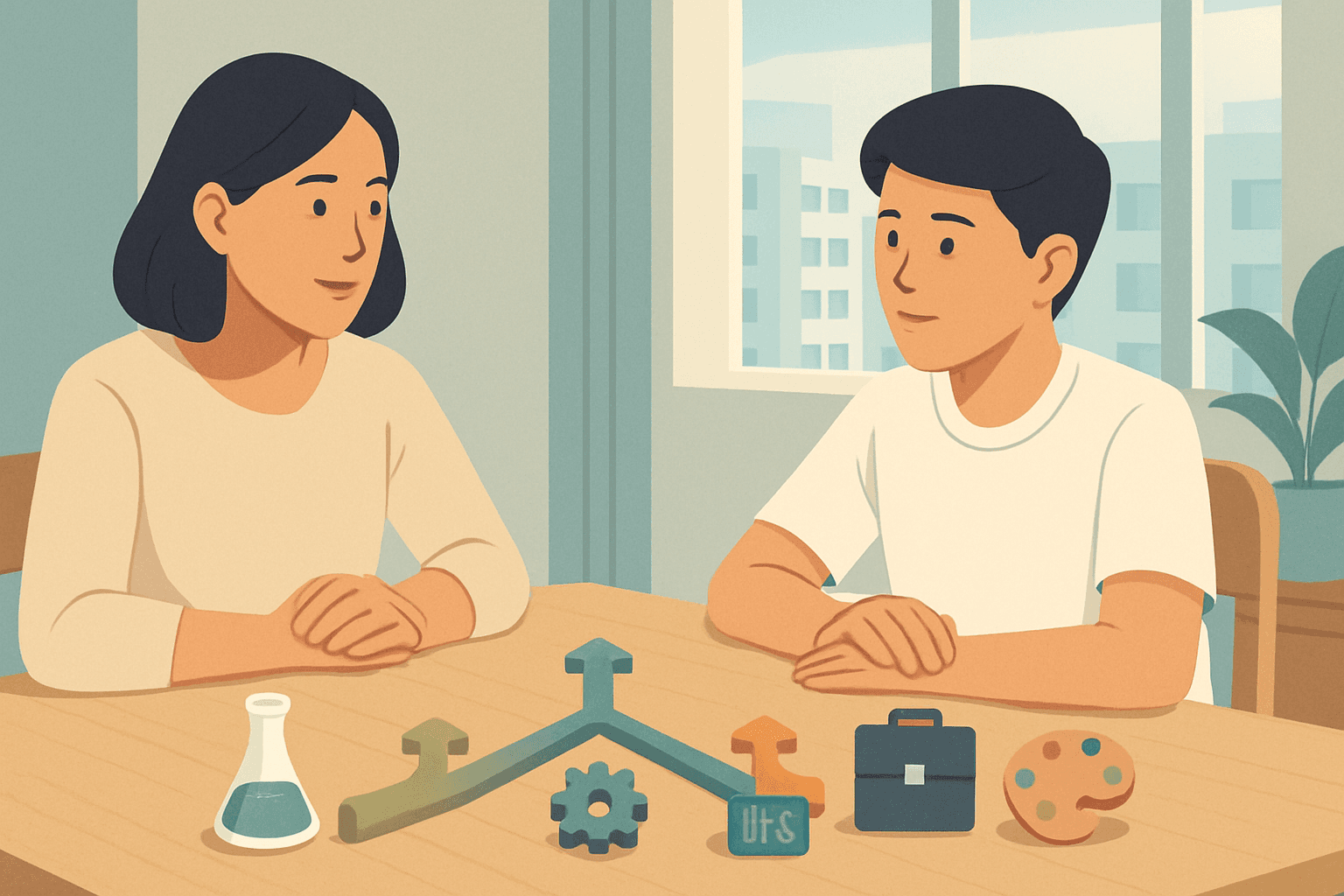
If your child may aim for polytechnic, do not choose G1, G2 or G3 based on status. Start with the diploma areas they are most likely to consider, protect the subjects that act as gatekeepers for those paths, and choose levels they can handle steadily enough to produce strong results across the whole subject mix.
What do G1, G2 and G3 mean in simple terms?
They are subject levels with different depth and pace under Full Subject-Based Banding, not labels for your child’s overall ability.
G1, G2 and G3 are subject levels under Singapore’s Full Subject-Based Banding framework. In simple terms, they reflect different depth and pace in a subject so that students can be matched more closely to their current readiness, instead of being boxed into one fixed track for everything. MOE describes Full SBB as subject-level customisation rather than old-style streaming, and Schoolbag’s overview explains this in parent-friendly language.
The most useful way to think about these levels is this: they are fit labels, not status labels. A child may be ready for faster, deeper work in one subject and need more support in another. For example, a student may cope well with a higher-level English class because reading and writing come naturally, but need a more manageable maths level because they are still building confidence with core concepts. Another child may show the opposite pattern.
Insight line: pick for fit, not for prestige. The best level is the one that lets your child learn steadily and score well. If you want a fuller parent guide to the framework itself, start with What Is Full Subject-Based Banding in Singapore? and then read What Do G1, G2 and G3 Mean in Secondary School?.
All About Polytechnics
If go poly, have to make sure to study the course u want. If not, wasting 3 years precious time and $. This is the risk, if go to poly. The school fees $ Polytechnic course, charged per year (annum) for PRs & SCs (Singapore citizens) : not cheap.
All About Polytechnics
Hi, I am asking around for my daughter who has just finished Sec 3 this year and contemplating of a Poly course after her OP. She is thinking of TP, NP, or SP. At the same time, the courses she has in mind are : (a) Maritime studies (b) Life science Applied science (d) Chinese media and communications (e) Chemical engineering (f) Psychology The Polys and courses are not in order of priority. Are there parents or children who have taken any of these courses or studied in any of these Polys ? Than
How do G1, G2 and G3 connect to polytechnic pathways?
Polytechnic planning is course-specific, so subject levels should support the strengths needed for the diploma areas your child is most likely to pursue.
They connect indirectly, but in a very practical way. Polytechnic admission is course-specific. Students apply to diploma courses, not to one general “poly” pathway, so the subject levels your child takes should support the diploma areas they are most likely to consider later.
That is why the better parent question is not, “Which level is best for poly?” It is, “Which subjects matter most for the kinds of diplomas my child may realistically want?” Engineering and many IT-related diplomas often place more pressure on maths. Applied science and healthcare-related areas may need stronger science readiness as well as workable English. Business courses often reward a combination of language, numeracy and consistency across subjects. Design and media pathways may fit creative students, but those students still need enough academic stability to cope with projects, coursework and communication tasks.
This is also why mixed subject levels can make sense. A child can be poly-suited overall, yet still need a lower level in one subject to protect the final result profile. That is normal under Full SBB. If you want a broader explanation of mixed subject combinations, see Can Students Take Mixed Subject Levels Under FSBB?. For a broader overview, see What Do G1, G2 and G3 Mean in Secondary School?.
Is it easier to go University via the Polytechnic Route?
cut-off grades: AAA/A NUS Dentistry 44 AAA/A NUS Materials Science & Engineering 50 AAA/A NUS Environment Engineering 58 AAA/A NUS Industry & Systems Engineering 67 AAA/A NUS Law 231 AAA/A NUS Medicine 260 AAA/A NUS Chemical Engineering 295 AAA/B NUS Pharmacy 132 AAA/B NUS Business Admin (Accountancy) 133 AAA/B SMU Laws 125 AAA/B NTU Aerospace Engineering 87 AAB/A NTU Maritime Studies with Business Major 16 AAB/B NUS Business Admin 457 AAB/B NTU Accountancy 574 AAB/B NTU Business 503 ABB/A NUS B
All About Polytechnics
Alamak... like that very hard to advice. Whether go the poly or JC route, must still read, revise and review to keep up with lesson plan. Student may not have an idea could be because there are too many choices out there. It can be rather overwhelming having to decide on one's future at 16yo. Time to go \"shopping\" for courses tomorrow and go for JAE counselling. JC: student may find GP a challenge due to the EL score Poly: as the student's strength is in Maths and Science, then perhaps explore
Have More Questions?
Get personalized guidance on schools, tuition, enrichment and education pathways with AskVaiser.
Try AskVaiser for Free →Which students are usually better suited to G1, G2 or G3 for a subject?
Students who are consistently coping with the pace and workload may suit a higher level, while students still building foundations often do better at a more manageable level.
The practical test is not ambition. It is readiness, consistency and stamina in that subject. A child is usually better suited to a higher level when they are already coping with class pace, completing work with reasonable independence, and showing that their stronger marks are steady rather than occasional. A child is usually better suited to a lower level when they still need more scaffolding, more teacher support, or more time to lock in fundamentals before moving on.
Parents often miss the stamina piece. Some children can survive a harder level for one term, but only with heavy tuition, nightly battles and rising stress. That usually means the level may be too ambitious over the long run. On the other hand, some children look average early in the year but are actually coping well once routines settle, so one weaker test should not decide everything.
A simple check helps. Look at the last few months, not just the last worksheet. Is your child keeping up in class, doing homework with manageable support, and recovering from tests without losing confidence? A realistic example is a student who is strong in English and humanities but shaky in maths. For that child, keeping English at a higher level may make sense if communication-heavy diploma areas are likely, while choosing a more manageable maths level may protect the overall result profile. Use the school’s advice seriously, but compare it against what you see at home: independence, stress response and how much outside help is needed. For a broader overview, see How to Choose Between G1, G2 and G3 for Each Subject.
All About Polytechnics
Hi, wld like to provide some inputs here! I had the benefits of experiencing both JC and Poly thus can provide my 2 cents worth of advice. The key question to ask yourself / your child is that what is the end goal of their education path. For many, its either 1) Get into a local university 2) Local or not, I would like to pursue what I passionate about. 1a) If the answer is 1, simply think what kind of education fits your personality! JC is kinda more stressful, focus on the results of your A le
Is it easier to go University via the Polytechnic Route?
not so sure, but i think it also largely depends on the popularity of the course. personal experience, i was accepted into NUS course via my poly grades (but i did not pursue that route); i don't think i will be able to get into the same course if I went JC considering that i was already struggling during the first 3 months scratching my brains on Physics, Chem, and 2 math subjects on top of languages, things that were academic but of no relevance to my eventual choice of work. dragged myself to
How should parents choose if their child wants poly but is unsure of the exact course?
Choose around broad interest areas and the subjects that usually matter for those clusters, rather than forcing the highest level for every subject.
Use broad diploma clusters, not exact course titles. Most Secondary 1 and Secondary 2 students do not know the exact diploma they want, so the sensible approach is to start with likely areas such as engineering, IT, healthcare, business or design, then work backwards to the subjects that usually matter most for those directions.
If your child likes coding, gadgets or problem-solving, maths often deserves special attention. If they lean toward healthcare or science-related fields, science and English may matter more because those areas often require both content understanding and communication. If business seems likely, dependable English and numeracy may be more important than forcing the highest level across every subject. If design or media feels like the natural fit, do not ignore English and general academic stability just because your child is creative. Poly still involves reports, presentations and project deadlines.
When a child is undecided, protecting overall performance is usually safer than maxing out every subject level. You are not trying to keep every theoretical door open. You are trying to keep the most plausible doors open without overloading your child. For a broader subject-by-subject planning framework, see How to Choose Between G1, G2 and G3 for Each Subject. For a broader overview, see How G1, G2 and G3 Subjects Work for O-Levels.
Which course to choose for Poly?
Start of with asking your child his area of interests. Business/Engineering/IT/Science etc. Do take note that for diploma holders, chances of going local uni is quite slim. He needs to get about 3.8 (perfect score is 4) for business courses and 3.5 for almost all other courses. Accountancy has much to offer and holds long term prospects though the first 3-5 years will be very tough going. There is always a demand for account graduates locally and overseas (Aust/New Zealand/UK). Marinetime/Aerosp
All About Polytechnics
1, any responses provided do not have to include all courses or Polys mentioned above. Even 1-2 insights will allow us to shed light. 2, the Poly discussions compared to those for IP, JCs even PSLEs are not a lot on this site. This makes it more difficult for anyone to understand what Polys have. We are not after the general differences already mentioned on the site but details. Unless someone has deep insights to answer various areas now, any knowledgebase will have to be built up progressively
Which subjects matter most for polytechnic preparation?
Focus first on English, maths, science and the subjects most closely linked to your child’s likely diploma area.
The subjects that usually matter most are English, maths, science and any subject closely tied to your child’s likely field. The exact emphasis differs by diploma course, so parents should think in terms of gatekeeper subjects rather than assume every subject matters equally for every pathway.
English matters more often than many parents expect because polytechnic courses still involve writing, presentations, teamwork and project communication. Maths is often the main pressure point for engineering, computing and some business-related directions. Science can matter more for students leaning toward applied science or healthcare. For students interested in design, media or other applied creative pathways, English and a stable overall profile can matter just as much as one specialist strength.
What parents often misunderstand is this: the most useful subject is not always the one taken at the highest level. It is the subject your child can turn into a strong final grade in an area that actually matters for their likely pathway. MOE’s page on the secondary school experience under Full SBB is helpful for understanding why subject levels are meant to match strengths rather than follow a one-size-fits-all model. For a broader overview, see Does Taking G1 or G2 Limit Future Options Later?.
All About Polytechnics
Hi mondecoinmetier, The following article may be useful for you. https://www.straitstimes.com/singapore/education/he-goes-for-tuition-and-hes-in-poly Tuition agencies contacted say they have been receiving more inquiries from tertiary students who want a tutor to help them do better in polytechnic or university. Most of the demand is for tuition in mathematics, statistics, engineering and accounting.
All About Polytechnics
Read on another thread that says poly students who want to aim local uni like NUS NTU SMU need to maintain a 3.7 GPA for all the modules. My friend’s kid can only go to poly to do hospitality type of courses. For such courses, can they even apply to any relevant course in NUS NTU SMU even if the kid can maintain a GPA of 3.7? Or must prepare $$ for overseas uni?
What are the tradeoffs between choosing a higher or lower subject level?
Higher levels may preserve more options, while lower levels may protect grades and confidence; the right choice is the one that leads to stronger usable results overall.
A higher level can keep more options open, but only if your child can cope with it well enough to produce strong results. A lower level can protect confidence, workload balance and grades, but it may narrow some future choices. The real tradeoff is not pride versus caution. It is flexibility versus manageability.
A subject taken too high can create a chain reaction. A child may pour so much time into one difficult subject that other subjects start slipping. This is especially risky when the pressure point is a core subject like English or maths, because weakness there tends to spill into other areas. The opposite mistake happens too. Some parents choose a lower level too quickly out of fear, even when the child is coping reasonably well and could have handled slightly more challenge without harming the rest of the timetable.
A practical way to judge the tradeoff is to ask what the likely outcome really is. Will the higher level stretch your child productively, or simply convert family time into damage control? Insight line: options are only useful if results are strong enough to use them. For most families, the best mix is balanced, not maximal.
Which course to choose for Poly?
Different people think different. You should find out why he think that the course is difficult. For example, certain courses are very mathematical/qualitative based so a good number of students don’t do well. However, that could be an advantage for another group of students. As for university courses, it is practically very difficult if you are considering NUS/NTU/SMU. SIT is a different story since it focuses mainly on poly graduates and its new (nowhere in the top 100 world uni yet). Engineer
All About Polytechnics
Allow me to share what I have heard from others regarding the Poly course (before i continue, please be assure that I am speaking from a neutral viewpoint). Poly is a good place for kids to grow up learning how to manage their time and strengthening their EQs through relationship management (due to projects after projects). However, if the student does not have a strong convictions of why he/she chooses a poly course, he/she might face difficulties in handling the course, which might lead to fai
How does subject choice affect O-Level results and other post-secondary options?
Subject choice affects the final exam profile, and that profile shapes which polytechnic, JC, ITE and other post-secondary options remain realistic later.
Your child’s eventual subject mix shapes the exam profile they bring to polytechnic, JC, ITE or other post-secondary routes. In practice, later options are influenced by final performance and subject combination, not by what your child hoped to do at the start of Secondary 1.
This matters because some routes look beyond an overall score. Subject-specific performance can matter too. MOE has stated this clearly in its release on post-secondary admissions, including that some routes such as PFP consider subject-specific requirements for the chosen course and not just aggregate performance, as seen in the O-Level results and JAE release. The exact details differ by pathway and course, so parents should not assume that “average across everything” is enough.
The practical takeaway is simple. A balanced profile with good grades in the subjects that matter is usually more useful than one over-advanced subject paired with several weak results. That matters even more if plans change later. Students are not locked forever into one intention, but flexibility depends on the final profile they build. For a broader parent guide, see How G1, G2 and G3 Subjects Work for O-Levels, Can G1 or G2 Students Still Go to JC, Poly or ITE?, and this general explainer on what students usually consider after the O-Levels.
My son not coping well in JC 1 now/is Poly route better ??
Just sharing my own experiences years ago. I was in a top 5 JC and good science class but wasn’t doing well (Ended up with B, B, C) - in JC 2 i had good private tuition for all subjects . If i could go back and choose again, i wouldn’t want to be pressured by my parents to 1st go to JC, then 2nd stay in JC to finish what i started. When i went to a good overseas uni to a science course of my choice, i felt that my two years in JC were a complete waste of my time since i did not particularly lear
All About Polytechnics
If the same poly courses (chemical engineering) r offered by NP, SP & TP. We placed 1st choice as SP as SP has the lowest cut iff point. If the child did not get into SP will he/she be allocated ti NP or TP instead? Although his 2nd choicr for course may be mass comms instead? I m kinda lost with the JAE poly application. Can someine advise?
What is the biggest mistake parents make when choosing G1, G2 or G3?
Choosing based on pride, fear or comparison instead of the child’s readiness, stamina and likely course fit.
The biggest mistake is choosing based on adult emotion instead of the child’s actual fit. Some families push for the highest level because it feels safer or more impressive. Others choose too low because they are afraid of struggle. Both decisions miss the real question: can this child handle this subject level steadily enough to keep confidence, manage workload and still build strong final results?
The wrong level is the one that looks reassuring to adults but makes daily learning harder for the child.
Employment rates for different poly courses?
2014 http://i66.tinypic.com/2hyud8x.png\"> http://i65.tinypic.com/apfgg0.png\"> http://i63.tinypic.com/ivydkl.png\"> 2015 http://i64.tinypic.com/3005ssz.png\"> http://i67.tinypic.com/2csa1wg.png\"> http://i66.tinypic.com/2db457m.png\"> Notes :\t\t\t\t\t\t\t 1) Polytechnics refer to Nanyang Polytechnic (NYP), Ngee Ann Polytechnic (NP), Republic Polytechnic (RP), Singapore Polytechnic (SP) and Temasek Polytechnic (TP).\t\t\t\t\t\t\t 2) Fresh graduates refer to those who had completed their studies
All About Polytechnics
By Christopher Ng Wai Chung As a parent of two kids, issues affecting Polytechnic students and graduates are important issues to me because, at this moment, I still lie behind the Rawlsian veil. I am concerned that if my children do not qualify for a seat in a local university and end up studying in a Polytechnic/ITE, they will face an uncertain future with the gig economy. I think many parents have this fear but they are too ashamed to admit it because it hurts the feelings of 50% of their frie
What should parents ask the school and themselves before deciding?
Use these questions to test fit, workload, likely diploma direction and how the subject mix may affect later options.
- ✓Which subjects does my child handle consistently well across a few terms, not just in one good test?
- ✓In which subjects is my child still building foundations and likely to need more scaffolding or a slower pace?
- ✓If we choose a higher level for this subject, is the likely outcome stronger learning and results, or simply more strain?
- ✓If we choose a lower level, are we protecting confidence sensibly, or underestimating what the child can manage?
- ✓Which broad diploma clusters does my child seem most interested in now, even if they do not know the exact course yet?
- ✓For those likely clusters, which subjects are the ones we most need to protect and strengthen?
- ✓How will this subject mix affect the child’s total workload across all subjects, not just one subject in isolation?
- ✓What have teachers noticed about pace, independence, class participation and the amount of support my child needs?
- ✓Have similar students in this school generally done better with this level mix, and where were the common pressure points?
- ✓If my child changes direction later, will this subject combination still leave reasonable post-secondary options open?
Have More Questions?
Get personalized guidance on schools, tuition, enrichment and education pathways with AskVaiser.
Try AskVaiser for Free →