
How to Compare DSA Schools by Academic Support and Workload
A practical parent guide to checking workload, academic tracking, and flexibility before choosing a DSA school.
To compare dsa academic support across schools, focus on three things first: the real weekly workload, the school’s system for tracking academic progress, and what happens when DSA commitments clash with schoolwork. A strong fit usually means the school can explain its monitoring process clearly, offers practical help when a student falls behind, and has a workable approach during competition or rehearsal periods.
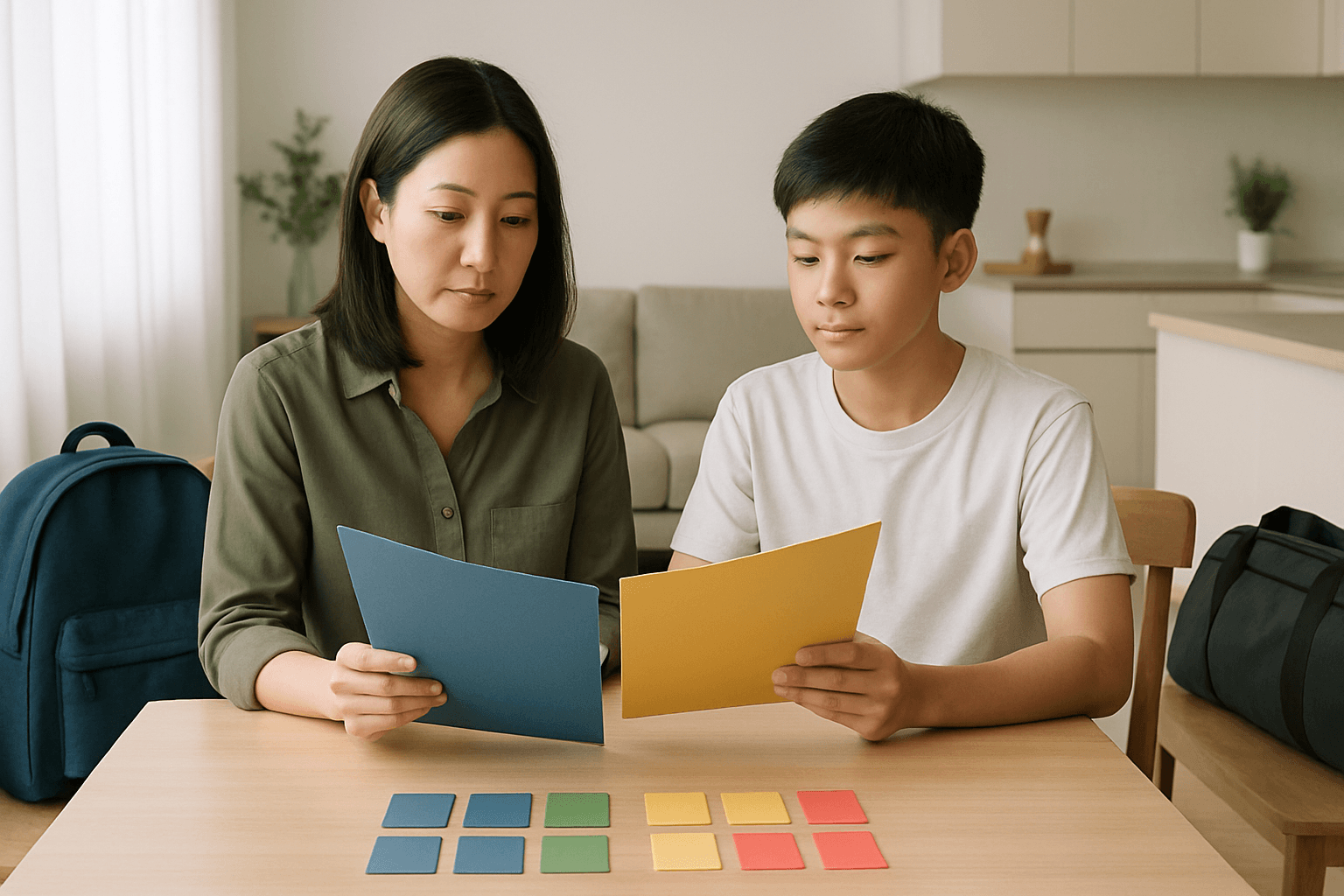
When comparing DSA schools, start with one practical question: can this school help your child keep up academically while meeting DSA commitments without burning out? That matters more than programme prestige. MOE says DSA-Sec schools consider academic suitability alongside talent and personal qualities, so parents should compare more than the talent pathway. Look at the real weekly time demand, how the school monitors academic progress, and what happens when lessons, tests, or deadlines clash with training or performances. Support is not standard across schools, which is why school-specific questions matter.
What should parents compare first when looking at a DSA school’s academic support and workload?
Compare three things first: weekly time demand, academic monitoring, and how the school handles clashes or setbacks.
Start with three things: the real weekly time demand, the school’s academic monitoring, and how it handles clashes or setbacks. This tells you much more than reputation alone.
A school may have a strong sports team, performing arts programme, or STEM pathway, but that does not tell you whether your child will still have enough space for homework, revision, sleep, and recovery. Parents often compare schools by programme strength first and support second. In practice, it is usually wiser to reverse that order.
Think of this as a fit check, not a prestige check. Imagine a normal week with training, one test, travel time, and one late return home. Can your child still finish work without constant chasing? If the answer already looks shaky on paper, the workload may be too tight. The better DSA school is usually the one your child can still manage in a busy term, not the one that only looks strongest at the open house. For a broader overview, see Direct School Admission Singapore: A Practical Parent Guide.
2010 DSA(Direct School Admission)
DSA is not that time consuming. Essentially there are just the following steps, for most schools: 1. Online application: Have your results and awards on hand for easy reference. 2. Preparation of portfolio: Photocopy and certify your results, awards, certificates etc as required by the school. Check with the school for their requirements. 3. Submission of portfolio to school: Some schools ask you to bring it with you during the interview, some schools require you to submit it before the intervie
2008 DSA(Direct School Admission)
[quote]How will we be able to tell which sports is favored by a particular school under DSA? Is such info published?[/quote] Yes, each school has its own preference and they are normally published on the schools' websites. DSA is not only for Sports or Music talents, if your child is good academically throughout the years (esp P4 - P6), then, you can also try for DSA at some of the top schools. Each school has their own entrance tests and interviews. Independent schools can take in up to 50% of
What does academic support usually mean in a DSA school?
Academic support usually means a clear system for tracking progress and helping students recover when schoolwork starts slipping.
Academic support usually means a system for noticing and responding when a student is struggling. In some schools, that can include regular grade checks, teacher consultations, subject-specific follow-up, structured catch-up arrangements after missed lessons, or a form teacher, coach, or programme lead who keeps an eye on whether the student is coping. These are common examples, not guaranteed services in every school.
What matters most is whether the school can describe the process clearly. Ask who notices if grades drop, who the student should approach after missing lessons, and what happens after a weak test result. A general line such as "our teachers are supportive" is less useful than a concrete answer such as "the subject teacher arranges consultation and the form teacher follows up if the issue continues." In DSA, goodwill helps, but systems matter more. For a broader overview, see How to Apply for DSA in Singapore.
2010 DSA(Direct School Admission)
Hi, I hope someone can enlighten me on DSA. I've completely no idea what it is. :? How does it work and is it related to CCA ? My boy is in P4. Thanks in advance.
2009 DSA(Direct School Admission)
Any one needs to know more about DSA school preference exercise can go moe web, dsa. Can read up the frequent-ask question, it explains very clearly.
Have More Questions?
Get personalized guidance on schools, tuition, enrichment and education pathways with AskVaiser.
Try AskVaiser for Free →How can parents tell if the workload is realistic for their child?
Build a realistic week on paper. Training, travel, homework, revision, sleep, and recovery all need space.
Translate the programme into normal weekly life. Look beyond the official timetable and map out how much time will really go into training or rehearsals, travel, homework, revision, meals, sleep, and recovery. A DSA arrangement may sound manageable until you include the journey home, the tiredness after training, and the fact that school assessments do not pause during a busy season.
A practical way to test this is to build a sample week. If your child already has two or three late afternoons, ask when revision will realistically happen and whether weekend catch-up will become the default. A self-directed child who already uses a planner and starts work early may cope with a heavier schedule. A child who needs repeated reminders may struggle once late evenings become routine.
A useful rule of thumb is this: a good DSA fit is one your child can sustain in Week 12, not just Week 1. For a broader overview, see DSA vs PSLE: Which Route Should Parents Prioritise?.
DSA academic route
Hi, I am new to the dsa thing, will appreciate some advice regarding academic dsa for rgs and nygh (non-gep) 1) Do the above 2 schools look for talent in a specific subject, eg math, or for overall good results in all 4 subjects? 2) What are considered good results? Is 80+ good enough? 3) Will the schools consider just school results, or will they also look at evidence of external achievements such as awards for competitions? 4) If students apply through academic dsa, are CCAs still important? T
2010 DSA(Direct School Admission)
Invariably at each year's open houses, such questions are asked and answered wrt vacancies By the way, the admission is based on merit and exceptional ability demonstrated, not to fill a quota Each independent schools has their own selection criteria, a desire to maintain a certain type of culture and environment, hence each school is unique and all their vacancies will be filled by the time of S1 posting. The DSA process can be viewed as a form of training for the kids - go strive for what you
What should parents ask about training, rehearsals, and competition periods?
Ask how the school handles missed lessons, tests, deadlines, and teacher coordination during peak periods.
Ask about the busiest periods, because that is when weak support systems usually show up. Find out what happens when a student misses lessons for competitions or performances, whether make-up work is given, whether subject teachers are informed, and how tests or assignment deadlines are handled if there is a genuine clash. The practical issue is not whether the child will ever be busy. It is whether the school has a workable response when busy periods happen.
Use real scenarios when you ask. For example, what happens if a student misses science revision because of a tournament, comes back late after a rehearsal, or has a class test during competition week? Parents often get clearer answers at open houses and Q&A sessions, which is why many families use resources such as this open house question guide to prepare.
If the answer is clear and operational, that is a good sign. If the answer stays broad, keep probing until you understand what the student is expected to do in real life. For a broader overview, see How DSA Fits Into the Secondary 1 Posting Process.
2009 DSA(Direct School Admission)
[Moderator's note: Topics merged.] Hi there, I am wondering if anyone out there has kids who have gone thru DSA via sports? My P5 son is in his pri school table tennis school team. I am thinking whether to let him try DSA next yr as I heard it can be quite taxing to cope with both school work and training. Pls advise. Thanks!
How many DSA schools did you apply to?
Did anyone discuss about the administration of the DSA program avywhere before? What I don’t understand are the following: i. Why administer the admission exercise before PSLE results are out? Why have parents do the unnecessary when they do it out of insurance? ii. What is the intention of the DSA? To attract bright and CCA-rounded individual or to reach out to potential-national team squad who probably can’t get into these schools otherwise? iii. Anyone knows what are the selection criteria fr
How do strong schools support students who fall behind academically?
Look for an early-response system: the school notices slippage, involves the right teacher, and follows up before problems deepen.
Strong schools do not assume DSA students will always cope smoothly. They notice problems early, involve the right teacher, and communicate clearly with home when needed. That might mean a subject teacher arranges consultation, a student is given structured catch-up work, or the form teacher checks whether the problem is temporary or becoming a pattern. The exact support differs by school, but the school should be able to explain the response without sounding unsure.
A common parent misunderstanding is to equate support with lower expectations. Good support is not about making school easier. It is about helping the student recover before a temporary dip turns into a bigger problem. If you hear examples such as follow-up after a poor test, regular grade monitoring, or early parent contact when a student starts slipping, that usually points to a more intentional support culture.
If you are still deciding whether the route itself makes sense, our guide on whether Direct School Admission is worth it for your child can help with that bigger decision.
2008 DSA(Direct School Admission)
Hi Sally, You can check all about DSA via this website. http://www.moe.edu.sg/education/admissions/dsa-sec/ One advice is to start working on your child's portfolio detailing his academic achievements, CCA involvement, certificates attained (NSW, Math Olympaid), proof of community involvement, leadership positions etc.... All the best!
2010 DSA(Direct School Admission)
That is an impressive percentage of students getting DSA. Do you know if they got in through Academic or Sport DSA? Also, which school would this be? Thanks.
What are the warning signs that a DSA programme may be too demanding?
Red flags include vague answers about support, unclear workload, and a culture that seems to expect students to just cope.
The clearest red flag is this: the school can describe the talent pathway in detail but gives vague answers about academics. Other warning signs include unclear weekly commitment levels, no clear explanation of what happens when lessons are missed, and little visibility on how teachers respond when grades fall. High standards are not the problem. High demands without structure usually are.
Should DSA be scrapped?
I think it is a matter of: 1. How much you really want to enter that institution? 2. How much you like that CCA in order to perform well all the time? If you really want something, you will make it happen for yourself despite all trials along the way. If you are really good in the CCA, it should be a breeze to be contributing. If you cannot answer the above 2 questions sufficiently to convince yourself, do not DSA, it means commitment and this requires one to put in great responsibilities.
Should DSA be scrapped?
Ykiasu.. What makes you think that DSA does not involve hardwork? Have you or your DS/DD been through DSA before?[/quote]DSA is just a different acceptance into the school. For PSLE, you study hard and you do well in your academic performance. But some pupils may not do well in exams but excel in competitions, Olympiads, Sports, Aesthetics, which DSA provides as a platform to enter the school. Plus, to go through DSA is not an easy process, you have to sort out the necessary certs etc. and prepa
What questions should parents ask during open houses or DSA interviews?
Use a short question list focused on workload, academic monitoring, and what happens during busy periods.
- ✓How many hours a week are typically spent on training, rehearsals, or programme activities during a normal school term?
- ✓How does the school monitor the academic progress of DSA students after they are admitted?
- ✓What usually happens if a student starts falling behind in one or more subjects?
- ✓How are tests, homework, or assignments handled during competition, performance, or travel weeks?
- ✓Do students usually get consultation time, make-up work, or other catch-up arrangements when they miss lessons?
- ✓If my child has not represented the primary school in competitions or events, how does the school assess readiness and fit?
- ✓Who should parents contact if academic pressure becomes too much during the school year?
How should parents weigh school support against their child’s temperament and study habits?
Match the school’s demands to your child’s current organisation, independence, and recovery habits, not just their interest level.
Match the school’s demands to how your child actually works now, not how you hope they will work next year. A self-directed student who tracks deadlines, recovers quickly after busy days, and asks for help early may cope in a more intense DSA setting. A child who needs frequent reminders, struggles to restart after setbacks, or becomes quiet when overwhelmed may need a school with closer structure and more visible follow-up.
This is where many families overestimate fit. They assume a child who loves the activity will automatically manage the workload that comes with it. Interest helps, but habits matter more over time. If your child already needs daily prompting for homework, a school with heavy commitments and weak academic monitoring may become stressful very quickly.
The right school is not just strong enough for your child. It is structured enough for how your child works. For broader context, this Schoolbag piece and our guide on DSA vs PSLE priorities are useful next reads.
2008 DSA(Direct School Admission)
One of the reasons why we decided to apply for DSA is because the independent schools can admit up to 50% of cohort through DSA. The remaining 50% vacancy are left for students going in through PSLE scores. So as a \"kiasu\" parent, want to maximise the chance. My son felt the DSA tests and interview \"drained up all his brain juices\". After spending 6 hours on all the tests and interview, he went home so tired and slept for the whole day. :lol:
2009 DSA(Direct School Admission)
Give your child the opportunity to try DSA but ensure they have realistic expectation and not to depend on DSA to gain entry into the choice school. From my understanding with parents who tried DSA CCA with various school, each school has its own criteria, expectation and preferred sports for DSA application including quota. The competition among students depends on the number of applications. If the student was awarded medal in National Level sports and the sport is a niche or preferred sport o
What is the simplest way to compare two DSA schools side by side?
Use a simple five-row comparison table: time load, missed-lesson support, help when grades dip, peak-period flexibility, and child fit.
Use a one-page comparison table and rate both schools on the same five areas: weekly time load, support for missed lessons, help when grades dip, flexibility during competition or rehearsal periods, and fit with your child’s work habits. Keep the scoring simple. Green, amber, and red is often enough.
This method helps families separate practical fit from reputation. For example, School A may have a stronger programme name but be unclear about make-up work or academic tracking. School B may look less prestigious but offer a steadier timetable and clearer follow-up if students struggle. For many children, School B is the better DSA choice.
Treat this as a long-term placement decision, not a casual trial. If your child is admitted through DSA-Sec, it affects the usual Secondary 1 pathway, so compare schools with the same seriousness you would use for any major school decision. If you need the wider process explained, start with our Direct School Admission Singapore guide, then read how DSA fits into the Secondary 1 posting process and how to apply for DSA in Singapore. For extra parent-focused perspective on readiness, this KiasuParents article is also useful.
Singapore Secondary School short listing for DSA
This is an online workbook to help you shortlist secondary schools for DSA. You may shortlist secondary schools by DSA, location and more: https://public.tableau.com/app/profile/sg.parent/viz/SingaporeSecondarySchoolSearchDSA/Search Please view these workbooks from a computer and not mobile device (may not not display in full). Will work towards updating them yearly.
How many DSA schools did you apply to?
Why go the DSA route if kids are definitely going to do well in psle? Is DSA about using cca to get to the sec school? Am I missing something here?
Have More Questions?
Get personalized guidance on schools, tuition, enrichment and education pathways with AskVaiser.
Try AskVaiser for Free →