
DSA Far From Home: How to Decide If the School Is Worth the Commute
A practical guide for Singapore parents weighing programme fit against daily travel, fatigue, and family routine.
Yes, a far DSA school in Singapore can be worth it, but usually only when the programme is a genuinely strong match and the commute still leaves enough room for sleep, homework, CCAs, and family life. If the route is tiring, fragile, or likely to cause repeated stress, a closer school is often the better long-term choice.
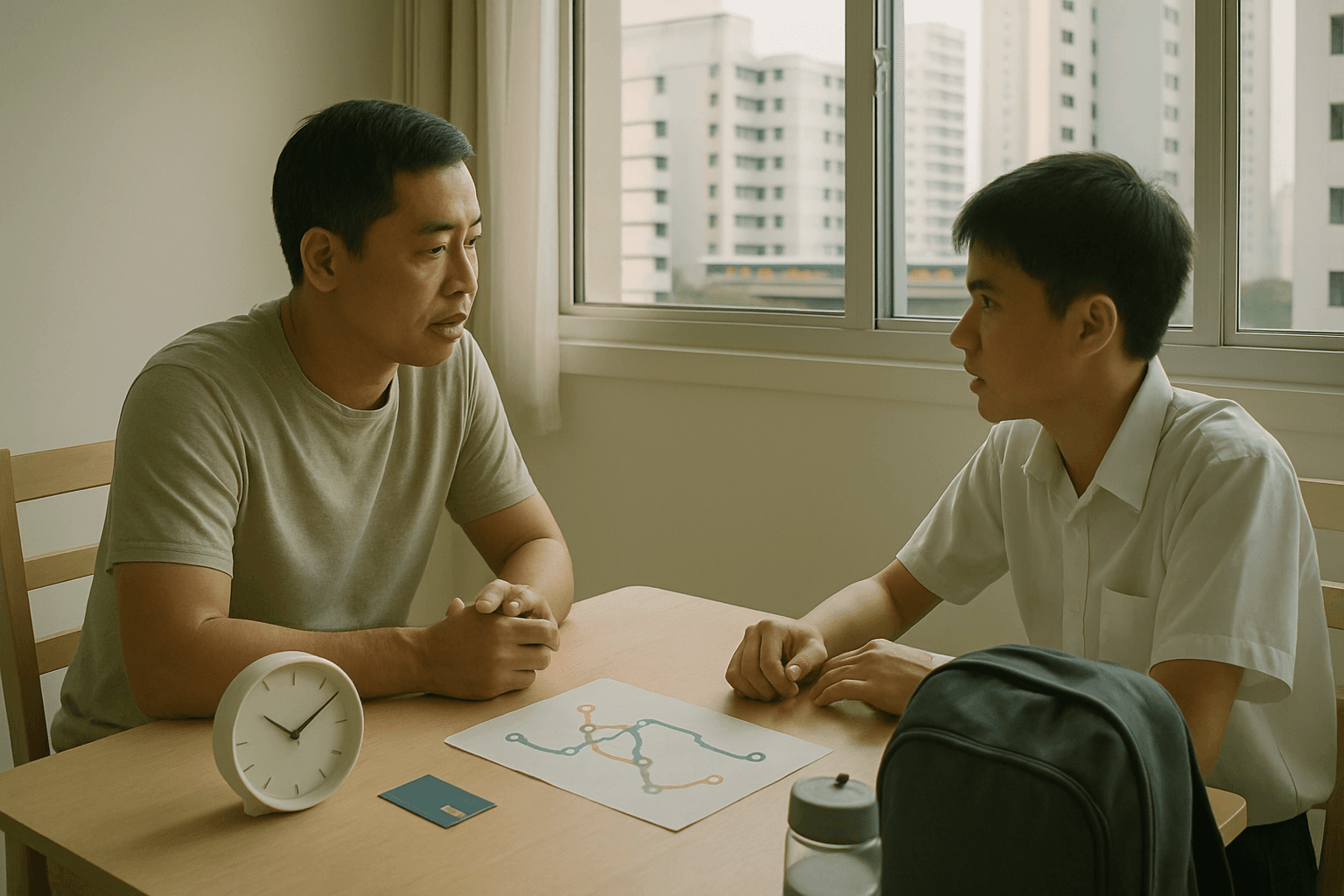
A far DSA school is worth serious consideration only when the programme fit is strong enough to justify the commute day after day. Distance alone should not decide the choice, but neither should school reputation. The better question is this: will this school give your child something meaningfully better than a closer option, without turning daily life into a strain that the family has to keep rescuing?
Short answer: is a far DSA school worth it?
A far DSA school is worth considering only when the programme fit is strong enough to justify a routine your child can realistically sustain every day.
Yes, it can be worth it, but only if the school offers a strong enough fit to justify the daily routine. If the child is going far mainly for a school name, vague prestige, or a programme that is only slightly better than a closer option, the commute often becomes the bigger story over time.
The most useful way to think about this is fit versus friction. A far school may make sense when the DSA area is genuinely important to your child, the school has a clear pathway in that area, and the commute is manageable enough that your child can still sleep properly, finish work, and stay emotionally steady. If the journey drains energy before the school day even starts, the advantage of the school becomes harder to enjoy.
A simple rule of thumb is this: a good fit that exhausts a child every day is not a good fit for long. If you want a broader overview first, start with our Direct School Admission Singapore guide, then read Is Direct School Admission Worth It For My Child? to judge whether DSA itself is the right route.
Do non-GEP student has much chance with DSA
Side track … but since we are talking about coming DSA . Is there any parents sending his/her child for DSA preparation course or have ever sent their kids for such course in the past? Any school to recommend and how much do they charge? Is it adviseable to attend such course?
How many DSA schools did you apply to?
Why go the DSA route if kids are definitely going to do well in psle? Is DSA about using cca to get to the sec school? Am I missing something here?
What should parents count as "far" in real life?
Far means the real door-to-door load of the journey, not just map distance.
Far is not just the number of kilometres on a map. It is the full door-to-door burden on a normal school day, including walking time, waiting time, transfers, crowded peak-hour travel, and the trip home after CCA or other after-school commitments.
Two routes that look similar on paper can feel very different in real life. A direct MRT ride with one short walk may be easier than a slightly shorter route that needs two transfers, a feeder bus, and a long walk in the rain. A route that is usually fine but breaks down badly during bad weather or rush hour can also be more stressful than a slightly longer but more predictable journey.
Parents often compare only the morning trip. That is not enough. Compare the full week instead: regular school mornings, late CCA days, exam periods, and rainy-day backups. That is also why broader school-choice advice, such as The Straits Times discussion on choosing the right secondary school, tends to look beyond headline factors and focus on what daily life will actually feel like. For a broader overview, see Is Direct School Admission Worth It For My Child?.
2010 DSA(Direct School Admission)
By the way, if any of you want to know about DSA to any specific schools, just ask here, lah - everyone can share.
How many DSA schools did you apply to?
You may look at the All About DSA thread http://www.kiasuparents.com/kiasu/forum/viewtopic.php?f=48&t=157 or http://www.moe.edu.sg/education/admissions/dsa-sec/ While for the intention and selection criteria, you may look up secondary schools that offer DSA as each of them has a different one. List of schools offering DSA http://www.moe.edu.sg/education/admissions/dsa-sec/participating-schools/
Have More Questions?
Get personalized guidance on schools, tuition, enrichment and education pathways with AskVaiser.
Try AskVaiser for Free →When does programme fit outweigh convenience?
Programme fit outweighs convenience when the school offers a specific opportunity that is genuinely important for your child and hard to find closer to home.
Programme fit outweighs convenience when the school offers something your child truly needs and is not easy to replace closer to home. That could mean a more developed niche area, a specialised environment, or a clearer pathway in the exact domain your child is applying through DSA.
The key distinction is between "nice to have" and "hard to replace". A strong fit looks like a child with real interest and sustained effort in a domain, matched to a school that can develop that strength meaningfully. For example, if your child is applying through a specific sport, performing arts area, or leadership domain, the far school should offer more than general reputation. Parents should be able to explain, in concrete terms, what is better there and why that difference matters.
A weak fit usually sounds vague. If the main reason is that the school feels more prestigious, has stronger branding, or is simply seen as "better," be careful. The more specific your answer to "What does this school give my child that a nearer school probably cannot?" the stronger the case. If you are still judging whether your child's strengths are substantial enough for DSA, our guide on What Talents Count for DSA Eligibility? can help frame that part of the decision.
2010 DSA(Direct School Admission)
My personal experience on DSA, think twice before you accept. We decided to try DSA route because our daughter’s performance is not consistent and she is in the range of above average. We gathered that should would get anywhere between 240-260. We saw our niece went through a bad experience when she got 240+. Where the girl can only be happy to be in the next best range, as the top ranges 255++. And staying in Bt Timah and wanting her to waste little in travel time means that her risk is high to
2010 DSA(Direct School Admission)
My boy was from a good full school. He didn't have to spend alot of time on DSA. Just go and do whatever they wanted, lor. He was quite happy with what he got.
How travel affects a student's day beyond the commute
A long commute affects sleep, homework time, recovery, and daily energy, not just transport time.
A long commute changes more than transport time. It changes wake-up time, sleep duration, evening recovery, homework pace, and how much energy a child still has by the last part of the day.
In practice, the strain is often hidden at first. A student who leaves home much earlier may lose sleep even if everything else stays the same. On CCA days, the effect is larger. A child who reaches home after training or practice may still need to shower, eat dinner, finish homework, and prepare for the next day. What looked manageable on one trial journey can feel very different after months of repeating it.
One useful way to picture this is to look at the whole timetable, not just the route. If a child needs to leave home before 6.30am, gets home after 7pm on some CCA days, and still has schoolwork to finish, the commute is no longer a small detail. It is shaping sleep, mood, and recovery. Fatigue does not always show up as dramatic burnout. Sometimes it appears as slower homework, more irritability, or a child who starts dreading school mornings even though they still like the school.
The commute is not one part of the day; it reshapes the whole timetable around it. That broader family impact is also why parent-support discussions on Schoolbag often go beyond grades and talk about wellbeing, support, and routine. For a broader overview, see Is a DSA Offer Binding? What Parents Commit To.
Re: DSA 2025
Improving school-based talent programs, collaborating with community centers to provide reasonably priced training, and emphasizing assessments on potential rather than polished abilities are some ways to make DSA more accessible. https://www.straitstimes.com/singapore/direct-school-admission-must-be-accessible-to-all-students-chan-chun-sing bitlife @trulyarise said in Re: DSA 2025 :
Should DSA be scrapped?
I think it is a matter of: 1. How much you really want to enter that institution? 2. How much you like that CCA in order to perform well all the time? If you really want something, you will make it happen for yourself despite all trials along the way. If you are really good in the CCA, it should be a breeze to be contributing. If you cannot answer the above 2 questions sufficiently to convince yourself, do not DSA, it means commitment and this requires one to put in great responsibilities.
What practical questions should parents ask before deciding?
Before deciding, test whether the daily routine works in real life, including delays, late days, and changes to family schedules.
Ask questions that test the routine, not just the school name. Start by checking the full journey in both directions on a realistic weekday. If possible, picture it at actual reporting time, again at likely CCA dismissal time, and again on a wet day or a day with a delayed transfer. One smooth trial trip can be reassuring, but it does not prove the routine will stay manageable for a whole term.
It also helps to pressure-test the family logistics. If your child misses a bus, a parent is working late, or dismissal timing changes, what happens next? Some families realise that the route only works if one parent can drive part of the way. That may be workable now, but it is worth asking whether it still works when work schedules change, a sibling's timetable gets heavier, or the family hits a particularly busy season.
This is also the stage to settle family agreement early. If parents are separated or share joint custody, MOE's DSA-Sec FAQ states that a common agreement is needed and both logins are required to complete submission. That matters because a far-school choice usually creates more day-to-day logistics, so disagreements tend to grow more difficult later, not easier.
Finally, ask whether your child can handle the mornings without constant adult rescue. General transition advice, such as this KiasuParents piece on preparing for primary and secondary school, is a useful reminder that routines, organisation, and independence are part of school readiness too. For a broader overview, see How to Build a Backup Secondary School List When Applying for DSA.
Should DSA be scrapped?
Does Singapore really have DSA, My answer is no.Becasue no matter you get DSA offer or not, you need go for PSLE.In fact for most of the p6 student who get DSA offer, their PSLE score are high enough to let them enter the same school. Even quite a lot students whose PSLE score can let them go into better school, then regret, appeal…why so many students like to apply DSA, the reason behind is same as the people buy insurance. In the end most of people pay much more than they gain, otherwise insur
Should DSA be scrapped?
No real data, this is my estimation (from my point of view, it’s very conservertive). Guess how many students apply for DSA every year, they need go through different tests and interview for each school they apply for. All these need a lot manpower/material involvement , it’s not free. After PSLE, many parents find their children actually can go into better school,then raise many appeal cases (you can refer to the forum), all these need manpower to handle as well.No need to mention how much mone
Which children usually cope better with a far school?
Children who usually cope better are more independent, more motivated, and better able to manage fatigue and routine disruptions.
Children who cope better are usually the ones who already show some independence, routine discipline, and genuine motivation for the school. They tend to wake up more reliably, manage their belongings with fewer reminders, recover reasonably well after long days, and stay fairly calm when small transport problems happen.
Motivation matters because a child who truly wants the programme is more likely to accept the trade-off of the commute. That does not mean only highly mature children can manage a far school. A less independent child may still do well if the family has strong support and the programme fit is exceptional. The real question is not whether your child is naturally easygoing or "strong enough." It is whether the child and family, as they are now, can handle the routine you are choosing.
Parents can often get good clues from ordinary life already. How does your child handle packing for training, reaching tuition on time, recovering after a busy day, or restarting after a setback? Those everyday habits often predict coping better than open-house excitement does. Broader school-choice discussions, including common parental worries about choosing a secondary school, often circle back to these practical readiness issues for a reason.
2009 DSA(Direct School Admission)
Any one needs to know more about DSA school preference exercise can go moe web, dsa. Can read up the frequent-ask question, it explains very clearly.
2010 DSA(Direct School Admission)
Anyone can advise if a student is selected by a school during DSA selection but then PSLE marks is much better when released. Can this student choose another better school and reject the offer from DSA school? I am not clear on the DSA part.
What most parents overlook about a far DSA school
The biggest thing parents overlook is not the distance itself but the cumulative wear of repeating that commute through normal school life.
What parents often miss is cumulative strain. The problem is rarely one terrible trip. It is the build-up of early mornings, late CCA days, heavier homework weeks, exam periods, rainy-day delays, and the amount of family effort needed to keep everything moving.
Another blind spot is assuming that admissions-stage enthusiasm will carry the child indefinitely. Open houses, trials, and offer discussions are exciting. Daily commuting is not. A single trial run cannot show what Month 4 feels like after repeated late evenings. When families underestimate that difference, the school may still be good, but the routine becomes the part that quietly wears everyone down.
2010 DSA(Direct School Admission)
Yep, but I'm thinking if your kid is in NAFA, then don't have to consider so much when choosing SOTA. Maybe don't need to do CCA, but do NAFA instead? Along those lines...
2010 DSA(Direct School Admission)
Invariably at each year's open houses, such questions are asked and answered wrt vacancies By the way, the admission is based on merit and exceptional ability demonstrated, not to fill a quota Each independent schools has their own selection criteria, a desire to maintain a certain type of culture and environment, hence each school is unique and all their vacancies will be filled by the time of S1 posting. The DSA process can be viewed as a form of training for the kids - go strive for what you
How should you compare a far DSA school with a closer non-DSA option?
Compare the far school's unique value against the closer school's day-to-day sustainability. If the programme advantage is small, the closer option often makes more sense.
The clearest comparison is this: compare the strongest programme fit against the most sustainable daily routine. If the far DSA school offers something meaningfully better and your child can still thrive with the travel, it may be worth it. If the gap in programme value is small, the closer school often wins because consistency usually beats aspiration that is hard to maintain.
A practical way to think about it is to rate each option across four areas: programme fit, commute burden, wellbeing impact, and long-term sustainability. Many parents naturally overweight the first area and underweight the last three. In real school life, though, sleep, punctuality, energy, and family steadiness shape outcomes too.
For example, a far DSA school may be the better choice when the route is fairly direct, the child is strongly committed to that domain, and the school offers a pathway that is clearly stronger than what is available nearby. The closer non-DSA school may be the wiser choice when it still offers decent opportunities, the child is less certain, or the far route would require repeated transfers and constant parental coordination. Sometimes the closer option also deserves a harder look if it offers a suitable CCA or environment that your child can realistically enjoy every week, not just admire from a distance.
If you are comparing options while keeping a safety net, our guide on How to Build a Backup Secondary School List When Applying for DSA can help. It is also worth understanding what parents commit to when a DSA offer is accepted, because a far-school decision is easier to judge before it becomes a commitment.
Do non-GEP student has much chance with DSA
I think comparing with GEP students, mainstreamers have a lower chance when it comes to acceptance thru’ DSA to top schools. However, having said that, there is still an opportunity and mainstream kids should still try for DSA to their dream school(s). Even if they are not successful, they have also gained through the DSA experience. The experience of going through selection test, group activites or interviews is good learning and eye-opener for these kids and these will benefit them in future.
General Observation about DSA
Hi Lizawa, How about selecting just one school which your dd is keen on to try for DSA? The process isn't taxing if it's just for one school. There's no harm trying. Aside from preparing her portfolio and the online application, you really only need to go through a test and interview, depending on the school you apply for.
How do I know the commute is already too much for my child?
The commute is too much when your child repeatedly pays for it with sleep, mood, health, or day-to-day school performance.
The clearest sign is repeated strain in ordinary weeks. If your child is regularly paying for the journey with sleep, mood, health, or school functioning, the commute is probably asking too much.
In real life, that can look like frequent morning distress, chronic tiredness, slower or poorer homework, irritability, repeated rushing, or a child who keeps saying the routine feels unmanageable. One bad week does not prove the choice is wrong. Adjustment periods happen, especially at the start. What matters more is whether the same pattern keeps returning even outside exam crunches or competition season.
If you are still deciding before enrolment, use current behaviour as evidence rather than hope. A child who already struggles badly with early starts, organisation, or busy days is less likely to find a long commute easy simply because the school is attractive. If your child is already trialling the route or has started the first stretch of school life and these warning signs appear early, re-evaluate sooner rather than later. Burnout is easier to prevent than to reverse.
Is going to a better school worth hour long travel times?
Yes, I agree. My ds now takes about 45 mins by MRT & bus one-way, but because he is so happy and excited to be in an SAP/IP school, he enjoys going to school and makes effort to participate in activities/projects and learn about the school's culture & values. He comes home and tells me what happens in school and I see him practicing some of the values that the school teaches. I'm so happy to see him change and develop so quickly. However, my dd's school is a 5-min walk away - She does not like t
How many DSA schools did you apply to?
Did apply for DSA. Would rather spend time helping my kids in their studies cos it’s nvr a good idea to count the chickens before it hatches.
Have More Questions?
Get personalized guidance on schools, tuition, enrichment and education pathways with AskVaiser.
Try AskVaiser for Free →