
Is DSA Realistic for Working Parents in Singapore?
A practical guide to trials, transport, backup care, and the weekday reality behind DSA.
DSA is realistic for some working families, but not all. It is usually manageable when parents can cover fixed school appointments, align quickly on decisions, and support the child’s weekly routine after admission, especially transport, pickup, and after-school commitments. The biggest mistake is judging DSA by the application alone instead of by the daily logistics that follow.
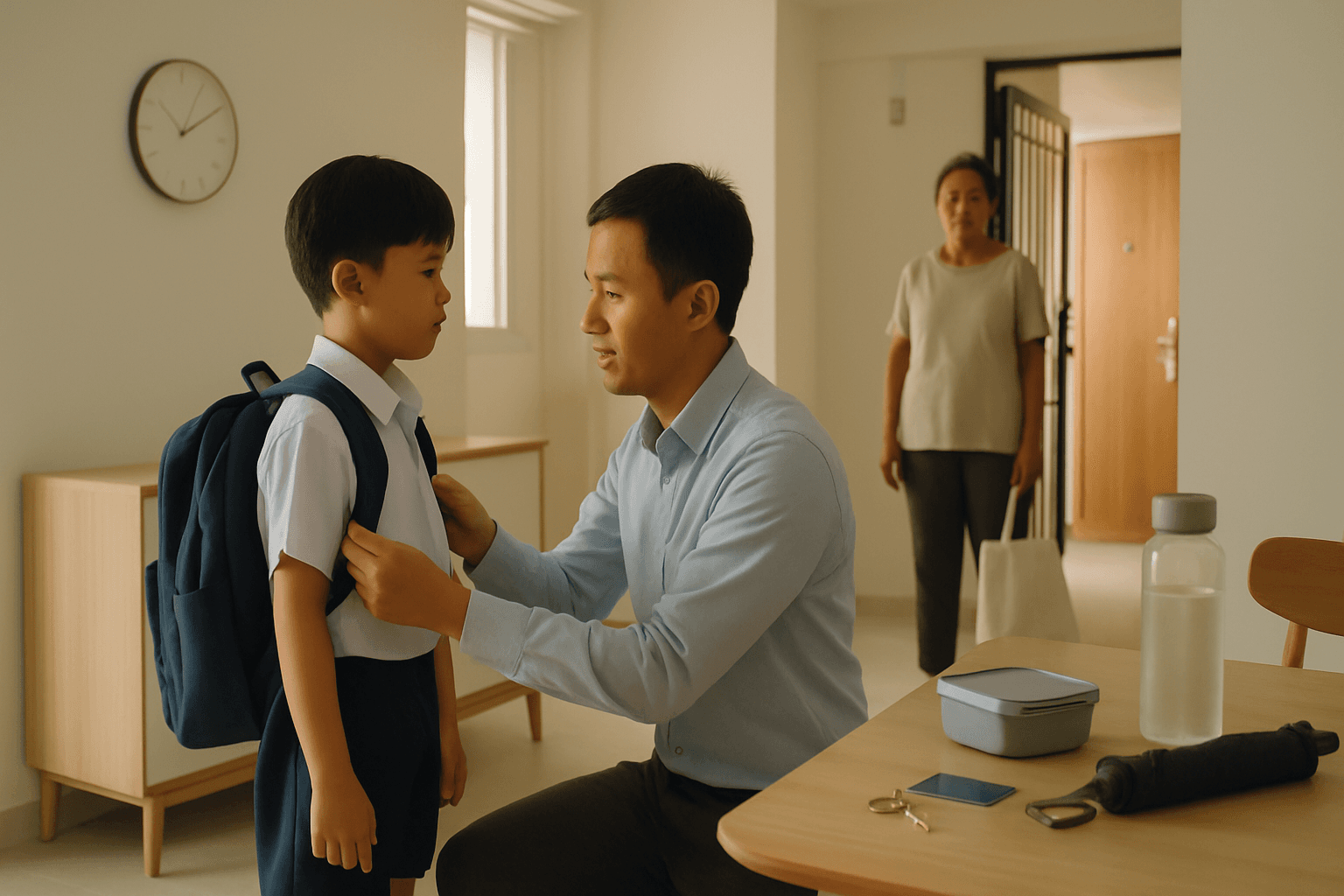
Yes, DSA can be realistic for working parents in Singapore. But it works best when the family has dependable backup support, a manageable commute, and enough flexibility to handle school communication, appointments, and quick decisions. For many families, the harder part is not the application form. It is whether the school routine will still make sense on a normal Tuesday after admission.
What does DSA usually ask of parents in real life?
DSA usually asks parents to do much more than submit a form. Most families need to manage school communication, admin, decisions, and at least some transport or care arrangements.
DSA is not just a child talent exercise. In real life, parents usually have to read each school’s instructions carefully, track emails or portal updates, help decide which schools are realistic, and make sure someone can handle transport and supervision when school appointments happen.
The exact workload differs by school and talent area, but the pattern is similar. The child may be assessed for ability, while the adults carry the coordination. That can mean one parent taking a half-day for an interview, a grandparent stepping in for pickup because an appointment runs late, or a helper accompanying the child to a trial while a parent stays reachable for calls and admin.
A simple way to think about it is this: DSA runs on two tracks. Your child is being assessed for fit, and your family is testing whether the process and the future routine are workable. If you want the broader overview first, start with our Direct School Admission Singapore: A Practical Parent Guide and then see How to Apply for DSA in Singapore.
How many DSA schools did you apply to?
Did apply for DSA. Would rather spend time helping my kids in their studies cos it’s nvr a good idea to count the chickens before it hatches.
Should DSA be scrapped?
No real data, this is my estimation (from my point of view, it’s very conservertive). Guess how many students apply for DSA every year, they need go through different tests and interview for each school they apply for. All these need a lot manpower/material involvement , it’s not free. After PSLE, many parents find their children actually can go into better school,then raise many appeal cases (you can refer to the forum), all these need manpower to handle as well.No need to mention how much mone
Can working parents realistically handle trials, interviews, and admin?
Yes, but usually only when the family has some leave flexibility and a backup adult for days when a parent cannot step away from work.
Yes, many do, but usually because the family plans around the process, not because the process is naturally easy. The parents who cope best often decide early who will take the lead, who can take leave if needed, and what the backup plan is if work suddenly becomes inflexible.
A realistic setup might look like this. One parent handles most school communication and attends the main appointment while the other covers normal pickup that day. Or a parent steps out for two hours for a school session and a grandparent covers the late afternoon. In another family, a helper brings the child to a school event and the parent joins later if needed. These are common arrangements, but they only work when everyone knows the plan in advance.
A useful insight is that DSA is often a scheduling problem before it becomes a school-choice problem. If weekday school matters already cause strain at home, DSA will usually magnify that. Broader reporting, such as this Straits Times piece on the strain of work and child supervision, reflects a reality many parents already know: school demands often land in the middle of the workday, not when adults are free. For a broader overview, see How to Apply for DSA in Singapore.
Re: DSA 2025
Improving school-based talent programs, collaborating with community centers to provide reasonably priced training, and emphasizing assessments on potential rather than polished abilities are some ways to make DSA more accessible. https://www.straitstimes.com/singapore/direct-school-admission-must-be-accessible-to-all-students-chan-chun-sing bitlife @trulyarise said in Re: DSA 2025 :
Should DSA be scrapped?
and for those who dsa, they may be the head or leader straight away without testing the others (those who did not dsa) abilities. they can perform and enter more competitions than a student who did not dsa but their abilities are about the same. is it very stressful to dsa? do you think that i should dsa into jc/ poly next time?
Have More Questions?
Get personalized guidance on schools, tuition, enrichment and education pathways with AskVaiser.
Try AskVaiser for Free →What parts of DSA are flexible, and what parts are harder to reschedule?
Research and document prep can often be done after work, but fixed school appointments and parent decision deadlines are much harder to move.
Some parts of DSA are relatively flexible. Parents can usually read school pages after work, compare talent areas at night, prepare common documents in advance, and discuss school choices over several evenings. This is the part many working parents assume the whole process will look like.
The harder part is anything tied to a school slot, a response deadline, or a parent action that cannot simply be done later. Interviews, trials, meetings, and final preference steps tend to be much less flexible. If you are in a joint-custody or separated-parent arrangement, there is an extra coordination point. According to the MOE FAQ, both parents must come to a common agreement on the DSA-Sec school choices because both are required to log in to the DSA-Sec Portal to submit school preferences. If one parent has sole custody, that parent can decide on the school choices.
This is where families often get stuck. The issue is not always the child’s readiness. It is whether the adults can respond on time. If decisions are shared, agree early on who will monitor updates, how you will compare schools, and what happens if one parent is travelling or hard to reach. For a broader overview, see What Happens During a DSA Interview in Singapore?.
Do non-GEP student has much chance with DSA
Side track … but since we are talking about coming DSA . Is there any parents sending his/her child for DSA preparation course or have ever sent their kids for such course in the past? Any school to recommend and how much do they charge? Is it adviseable to attend such course?
Should DSA be scrapped?
Does Singapore really have DSA, My answer is no.Becasue no matter you get DSA offer or not, you need go for PSLE.In fact for most of the p6 student who get DSA offer, their PSLE score are high enough to let them enter the same school. Even quite a lot students whose PSLE score can let them go into better school, then regret, appeal…why so many students like to apply DSA, the reason behind is same as the people buy insurance. In the end most of people pay much more than they gain, otherwise insur
How much childcare backup do families usually need during the DSA period?
Most working families need at least one reliable backup adult who can step in smoothly on school-related days.
At minimum, most working families need one dependable backup adult. This is not only for emergencies. It is often needed for predictable school-related days when a parent cannot leave the office, gets delayed in a meeting, or has to split attention between two children.
The practical question is not just who is willing to help, but who can handle the full chain. Can that person travel with the child if needed, wait during an appointment, answer a call from the school, or manage pickup if the timing shifts? Grandparents may be supportive but not comfortable with a long trip. A helper may be available but need clear instructions about route, timing, and who to contact. After-school care may help with the usual routine but not with off-site school visits.
A common scenario is a weekday appointment that starts on time but ends later than expected. If the parent is still in back-to-back meetings, the backup adult needs to know exactly where to go, what to bring, and whether a younger sibling also needs collection. Good backup is not just available help. It is help that can step in without confusion. For a broader overview, see Is a DSA Offer Binding? What Parents Commit To.
Singapore Secondary School short listing for DSA
This is an online workbook to help you shortlist secondary schools for DSA. You may shortlist secondary schools by DSA, location and more: https://public.tableau.com/app/profile/sg.parent/viz/SingaporeSecondarySchoolSearchDSA/Search Please view these workbooks from a computer and not mobile device (may not not display in full). Will work towards updating them yearly.
General Observation about DSA
I am weighing the pros and cons of DSA for my daughter next year. She is not outstanding academically, no special sports talent. So I was thinking perhaps we should not stress ourselves with DSA application and with all the tests and interviews.
What school logistics should parents check before accepting a DSA offer?
Before accepting a DSA offer, check whether the commute, school timings, and after-school demands are sustainable for the next few years.
Look beyond the excitement of the offer and picture an ordinary weekday. The main checks are the commute, likely dismissal time, after-school commitments linked to the child’s talent area, and who will handle the journey home if the child stays back.
A school can be an excellent match on paper and still be a hard fit in daily life. A longer trip may mean your child starts homework much later. A school that ends after your usual pickup window may force you into permanent transport dependence. Repeated training sessions or rehearsals can make the week much tighter than you expected. These are not minor details. They are the routine.
A useful test is to run one normal Tuesday in your head from morning departure to dinner. Better still, do the actual route at the times your child would travel. If the day only works when nothing goes wrong, that is a warning sign. This is also why it helps to read Is a DSA Offer Binding? What Parents Commit To before you decide. For a broader overview, see How to Build a Backup Secondary School List When Applying for DSA.
2010 DSA(Direct School Admission)
Applying for DSA is like applying for jobs, cast your net and see whether you get any offers. Choose the one that suit you most.
2010 DSA(Direct School Admission)
Invariably at each year's open houses, such questions are asked and answered wrt vacancies By the way, the admission is based on merit and exceptional ability demonstrated, not to fill a quota Each independent schools has their own selection criteria, a desire to maintain a certain type of culture and environment, hence each school is unique and all their vacancies will be filled by the time of S1 posting. The DSA process can be viewed as a form of training for the kids - go strive for what you
How can DSA change after-school routines and family schedules?
DSA can affect the whole household because later school days and talent-related commitments often reshape meal times, pickup duties, and evening routines.
DSA can reduce family flexibility because the child may have more school-linked commitments outside normal lesson time. That can affect dinner timing, tuition slots, sibling pickup, parent work hours, and even who is home to supervise homework.
This is where some families feel the real weight of the decision. One child may stay back for training while a younger sibling still needs collection elsewhere. Dinner may shift later several times a week because the child gets home much later than before. A parent who used to do one predictable pickup may suddenly need to juggle two locations and uneven end times.
If you are unsure how a school’s rhythm feels in practice, parent communities can be useful for practical insight on communication, expectations, and everyday school culture. Features such as this Schoolbag story on a parent support group are a reminder that school life is often easier to understand through routine details, not just official descriptions. The right question is not only whether your child can cope, but whether your household can absorb the change without constant stress.
All about DSA into Junior Colleges
I think at upper secondary, most kids eyeing DSA already know where they want to go…they are checking reddit forums and discuss over there. Or they ask their seniors. And they usually manage the application process on their own (dont think they need parent’s Singpass). But, still welcome to have a discussion thread on KSP for parents who want to support their kids.
Should DSA be scrapped?
DSA via academic for mainstream is limited vacancies. More of DSA via GEP is the biggest group for the top IPs (RI, RGS, HCI, NYGH, ACSI etc). I am getting used to the notion that other than sports/CCA, DSA is mainly for GEPpers. But I guess we (the mainstream parents) have to understand these GEP kids are undergoing a different track and not totally prepared for PSLE. Thus, DSA is the primary route for their admission and actually the carrot for entry into GEP. Many GEP parents commented that i
What do working parents most often underestimate about DSA?
The biggest mistake is underestimating commute, timing, and support needs while focusing too much on the school name or the child’s talent.
The most common mistake is focusing on prestige or talent while underestimating the family logistics. Parents may assume they will somehow make the routine work later, only to discover that the real strain starts after the offer is accepted.
Another common mistake is assuming leave will always be available. In reality, work crunch periods do not pause for school appointments. Some parents check a school on a map without testing the actual travel time at the hours their child would travel. Others assume grandparents can always help without asking whether that support is sustainable every week rather than only once in a while.
Families with shared parenting arrangements can also overlook how important early alignment is. If both adults are not truly on the same page, the admin becomes harder and the school decision becomes more stressful. If you are still deciding whether DSA is worthwhile at all, read Is Direct School Admission Worth It For My Child?. It helps separate genuine fit from reputation-driven choice.
A simple rule helps here: do not choose the school first and solve the life problem later. Solve the life problem first, then decide if the school still makes sense.
Do non-GEP student has much chance with DSA
I am a parent of ex-GEP girl now in NUSH. If you ask me the qn "Do DSA favours the GEP ?? " Yes, the answer is a resounding YES. GEP students are catgorically asked to submit their DSA application and to complete their choice of IP-school. GEP students are favoured and generally have the first bite of the cherry at all IP-school. If a GEP student do not apply DSA, most teachers will ask why ??? As for rest of mainstream, my advise is to work hard on PSLE and get in thru the various COP. For main
Do non-GEP student has much chance with DSA
I think comparing with GEP students, mainstreamers have a lower chance when it comes to acceptance thru’ DSA to top schools. However, having said that, there is still an opportunity and mainstream kids should still try for DSA to their dream school(s). Even if they are not successful, they have also gained through the DSA experience. The experience of going through selection test, group activites or interviews is good learning and eye-opener for these kids and these will benefit them in future.
When is DSA a good fit for a working family?
DSA is more realistic when your family has stable backup care, a workable commute, and a child whose strength is a genuine long-term fit for the school.
DSA is usually a better fit when the family already has a stable support structure. That means there is at least one dependable adult who can step in, the commute is reasonable, and the child’s strength genuinely matches the school’s programme rather than just sounding impressive.
In practical terms, this often looks like a family where one parent has some work flexibility, or where both parents can split duties without frequent conflict. It can also work well when the chosen school is still reasonably accessible from home or from the caregiver’s routine. Most importantly, the child should be ready for the commitment that may come with the talent area, because a reluctant child makes every logistics problem heavier.
Families do not need perfect conditions. They do need repeatable conditions. If your setup can absorb fixed school demands without weekly crisis planning, DSA may be realistic. Broader conversations about parenting and routine, such as this Schoolbag article on work-life balance, point back to the same lesson: sustainability matters more than heroic one-off effort.
Do non-GEP student has much chance with DSA
For parents who is looking to register their child into Raffles via DSA - it is open for registration now. FYI Only
General Observation about DSA
Hi Lizawa, I would like to share with you my experience. My daughter is not an outstanding student, just above average and has no special sports talent. Inconsistent results during exam too. She just loves to read and does not want any tuition except for MT. However she was very keen to try DSA for a certain institution after the principal went for a talk / presentation. She went for the GAT test and I was extremely surprised when she was offered a place. Now I am a firm believer that doing well
When might a family be better off not pursuing DSA?
If the process or the long-term school routine will strain your family too much, DSA may not be the right route right now.
Sometimes the honest answer is that DSA is possible but not wise for your family right now. If weekday appointments are almost impossible to cover, if there is no dependable backup on busy days, if co-parents cannot align on school choices, or if the likely commute would make daily life too tiring, it may be better to step back.
The child’s current load matters too. A child who is already stretched by school, enrichment, health needs, or emotional stress may not benefit from adding a more demanding arrangement. A long commute that pushes homework and bedtime later every day is not a small sacrifice. Over time, it can affect rest, mood, and motivation.
Choosing not to pursue DSA is not the same as closing doors. It may simply mean protecting your child’s routine and using the main posting route more thoughtfully. If you need a fallback plan, see How to Build a Backup Secondary School List When Applying for DSA. If you are worried about downside risk, Does a DSA Rejection Affect Normal Posting? explains what parents should understand before deciding.
How many DSA schools did you apply to?
Why go the DSA route if kids are definitely going to do well in psle? Is DSA about using cca to get to the sec school? Am I missing something here?
How many DSA schools did you apply to?
You may look at the All About DSA thread http://www.kiasuparents.com/kiasu/forum/viewtopic.php?f=48&t=157 or http://www.moe.edu.sg/education/admissions/dsa-sec/ While for the intention and selection criteria, you may look up secondary schools that offer DSA as each of them has a different one. List of schools offering DSA http://www.moe.edu.sg/education/admissions/dsa-sec/participating-schools/
What is the key thing working parents should remember about DSA?
The real test is whether your family can sustain the weekly arrangement after admission, not just complete the application.
The application period is temporary, but the school routine can last for years. That is the part many parents underestimate.
If you remember one thing, make it this: DSA is not only a talent decision. It is a family logistics decision. The real test is not whether you can submit the form or attend one interview, but whether your family can live with the commute, timing, and support demands every ordinary week.
2010 DSA(Direct School Admission)
DSA is not that time consuming. Essentially there are just the following steps, for most schools: 1. Online application: Have your results and awards on hand for easy reference. 2. Preparation of portfolio: Photocopy and certify your results, awards, certificates etc as required by the school. Check with the school for their requirements. 3. Submission of portfolio to school: Some schools ask you to bring it with you during the interview, some schools require you to submit it before the intervie
2010 DSA(Direct School Admission)
Hi, I hope someone can enlighten me on DSA. I've completely no idea what it is. :? How does it work and is it related to CCA ? My boy is in P4. Thanks in advance.
Have More Questions?
Get personalized guidance on schools, tuition, enrichment and education pathways with AskVaiser.
Try AskVaiser for Free →