
Who Is the High Ability Programme For? GEP vs HAP for Singapore Parents
A practical guide to who each pathway is meant for, how selection works, and what the difference means for your child.
In practice, the High Ability Programme is best understood as Singapore's broader current approach to supporting higher-ability primary pupils through school-based programmes and modules across more schools. The older GEP was a separate pathway for intellectually gifted students, selected through a Primary 3 exercise and entered in Primary 4. Parents should judge fit by learning need, readiness for deeper and more independent work, and the child's school and social context, not by how selective the label sounds.
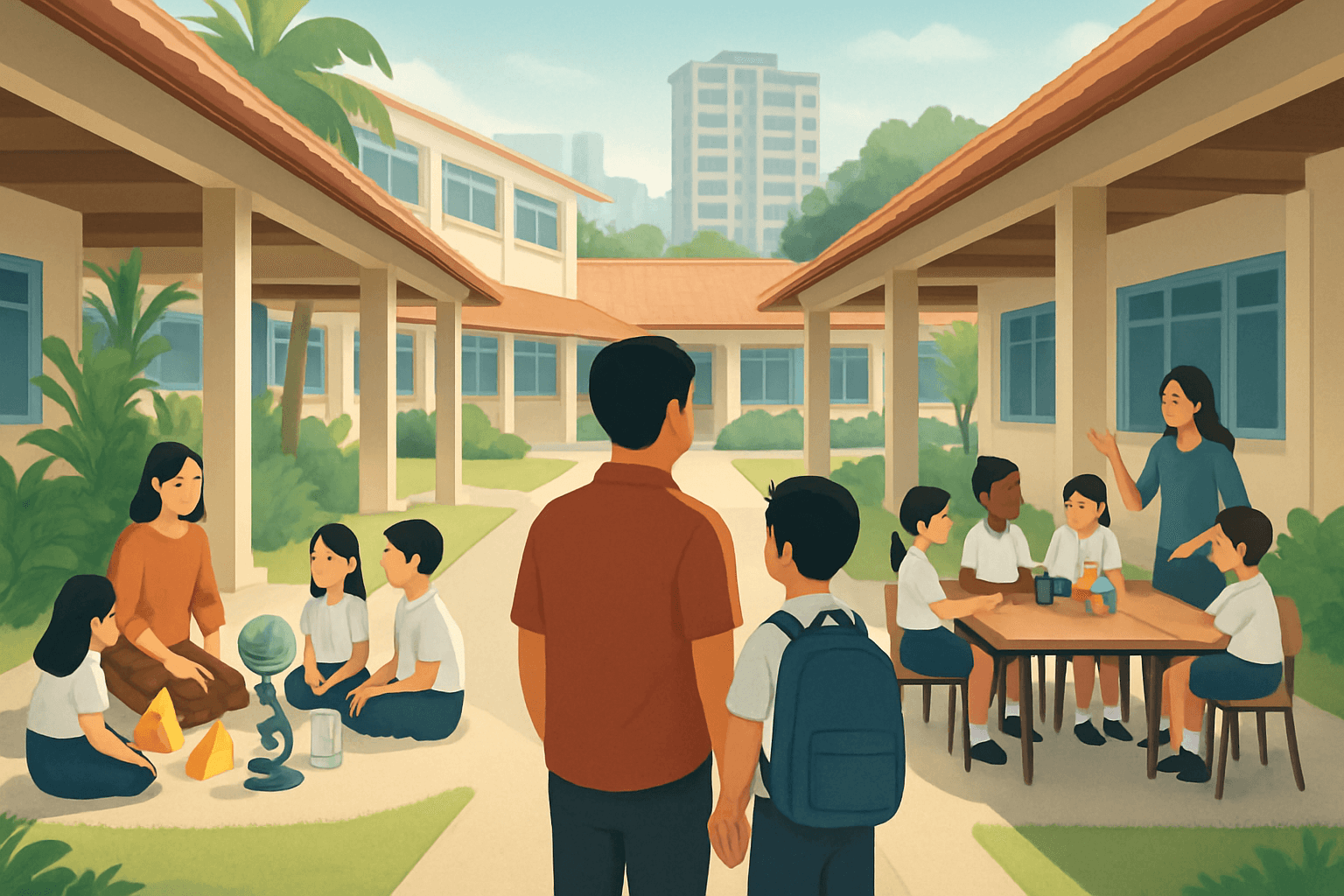
If you are asking who the High Ability Programme is for, the short answer is this: it is for children who need more stretch, deeper thinking, and richer work in school, not just children with very high marks. Parents often use "HAP" as shorthand for MOE's broader support for higher-ability learners across more primary schools. By contrast, the older Gifted Education Programme, or GEP, was a more distinct pathway for intellectually gifted pupils. For most families, the real question is not which label sounds better, but which learning environment fits the child best.
What is the High Ability Programme, in plain English?
HAP is best understood as the broader current model for supporting higher-ability learners in primary school, usually through school-based stretch and enrichment rather than one separate gifted track.
In plain English, most parents use "High Ability Programme" to mean Singapore's newer, broader way of supporting higher-ability learners in primary school. It is better understood as stretch for children who need more challenge, usually through school-based opportunities and, where suitable, after-school modules, rather than one small nationwide gifted track. MOE's direction in its 2024 announcement on strengthening support for higher-ability learners is to reach more pupils across more schools.
That matters because many parents picture a single special class. The current model is broader than that. A child may stay in the same school and still get richer tasks, deeper discussion, more exploratory work, or access to selected modules. If you are searching for "HAP", the most useful mental model is this: it is stretch built into or around school life, not automatically a separate gifted lane.
A simple parent check is to ask whether your child is merely doing well, or is repeatedly under-challenged by routine work. Top scores show performance. Need for stretch shows fit. If your child is regularly finishing early, spotting patterns quickly, and wanting more meaningful thinking, this is the kind of support you should be asking about. For a broader overview, see Gifted Education Programme (GEP) in Singapore: A Parent's Guide.
GEP Preparatory Program
Good morning Angelight, Gifted Education Programme (GEP) is not a PSLE preparatory program. As stated in MOE’s website that Ministry has recognized that children have varying abilities, it’s not a sound practice to give every child the same education and to expect him/her to move at the same pace as his/her peers. Those intellectually gifted children need high degree of mental stimulation. Normally, intellectually gifted children are very inquisitive, fast learners and with very high level of re
GEP Preparatory Program
Having checked with parent chatgroups, here is my humble assessment of the TOP 3 GEP Preparatory Program specialists . EduCHAMPS academy https://www.theeduchamps.com/gep-preparation-class-2/ • 2 branches – Novena and Katong. • 6 to 10 students per class • Known for following a patented Advanced Brain Training and 5 ‘A’s Method to bring out the full intellectual potential in students • 100% passed the GEP Screening test (1st round). 68% passed the GEP Selection test (2nd round) and got into the P
What was the Gifted Education Programme, or GEP, meant for?
GEP was the older MOE pathway for intellectually gifted students who needed a deeper, broader, more inquiry-based curriculum rather than simple acceleration.
The older GEP was meant for intellectually gifted students. MOE states this clearly on its Gifted Education overview page. Under that model, selected pupils were identified through a two-stage exercise in Primary 3 and entered the programme in Primary 4.
Just as importantly, MOE describes the GEP curriculum as enriched rather than accelerated, which you can also see in its enrichment model explanation. In practical terms, that means children were not simply pushed ahead to older content faster. They covered the same broad subject areas as mainstream pupils, but with more depth, wider exploration, and more independent inquiry.
For parents, the key takeaway is this: GEP was not just "harder school" for top scorers. It was designed for a smaller group of pupils who needed a different level of intellectual challenge. In the classroom, that could look like more open-ended questions, more discussion, more project-style learning, and more emphasis on reasoning, comparison, and original thought. For a broader overview, see GEP vs High Ability Programme in Singapore: What’s the Difference?.
All About GEP
For students already in the Gifted Education Programme, here are the TOP 3 Gifted Education Programme subject specialists. Nicklebee math ( https://nicklebeetutors.com/ ) provides GEP math classes. They also do advanced PSLE math tuition for both GEP and high-ability students, where they focus on teaching more advanced math concepts (like those used in IQ math / olympiad math) to target the challenging 4-mark / 5-mark type of PSLE math questions. Similar to the helen & ivan question back in 2021
All About GEP
https://singaporemotherhood.com/articles/2020/10/gep-gifted-education-programme-singapore/
Have More Questions?
Get personalized guidance on schools, tuition, enrichment and education pathways with AskVaiser.
Try AskVaiser for Free →GEP vs High Ability Programme: what is the real difference?
GEP was a separate gifted pathway for a small selected group, while HAP is a broader model designed to stretch more higher-ability learners across schools with less separation from the mainstream path.
The real difference is structure and purpose. GEP was a distinct gifted pathway for a smaller selected group. HAP, as parents commonly use the term, refers to a broader support model meant to stretch more higher-ability learners across more schools.
A useful way to think about it is this: GEP was a lane, while HAP is a support system. Under the older GEP model, a selected child entered a clearly defined programme with a concentrated peer group and a purpose-built enriched curriculum. Under the newer direction, a child may remain in the current school, keep the same social environment, and receive higher-level challenge through differentiated work, school-based opportunities, or selected modules.
Neither model is automatically better. A child who thrives when surrounded by peers learning at a similar pace may have benefited from the older GEP structure. A child who needs more challenge but is socially settled and doing well in the current school may benefit more from broader in-school support. If you want a fuller side-by-side comparison, see our guide on GEP vs High Ability Programme in Singapore and our main GEP parent guide. For a broader overview, see GEP Selection Process in Singapore: Stage 1 and Stage 2 Explained.
All About GEP
Parents that pay thousands of dollars to try to get their children into GEP: Yes, GEP is a coveted programme. Yes, GEP allows your dd/ds to be able to have a higher chance of getting into an IP school. But bear in mind that the programme is immensely challenging. Your child will have to juggle tonnes of projects and lots of HW and at the same time prepare for the all-important PSLE. And if you PUSH for your child to get into GEP by loads of tuition classes, ask yourself: Will he/she be cope? Wil
All About GEP
https://www.straitstimes.com/singapore/politics/45-of-pupils-in-gifted-programme-in-the-last-five-years-live-in-hdb-flats-chan-chun-sing Ng Wei Kai PUBLISHED MAR 9, 2022, 10:37 PM SGT SINGAPORE - About 45 per cent of pupils who joined the Gifted Education Programme (GEP) over the last five years live in Housing Board flats, said Education Minister Chan Chun Sing on Wednesday (March 9). The pupils selected for the GEP came from 60 per cent of Singapore's primary schools, he added in response to a
How does selection work for GEP and higher-ability support?
Old GEP used a two-stage Primary 3 selection exercise for Primary 4 entry. Current higher-ability support is broader and can identify children at multiple points, so parents should expect a more holistic process rather than one fixed universal test.
For the older GEP model, the process was clearer and more centralised. MOE says pupils were identified through a two-stage exercise in Primary 3, and selected students entered GEP in Primary 4. If you want the legacy flow explained in parent-friendly language, our article on the GEP selection process breaks that down further.
For the newer higher-ability support approach, parents should not assume there is one universal entrance test that works exactly like the old GEP. MOE has said in a parliamentary reply on the GEP transition that students can be identified at multiple junctures from Primary 4 to Primary 6. In practice, that points to a broader picture over time rather than one single moment. Schools may consider how a child handles unfamiliar problems, the quality of thinking in class and in written work, and whether the child consistently needs more stretch.
This is where parents often misunderstand the process. Heavy exam drilling can raise scores, but it does not automatically show the same profile as quick reasoning, strong pattern recognition, unusual curiosity, or comfort with less structured tasks. If your school offers higher-ability opportunities, ask three practical questions: how children are noticed, what the learning actually looks like, and whether support is reviewed over time. Those answers are more useful than chasing a label alone. For a broader overview, see Is My Child Gifted or Just Advanced?.
All About GEP
The top 5 % of the 1st round GEP test goes into the 2nd round Out of those in the second round, about 1/5 will make it to be the selected GEP students, hence the GEP cohort is about 1% of the overall cohort I believe the schools have certain details of performance of the 1%, and the 4% who made the 2nd round but not selected. School will use the data to form the top class and second top class (mainstream). Some GEP schools have started the High Ability class which are formed by these 4% candidat
All About GEP
Hi NJmom, Congratulations to your child being selected for the selection test! Which means your dd is among the top 4000 P3 student in Singapore. That's some recognition! So far from what I have found out, the GEP programme are a course designed to cater for a different group of students, for those intellectually gifted kids. Thus, the learning concepts and assumptions are completely different from our main stream. There will be alot of research work and like what fairy has mentioned in her post
Who is the High Ability Programme actually for?
HAP is for children who need more stretch, deeper thinking, and richer learning in school, not just children who happen to score well on tests.
HAP is for children who need more challenge in school and benefit from deeper thinking, not simply for children with high marks. The cleanest way to think about it is this: high ability is about how a child learns, not just how high the score is.
A good fit is often a child who finishes ordinary work early and still wants something meaningful to think about. It may be a child who asks probing questions beyond the worksheet, spots patterns quickly, enjoys solving unfamiliar problems, or stays engaged when tasks are open-ended instead of tightly coached. These children are not only fast. They usually want more depth.
A common parent contrast helps here. One child scores very well because she is careful, disciplined, and heavily prepared, but she dislikes ambiguous questions and feels stressed by exploratory work. Another child may be less polished on standard tasks, but lights up when asked to explain a pattern, compare ideas, or invent more than one solution. The second child may be the more natural fit for higher-ability support.
The practical takeaway is simple. If your child seems bored by routine work but energised by richer thinking, HAP-style support is worth exploring. If your child mainly prefers predictability, repeated practice, and highly structured tasks, mainstream with some enrichment may still be the better fit.
All About GEP
Well to me, GEP is a programme to further stretch and nurture the 'higher ability' kids. It is a programme to see how far can these group of students be stretched and of course those kids who are able to cope well will be those that are able to benefit from this programme the most. As at for Primary School Leaving Exam, it is to test how well P6 students have understand the school education syllabus and how well they have prepared for it.. ..nevertheless also the student academic ability..
GEP Preparatory Program
Sorry have not heard of Joyous but it has sent more than 300 students into GEP within 8yrs of operation? Why not claim 1,000 or 10,000? Since MOE does not step forward to refute such claims anyway. GEB has the brains to administer the GEP, but no idea how to stop fake advertising.
What kind of child is a better fit for gifted education?
Gifted education is usually a better fit for a child who consistently learns faster or deeper across the curriculum and responds well to complex, less structured, more independent work.
Gifted education is usually a better fit for a child who is consistently ahead in understanding and can handle complexity, ambiguity, and independent learning. That is different from being merely high-performing. Many strong pupils do very well because they are diligent, attentive, and well-supported. A gifted-style environment is usually a better fit when a child also needs a different level of cognitive challenge across the curriculum.
In real life, that may look like unusually quick concept grasp, strong pattern recognition, curiosity that spills beyond the syllabus, or the ability to connect ideas without much scaffolding. It also shows up in how the child reacts to challenge. Some children become more alive when the work gets harder and less scripted. Others become anxious and shut down.
Parents often miss two mismatch cases. The first is the child who is excellent at standard school tasks but dislikes open-ended work and loses confidence when there is no single correct method. The second is the child who is far ahead in only one area, such as mathematics or reading, but does not clearly need broader stretch across subjects. Those children may still need support, but not necessarily a full gifted-style environment.
If you are unsure, our guide on whether your child is gifted or just advanced is a useful next read. The decision is less about finding the most impressive label and more about spotting where your child is persistently out of sync with the ordinary pace of learning.
All About GEP Schools
I feel that the GEP system does not necessarily benefit children with a higher IQ. The most successful people career wise don't seem to be GEPers. This holds true whether you consider successful in terms of who earns the most money, are at the top of their field, or have achieved the most scientific breakthroughs etc. I have lived overseas for some time and in some countries, the \"gifted\" are simply allowed to skip levels and attend higher levels. Sometimes if they are good in a certain field,
All About GEP
Just wondering whether you have mixed up the GEP discussed here and the IP programme. Most of the discussion here are for GEP for P4 to P6, so we are talking about the programme MOE has in place to identify gifted children from young. In this thread, we have discuss at length whether the screen method may or may not be the right. IP is for the secondary education to pre-u. So what is the link between this distinctly different programme? Within the IP programme in secondary school, there is still
What are the workload and curriculum differences parents should expect?
Expect more depth, more complexity, and more independent learning rather than just more homework, although the work can still feel heavier because it demands more thinking and self-management.
The biggest difference is usually not just more work. It is deeper, broader, and more independent work. MOE describes the GEP curriculum as enriched rather than accelerated, and that same idea helps parents think about higher-ability support more generally. The child is not simply given extra pages. The tasks often demand more reasoning, more explanation, and more self-management.
That can still feel heavier at home. A child may need to juggle project work, exploratory assignments, richer reading, or questions with no obvious single answer. One child may find that energising because it finally matches how quickly he thinks. Another may find it tiring because the work is less predictable and requires more planning.
What many parents miss is that workload is often about cognitive load, not page count. A short task that asks a child to compare, justify, and create can feel much harder than twenty routine questions. If you want a fuller picture of how this can feel in real family life, our article on what the GEP workload is like and this parent-perspective piece on life in the GEP offer useful context.
At home, watch the child's response, not only the grades. If your child becomes more curious, talks about ideas, and manages the challenge with support, the fit may be good. If you see steady fatigue, regular tears, or a sharp drop in confidence, the issue may be mismatch rather than lack of ability.
All About GEP
GEP curriculum covers the same content areas as those in mainstream but is extended in breath and depth. And GEP students will sit for the same PSLE and proceed to IP or O level, just like mainstream students. Sounds quite like IP, where students are exposed to an enriched curriculum but also learn the same syllabus and sit for the same A level exam as mainstream students. Or A level students taking H3 subject with extended contents but only the standard syllabus H2 content results will count to
GEP Preparatory Program
GEP curriculum covers the same content areas as those in mainstream but is extended in breath and depth. And GEP students will sit for the same PSLE and proceed to IP or O level, just like mainstream students. Sounds quite like IP, where students are exposed to an enriched curriculum but also learn the same syllabus and sit for the same A level exam as mainstream students. Or A level students taking H3 subject with extended contents but only the standard syllabus H2 content results will count to
What are the advantages of GEP and HAP?
The main advantages are better challenge, better pacing, and a stronger learning fit. HAP may offer this with less disruption, while GEP offered a more concentrated gifted-peer environment.
The main advantage of both approaches is better fit. A child who is consistently under-challenged in regular lessons often becomes more engaged when the work finally matches his or her level. That is the real benefit, not the badge.
For HAP-style support, one clear advantage is that the child can often stay in the same school environment while still getting more stretch. That may preserve friendships, reduce disruption, and make the experience feel less like a high-stakes move into a special lane. For many families, that matters because social ease and emotional stability are part of academic fit too.
For the older GEP model, the advantage was a more concentrated gifted-peer environment and a curriculum designed specifically for that profile. Some children thrive when the whole classroom is working at a similar pace and depth because they no longer feel odd for asking unusual questions or thinking far beyond the worksheet. If you are comparing that experience with a regular class, our article on GEP vs mainstream primary school may help.
The sharp takeaway is this: the best advantage is relief from chronic under-challenge. If a programme helps a child feel appropriately stretched, mentally awake, and more interested in learning, it is doing what parents actually need.
All About GEP
Extract from The Sunday Times 3 June 2012 Should you prepare for the GEP test? But is preparing for the GEP test necessary or beneficial to the child? The Education Ministry, schools and experts say no. A ministry spokesman advised parents against sending their children for special preparatory classes. 'A child who gains admission into the GEP through intensive coaching may not be able to cope with the programme's demands, and this could cause the child unnecessary stress and could lead to loss
GEP Preparatory Program
The GEP programme is generally (not in every specific case) good, beneficial and advantageous for most GEP kids. If it weren’t so, the programme would have shut down long ago. If it weren’t so, parents won’t be trying or wishing for kids to get into GEP.
What are the common myths parents should avoid?
Do not assume that strong grades alone mean gifted fit, or that a more selective programme is automatically the better choice. Fit matters more than prestige.
The biggest myth is that gifted education is simply for top scorers. It is not. High marks can come from diligence, tuition, and strong routines, while gifted-fit learners often show a different pattern: quick abstraction, unusual curiosity, and comfort with complex thinking.
Another common mistake is treating selection as a prestige badge that must be accepted at all costs. A child can be capable and still be unhappy in a faster or more demanding environment. Parents also sometimes assume that more challenge must automatically mean better long-term outcomes. The available sources do not support that promise.
One more myth worth dropping is that school name matters more than learning profile. It does not. Fit beats label, and a child who is well-supported in a suitable environment usually does better than a child placed in a celebrated pathway for the wrong reasons.
All About GEP
Dear sharonsharon, a key reason why we started KiasuParents.com is to show parents that if they think they need to spend thousands of dollars on preparing their children for GEP, then they have missed the entire point about what GEP and being Kiasu is all about. Being Kiasu is really about being an effective parent, to give our best efforts in guiding our children to be the best of what they can be. Every child is gifted, but not in the same way. The GEP would have us believe that gifted childre
All About GEP
i was wondering why so many parents are talking about GEP is it because it is the only way for their kids to get into a good school before PSLE or it is really a good training progamme for the gifted? :?:
What happens after primary school for children in HAP or GEP?
These are best seen as primary-level support approaches, not guaranteed long-term tracks. The biggest benefit that carries forward is how the child learns, not the label itself.
Parents should not treat HAP or GEP as a guaranteed long-term route. Based on the available source material, these are best understood as primary-stage support structures, not lifelong labels that lock in a future outcome.
What usually carries forward is not the badge, but the habits the child builds. A child who has learned to handle challenge, think independently, discuss ideas clearly, and cope when work becomes less straightforward is likely to benefit later regardless of the exact secondary path. A child who has only learned to chase selection labels may struggle once the environment changes.
This is why it helps to keep the decision grounded in the present. Choose the setting that supports the child now, not the one you hope will signal something years later. If you want context on the policy shift, our article on why Singapore is moving from GEP to HAP and this TODAY explainer on the revamp are useful next reads. The better parent question is not "Will this guarantee an advantage later?" but "Will this help my child learn well now?"
All About GEP
GEP Status in Secondary Levels 1.What happens after the primary GEP? After Primary 6, retention of the GEP status and promotion to the next level of gifted education is based on: ■performance in the GEP from Primary 4 to 6, including a pass in Social Studies ■attitude towards work and the enrichment programme ■performance at the PSLE 2.What percentage of the Primary 6 GEP pupils meets the criteria for retaining the GEP status? Each year approximately 99% of the pupils meet the criteria. For more
All About GEP
at the beginning of P4, principal will give a letter to say the kid is in HA class, and other enrichment programs are offered along the way in P4/5/6 http://www.moe.gov.sg/education/programmes/gifted-education-programme/high-ability-learners/ it is now an official program, but may be not every school, or only available in GEP schools.
Have More Questions?
Get personalized guidance on schools, tuition, enrichment and education pathways with AskVaiser.
Try AskVaiser for Free →