
Can You Defer Your Child's Primary 1 Entry in Singapore?
What Primary 1 deferment usually involves, which concerns carry more weight, and how parents can decide whether a child needs more time or better support.
Primary 1 deferment in Singapore may be considered, but it is generally a needs-based discussion, not a casual request to start school later. The concerns that usually matter more are developmental, medical, or special needs-related issues that affect everyday school functioning. Shyness, uneven pre-academics, ordinary immaturity, or a late-year birthday alone are usually not strong reasons by themselves. If you are considering deferment, the most practical next steps are to document specific concerns, get relevant professional input, and prepare a backup plan in case your child starts school on time.
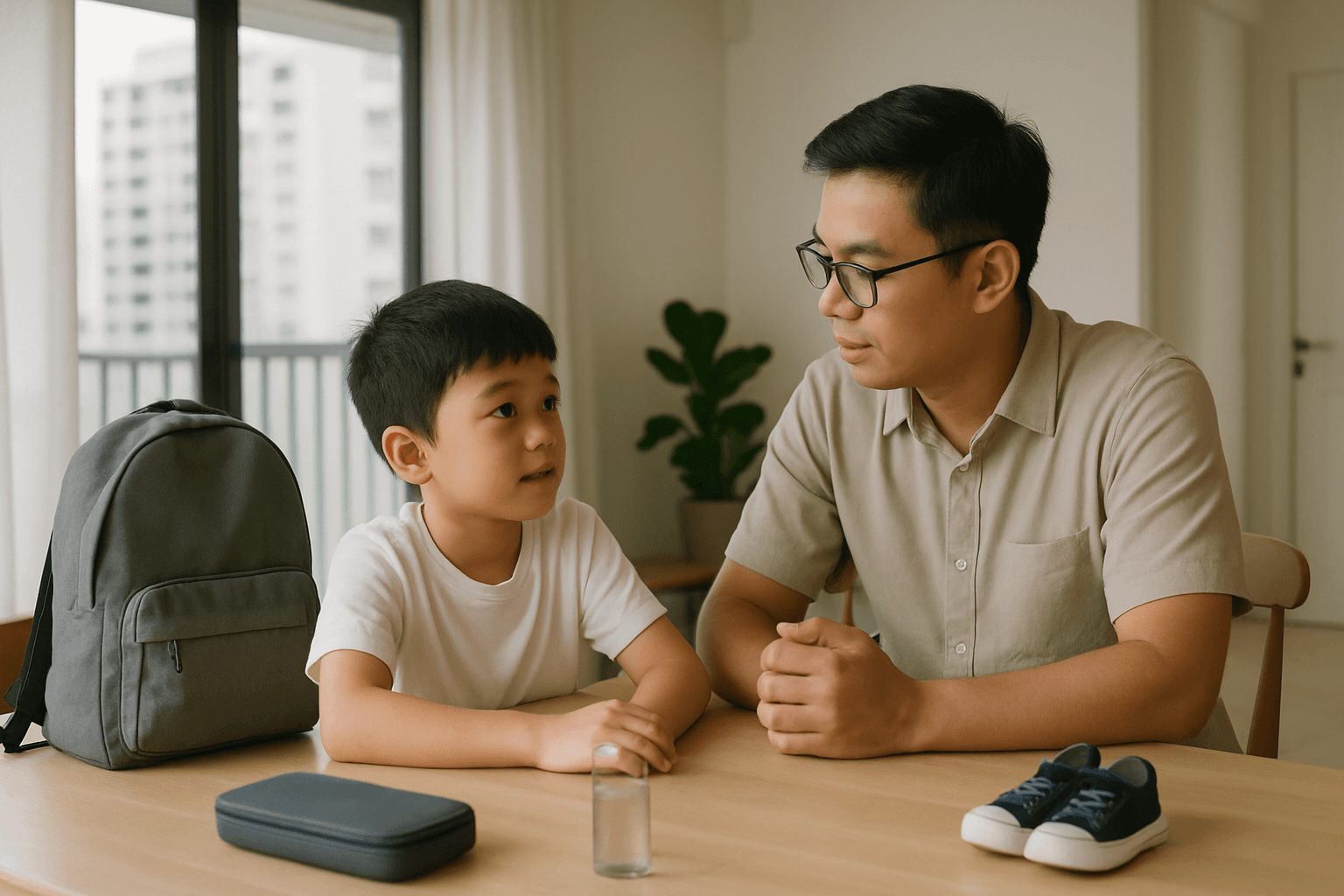
Yes, you can ask about deferring your child's Primary 1 entry in Singapore, but it is usually not treated as a routine parent choice. In practice, deferment is more likely to be considered when there are developmental, medical, or special needs-related concerns that affect how a child manages day-to-day school life. For most families, the real question is not whether a child is perfectly ready, but whether the child can cope with Primary 1 and benefit from it with the right support.
Can you defer Primary 1 entry in Singapore?
Yes, Primary 1 deferment may be considered in Singapore, but it is usually a needs-based discussion rather than a simple parent preference.
Yes, Primary 1 deferment may be considered in Singapore, but parents should think of it as a needs-based option rather than a simple choice to start later. In practice, it usually comes up when a child has developmental, medical, or special needs-related concerns that may affect daily functioning in a mainstream Primary 1 setting. For example, a child with a significant language delay may still struggle to understand group instructions, or a child with an ongoing medical condition may have difficulty with stamina, attendance, or treatment schedules.
The most useful mindset is this: deferment is usually about whether a child genuinely needs more time or a different support plan, not whether another year simply feels safer. That distinction matters because many children who seem young, shy, or uneven at age six still adjust reasonably well once school begins. If you are also sorting out enrolment timing, it helps to understand the wider Primary 1 registration process, because planning and documentation often overlap.
Preschools prepared your kids well for Singapore primary?
For parents who have already been through the pre-school days and with kids now in primary schools (Singapore schools), can you share your comments on your kid's previous preschool and their curriculum - specifically if they have prepared your child properly for the Singapore education system ? (not discussing the international or foreign schools system here) Nowadays, there are so many pre-schools and childcare centres with many learning methods. Parents currently at the pre-school stage will b
Nanyang Primary
If you are referring to P1 admission, then the answer is no. P1 admission to all schools in Singapore is governed by MOE guidelines on the various phases - Phase 1, 2A(1), 2A(2), 2B, etc etc. You can apply to transfer schools in the subsequent years if there are any vacancies and that's where you would submit your (current) school results & achievements. What you are referring to in sports talent scheme for priority admission sounds more like DSA into Sec 1 during the P6 year before the PSLE exa
Key thing parents often miss about Primary 1 deferment
Think in terms of need, not convenience.
Deferment is usually about need, not convenience. Being young for the cohort, shy, clingy, or slower to read does not automatically make a deferment case stronger. The more important question is whether there is a real issue affecting daily school functioning, such as communication, regulation, health, stamina, or independence.
A simple way to think about it is this: do not ask whether your child is perfect for P1. Ask whether your child can cope with and benefit from P1 with the right support. For a broader overview, see Who Is Eligible for Primary 1 Registration in Singapore?.
All About Preparing For Primary One
Starting primary school? This is a big milestone. Do enjoy the journey with your child! :rahrah: https://www.straitstimes.com/singapore/education/the-st-guide-to-preparing-your-child-for-primary-1 Parents often confuse being ready for school with being academically capable in skills like reading and counting. Instead of focusing solely on academic progress, it is more important to make learning an enjoyable process, and help your child have a swift and happier adjustment to primary school. Here
All About Preparing For Primary One
the standard of kindergarten and child care centres in SG varies from one another. Some kindy prepare kids well for P1, but other kindy not sufficient. The standard varies. moreover, P1 standard is getting higher and higher, each year. that is why some parents still prefer to send kids for P1 Prep course. if you think you come from a kindy where then standard is reasonable, then ok.
Have More Questions?
Get personalized guidance on schools, tuition, enrichment and education pathways with AskVaiser.
Try AskVaiser for Free →What reasons are commonly raised for Primary 1 deferment?
The reasons that usually carry weight are developmental, medical, or special needs-related concerns that affect daily school functioning.
The reasons that usually carry more weight are developmental, medical, or special needs-related concerns, especially when they affect a child's ability to function in school each day. Common real-world examples include significant speech or language delay, broader developmental delay, serious difficulty with attention or emotional regulation, medical conditions that affect stamina or frequent attendance, or support needs linked to a diagnosed or suspected special need.
What usually matters more than the label is the impact. Saying "my child has speech delay" is less useful than explaining what that means in school terms, such as difficulty understanding group instructions, limited ability to express needs, or distress during fast-moving classroom routines. The same applies to health concerns. "My child has a medical condition" is broad, but "my child still needs regular treatment and tires easily by midday" gives a clearer picture of why school entry may need more thought.
These are examples, not an official checklist. The practical takeaway is that stronger deferment cases usually connect the concern to real school demands, not just a general feeling that the child is behind peers. For a broader overview, see Primary 1 Registration Documents Checklist: What Singapore Parents Commonly Prepare.
All About Preparing For Primary One
hey hi everyone, my DD will be entering Primary 1 next year and it seems like more and more students are now enrolling in some form of preparations for primary education. It comes in the form of teaching maths and english in advance http://sg.mpmmath.com/ , cognitive improvements http://cce.education/p1prepclass/ , and some even learn things like packing bag and being organised https://www.thelearninglab.com.sg/programme/preschool/ The kindergarten my DD attends do teach them maths and english.
All About Preparing For Primary One
Isn’t pre-school and kindergarten is prep for P1? Or are there still many in SG who donch go to kindy?
Does being "not ready" for school count?
"Not ready" only becomes persuasive when it points to specific, repeated difficulties with daily school functioning.
"Not ready" can point to a real issue, but on its own it is usually too vague to be useful. School readiness becomes clearer when parents break it down into practical functions such as following instructions, transitioning between activities, managing toileting, communicating needs, coping with group settings, handling frustration, and sustaining attention long enough to participate.
This is where many parents blur two very different situations. One child may be shy, get tired after preschool, prefer play to worksheets, or still reverse letters. Those are common transition concerns and do not automatically suggest that starting a year later is the right answer. Another child may melt down during transitions almost every day, still have major toileting difficulties, need one-to-one help to stay in a group, or struggle to understand simple classroom directions. That is a more serious functioning issue.
A good rule of thumb is that ordinary adjustment worries are part of many children's move into Primary 1. Readiness becomes a stronger deferment concern when the difficulty is persistent, broad, and visible across settings such as home, preschool, therapy, and group activities. For a broader overview, see Primary 1 Registration Phases in Singapore: What Each Phase Means for Your Chances.
All About Preparing For Primary One
Was surfing around on understanding if I am well prepared on behalf of my DD1 for Primary 1 Chanced upon a few websites, thought to share though it could have been mentioned before Tips For Parents ◦Work on independent reading skills. ◦Set up a study area and regular study times that are not interrupted. ◦Learn to follow a routine with a lot of sleep and early mornings. ◦Practice organisation and planning by packing a daily bag with essentials for the day. ◦Talk about social skills and communica
Kindergarten that prepares child well for Primary 1
Hello all I am very concern of which nursery, kindergarten actually prepares a child well for primary 1. I was told that some church kindergarten does not prepare a child well for primary 1. I was also told that those good preschool are pat school house, chiltern house, eaton house… which you actually have to pay premium for their school fees. Whereby Nanyang kindergarten, St James kindergarten and Nafa kindergarten have a long waiting list which is impossible to get my child in. Can anyone plea
How do special needs affect Primary 1 deferment?
Special needs can support a deferment discussion, but they may also point to better support planning rather than delay alone.
Special needs can be part of a valid deferment discussion, but they do not automatically mean that delay is the best answer. For some children, an extra year may help because they still need time to build core communication, regulation, motor, or adaptive skills before entering a mainstream Primary 1 classroom. For others, the better plan may be to start school on time with support arrangements, therapy continuity, and realistic expectations in place.
This is why parents should focus on function, not just diagnosis. A child with autism, ADHD-related concerns, language disorder, global developmental delay, or another identified need may still be able to enter Primary 1 if the child can manage basic routines with support. Another child with the same diagnosis may still be struggling so much with transitions, communication, sensory regulation, or self-care that deferment is worth discussing.
The sharper question is not "Does my child have special needs?" but "What does school look like for my child right now?" If the main issue is needing support within school, planning for support may matter more than deferment. If the main issue is that the child is unlikely to cope even with support because daily functioning is still too fragile, then deferment becomes a more serious option to explore.
All About Preparing For Primary One
Here's the thing: most of them do not add any real value. Teaching in advance doesn't help in preparation, it's just... learning in advance. And when P1 comes, they get distracted or bored or worst, a disturbance in class because none of the lessons interest them (because they already know them). Notwithstanding, there are some courses / programmes that may be beneficial but they are not compulsory and may not benefit everyone equally. Examples of such programmes are English / Chinese reading /
All About Preparing For Primary One
hi, for parents with kids in pre-nursery / nursery, these two initial years are “honeymoon” years, usually quite relaxed. But for parents with kids in k1, k2, where you are stepping on the final last lap accelerator for more oil to speed up momentum, help yr child prepare Pri 1, it is always good to attend - one year ahead in advance, the parents’ briefing on detailed Pri 1 curriculum. do not wait until the year when your child has started Pri 1, then come to attend such parents’ briefing. why ?
What kind of documentation or professional input is usually helpful?
Helpful input often includes a doctor's letter, developmental assessment, psychologist report, therapist notes, or preschool records that explain daily functioning clearly.
Professional input is often useful because it turns a broad parental worry into a clearer explanation of the child's needs. Common examples parents may prepare include a paediatrician's letter, a psychologist's report, a developmental assessment, a speech therapist's summary, an occupational therapist's observations, or preschool records describing persistent challenges. These are examples only, not an official checklist and not a guarantee of approval.
The most helpful documents usually do more than name a condition. They explain how the issue affects everyday school functioning. A stronger report might describe difficulties with communication, attention, regulation, stamina, mobility, or adaptive skills, and may comment on whether another year is likely to make a meaningful difference. A weaker note simply states a diagnosis without explaining why Primary 1 would be hard right now.
Parents also often overlook the value of patterns across settings. If the same concern shows up at home, preschool, therapy, and group activities, that is usually more useful than a single bad incident. If you are organising paperwork more broadly, our guide on Primary 1 registration documents parents commonly prepare can help you separate routine enrolment admin from child-specific records.
Preparing Your Child for Primary School:Parent Seminar - MOE
Preparing Your Child for Primary School: A Parent Seminar by MOE Starting primary school is a big step in your child's life. To help you better understand primary school programmes and enable you to make key education decisions, the Ministry of Education will be conducting a seminar on Primary School Education. At the seminar, parents can look forward to sharing sessions by the school principal and a parent volunteer, as well as view the various programmes our primary schools provide. The Primar
All About Preparing For Primary One
Dear parents, I hope parents could share your experience regarding the preparation for primary school and time schedule spend with your kids everyday. I have a son of 6 this year going to P1 next year. I would like to find out with parents things that you are doing with your child prior going P1, cos I do not want to react too kan-jiong or too relax in front of my child. I am particularly concerned about the 3 main subjects being taught in P1 and wonder should I expect him to be able to do the a
What should parents do if they are considering deferment?
Treat deferment as a planning process, not a one-step request.
- ✓Write down the specific concerns you are seeing instead of using broad labels like "not ready".
- ✓Note where the difficulty shows up, such as at home, in preschool, during therapy, or in group activities.
- ✓Track practical functions like following instructions, toileting, transitions, attention, communication, stamina, and emotional regulation.
- ✓Speak to a relevant professional if the concern seems bigger than ordinary school adjustment, such as a doctor, psychologist, therapist, or preschool support staff member.
- ✓Ask that professional to comment on daily functioning and likely Primary 1 demands, not just on diagnosis.
- ✓Raise the issue early with the school or relevant education contact so you can understand what options may be available.
- ✓Prepare a backup plan in case deferment is not approved, such as therapy continuity, a school-readiness routine, or extra support during the first term.
What if deferment is not the best option?
If delay is not the best fit, the next best move is often targeted support rather than hoping your child will simply mature with time.
Sometimes the better answer is support, not delay. A child can be uneven, immature, or anxious and still do reasonably well in Primary 1 if the main difficulty is manageable with preparation and support. In those cases, an extra year may not change as much as parents hope. What often helps more is targeted work on the actual weak spots before school starts and close support during the transition period.
For one child, that may mean continuing speech therapy while working on asking for help, understanding instructions, and joining group activities. For another, it may mean occupational therapy or behavioural support focused on transitions, sitting tolerance, and self-regulation. For a child with weaker pre-academic skills but decent daily functioning, a calmer home routine with reading aloud, short guided practice, and realistic expectations may matter more than postponing entry.
The key trade-off is simple: if your child can probably cope with school routines with support, starting on time may be the more useful path. If your child is still likely to struggle across most of the day even with support, then deferment becomes a more serious option to discuss.
is there a kindergarten for gifted kids in singapore?
My dd skipped a year when she was 2 years old. Sent her to a playgroup at a montessori child care center. Teachers decided to transfer her to N1 a couple of months later. She was the youngest in N1 and N2 till I withdrawn her towards end of N2 because I didn't need childcare service anymore. I kept her home for 1 year+ beofre enrolling her in a nearby kindergarten at K1 with kids of same age. My 2cts, academic pursuit is only one aspect in life. Knowing how to make friends goes a long long way,
Coping with Primary 1
Dear parents, I hope parents could share your experience regarding the preparation for primary school and time schedule spend with your kids. I have a son of 6 this year going to P1 next year. I would like to find out with parents things that you are doing with your child prior going P1, cos I do not want to react too kan-jiong or too relax in front of my child. I am particularly concerned about the 3 main subjects being taught in P1 and wonder should I expect him to be able to do the assessment
How should parents decide between sending the child on time or waiting?
Ask two practical questions: can your child cope day to day, and would an extra year materially improve that?
Use a function-based lens. The most useful question is whether your child can cope with the daily demands of Primary 1 and benefit from being there, not whether your child is ahead of peers or fully confident. Parents usually make better decisions when they look at everyday school tasks rather than an abstract idea of readiness.
A child may be suitable to start on time if the main concerns are mild nervousness, slower academic progress, or ordinary immaturity, but the child can still follow simple instructions, manage basic self-care, communicate needs, stay in a group for reasonable periods, and recover from frustration with support. A delay may deserve more serious thought if the child still struggles with core daily functions in a persistent and significant way, such as severe transition difficulties, ongoing toileting dependence, very limited communication, or a health condition that makes a standard school day hard to sustain.
Another useful question is whether an extra year is likely to change the picture meaningfully. If the answer is probably yes because the child is actively making gains through therapy, intervention, or treatment, waiting may have a clearer purpose. If the child is likely to need support either way, the decision may be less about waiting and more about choosing the right school setup and planning support well. If you are still sorting out the practical side, our guides on who is eligible for Primary 1 registration and the overall Primary 1 registration process can help you keep enrolment details organised while you assess readiness.
All About Preparing For Primary One
My girl is in P1 this year. Based on my experience, I think you are doing a fine job so far... As long as kids go to pre school, they are more or less ready for P1 because topics cover in first semester are very similar to what they will be learning in K2... I did buy some assessment books for my girl when she was in K2 because she had so much free time after school. Whether to draw up a time table is subjective... it definitely incultivate good habits which may be ideal when he starts P1. Prepa
All About Preparing For Primary One
You should have seen the way the mum drilled the poor child, depriving him of food till he completed his revision. Obviously, an uninterested child will only retain the information into his short term memory. Preparing a child for primary 1 is more than just the academics. There are several areas that parents have to take note of. Does your child know how to clean up after himself if he does a big business in the toilet? Does your child know how to wash his hands correctly and rinsed his hands p
My child is younger for the cohort or born late in the year. Is Primary 1 deferment easier to get?
No. A late-year birthday or younger age alone does not usually make deferment automatic or easy.
No. Being younger within the cohort or born later in the year does not automatically mean deferment will be approved. A late-year birthday may partly explain why a child seems less mature than some classmates, but age timing alone is not the same as having a clear developmental, medical, or support-related reason.
The same applies to slower development. Parents should not assume that any delay guarantees a deferred start. What matters more is how serious the concern is, how it affects daily functioning, whether it appears across settings, and whether relevant professionals think another year is likely to help in a meaningful way. If you are unsure, the practical next step is not to argue from age alone. It is to document what your child is struggling with, get a professional view if needed, and work out whether your child mainly needs more time or more support.
International students applying to Singapore Pr schools
I'm pretty sure they cannot approach a school/MOE for a place mid-year at this point in time. If arriving March +/-, I think the two options are: a) Get kid and one parent temporarily here in Feb for S-AEIS. If pass, I assume entry starts in Term 3 (after June holidays). If unsuccessful, probably need to enroll in int'l school for Aug-Sept and can try AEIS again in Sept. b) Arrive in March +/- and take AEIS in Sept for entry the following year. Outcome probably won't be known until very late in
All About Preparing For Primary One
My kid's gonna go P1 next year, yeh i'm kiasu and hope to start to prep her liao The above quoted post seems right enough however i see objections from the audience here and i know there aint a right or wrong to preparing her but any kind (updated) advice would be appreciated
Have More Questions?
Get personalized guidance on schools, tuition, enrichment and education pathways with AskVaiser.
Try AskVaiser for Free →