
Who Is Eligible for Primary 1 Registration in Singapore?
A practical guide to age, citizenship, overseas return cases, deferment, and when your child needs a different route from the standard MOE exercise.
In most cases, a child can join Primary 1 registration in Singapore if the child meets MOE’s age requirement for that intake year and is entering through the normal mainstream school pathway. Citizenship, overseas residence, deferment, exemption, and unusual schooling history can change the route. A child may be eligible to enter the process but still not get a place in a preferred school.
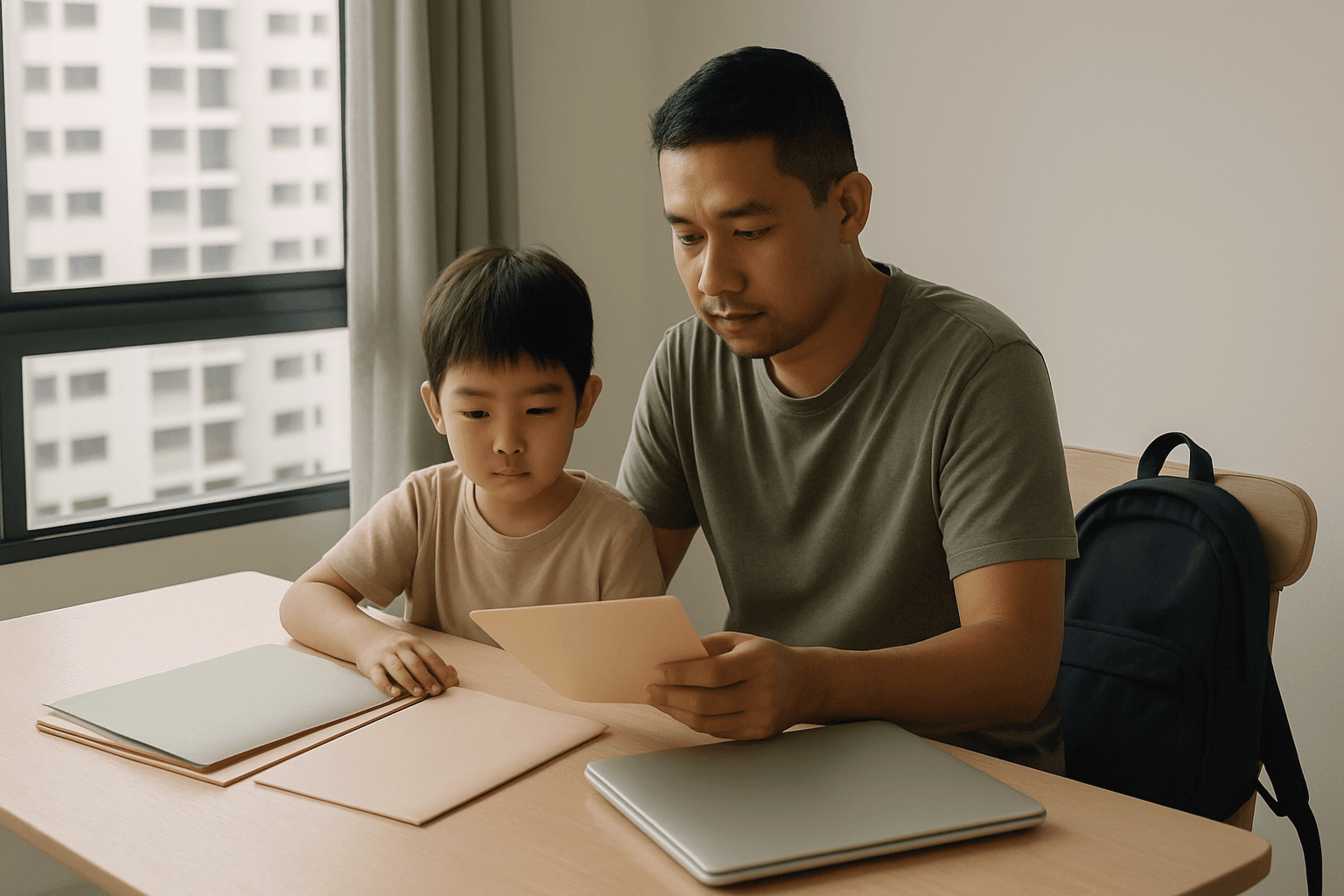
A child is usually eligible for the standard Primary 1 registration exercise only if the child meets MOE’s age rule for that intake year and fits the normal pathway into a mainstream primary school. The two most common mistakes parents make are assuming birth year alone decides everything, and assuming eligibility means they can get any school they want. It does not.
Who is eligible for Primary 1 registration in Singapore?
A child is usually eligible if the child meets MOE’s age rule for that intake year and fits the normal mainstream Primary 1 entry pathway. Overseas return cases, deferment, exemption, and unusual schooling history can change the route.
In plain English, a child is usually eligible for Primary 1 registration if the child meets MOE’s age rule for that intake year and fits the normal pathway into a mainstream primary school. That is the standard case for children entering primary school for the first time in Singapore.
The part parents often miss is that eligibility is only the starting point. It answers, “Can my child enter the process?” It does not answer, “Can my child get into my preferred school?” Those are separate questions. If you want the bigger picture after eligibility is confirmed, start with AskVaiser’s Primary 1 Registration in Singapore guide.
A straightforward example is a child living in Singapore, at the normal entry age, and joining primary school for the first time. A less straightforward example is a child returning from overseas close to the start of school, or a child whose entry has been delayed for a valid reason. Those children may still enter Singapore’s system, but not always through the same route as a typical first-time entrant.
School Placement Exercise for returning S'porean children
Singaporean children returning from overseas and wishing to join secondary schools and junior colleges at the start of the academic year in 2010 can register for the School Placement Exercise from August 3. http://www.moe.gov.sg/education/admissions/returning-singaporeans/
Phase 2A2 eligibility for MOE Kindergarten
How does this MK kindergarten ruling work ? Suppose at N2 (4 year old), parents signed up a toddler, to study at MK kindergarten, X. 3 years later, after going througg N2, K1 and K2 (6 year old) graduation - can this child then enrol into any of those 12 primary schools listed Above, or this child can only enrol into that one & only one affliated primary school, in which that MK kindergarten X is specifically affliated to ?
What age must a child be to enter Primary 1?
Check your child’s exact date of birth against MOE’s official intake rule for that year. Do not rely on birth year alone or on what other families are doing.
Age is the first thing parents should check, but use your child’s exact date of birth, not a rough birth-year estimate. The official birth-date cutoff for the relevant intake year was not included in the source material for this article, so the practical step is to compare your child’s date of birth against MOE’s published intake rule before the registration window opens.
This matters most for borderline birthdays. A child born near the cutoff can move into a different intake year based on just a few days. That is why comparisons such as “same birth year as a cousin” or “most children in kindergarten are registering this year” are not reliable.
If your child is clearly within the normal age band, move on to checking the right registration route. If your child is too young for that intake, the realistic answer is usually to wait for the next intake year. If your child is old enough but you believe entry should be delayed for a valid reason, treat that as a deferment question, not a normal age-eligibility question. For a broader overview, see Primary 1 Registration Phases in Singapore: What Each Phase Means for Your Chances.
Preparing Your Child for Primary School:Parent Seminar - MOE
Preparing Your Child for Primary School: A Parent Seminar by MOE Starting primary school is a big step in your child's life. To help you better understand primary school programmes and enable you to make key education decisions, the Ministry of Education will be conducting a seminar on Primary School Education. At the seminar, parents can look forward to sharing sessions by the school principal and a parent volunteer, as well as view the various programmes our primary schools provide. The Primar
All About Preparing For Primary One
Starting primary school? This is a big milestone. Do enjoy the journey with your child! :rahrah: https://www.straitstimes.com/singapore/education/the-st-guide-to-preparing-your-child-for-primary-1 Parents often confuse being ready for school with being academically capable in skills like reading and counting. Instead of focusing solely on academic progress, it is more important to make learning an enjoyable process, and help your child have a swift and happier adjustment to primary school. Here
Have More Questions?
Get personalized guidance on schools, tuition, enrichment and education pathways with AskVaiser.
Try AskVaiser for Free →Does citizenship or PR status affect eligibility?
Yes. Citizenship and residency can affect both whether your child joins the mainstream system and which route your family should follow into Primary 1.
Yes. Citizenship and residency do more than affect priority later in the process. They can also affect how your child enters the system in the first place. MOE’s Compulsory Education guidance says Singapore Citizens born after 1 January 1996 and living in Singapore must attend a national primary school unless an exemption is granted. For many Singapore Citizen families living locally, that means the child is expected to enter the mainstream school system unless there is an approved reason not to.
What parents often overlook is that not every child in Singapore follows the same administrative path. A Singapore Citizen child living locally is one case. A Singapore Citizen child still overseas and returning later is another. A child with a different residency situation may need parents to confirm the right route early instead of assuming the process works exactly like it does for a typical local citizen family.
The practical takeaway is simple: confirm your child’s status before you spend time comparing schools. Status can shape both the child’s route into the system and the options available later. If your family is moving, returning from overseas, or relying on a future address, sort out those basics first so your school shortlist is built on the right assumptions. For a broader overview, see Primary 1 Registration Documents Checklist: What Singapore Parents Commonly Prepare.
Give citizens priority in Primary 1 registration
Ha.ha. maybe next time the P1 registration phase can propose like that, just a suggestion: Phase 1 – Existing siblings in the Primary school except PR siblings. Phase 2A(1) – No Change Phase 2A (2) – No Change Phase 2B – No change Phase 2C – Singapore Citizenship Only. Phase 2C Supplementary - Singapore Citizenship Only Phase 3A – Permanent Residents Phase 3A Supplementary - Permanent Residents Phase 4 – Non Citizen.
Give citizens priority in Primary 1 registration
http://www.guidemesingapore.com/permanent-residence/singapore-pr-pros-and-cons.htm Quote from above : If your children are school-aged, they are high on the priority list, behind citizens, to enter public schools of your own choosing. Non PRs are at the bottom of the list and are often left with no choice when it comes to schools.
Who cannot join Primary 1 registration?
Most often, the children who cannot use the standard exercise are those who are too young for that intake year or whose cases should be handled through deferment, exemption, or a different placement route.
The clearest group who cannot join the standard Primary 1 exercise are children who do not meet the official age requirement for that intake year. If a child is too young under MOE’s rule, parents should treat that as a hard filter, not a flexible guideline.
Another broad group are children whose situations should be handled through deferment, exemption, or separate placement help rather than the normal first-time P1 route. In practice, this often includes children whose schooling was interrupted, children who have already been studying in another system, or children returning to Singapore at an unusual point in the school timeline.
The important distinction is this: not eligible for the standard exercise does not automatically mean shut out of Singapore primary education. Sometimes the child is simply too early. Sometimes the child needs a different administrative route. Sometimes the family should be asking a placement question instead of a registration question. For a broader overview, see Which Home Address Counts for Primary 1 Registration in Singapore?.
All About Preparing For Primary One
the standard of kindergarten and child care centres in SG varies from one another. Some kindy prepare kids well for P1, but other kindy not sufficient. The standard varies. moreover, P1 standard is getting higher and higher, each year. that is why some parents still prefer to send kids for P1 Prep course. if you think you come from a kindy where then standard is reasonable, then ok.
2021 P1 Registration Exercise for 2022 In-take
As per https://www.moe.gov.sg/primary/p1-registration , Details of the 2021 P1 registration exercise will be updated in May. There are still 20 odd days to go before their dateline. Chill.
Can children living overseas or not yet in Singapore register?
Yes, some children living overseas can still enter Singapore’s system, but overseas residence is a special case and may need placement handling instead of the usual local registration route.
Sometimes, yes, but parents should not assume the normal local route applies automatically. MOE specifically treats overseas cases as special situations, and parents are expected to inform MOE when the child is returning. For returning Singaporean children, MOE guidance indicates that a place is generally arranged in a suitable primary school near home, taking into account practical factors such as vacancies and overall fit. That is helpful, but it is different from saying every returning child can simply pick any school and enter through the usual local process.
A common example is a family planning to move back to Singapore a few months before Primary 1 starts. In that case, the real question is not just age. It is also when the child is returning, what address the family will actually use, and whether MOE placement help is needed. Another example is a child already studying overseas whose parents want to switch systems. In that situation, prior school records and timing often matter as much as age.
If this is your case, settle the return plan early. Parents commonly prepare documents such as identity records, overseas school reports, and proof related to the move. These are examples of what families often find useful, not a guaranteed official checklist for every case. If the family is also moving house, it helps to understand how address questions work before you assume a school option is available. AskVaiser’s guides on which home address counts for Primary 1 registration and registration after moving house can help you plan that part properly. For a broader overview, see Primary 1 Registration Unsuccessful: What Happens If You Do Not Get Your Preferred School.
Give citizens priority in Primary 1 registration
Not sure if this has been mentioned in KSP forum? From 2010, Singapore Citizens (SCs) will be given an additional ballot slip (i.e. two chances instead of one), while Permanent Residents (PRs) will retain one ballot slip whenever balloting is conducted by any school during the P1 Registration Exercise. SCs will therefore have a higher chance of securing a place for their child in a school of choice when there is balloting. Giving Singaporeans two chances during balloting will retain the underlyi
2013 School Placement Exercise for Returning Singaporeans
School Placement Exercise 1) The 2013 School Placement Exercise for Returning Singaporeans (SPERS) is open for registration from 17 July 2013 for Singaporean children who are returning from overseas and wish to join our secondary schools, junior colleges (JC) or Millennia Institute (MI) at the beginning of academic year 2014. 2) SPERS is a centralised placement exercise held at the end of the year for Returning Singaporeans (RS). With SPERS, Singaporean parents working abroad can look forward to
What if my child is older, younger, or has an unusual schooling history?
Children outside the usual intake pattern may need deferment, exemption, or placement help rather than normal registration. Mild special needs alone do not automatically create a separate P1 route.
When a child falls outside the usual intake pattern, the best question is usually not, “Can I just register normally?” but, “What is the right route for my child now?” A child who is younger than the official entry age will usually need to wait for the next intake. A child whose entry is being deliberately delayed may need a deferment route instead of ordinary registration. A child who started school late overseas, missed the usual intake, or had interrupted schooling may need placement guidance rather than a simple P1 sign-up.
This is also an area where parents can over-assume separate treatment. MOE’s FAQ on children with mild special needs says these children register for Primary 1 in the same way as other children, based on their eligibility for the normal registration phases. In other words, mild special needs do not automatically create a different Primary 1 registration pathway.
A useful way to frame it is this: an unusual history changes the pathway question, not necessarily the schooling goal. Parents usually get better results when they stop trying to force every case into the standard first-time P1 template and instead work out what placement makes sense now.
All About Preparing For Primary One
Isn’t pre-school and kindergarten is prep for P1? Or are there still many in SG who donch go to kindy?
2021 P1 Registration Exercise for 2022 In-take
https://www.straitstimes.com/singapore/parenting-education/phase-2a2-of-p1-registration-begins-july-14-no-spots-in-6-schools [quote]All available spots at these schools were snapped up during the second phase: 1. Ai Tong Primary School 2. Catholic High School (Primary) 3. CHIJ St. Nicholas Girls' School (Primary) 4. Nanyang Primary School 5. Pei Hwa Presbyterian Primary School 6. Rosyth School[/quote]
What do parents often misunderstand about eligibility versus school placement?
A child can be fully eligible for Primary 1 and still not get a place in the family’s preferred school.
The biggest misunderstanding is thinking that if a child is eligible, the child can therefore get a place in any school the parent chooses. That is not how Primary 1 works. Eligibility decides whether your child can enter the process at all. Registration phases, distance rules, vacancies, and balloting affect the school result after that. Eligibility gets you into the process; it does not guarantee the outcome. If that is the part you are worrying about next, read how Primary 1 registration phases affect your chances and what happens if you do not get your preferred school.
Kindergarten that prepares child well for Primary 1
Hello all I am very concern of which nursery, kindergarten actually prepares a child well for primary 1. I was told that some church kindergarten does not prepare a child well for primary 1. I was also told that those good preschool are pat school house, chiltern house, eaton house… which you actually have to pay premium for their school fees. Whereby Nanyang kindergarten, St James kindergarten and Nafa kindergarten have a long waiting list which is impossible to get my child in. Can anyone plea
Give citizens priority in Primary 1 registration
BTW I wrote ths to ST but it never got posted: In her letter, Mrs Agawal have hit the gist of why PR students should not be given equal chance for Primary 1 registration. She says that if her children were unable to secure a place in a good public school, why would her family to stay? A Singpore citizen will never be able to say that. We are here to stay and as such deserve the right to choose before a permanent resident. My son, a 4th generation Singaporean, was not able to secure a place in a
How should parents check eligibility before registration opens?
Check your child’s date of birth, status, and schooling history early, then confirm whether the case fits the standard route or needs special handling.
Start by checking the child, not the school. First confirm the exact date of birth against the relevant intake rule. Then confirm the child’s citizenship or residency situation. After that, look at whether the child fits the usual local route or a special case such as overseas return, deferment, exemption, or prior schooling elsewhere. This order matters because many parents spend weeks talking about school choice before realising they still have an unresolved eligibility issue.
In practical terms, families usually review a few records early. Common examples include the child’s birth or identity documents, records showing citizenship or residency status, the family’s current or intended Singapore address, overseas school reports if the child has studied elsewhere, and any prior correspondence about deferment, exemption, or special education needs. These are examples of what parents commonly prepare, not an official all-cases checklist.
If anything looks unclear, resolve that before you shortlist schools. This matters most for families moving house, returning from overseas, or trying to work out whether the child is entering at the normal point. AskVaiser’s documents checklist guide can help you think through what parents commonly gather before registration season.
Share with us your kid's P1 registration experience
Hi parents, I've gone through 2 rounds of registration for my kids - Phase 2B 5 years ago (2006) and Phase 2A2 (2010). For son's P1 registration at Pei Hwa then, there was just 1 stop - ie to submit documents for verification. No guarantee at Phase 2B, just a high chance of getting in. Today's registration for daughter is slightly longer - 3 'stops'. Station 1 is at ground floor where a lady will make sure we are eligible for Phase 2A2. If so, then we proceed to the hall on 2nd floor. Station 2
All About Preparing For Primary One
hi, for parents with kids in pre-nursery / nursery, these two initial years are “honeymoon” years, usually quite relaxed. But for parents with kids in k1, k2, where you are stepping on the final last lap accelerator for more oil to speed up momentum, help yr child prepare Pri 1, it is always good to attend - one year ahead in advance, the parents’ briefing on detailed Pri 1 curriculum. do not wait until the year when your child has started Pri 1, then come to attend such parents’ briefing. why ?
What should I do if my child is not eligible for the standard Primary 1 registration exercise?
If your child does not fit the normal exercise, do not submit a standard application and hope for the best. Work out whether the right next step is waiting for the next intake, seeking deferment or exemption, or using an overseas-return or placement route.
Do not try to force the standard route. The right next step depends on why your child does not fit it. If your child is simply too young for that intake, the practical answer is usually to wait for the next intake year. If entry needs to be delayed for a valid reason, treat it as a deferment issue rather than a normal registration problem. If your child is overseas, returning to Singapore, or has already been educated in another system, clarify the placement pathway first instead of assuming the usual school-by-school exercise applies.
For Singapore Citizen families, MOE’s Compulsory Education guidance is an important starting point because it explains the national school obligation and the role of exemption. The useful mindset is this: not eligible for the standard exercise now does not always mean not eligible for Singapore primary school at all. Sometimes the child needs a later intake. Sometimes the child needs a different route. The best outcome usually comes from sorting out the correct pathway early, before the registration window becomes urgent.
International students applying to Singapore Pr schools
I'm pretty sure they cannot approach a school/MOE for a place mid-year at this point in time. If arriving March +/-, I think the two options are: a) Get kid and one parent temporarily here in Feb for S-AEIS. If pass, I assume entry starts in Term 3 (after June holidays). If unsuccessful, probably need to enroll in int'l school for Aug-Sept and can try AEIS again in Sept. b) Arrive in March +/- and take AEIS in Sept for entry the following year. Outcome probably won't be known until very late in
Give citizens priority in Primary 1 registration
Sharing with you the below blog entry from http://mrwangsaysso.blogspot.com/ on the same topic. Education, and Even More Discrimination Against Citizens ST Aug 20, 2009 Thanks, being a PR is good enough IN RESPONSE to letters by Mr Jimmy Loke ('The PR difference', last Saturday) and Mr Chia Kok Leong ('No school, no Singapore', last Saturday), I would only ask them to refer to Minister Mentor Lee Kuan Yew's speech reported last Friday ('MM: Foreign talent is vital'), where he gave an idea of the
Have More Questions?
Get personalized guidance on schools, tuition, enrichment and education pathways with AskVaiser.
Try AskVaiser for Free →