
Primary 1 Registration Phases in Singapore: What Each Phase Means for Your Chances
A plain-English guide to the P1 phase sequence, who usually applies in each stage, and how phase position affects your odds at popular schools.
Primary 1 registration phases in Singapore usually run from Phase 1 to Phase 2C Supplementary. Children apply in the phase they qualify for, and earlier phases generally give better chances at popular schools because more places are still available.
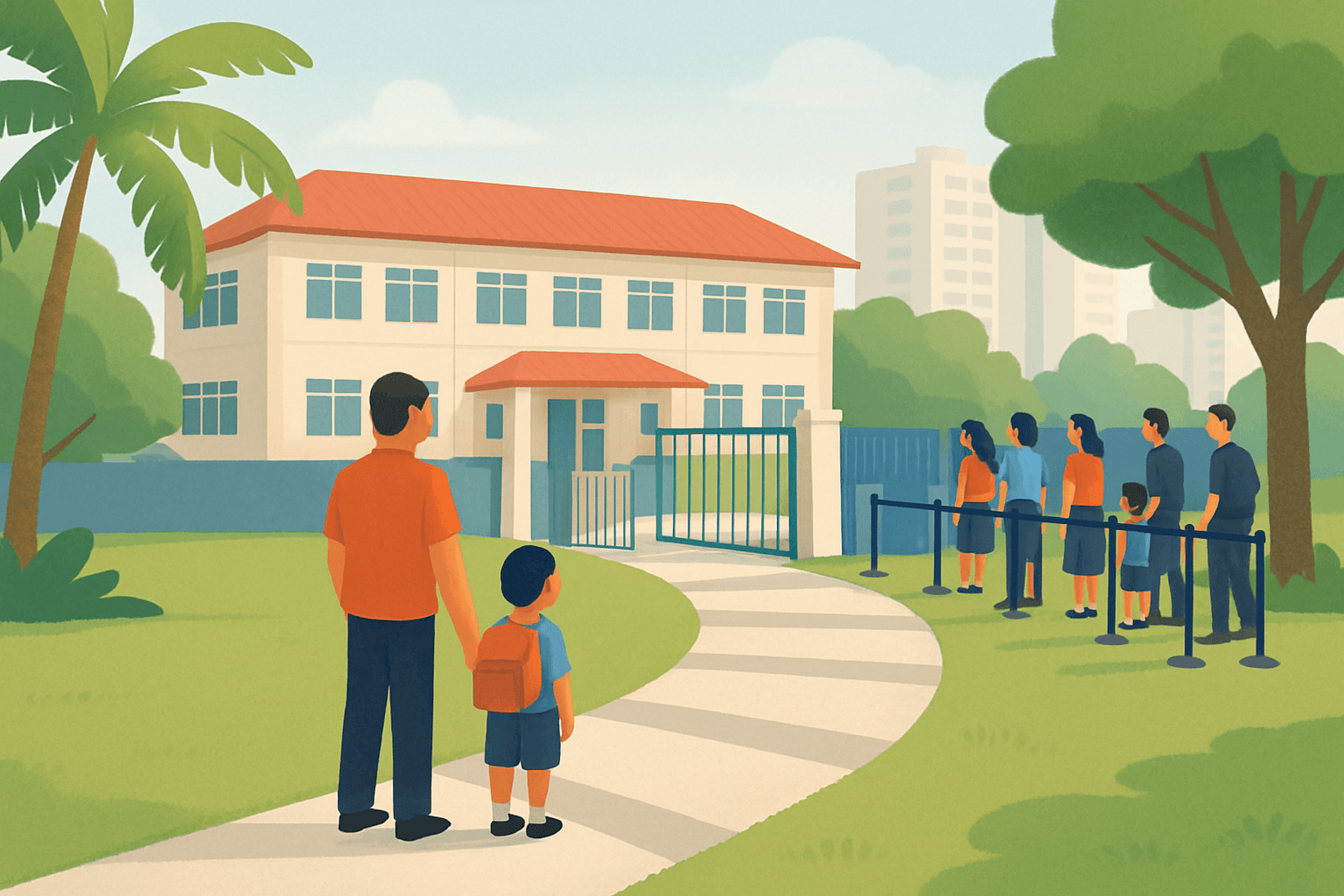
Primary 1 registration in Singapore is split into phases, and children register in the phase they qualify for. The commonly discussed sequence is Phase 1, Phase 2A, Phase 2B, Phase 2C, and Phase 2C Supplementary.
For parents, the main question is not just what the labels mean. It is how the phase affects your chances. Earlier phases usually leave you with more vacancies still available. Later phases usually mean tighter competition, especially at schools that are already in high demand. If you want the full process, start with our Primary 1 registration guide. This article focuses on the phase order and what it means for school planning.
What are the Primary 1 registration phases in Singapore?
Primary 1 registration is split into phases, and children apply in the phase they qualify for. The usual sequence is Phase 1, Phase 2A, Phase 2B, Phase 2C, and Phase 2C Supplementary.
The Primary 1 registration phases are the stages MOE uses to decide who gets to apply first for a school place. In simple terms, it is a priority queue. Parents do not choose any phase they want; they register in the phase their child qualifies for.
The commonly used sequence is Phase 1, Phase 2A, Phase 2B, Phase 2C, and Phase 2C Supplementary. The easiest way to think about it is this: earlier phases usually come with stronger priority, while later phases are more open but also more competitive.
The practical takeaway is simple. Your phase can affect your school options just as much as your preferred school list does. A school that looks realistic in an earlier phase may become much harder to secure later, especially if demand is high. That is why parents who understand the phase order early tend to make calmer backup plans. For a broader overview, see Primary 1 Registration in Singapore: How It Works, Balloting Risk, and How to Choose a Realistic School Plan.
All About Pri 1 Registration for Foreigners & Phase 3
The child is currently in K1 and going K2 next year as such I have seen that we should indicate interest for primary 1 during next year June or July for the kids.[/quote]There are a couple of things you will need to or can do: 1. Assuming nothing much (as in status) changes, wait for MOE announcement and indicate your interest for participating in Phase 3. Take note that the child will be treated as a foreigner and there is no special privileges given, ie, there’s a possibility that the child wi
Preparing Your Child for Primary School:Parent Seminar - MOE
Preparing Your Child for Primary School: A Parent Seminar by MOE Starting primary school is a big step in your child's life. To help you better understand primary school programmes and enable you to make key education decisions, the Ministry of Education will be conducting a seminar on Primary School Education. At the seminar, parents can look forward to sharing sessions by the school principal and a parent volunteer, as well as view the various programmes our primary schools provide. The Primar
Why does phase order matter so much for a popular primary school?
Earlier phases usually improve your chances because more places are still available. Later phases are more open, but they are often where competition becomes much sharper.
Phase order matters because school places are gradually taken up across the exercise. By the time later phases open, some vacancies at high-demand schools may already be gone. That is why earlier access usually improves your odds.
A useful way to think about it is this: earlier phase usually means more certainty, while later phase usually means more competition. The phase system is not just an admin sequence. It changes the admissions picture school by school.
This matters most at schools that attract many applicants. CNA’s reporting on MOE data has described Phase 2C as the open-to-all round and the most competitive stage, with many schools oversubscribed and balloting common at popular schools, as seen in its coverage of Phase 2C results. For parents, the lesson is practical: if a school is already highly sought after, your phase can matter more than how much you like the school on paper. For a broader overview, see Who Is Eligible for Primary 1 Registration in Singapore?.
Give citizens priority in Primary 1 registration
Ha.ha. maybe next time the P1 registration phase can propose like that, just a suggestion: Phase 1 – Existing siblings in the Primary school except PR siblings. Phase 2A(1) – No Change Phase 2A (2) – No Change Phase 2B – No change Phase 2C – Singapore Citizenship Only. Phase 2C Supplementary - Singapore Citizenship Only Phase 3A – Permanent Residents Phase 3A Supplementary - Permanent Residents Phase 4 – Non Citizen.
All About Preparing For Primary One
Starting primary school? This is a big milestone. Do enjoy the journey with your child! :rahrah: https://www.straitstimes.com/singapore/education/the-st-guide-to-preparing-your-child-for-primary-1 Parents often confuse being ready for school with being academically capable in skills like reading and counting. Instead of focusing solely on academic progress, it is more important to make learning an enjoyable process, and help your child have a swift and happier adjustment to primary school. Here
Have More Questions?
Get personalized guidance on schools, tuition, enrichment and education pathways with AskVaiser.
Try AskVaiser for Free →Which Primary 1 phase is my child likely to fall under?
Most families are either in an earlier priority phase because of a recognised school link, or in the later open phases if there is no qualifying link. Confirming that early makes school planning much clearer.
The fastest way to work this out is to ask one practical question: does your family have a recognised school-linked priority, or are you likely entering the open phase? That is usually enough to tell you how cautiously you should plan.
Families with a recognised link to a school may qualify for an earlier round. Families without one usually plan for the later open stages. Common examples parents often think about include an older sibling already in the school, alumni-related links, parent association links, or volunteer and service ties where those are recognised under the rules for that year. These are examples only, not guaranteed routes, so the important step is to confirm whether your exact situation counts before you build a shortlist around it.
If you are unsure, do not start by comparing ten schools. First confirm your likely phase using our eligibility guide and the current MOE registration information for that exercise. That quickly tells you whether you should plan like an earlier-priority applicant or like an open-phase applicant.
Parents sometimes also worry that children with mild special needs follow a separate route. MOE says they register in the same phase-based way as other children, based on eligibility for the registration phases, as explained in this MOE FAQ. For a broader overview, see How to Estimate Balloting Risk Before Primary 1 Registration.
All About Preparing For Primary One
hi, for parents with kids in pre-nursery / nursery, these two initial years are “honeymoon” years, usually quite relaxed. But for parents with kids in k1, k2, where you are stepping on the final last lap accelerator for more oil to speed up momentum, help yr child prepare Pri 1, it is always good to attend - one year ahead in advance, the parents’ briefing on detailed Pri 1 curriculum. do not wait until the year when your child has started Pri 1, then come to attend such parents’ briefing. why ?
All About Preparing For Primary One
Was surfing around on understanding if I am well prepared on behalf of my DD1 for Primary 1 Chanced upon a few websites, thought to share though it could have been mentioned before Tips For Parents ◦Work on independent reading skills. ◦Set up a study area and regular study times that are not interrupted. ◦Learn to follow a routine with a lot of sleep and early mornings. ◦Practice organisation and planning by packing a daily bag with essentials for the day. ◦Talk about social skills and communica
What happens in Phase 1, Phase 2A, Phase 2B, and Phase 2C?
Phase 1 is the earliest round, Phase 2A and Phase 2B are earlier-priority rounds for recognised links, and Phase 2C is the open round that is usually the most competitive.
Phase 1 is the earliest round. In practice, it is where the strongest built-in school-linked priority situations are handled first under MOE’s rules for the year. If your child qualifies here, you are usually planning from a much stronger starting point than families who must wait.
Phase 2A and Phase 2B are still earlier-priority rounds, but they usually cover different types of recognised links to the school. The exact categories are set for each registration exercise, so parents should verify them carefully instead of assuming that any connection to a school will count. The practical meaning is straightforward: some families still get to apply before the fully open round begins.
Phase 2C is the open round for eligible children, and it is widely seen as the pressure point because many more families are competing without earlier priority. By this stage, a school’s remaining vacancies may look very different from what parents imagined at the start.
A simple comparison helps. One family may have a recognised school link and decide whether to try a high-demand school early. Another family may like the same school but have no qualifying link, so they are really deciding whether it is still realistic by the open stage. Same school, different phase, very different odds.
Treat the phase labels as probability labels. They do not guarantee an outcome, but they tell you how cautious your planning should be. For a broader overview, see Primary 1 Registration Distance Priority: How Home-School Distance Works.
Share with us your kid's P1 registration experience
Hi parents, I've gone through 2 rounds of registration for my kids - Phase 2B 5 years ago (2006) and Phase 2A2 (2010). For son's P1 registration at Pei Hwa then, there was just 1 stop - ie to submit documents for verification. No guarantee at Phase 2B, just a high chance of getting in. Today's registration for daughter is slightly longer - 3 'stops'. Station 1 is at ground floor where a lady will make sure we are eligible for Phase 2A2. If so, then we proceed to the hall on 2nd floor. Station 2
All About Pri 1 Registration for Foreigners & Phase 3
I think it is actually quite difficult to get a spot. Probably more unsuccessfuls than spots awarded...
What is Phase 2C Supplementary and who is it for?
Phase 2C Supplementary is the later fallback round for children who still need a place after the main phases. It helps only where schools still have vacancies, so it is a backup stage, not a promise.
Phase 2C Supplementary is the later fallback stage after Phase 2C. In practical terms, it is for children who still need a place and for schools that still have vacancies after the main rounds.
Many parents do not think seriously about this phase until they need it. That is a mistake, because this is usually the point where planning shifts from chasing a preferred school to securing a workable place.
What matters most is not to treat Phase 2C Supplementary as a guaranteed safety net for any school you want. It only helps where vacancies remain. A useful parent mindset is this: prepare your fallback before disappointment, not after it. If an earlier attempt does not work out, this guide on what happens when you do not get your preferred school can help you think through next steps calmly.
All About Pri 1 Registration for Foreigners & Phase 3
Welcome to KiasuParents! Not sure if you can actually apply to International School right now; it'd be odd since your child isn't even in the school at the moment. I'm sure if you call them they will advise you on what to do. Good luck for your P1 registration.
All About Pri 1 Registration for Foreigners & Phase 3
Firstly, AEIS is not applicable to your daughter this year. AEIS is for international students seeking admissions to Primary 2 to 5 and Secondary 1 to 3 in the following academic year . Given that she’s 6yo this year, you will have to wait till next year to apply. For this year, you have to indicate your interest to participate in Phase 3 of application via MOE. Details will be on their website. Lastly, it doesn’t matter where you going to live. You are at the mercy of the system. No guarantee t
What most parents misunderstand about popular schools and phase priority
The common mistake is choosing a school first and checking phase reality later. For oversubscribed schools, your phase often matters more than your preference.
A popular school name is not the same as a realistic admission plan. Many parents spend too much time comparing reputation or programmes before asking the more important question: what phase are we actually entering in?
The later your child enters the process, the more your shortlist should be shaped by risk, not wishful thinking. Phase first, school second. If your whole strategy depends on one oversubscribed school in a later phase, you do not really have a strategy yet.
All About Preparing For Primary One
My son is going primary 1 next year and I am eligible for phase 2b under a good school but it took two hours of time of bus transport to n fro from home. The kid have to be at the bus stop at 6am waiting for bus. That school have proven track record for the past many years because of it’s strict standards. Now, my headache is there Is a relatively new school which is only a few years old n has not proven track records n the highest psle scores is 230plus. This school is just downstairs my home b
All About Preparing For Primary One
First of all, how far are u from the school? Within 1km or 1 - 2km? If near, don't take school bus, send yourself. Any balloting history for the neighbourhood school under 2C?
How should parents choose schools if they are in a later phase?
If you are in a later phase, shortlist schools by probability, not just by prestige. Keep one hopeful choice, one realistic choice, and one backup you can genuinely live with.
If you are likely entering in a later phase, choose schools by likelihood as well as preference. A useful approach is to build a shortlist with three levels in mind: one aspirational option you still want to try, one realistic option where your odds feel more workable, and one safer backup that you would genuinely accept.
This is not about lowering standards. It is about matching your plan to the admissions landscape you are actually in. A school can be a good fit and still be a high-risk choice if it is heavily contested by the time your phase opens. Another school may have a less famous name but offer a shorter commute, less registration stress, and a better day-to-day routine for a young child.
For example, some parents focus on a well-known school even though they are entering in an open phase and do not live especially near it. A more useful comparison is that school versus a nearby school with a manageable morning route and historically lower pressure. If you are making that kind of trade-off, this article on dream schools versus safer nearby choices, this guide to estimating balloting risk, and this explanation of distance priority can help.
For many families, the best school is not the one that sounds most impressive on paper. It is the one that is realistic to enter and realistic to live with every weekday.
Kindergarten that prepares child well for Primary 1
Hello all I am very concern of which nursery, kindergarten actually prepares a child well for primary 1. I was told that some church kindergarten does not prepare a child well for primary 1. I was also told that those good preschool are pat school house, chiltern house, eaton house… which you actually have to pay premium for their school fees. Whereby Nanyang kindergarten, St James kindergarten and Nafa kindergarten have a long waiting list which is impossible to get my child in. Can anyone plea
Preschools prepared your kids well for Singapore primary?
For parents who have already been through the pre-school days and with kids now in primary schools (Singapore schools), can you share your comments on your kid's previous preschool and their curriculum - specifically if they have prepared your child properly for the Singapore education system ? (not discussing the international or foreign schools system here) Nowadays, there are so many pre-schools and childcare centres with many learning methods. Parents currently at the pre-school stage will b
What should you prepare before Primary 1 registration starts?
Prepare by confirming your likely phase, building a realistic shortlist, testing travel practicality, and keeping any relevant identity, address, or school-link records ready.
Before registration opens, remove as much guesswork as you can. Confirm your child’s likely phase first, then compare schools through that lens. Parents often do this in the wrong order and end up emotionally committed to schools that were never realistic from their phase position.
It also helps to prepare the practical information you may need early. Parents commonly keep their child’s identity details, home address details, and any records linked to a possible school-priority claim ready. These are common examples, not an official MOE checklist and not a guarantee of what will be requested. If you want a more practical preparation guide, this documents checklist article is a useful next read.
You should also test your shortlist in real life, not just on a screen. Check the route to school during the morning peak. Think about who is doing drop-off and pickup. Compare what happens if your first choice does not work out. If address-related priority may affect you, read which home address counts or whether to use your old or new address after moving.
Finally, remember why planning early matters. For Singapore Citizens living in Singapore, compulsory education applies unless an exemption is granted. That does not change the phase mechanics, but it is a practical reminder that Primary 1 registration is not something to leave to assumptions or last-minute scrambling.
All About Preparing For Primary One
My girl is in P1 this year. Based on my experience, I think you are doing a fine job so far... As long as kids go to pre school, they are more or less ready for P1 because topics cover in first semester are very similar to what they will be learning in K2... I did buy some assessment books for my girl when she was in K2 because she had so much free time after school. Whether to draw up a time table is subjective... it definitely incultivate good habits which may be ideal when he starts P1. Prepa
All About Preparing For Primary One
Dear parents, I hope parents could share your experience regarding the preparation for primary school and time schedule spend with your kids everyday. I have a son of 6 this year going to P1 next year. I would like to find out with parents things that you are doing with your child prior going P1, cos I do not want to react too kan-jiong or too relax in front of my child. I am particularly concerned about the 3 main subjects being taught in P1 and wonder should I expect him to be able to do the a
If my child is in a later phase, can we still try for a popular school?
Yes, but it is usually a higher-risk move. If you try for a popular school in a later phase, pair that choice with realistic backups instead of relying on one result.
Yes, you can still try, but you should treat it as a higher-risk choice, not a likely outcome. A later phase does not automatically shut the door, but it usually means more places may already be taken and competition may be sharper by the time you apply.
The more useful question is not only “Can we try?” but also “What is our plan if this does not work out?” If you genuinely like the school and are comfortable with the risk, applying can still make sense. Just do not make it your only plan. Pair it with schools you would realistically accept if the popular option becomes oversubscribed or goes to ballot.
This is where many parents get misled by isolated success stories. A family somewhere may have got in during a later phase, but that is not the same as saying the odds are good for everyone. Good planning means hoping for the preferred outcome while preparing for the more probable one.
[Pasir Ris] Primary Schools
School Vacancies by Phases - Phase 2B (as at 25 July 2014) Source : http://www.moe.gov.sg/education/admissions/primary-one-registration/vacancies/#pasir-ris http://i57.tinypic.com/veyx5v.png\"> Do note that Phase 2C internet registration starts from 9.00 am on 29 July 2014 to 4.30 pm on 31 July 2014.
[Pasir Ris] Primary Schools
School Vacancies by Phases - Phase 2C (as at 31 July 2014) Source : http://www.moe.gov.sg/education/admissions/primary-one-registration/vacancies/#pasir-ris http://i60.tinypic.com/2ij2j9l.png\"> If more than 7 registered in Elias Park on 1 August, Elias Park will go into balloting this year. It has no balloting for past 2 years.
Have More Questions?
Get personalized guidance on schools, tuition, enrichment and education pathways with AskVaiser.
Try AskVaiser for Free →