
Primary 1 Registration: Dream School or Safer Nearby School?
A practical Singapore parent guide to weighing school fit, balloting risk, commute, and family stress.
Choose the dream school only if you have a real reason for wanting that specific school and you can live with the possibility of missing out. Choose the safer nearby school if you want better admission odds, simpler logistics, and less family stress. For many families, the smartest Primary 1 choice is the school they can manage well every weekday, not just the one with the strongest reputation.
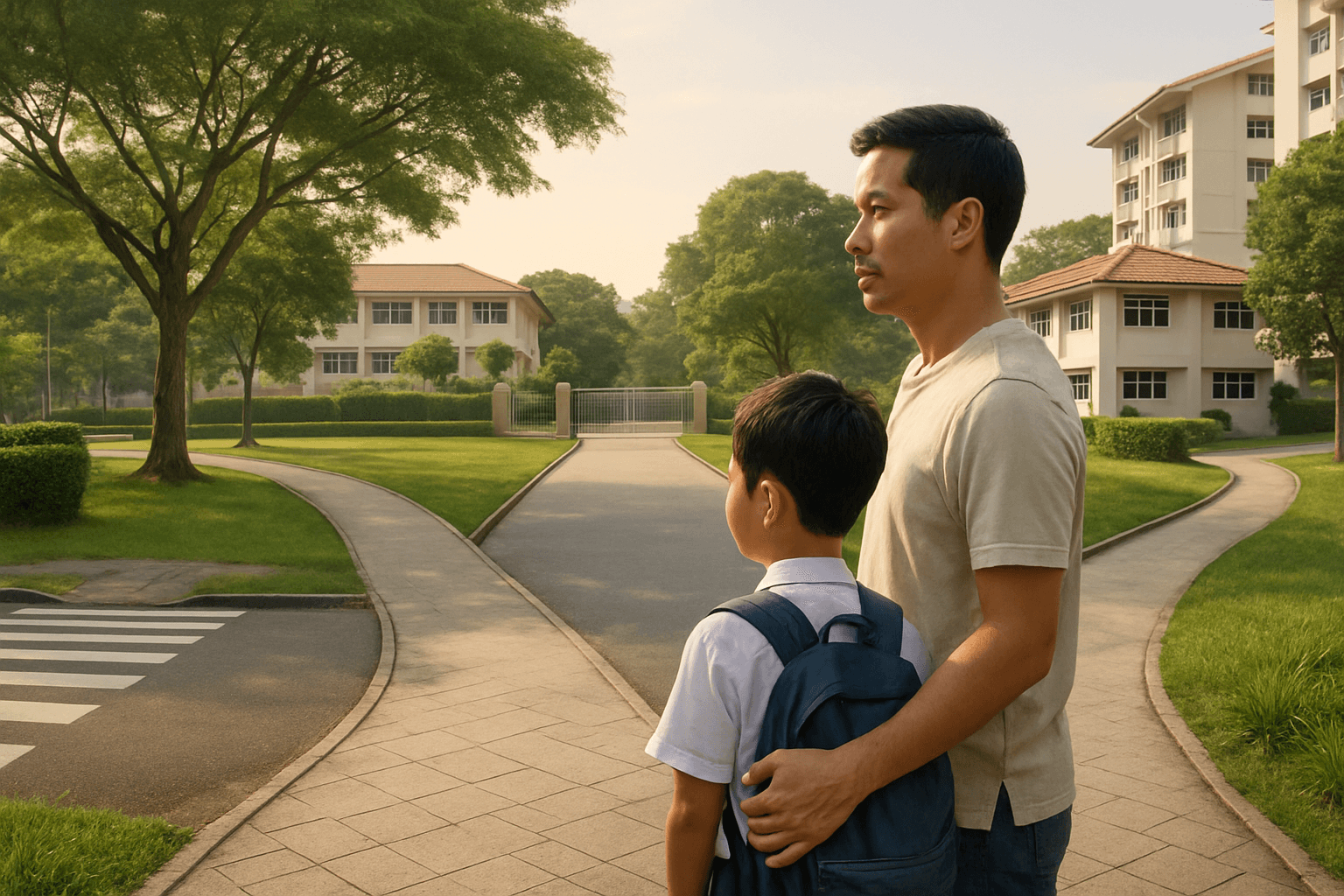
If you are torn between a popular dream school and a safer nearby school, the short answer is this: try for the dream school only if it is a genuine fit and your family can accept the risk of not getting it. Choose the nearby school if certainty, commute, and day-to-day family logistics matter more. In Singapore's Primary 1 system, this is usually not a choice between a good school and a bad school. It is a choice between taking on more admission risk and protecting six years of daily routine.
What is the real decision here: aspiration or certainty?
This is mainly a choice between higher aspiration and higher certainty, not between a good school and a bad one.
The real decision is usually aspiration versus certainty. Under MOE's system, parents may register at any primary school of choice, but if applications exceed vacancies in a phase and distance category, balloting can happen, as MOE explains in its Primary 1 registration FAQ. That is why a popular school can be attractive and still be a risky choice, while a nearby school can be less contested and much more predictable.
A better way to frame the decision is not "top school versus ordinary school." It is "how much uncertainty is my family willing to carry?" One family may be comfortable taking a chance because they already know which other schools they would accept. Another may need a school that a grandparent, helper, or working parent can reliably manage every day. Both approaches are valid. The better choice is the one that still feels workable if your first preference does not happen.
Insight line: your Primary 1 choice is not just about a school. It is about how your household will run every weekday for the next six years. For a broader overview, see Primary 1 Registration in Singapore: How It Works, Balloting Risk, and How to Choose a Realistic School Plan.
Top Primary school?
for me, there is only one school within 1km from my place...it is a good one, but...i don't have any girls. i will need to ballot for a place for one sch within 1-2km from my place (next nearest school). if *touch wood*, balloting is unsuccessful, i will go for the next nearest neighbourhood school. for this, i am wary that this school focus its resources on the 'diamond' class and streaming starts as early as end of P1! getting him into such class will be my next best bet. so neighbourhood scho
Choosing Secondary school
Hi, Wonder if anyone knows what happens in this Secondary School selection scenario : If there are 10 places left in School A and 20 pupils with EXACTLY the same PSLE score apply, how does MOE decide which 10 to take into the school. Does it matter in this case whether the child had put School A as the first choice? This impacts what schools to put as 1st and 2nd choice - whether the common advise of putting the dream school which is just out of range of the child’s mark is a wise thing to do. P
When does it make sense to try for the popular dream school?
Try for the dream school when the fit is real, the logistics are workable, and your family can accept not securing it.
It makes sense to try for the dream school when the attraction is real and specific, not just social pressure. A school may be worth pursuing if its culture, programmes, or learning environment genuinely suit your child, and your family is prepared for the possibility of not getting in. MOE's parent-facing advice is often centred on fit, values, interests, and programmes rather than reputation alone, which is a useful starting point. If you need the wider registration context first, see our Primary 1 Registration in Singapore guide and this parent guide on choosing a primary school.
A practical test helps. If you want that school because your child would genuinely benefit from what it offers, and the travel is still manageable, the risk may be worth taking. For example, a family living reasonably near a school they strongly like may sensibly decide to try. But if the main reason is that other parents call it a "branded" school, that is usually too weak a reason to accept a stressful, uncertain process.
A common parent mistake is confusing prestige with fit. If you cannot explain why that specific school suits your child beyond its name, pause before treating it as a dream school. For a broader overview, see Popular Primary School vs Neighbourhood School in Singapore: Which Is Better for Your Child?.
Top Primary school?
Honestly I am not sure if there is such a thing as a top primary school based on the efforts of the school. All schools have the same mission set by MOE to deliver the same thing. If you hear from them, even teachers they have no control, it's all from MOE. So what then would you consider as top primary school? It definitely cannot be results alone because results are typically parents-driven in today's context in some schools. Every school has the best cream of the crop and the worst performers
Which preschool would you choose?
I would choose School 2. My reasons: 1. School 1 seems to be lacked of enough facilities to provide sufficient stimulation (unless teacher is sooooo creaitve???). They don’t have outdoors, just w classrooms?? Being in an enclosed room for 3hrs everyday without being able to go outdoors or change environment, I myself hate that! And I dun like children to be in such environment too. 2 hours is the max maximum I would go for such enclosed environment. 2. What level is your child in? For Nursery/pl
Have More Questions?
Get personalized guidance on schools, tuition, enrichment and education pathways with AskVaiser.
Try AskVaiser for Free →A nearby school is not the same as settling.
A nearby school can be a strong first-choice decision, not a second-rate one.
Parents often use terms like "backup school" or "safety school," but those are informal planning labels, not official MOE categories. In practice, a nearby school can be the stronger strategic choice if it gives your child a manageable routine, lowers balloting exposure, and protects family energy. Choosing sustainability is not giving up. It is often the more disciplined decision. For a broader overview, see How to Estimate Balloting Risk Before Primary 1 Registration.
Pls advise: Choose River Valley Primary School or Pei Chun Public School
Hello, My younger son was born in 2020 and will be registering for primary school in 2026. We also have an older daughter who is currently in Primary 3. We would like to seek everyone’s advice on whether River Valley Primary School or Pei Chun Public School would be a better choice for our son. We are a Chinese family and hope that our children can develop a good foundation in the Chinese language. We also place great importance on character education in school. In addition, we have been trying
Which preschool would you choose?
so u won’t consider nativity? anyway school 2 also needs to take school bus mah. if u r changing to st anne’s or seng kang methodist church kindy for n2 onwards cos they are near your house and no need to travel, then i suggest u stick to the current one until this year end. afterall, 30 months to 42 mths - ok to use potty stil n if u have no big issues with them since 18mths til now, and given that n1 level most schools dun teach much academics yet, ok to stay. but u need to take note of the re
When is the safer nearby school the smarter choice?
Choose the nearby school when certainty, routine, and family bandwidth matter more than reputation.
The safer nearby school is often the smarter choice when everyday practicality matters more than status. This is especially true if both parents work long hours, if pickup depends on grandparents or a helper, or if your child is likely to settle better with a calmer routine. A shorter journey can matter far more in Primary 1 than many parents first assume because it affects sleep, punctuality, after-school fatigue, and who can realistically step in when plans change.
Think about common family situations. If one parent must leave for work early, a faraway school can turn every morning into a rush. If a grandparent helps only a few afternoons a week, a nearby school may be the only realistic option. If your child is already anxious about starting primary school, a simpler commute can remove one layer of stress straight away. If you are comparing nearby options, this guide on how to choose the best primary school near you can help you look beyond reputation.
Insight line: the best school is the one your family can actually run every weekday. For a broader overview, see Primary 1 Registration Distance Priority: How Home-School Distance Works.
Top Primary school?
Let’s put it this way… If all schools are equal in standards & teachings etc, parents will not have to go thru the stressful registration process to get into the top schools. Imagine that: no more volunteer, no need to donate, etc… How nice… Good schools or top schools is all in our mindset… Neighbourhood schools can also produce top students… The reason why MOE had forego the ranking systems is because they realise that principals nowadays is forgetting the importance of education. Principals a
Top Primary school?
in my opinion, I do not believe in ranking primary schools as these are totally nonsense… Primary school is an early stage of education for young kids especially from P1-P3. We should not emphasis too much on academic results. By ranking schools, it put pressure to the principals to emphasis on results & thus favours better students than the average students. This will have negative effect on the average students… Education have to be fair to ALL students… this is just my opinion and i hope pare
How much should distance and daily logistics matter in Primary 1 registration?
Distance matters more than many parents expect because it affects both admission odds and six years of daily routine.
They should matter a lot because distance affects both admission chances and daily life. In registration, home-school distance can affect priority and your exposure to balloting. In family life, it shapes wake-up times, travel fatigue, rainy-day stress, after-school care, and whether another adult can take over if you are unavailable. If you have not thought through those details, you are judging the school on paper rather than the school as lived experience.
Small differences add up. An extra twenty minutes each way may not sound major during registration season, but over a school year it can mean earlier mornings, later arrivals home, and a child who is simply more tired by dinner time. A school that is hard to reach can also make enrichment schedules, sick-day pickup, and last-minute work delays much harder to absorb. If you are deciding between two acceptable schools, the easier route often deserves more weight than parents first give it. For a closer look at how this affects admissions, read our guide to Primary 1 registration distance priority.
Convenience is not laziness. It is part of whether the school choice is sustainable for six years.
All About Preparing For Primary One
First of all, how far are u from the school? Within 1km or 1 - 2km? If near, don't take school bus, send yourself. Any balloting history for the neighbourhood school under 2C?
All About Preparing For Primary One
My son is going primary 1 next year and I am eligible for phase 2b under a good school but it took two hours of time of bus transport to n fro from home. The kid have to be at the bus stop at 6am waiting for bus. That school have proven track record for the past many years because of it’s strict standards. Now, my headache is there Is a relatively new school which is only a few years old n has not proven track records n the highest psle scores is 230plus. This school is just downstairs my home b
How do you judge whether the dream school is realistically attainable?
Assess the dream school by phase, distance, and likely demand, not by its name alone.
Judge it by risk factors, not by reputation. The practical questions are which registration phase you are likely to enter, whether the school tends to be oversubscribed, and whether your home address puts you in a stronger or weaker position. Parents often overestimate their odds because they focus on the school's name and overlook how vacancies, demand, and distance shape outcomes. For a more grounded read, see our guides on Primary 1 registration phases, how to estimate balloting risk, and how to read past balloting data.
Past patterns are useful, but only as clues. A school that was heavily contested before may remain risky, but demand can still shift from year to year. Parent summaries such as these common Primary 1 registration questions can help you understand the pressure points, but they should not be treated as a prediction tool. A sensible rule of thumb is this: if you are likely to enter a crowded phase and you do not appear to have a strong distance position, treat the dream school as a long shot rather than your main plan.
What many parents overlook is the difference between possible and likely. If your family would struggle badly with a miss, that risk deserves more weight than the school's reputation.
How to Prepare For Primary School
You have to start teaching your child one to one and start from scratch. This is crucial year to prepare your child. Your child MUST be able to recognise high frequency words, can read, can spell some simple words, comprehend questions and answer logically, write neatly etc. please start preparing now before he goes P1. Share a personal experience with you. My friend has a son who enrolled in a new kindergarten in K2 this year. The boy's new teacher was shocked to discover that he could not reco
Selection of school
1st choice should be the one she most prefer. U can consider tkgs and tk sec as well....
What should parents do if they want to try for a dream school but avoid a bad outcome?
Treat the dream school as an attempt, but build your family plan around fallback schools you can genuinely accept.
Use a two-track plan. Try for the dream school if it is worth the shot, but prepare the rest of your family decision as if it may not happen. In practice, that means identifying one or two nearby schools you would genuinely accept, thinking through transport and after-school care for those schools, and agreeing as a family how you will respond if the first attempt fails. That turns disappointment into a manageable planning outcome instead of a last-minute scramble.
The most useful backup is not a school you reluctantly tolerate. It is a school you can already imagine your child doing reasonably well in. This is also where informal parent language like "safety school" can be helpful, as long as you remember it is not an official guarantee. If you need help thinking through those fallback options, this piece on hidden signs of a good safety school is a useful companion, and our guide on what happens if you do not get your preferred school can help you prepare calmly.
Insight line: hope for the dream school, but make peace with the backup before registration closes.
What are the hidden costs of choosing a faraway or highly popular school?
The hidden costs are usually longer travel, more fatigue, tougher logistics, and sometimes a more pressurised environment.
The obvious cost is uncertainty, but the longer-term costs are usually time, fatigue, and coordination stress. A faraway school can mean earlier wake-ups, longer journeys, and less margin when work runs late or childcare arrangements break down. Over time, that affects the child's energy, the family's schedule, and how much patience everyone still has left for homework, dinner, and bedtime.
There can also be softer pressures that parents do not always see at first. Some highly sought-after schools may have children who arrive with more enrichment or stronger early exposure in language and maths because of tutoring and family support. That does not make those schools wrong for your child, and it is not true in exactly the same way everywhere. But it does mean reputation can come with a pace or culture that feels more demanding than parents expected. If you want a useful counterweight to prestige thinking, this article on whether a primary school determines your child's future success is worth reading.
Prestige has operating costs. If your family will feel those costs every single day, they belong in the decision from the start.
How should parents handle disappointment if the child does not get the dream school?
Handle disappointment as a normal planning setback, not as proof that your child or your choices have failed.
Treat it as a planning outcome, not a verdict on your child or your parenting. Missing a dream school usually reflects competition and allocation realities, not your child's worth. Parents often feel embarrassed or second-guess themselves because they compare outcomes with other families, but that reaction usually causes more distress than the result itself. The more useful question is whether the school your child gets is safe, workable, and capable of supporting a steady start.
The best response is calm and practical. If your child asks about it, keep the explanation simple: the family tried for one school, and now this is the school you will make work well together. Then move quickly into concrete next steps such as visiting the school, practising the route, and talking positively about the new routine. If you want a clearer sense of what happens next in the process, read our article on what happens if you do not get your preferred school.
A non-preferred school is not a damaged outcome. It is simply the school where your child's primary years will begin, and many children do well from that starting point.
Share with us your kid's P1 registration experience
P1 registration experience… On the 1st day, went to the 1st choice school in the morning of 2/Aug to register… Actually I wanted to go on the last day to better gauge the chances as I was staying between 1-2km but the other half keep pestering me to go early… many parent still don’t understand the concept of balloting and priority and 3 days registration period… no sure why they always have the belief of 1st-come-1st-serve go later no place misconception even after much much explanation… No choi
Share with us your kid's P1 registration experience
:rotflmao: and some believed that once registration is accepted means place in school is confirmed.
Have More Questions?
Get personalized guidance on schools, tuition, enrichment and education pathways with AskVaiser.
Try AskVaiser for Free →