
Popular Primary School vs Neighbourhood School in Singapore: Which Is Better for Your Child?
A practical guide to balloting risk, commute time, school fit, and the daily realities Singapore parents should weigh.
A popular primary school in Singapore is not automatically better than a neighbourhood school. For most families, the better choice is the school your child can realistically get into, travel to easily, and handle day after day; a high-demand school only makes sense if the fit is strong, the commute is sustainable, and you have a realistic backup plan.
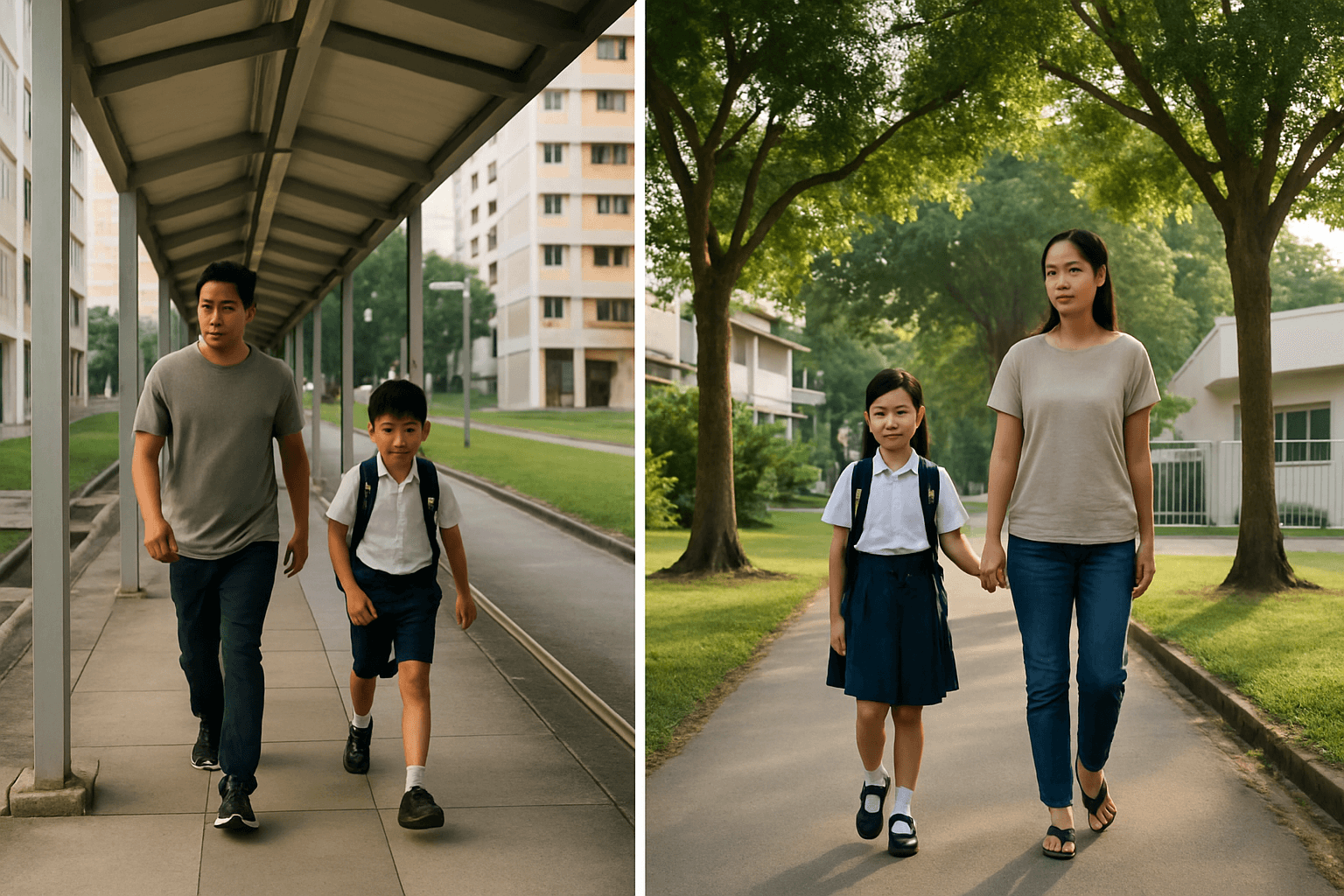
Many Singapore parents feel torn between a well-known primary school and a nearby school that is easier to reach and easier to build routines around. In practice, the better choice is usually not the school with the stronger name. It is the one your child can realistically get into, travel to without constant rushing, and attend with enough energy to learn well.
What is the real difference between a popular primary school and a neighbourhood school in Singapore?
Popular schools are high-demand schools with tougher entry odds, while neighbourhood schools are usually the closer and more practical option.
In practical terms, a "popular" primary school is usually a school with strong parent demand and limited places at some registration stages, so getting in may involve competition or balloting. It is not an official MOE quality label, and it does not automatically mean the teaching is better for every child.
A "neighbourhood school" is usually the school closer to home and easier to reach every day. That often means a more predictable registration path and a simpler daily routine, because home-school distance matters in Primary 1 registration.
So the real difference is not famous school versus ordinary school. It is higher demand versus easier access, and perceived prestige versus daily convenience. If a school is close to home, it may be a realistic option. If the same school is far away and highly sought after, you are making a much riskier choice.
A useful way to think about it is this: the best school choice is not the one that looks strongest on paper. It is the one that still works when school becomes part of ordinary family life. For a broader overview, see Primary 1 Registration in Singapore: How It Works, Balloting Risk, and How to Choose a Realistic School Plan.
[Geylang] Primary Schools
For primary schools, I recommend going for convenience than popularity. Reason is the kids are still young, and travelling time should not be long enough to tire them out, even for those driving. Have you seen children dozing off in the parents car (some in an awkward position, especially straining their necks) because they have to wait up earlier than their peers to reach these “better” schools to feed their parents “ego”. Please note that the above is just my PERSONAL view as I have gone throu
Top sch vs Good neighbourhood sch
My child went to one of the IP schools in Singapore following his PSLE. I think access to resources (e.g. facilities, materials, quality teachers, etc.) is one factor, but more importantly is the type of learning environment that he/she will be subject to. In such schools that may be deemed “better”, students are generally motivated to study harder and are more focused on their academics. This will play a huge part in what your child prioritises during these early / impressionable years. Even if
Why do parents chase popular schools?
Parents often chase popular schools because they believe the name, peer group, reputation, or possible long-term advantages will help their child.
Parents usually chase popular schools for understandable reasons. They may believe the school name will help their child later, expect a stronger academic environment, hope for a more driven peer group, or value alumni ties and affiliation benefits where these exist. Some parents are also responding to social pressure. When the same schools keep coming up in parent chats, preschool circles, and family conversations, it can start to feel risky not to aim for them.
What many parents overlook is that popularity reflects demand and perception as much as school quality. A school may be popular because of its history, brand name, parent community, or years of accumulated reputation. That does not automatically make it the best fit for your child.
Think of popularity as a signal of demand, not proof of fit. If you want a more grounded way to compare schools, Choosing a Primary School: Frequently Asked Questions by Parents and Choosing a Primary School: 6 Alternative Ways to Assess a School are useful for looking beyond reputation alone. For a broader overview, see Primary 1 Registration: Should You Pick a Popular Dream School or a Safer Nearby School?.
Top Primary school?
Honestly I am not sure if there is such a thing as a top primary school based on the efforts of the school. All schools have the same mission set by MOE to deliver the same thing. If you hear from them, even teachers they have no control, it's all from MOE. So what then would you consider as top primary school? It definitely cannot be results alone because results are typically parents-driven in today's context in some schools. Every school has the best cream of the crop and the worst performers
Top Primary school?
To be fair, I think people should not tag “good” or “bad” to a school. I don’t think there is really a “bad” school in Singapore. To me, the most important thing is the teacher your child gets. You can have very lousy teachers in the popular “good” schools as well. Or you can have very good teachers in the normal neighbourhood schools. Academic excellence is not the only thing to look for in primary school education, what about character building ? team work ? All these should be equally importa
Have More Questions?
Get personalized guidance on schools, tuition, enrichment and education pathways with AskVaiser.
Try AskVaiser for Free →What are the practical advantages of a neighbourhood school?
The main advantage is daily ease: shorter travel, easier mornings, less fatigue, and simpler family logistics.
The biggest advantage is daily ease. A shorter trip usually means calmer mornings, less rushing, fewer transport arrangements, and a child who starts the day with more energy. That sounds simple, but it affects almost everything else.
For working parents, a nearby school can make drop-off and pickup much easier to manage. For families who rely on grandparents or a helper, a simpler route can be the difference between a workable routine and a fragile one. On wet mornings, exam days, or days when someone is unwell, proximity matters even more.
The benefits continue after school. A child who spends less time travelling home has more time to eat, rest, read, play, or attend student care without feeling stretched. If there is an early dismissal, a sudden fever, or a missed transport arrangement, a nearby school is simply easier to handle.
Shorter travel does not just save time. It protects energy. That is why many parents later realise convenience was not a small factor at all. It was one of the main reasons the routine stayed sustainable. For a helpful parent perspective, see Neighbourhood Schools Are Worthy Too. For a broader overview, see How to Estimate Balloting Risk Before Primary 1 Registration.
[Bedok] Primary Schools
Neighbourhood schools the best option! If get into a poppular school - it is not just torturous process now (with ballotting and all) but also for the next 6years for a child’s life and of course the poor mummy and daddy too! Popular school…nah for me…
[Geylang] Primary Schools
Hi Candymum, No problem. I was once in your shoe so can understand the stress that you have. Honestly speaking, some neighbourhood schools are better than those popular school. One of these schools is Changkrat Primary School. It is a neighbourhood school. My niece is currently studying in that school. She was accepted by St Hilda's Primary becos she got into the GEP program. But my sister decided to like her continue studying at Changkrat because of transportation problem. Even she was accepted
How does balloting and school demand affect your chances?
If a school is highly sought after, you may be relying on balloting rather than a straightforward place, which makes the outcome uncertain.
If a school is highly sought after, you may not be choosing a place yet. You may be choosing a chance. When applications exceed vacancies, balloting can happen, and home-school distance can affect priority. That is why a dream school should be treated as a hopeful option, not a guaranteed plan.
A common mistake is assuming a school is still realistic just because it is in the same general area or because other children nearby got in before. Demand shifts from year to year. A school that looked reachable in the past may become more competitive, and a school that seems "not too far" may still leave you in a weaker position once distance priority comes into play.
The practical move is to build a shortlist with at least one nearby school you would genuinely accept. Then review the bigger process through AskVaiser’s Primary 1 registration guide, balloting risk guide, and distance priority explainer. If you want a more focused comparison of risk versus convenience, this guide on dream schools versus safer nearby schools is a useful next read.
Past patterns can help you think more clearly, but they are clues, not promises.
All About Primary Schools' Balloting History
I see the wealth effect playing a larger role for popular schools. If you are alumni, you had better get yourself within 1km if you have the means, unlike now. As alumni ‘dilution’ will occur, this opens the door to new money who can afford the move at 2C.
All About Primary Schools' Balloting History
Have you check out this http://www.kiasuparents.com/kiasu/content/singapore-primary-1-registration-school-balloting-history ?
How important is commute time for a primary school child?
Very important, because commute affects sleep, mood, punctuality, and how much energy your child has left for the rest of the day.
It matters a lot because commute time shapes the whole day. A longer or more complicated route can mean earlier wake-up times, more pressure to leave home on time, less time for breakfast, and a child who arrives already tired. The strain is often cumulative rather than dramatic. It may show up as fussier mornings, more irritability after school, or less energy left for reading and homework.
Parents often focus only on the number of minutes, but the route matters too. A simple 20-minute journey may be easier than a shorter trip that involves multiple transfers, crowded transport, or constant rushing. A route that depends on one parent always being available can also be riskier than it first appears.
A good practical test is to imagine the route on an ordinary weekday, not on your best day. Who takes the child if one parent has an early meeting? What happens if it rains heavily? Can your backup caregiver manage the journey confidently? If the trip is likely to feel like a daily hassle for years, do not treat it as a small detail. A manageable route is often better than a prestigious route that drains the child and the household. For more ideas on judging convenience realistically, see How to Choose the Best Primary School Near You. For a broader overview, see Primary 1 Registration Unsuccessful: What Happens If You Do Not Get Your Preferred School.
Preschools prepared your kids well for Singapore primary?
For parents who have already been through the pre-school days and with kids now in primary schools (Singapore schools), can you share your comments on your kid's previous preschool and their curriculum - specifically if they have prepared your child properly for the Singapore education system ? (not discussing the international or foreign schools system here) Nowadays, there are so many pre-schools and childcare centres with many learning methods. Parents currently at the pre-school stage will b
[Punggol] Primary Schools
hmm… the most impt thing is your child must be happy. This must come from supportive parents in their learning. My boy enjoys his class and gamely contribute and am glad teachers (Chinese and form teacher) have been responsive in his learning. As he was a transferred student, I was also concern of him blending to his school but such were unfound. Phew! All in all, in a primary school, be it a popular, a top or mediocre school (in others’ opinion) you can still “control” a child’s learning habits
Does a popular school always give a better primary school experience?
No. A popular school may be strong, but it is not automatically a better experience or a better fit for your child.
No. A popular school may offer a strong environment, but it does not automatically give every child a better experience. Some well-known schools may feel more achievement-oriented, faster-paced, or more comparison-heavy. That may suit some children, but it can also be tiring for a child who needs a calmer start, more routine, or less pressure.
It also helps to separate reputation from what is actually happening in the classroom. A popular school does not automatically have better teachers. Sometimes what parents are noticing is that more students arrive with tutors or enrichment support, which can make the school appear stronger academically from the outside. That is not the same as saying the school is better for every child.
A less famous school may still have caring teachers, solid programmes, and a culture that helps your child feel safe enough to participate and learn well. Fit matters more than image. If you want a useful reset on school-name anxiety, Can a Primary School Determine Your Child's Future Success? is worth reading, and Choosing a Primary School: 6 Alternative Ways to Assess a School offers better ways to judge schools than reputation alone.
Are All Primary Schools The Same?
A lot of people underestimate the role parents play in the education landscape. In every school, the “parent support group” synergy can be a powerful source of strength for further improvements. A school with a better track record attracts parents who want the same for their children. Higher expectations will also lead to higher demands on the school teachers. In some schools, it is not uncommon for parents to voice their concerns to the school leaders, even to the ministry if teachers or exam p
Are All Primary Schools The Same?
Maximum class size for P1 and P2 is 30. Maximum class size for P3 to P6 is 40. But some of the less popular schools, class is only 3/4 filled. So they have better teacher:student ratio which translates to more attention per child. Also, teachers can request to be posted to a school nearer their dwelling, for logistics reason. Furthermore, plenty of mission schools’ or famous schools’ alumni can request to be posted back to their Alma mater, so that they can “give back” to their roots. Need the p
Which child is more likely to do well in a high-demand school?
Children who adapt quickly to pace, structure, and capable peers may cope better in a high-demand school, but fit matters more than labels.
Children who adapt quickly, recover well from change, and are not easily unsettled by being surrounded by capable peers may handle a high-demand environment more comfortably. This does not mean they need to be unusually advanced. It usually means they cope reasonably well with pace, structure, and comparison.
The reverse matters just as much. A child who takes longer to warm up, gets tired by packed days, or loses confidence when things move too fast may do better in a steadier environment with an easier routine. That could be a neighbourhood school, but the real point is not the label. It is whether the child can settle well enough to learn.
Parents can often spot the clues earlier than they think. How does your child react to a new classroom, a more structured activity, or a busy enrichment setting? Do they bounce back quickly, or do they need more reassurance and recovery time? This is not about choosing the "best" child. It is about choosing the setting where your child is most likely to feel secure, engaged, and confident enough to grow.
Sengkang Primary School vs Compassvale Primary School
Hello, I’m an Employment Pass (EP) holder living in Sengkang, about 450m from Sengkang Primary School and 900m from Compassvale Primary School. I plan to apply for my daughter’s Primary 1 admission in 2026. She is a Dependant Pass (DP) holder. Could you provide insights into which of these schools has a better reputation? Additionally, based on my circumstances, which school might offer a better chance of admission for my daughter? Thank you!
[Geylang] Primary Schools
From what you've described, it appears that GMPS may be a better overall school than Haig Girls. But could it be that GMPS has more obvious credentials (given its a government-aided school) and therefore more of what it does is known? And Haig Girls, being a much smaller school (in terms of physical size) does not have so much publicity, and less of what it does is actually known to the public (except of course its PSLE results which of course doesn't look that fantastic)? :idea: So would anyone
What family trade-offs should you consider before choosing?
School choice affects the whole household, so you need to think about transport, caregivers, siblings, work schedules, and after-school care.
School choice affects the whole household, not just the child. Before choosing a farther or more competitive school, think through who will handle drop-off and pickup, whether grandparents or a helper can realistically manage the route, how student care fits in, and what happens when one adult is unavailable. A plan that works only on ideal mornings is not a strong plan.
Families also tend to underestimate the effect on siblings and work schedules. One parent may need to shift office hours. A helper may need to travel with a younger sibling. Enrichment classes may become harder to coordinate if school ends far from home. Even something as simple as a child forgetting an item can become a much bigger problem when the school is far away.
If you are taking a registration risk for a popular school, it is wise not to lock in transport or childcare plans too early. Read AskVaiser’s guide on what happens if you do not get your preferred school before building your household routine around an outcome that is not certain yet.
[Geylang] Primary Schools
Hi thanks for your message. Ok lah, I will tell you everything. All the schools you mentioned are not too bad, in fact we qualify for phase 2B under Saint Stephen. But because I have a boy and a girl and expecting another girl, I opted this boys' school out. Don't wanna go through P1 registration stress again. I would choose Tao Nan if I have a choice because I had heard good feedbacks from my friends (who have kids in the school) and also due to its chinese culture emphasis (I'm from chinese sc
[Punggol] Primary Schools
Since you are staying in Sengkang area, better choose primary schools in Sengkang area rather than coming to Punggol area.
How should parents decide between prestige and convenience?
Choose prestige only if the fit is genuinely strong and the commute is sustainable; otherwise, prioritise the school that supports daily family life.
Use a simple rule: choose prestige only if the school is a genuinely strong fit and the daily logistics are sustainable. If the school mainly looks attractive because of its name, but comes with high uncertainty, a draining commute, or a routine your family can barely support, the nearby school is often the better decision.
A practical way to decide is to compare each shortlisted school across the same factors: admission realism, travel burden, school culture, support for your child's needs, and how well the arrangement fits your household. Some parents find it useful to assign rough weight to each factor instead of discussing schools in general terms. That approach makes the trade-offs much clearer.
For example, School A may score high on reputation but low on certainty and commute. School B may be less talked about but far easier to get into, closer to home, and a better fit for your child’s temperament. In real life, School B may give the child the better primary school experience.
A school your family can live with every day is better than a school that only looks better on paper. If you are stuck, ask yourself one useful question: which option will still feel workable on a tired Tuesday morning?
[Geylang] Primary Schools
both SJI and Anglo Chinese are very popular schools. Chance of getting in via P2C is very competitive. If you fail to get in via P2C, you can only go into whichever schools in the area that still has openings in P2CS. I always believe that if you have a chance to go into a good school via P2A, you should take this chance. Many parents I know actually rent out their places and then rent a place near their school of choice. My place is located near a SAP and currently a family is renting it cuz th
[Geylang] Primary Schools
My best pick is Ngee Ann. St Stephen's n TKPS is not in my radar cos of the reviews I heard about them.
If my child does not get into a popular school, is a neighbourhood school just a compromise?
No. For many families, a neighbourhood school is the better long-term choice because it is easier to sustain and can still be an excellent fit.
No. For many families, a neighbourhood school is not a fallback but a better long-term match. A child who can get to school easily, feel less rushed, and have steadier mornings may settle faster and enjoy primary school more than a child managing a hard commute just for the sake of a school name.
It helps to reframe what was lost and what was gained. Missing out on a popular school place may feel disappointing at first, but a nearby school often gives the family more breathing room, more reliable after-school arrangements, and more predictable evenings. Those things are not minor. They shape the child's daily experience for years.
Many children do very well in schools that were not their parents' first status choice. The better question is not whether the school was your first pick. It is whether your child is likely to feel secure, supported, and ready to learn there.
Moving to Singapore and looking for a good Secondary School
My son has gone through 3 international schools in Singapore, although none of those u mentioned. I am beginning to realize that the local system might be better for a child that is average and above. By local system, I do include the 3 local international schools - SJI (I have heard many good things about this school from separate sources), ACS International and Hwa Chong International. If your child excels in Math, all the more u should consider the local system. My son is slightly above avera
Sengkang/punggol primary school - input from parents of kids in schools in these area?
~ starting to think about primary school registration (applying this year, 2025) and it’s giving me a headache. The schools my kid has a good chance of getting in (2B - 1km) are: 1)Nativity primary 2)Mee Toh 3) Rivervale primary My kid is really quite nerdy and has a hard time finding friends because of her subject-specific interests (usually science-related). Has expressed a preference for co-ed, but I don’t know how seriously to consider her input. Nan Chiau (phase 2b) seems impossible because
Have More Questions?
Get personalized guidance on schools, tuition, enrichment and education pathways with AskVaiser.
Try AskVaiser for Free →