
P1 Registration Distance Priority in Singapore: How Home-School Distance Works
What 1km means in practice, when distance helps, and why living nearby still does not guarantee a place.
P1 registration distance priority means living closer to a school may improve your child’s chances, but only when the school is oversubscribed in the phase your child is applying under. In practice, within 1km is usually a stronger position than 1km to 2km, and both are usually better than beyond 2km, but distance never guarantees admission. Sibling links and other school-based priority routes can matter first, so parents should treat proximity as a helpful edge, not a sure route in.
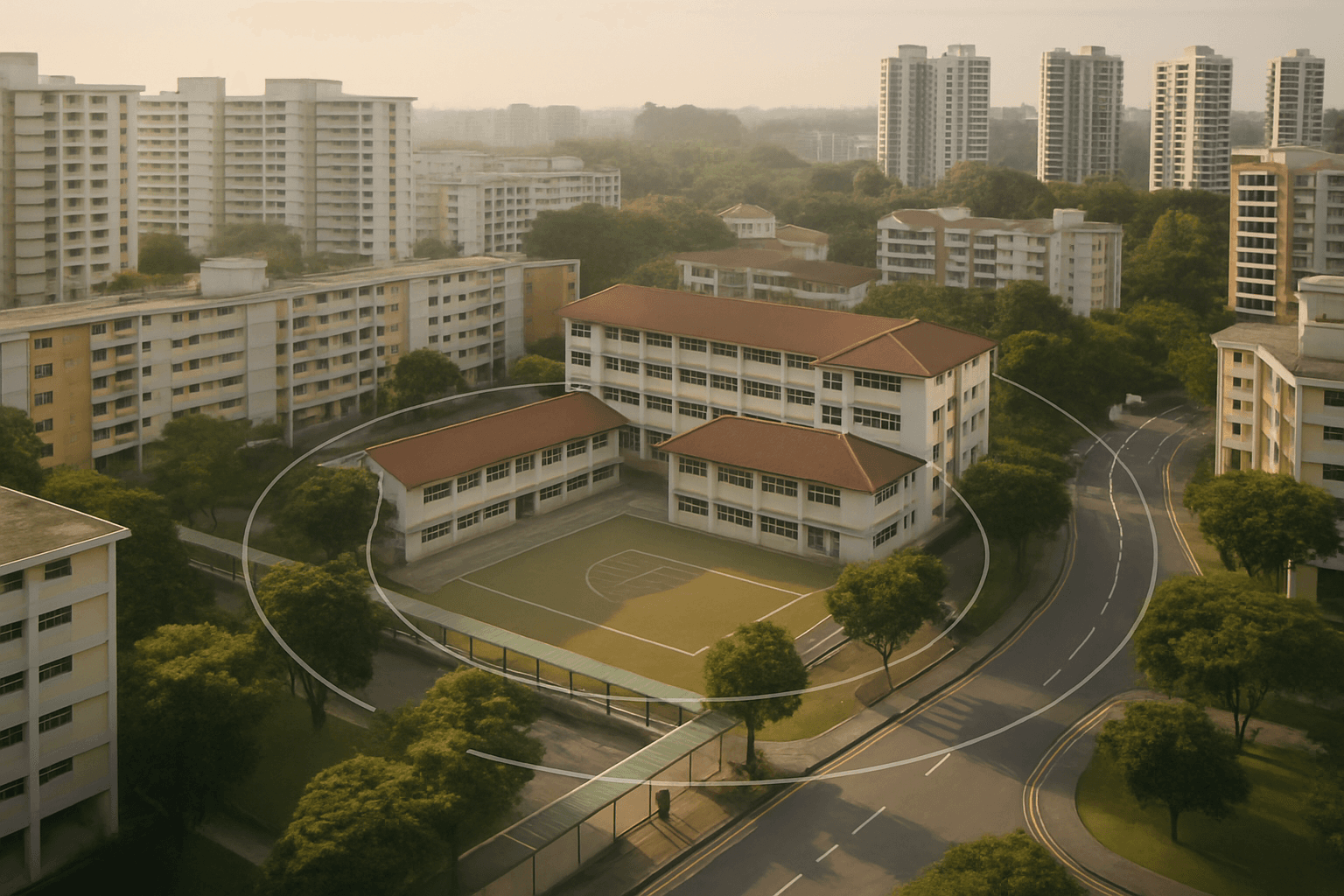
Many parents assume that living near a primary school makes admission straightforward. In reality, distance only helps when the school has more applicants than places and still needs to decide among children in the same broad priority group.
This guide explains how P1 registration distance priority works in practical terms, what the common 1km and 2km bands mean, and how much weight to give a nearby address when planning your school choices. If you want the wider process first, start with our Primary 1 registration guide.
What does P1 registration distance priority actually mean?
Distance is a tie-break advantage when a school is crowded, not an automatic route into the school.
It means home-school distance can improve your child’s chances only when the school still has to sort applicants. It is not a separate admission pass.
Think of distance as a sorter, not a ticket. If a school has enough vacancies for everyone in your child’s phase, being 700m away and being 2.3km away may make little practical difference. If the school is oversubscribed, then living closer may become important.
Distance also does not move your child into an earlier phase. MOE’s FAQ states that living within 1km does not qualify a child for Phase 1. Phase 1 is for children whose older siblings are already studying in the school. The practical takeaway is simple: proximity can help inside the process, but it does not replace the process. For a broader overview, see Primary 1 Registration in Singapore: How It Works, Balloting Risk, and How to Choose a Realistic School Plan.
Questions on new rules of P1 registration
With the announcement of the new rules of P1 registration - that citizens now have advantage over PRs, I have 2 questions: 1. Does the living distance to the school matter (ie 1 km away)? 2. If the PR has an older child in the school already, is priority given to the child’s younger sibling? Thanks!
All About Getting Priority Registration
http://www.straitstimes.com/BreakingNews/Singapore/Story/STIStory_579675.html \"THE current Primary 1 registration process will not be changed to give higher priority to children living very near to their school of choice - even if they live right across the street from it.\" :stupid: :stupid: :stupid: :stupid: Sad lah....
What do the 1km, 1km to 2km, and beyond 2km bands mean in practice?
Treat the common distance bands as levels of possible advantage: closer usually helps more, but only if the school is crowded enough for distance to matter.
Parents often use three distance bands as a shorthand because closer homes usually have an advantage in competitive registration. In plain terms, within 1km is usually the strongest location advantage, 1km to 2km is a smaller advantage, and beyond 2km is usually the weakest. The key word is usually.
A better way to read the bands is as risk bands, not promise bands. If a popular school is surrounded by dense HDB blocks and condos, there may still be many applicants within 1km. In that case, being near helps, but it does not make the application safe. At a less contested school, children living beyond 2km may still get in because the school does not need to separate applicants tightly by distance.
So when you hear parents say, "We are within 1km," do not hear, "We are definitely in." Hear, "We may have a better position if the school becomes competitive.". For a broader overview, see Primary 1 Registration Phases in Singapore: What Each Phase Means for Your Chances.
*** READ ME FIRST !!! - P1 Registration FAQ ***
P1-IS is now offered for ALL participating Primary schools (see the http://www.moe.gov.sg/education/admissions/primary-one-registration/phases/ under \"Registration Procedures\" and \"Phase 2C/Phase 2C Supplementary\"). However, please note that 8 out of the past 9 years, Kong Hwa school required balloting for Singaporean Citizens under 1km in Phase 2C. I suggest that you work on an alternative school for Phase 2C instead, given that you are between 1km and 2km.
*** READ ME FIRST !!! - P1 Registration FAQ ***
Can someone tell me if this rule is new starting from this year or was it around before? Extracted from MOE FAQ under Proximity to School FAQ 4. How long do we need to stay in the address used to register our child during the P1 Registration Exercise? In a small number of cases, there may be situations where the families are unable to remain at the address for the entire duration of the primary school studies. Even so, a child who gains priority admission into a school through his/her distance c
Have More Questions?
Get personalized guidance on schools, tuition, enrichment and education pathways with AskVaiser.
Try AskVaiser for Free →When does distance start to matter most in registration?
Distance starts to matter when your phase is tight and the school still has to separate too many applicants for too few places.
Distance matters most when the school is oversubscribed in the phase where your child is applying. That is the point where the school has to choose among applicants with similar standing.
This is why the same address can feel powerful in one case and nearly irrelevant in another. A family living 900m from a very sought-after school may still face real balloting risk because many other children are also nearby. Another family living the same 900m from a less crowded school may find that distance barely matters because there are enough places to go around.
Parents also often miss a second layer of risk: what happens before their phase even starts. If many places have already been taken by siblings or other school-linked applicants, your child may be competing for a much smaller remainder. That is why a map alone is not enough. Pair distance with phase planning and past demand patterns. Our guides on P1 registration phases, how to estimate balloting risk, and how to read past balloting data can help you judge whether your address is a real advantage or just a small one. For a broader overview, see Which Home Address Counts for Primary 1 Registration in Singapore?.
*** READ ME FIRST !!! - P1 Registration FAQ ***
2A need to apply at school , so withdrawal also need to be at school. Then go over to school B for registration. Consider time for travel, withdrawal take 5-10min. Buffer 1.5 hours would be safe if driving. If you can let us know your 2C choice , we can tell you the risk. It might be worth just to go 2C
*** READ ME FIRST !!! - P1 Registration FAQ ***
Phase is Phase. Distance is Distance. The Phase you are in is affected by your eligibility, not by your distance. See MOE for a better idea: https://www.moe.gov.sg/admissions/primary-one-registration/phases
If we live within 1km, are we basically safe?
No. Within 1km is an advantage, but popular schools can still have more nearby applicants than places.
No. Living within 1km improves your position, but it does not make admission secure.
The clearest official clue is that MOE states that being within 1km does not qualify a child for Phase 1. That matters because it shows proximity is not treated as a top-level entitlement on its own.
In practice, popular schools can have more nearby applicants than vacancies. A school near several large housing estates may have many families within 1km, all hoping the address will be enough. Some of those families can still miss out. At a quieter neighbourhood school, the same 1km address may feel much more helpful because competition is lower.
The better question is not, "Are we within 1km?" It is, "Are we within 1km at a school and in a phase where that advantage is likely to be enough?". For a broader overview, see How to Estimate Balloting Risk Before Primary 1 Registration.
[Punggol] Primary Schools
Based on last year's statistics, there was balloting for SCs staying within 1 km during P2C.
All About Getting Priority Registration
The full article in ST had a paragraph that I found puzzling: <quote> In short, children living within a 1km radius of the school are given priority, followed by those within 2km, and finally to those beyond 3km, said Mr Iswaran. <unquote> I wonder if our ST journalist made an error on the quote, or does our Senior Minister of State (Education) not know that there is no 2-3km category?
Why do parents often overestimate the value of a nearby address?
Parents often treat distance like a shortcut, when it is really just one factor inside a competitive process.
Because the map is visible, but the competition is not.
Parents can see the school, measure the route, and feel they have done something decisive. What they cannot see as easily is how many other families are also nearby, how many places may already be taken before their phase starts, or whether the school even becomes tight enough for distance to matter.
Three common mistakes come up again and again. One is focusing on the address and ignoring the school’s likely demand. Another is assuming that being close matters more than sibling priority or other school-linked routes. A third is building the whole plan around one nearby school and preparing no realistic backup.
The right mental model is simpler: being close helps only if the school still has to choose among children like yours. That is also why proximity often leads to appeals. In a parliamentary reply, MOE said it receives appeals from parents seeking admission to schools near their homes. That does not mean the policy is unclear. It shows how often parents expect distance to do more than it actually does.
*** READ ME FIRST !!! - P1 Registration FAQ ***
You will feel you are kiasu until you realise that for anyone to get Phase 2B priority and living <1km, you must perform PV duties or be a clan member for at least 1 or 2 years, and plan to move just in time for P1. So actually, you are just in time. Some people call it prudence. Sour grapers call it kiasu. Does it really matter?
Give citizens priority in Primary 1 registration
Ha.ha. maybe next time the P1 registration phase can propose like that, just a suggestion: Phase 1 – Existing siblings in the Primary school except PR siblings. Phase 2A(1) – No Change Phase 2A (2) – No Change Phase 2B – No change Phase 2C – Singapore Citizenship Only. Phase 2C Supplementary - Singapore Citizenship Only Phase 3A – Permanent Residents Phase 3A Supplementary - Permanent Residents Phase 4 – Non Citizen.
Do sibling links or other school ties matter more than distance?
Yes, in some phases sibling and other school-linked priority routes matter before distance does.
Often, yes. Distance is not always the first filter.
The clearest example is sibling priority. MOE’s FAQ says Phase 1 is for children whose older siblings are already studying in the school. That means a sibling connection is stronger than simple home proximity in that phase.
Later in the exercise, parents may also encounter other school-based categories, such as alumni or former-student links, depending on the school and phase. The practical lesson is to plan in this order: phase first, school-linked priority second, distance third. If a school has a strong pipeline of children entering through earlier routes, your nearby address may still leave you competing for a small number of remaining places.
Another detail parents sometimes overlook is timing. If you miss a phase you were eligible for, you can still register in the next eligible phase, but you will not keep the earlier priority. If your family has an older child already in the school, our guide on whether a younger sibling automatically gets in explains what that usually means in practice.
All About Getting Priority Registration
Does anyone know if there's any priority for grassroots over PV parents in P2B? Or both have same priority? (assuming both are citizens and stay with 1km of the school) Thanks! :please:
*** READ ME FIRST !!! - P1 Registration FAQ ***
For Singaporean - The child’s Singapore Birth Certificate - The child’s Singapore Citizenship Certificate for those who are not Singapore Citizens at the time of birth - Singapore NRIC of both parents or Entry / Re-entry Permits of parents if they do not possess Singapore NRIC - The child’s Immunisation Certificates For PR - The child’s Birth Certificate - The child’s Entry/Re-entry Permit - Singapore NRIC of both parents or Entry/Re-entry Permits of parents if they do not possess Singapore NRIC
We live near a popular school. How should we plan?
If the nearby school is very popular, use distance as a helpful edge, not as your only plan.
Treat the nearby popular school as a possible win, not your whole strategy, unless you also have a stronger priority route into that school.
A practical way to think about this is to check three things together. First, how contested is the school likely to be? Second, which phase are you realistically entering? Third, apart from distance, do you have any stronger connection such as a sibling already there? A family living 800m from a highly sought-after school, with no sibling link and no other school-based priority, should usually think in probabilities rather than assumptions.
This is where many parents become too narrow. They spend all their attention on the dream school and too little on what daily life and admission risk will look like across their other options. A less contested nearby school may offer both a more realistic admission path and a better routine for the child and family.
The most stable plan is usually one hopeful option and at least one realistic backup. If you are weighing that trade-off, our guides on whether to pick a popular dream school or a safer nearby school and popular primary school vs neighbourhood school can help.
Share with us your kid's P1 registration experience
Funtastic4, RGPS finally had 117 applicants >2km fighting for 51 places under phase 2C (after 26 applicants <2km admitted). For my case, I had a daughter borned in year 2002. From 2005 onwards, we were closely monitoring the P1 registration stats, keeping all the records ourselvs as MOE dont retain them. Since my mil stayed near HPPS, we decided to enrol our child there. We were prepared to move <1km of the school. However after studying the stats, we discovered that HPPS needs balloting under p
[Punggol] Primary Schools
dear parents, my daughter born on 2009 and looking to P1 register few months later. I am staying within 1km to MT, Horizon and PV, history show all school required ballot for SC within 1km in phase 2c. Dun think I will register MT as chance is low, any idea/comment/advise to choose between Horizon and PV?
What should you verify before relying on an address for P1 registration?
Use an address only if it is genuine, supportable, and clearly tied to where your child actually lives.
- ✓Make sure the address genuinely reflects where your child lives during the registration period, not just an address that is more convenient or closer to the school.
- ✓If the P1 Registration Portal does not show the address you intend to use, submit the new address through the portal early rather than assuming it can be changed casually later.
- ✓If your family has moved or is about to move, compare your situation with our guides on [which home address counts](/blog/which-home-address-counts-for-primary-1-registration-in-singapore) and [whether to use the old or new address after moving house](/blog/primary-1-registration-after-moving-house-old-or-new-address).
- ✓Keep common proof-of-residence records ready in case they are needed. Parents often prepare examples such as NRIC address details, HDB or property papers, tenancy documents, and recent utility or service bills. These are common examples, not an official or guaranteed checklist. Our [documents checklist guide](/blog/primary-1-registration-documents-checklist-what-singapore-parents-commonly-prepare) explains this in more detail.
- ✓Align both parents early on what address is being declared and why. Many avoidable problems come from last-minute assumptions involving grandparents’ homes, newly rented homes, or recent moves.
- ✓Do not treat address planning as a loophole. In a parliamentary reply on address verification, MOE said it verifies declared addresses and takes false declarations seriously.
We are more than 1km away. Does it still make sense to apply?
Yes. Outside 1km usually means weaker odds at popular schools, not no chance at all.
Yes. Being outside 1km does not mean your child has no chance.
What it usually means is that your margin is thinner at heavily oversubscribed schools, especially if you do not have a stronger school-linked priority route. But not every school is equally competitive. Some schools still have enough places for children living farther away, especially when demand is more moderate.
The practical move is to match your expectations to the school. If the target school is well known, historically crowded, and you are outside 1km with no sibling link, treat it as a higher-risk option and prepare alternatives early. If the school is less contested, do not rule it out just because you are beyond 1km. Use distance as one factor, not the whole decision. Our guides on how to estimate balloting risk and what happens if you do not get your preferred school can help you plan calmly.
*** READ ME FIRST !!! - P1 Registration FAQ ***
GENERAL 0. This Forum will only allow you to post REPLIES to existing threads. You will NOT be able to create New Topics. If you think you cannot find a relevant thread to post your query to, please use this http://www.kiasuparents.com/kiasu/forum/viewtopic.php?t=31485 . We seek your understanding on this matter. Thank you. 1. Bookmark this: http://www.moe.gov.sg/education/admissions/primary-one-registration/ . All you need to know about the P1 Registration Exercise for next year's P1 going chil
*** READ ME FIRST !!! - P1 Registration FAQ ***
Yes, a new rule. last year (2014) P1 registration : no mention of 30 months only this year (2015) : then, start mention Once 30 months limit been announced : many people may start to use this new rule, in whichever Phase they are in that involve balloting. Example Suppose parents staying outside 2 km need to ballot in Phase 2A2 (old girls) With this new rule kicked in : these affected parents (outside 2 km) can now start to rent houses within 1 km, for 30 months (middle of Primary 3) This way, t
Have More Questions?
Get personalized guidance on schools, tuition, enrichment and education pathways with AskVaiser.
Try AskVaiser for Free →