
Which Home Address Counts for Primary 1 Registration in Singapore?
How to decide which address MOE is likely to recognise, and when it matters for distance priority.
For Primary 1 registration in Singapore, the safest address to use is the child's real home address: the place where the child actually lives as part of normal family life. Do not assume a parent's NRIC address, a mailing address, a property you own, or a relative's home will count just because it is more convenient or closer to school. If your family situation is unusual, use the address that best reflects actual residence and that you can reasonably support if asked.
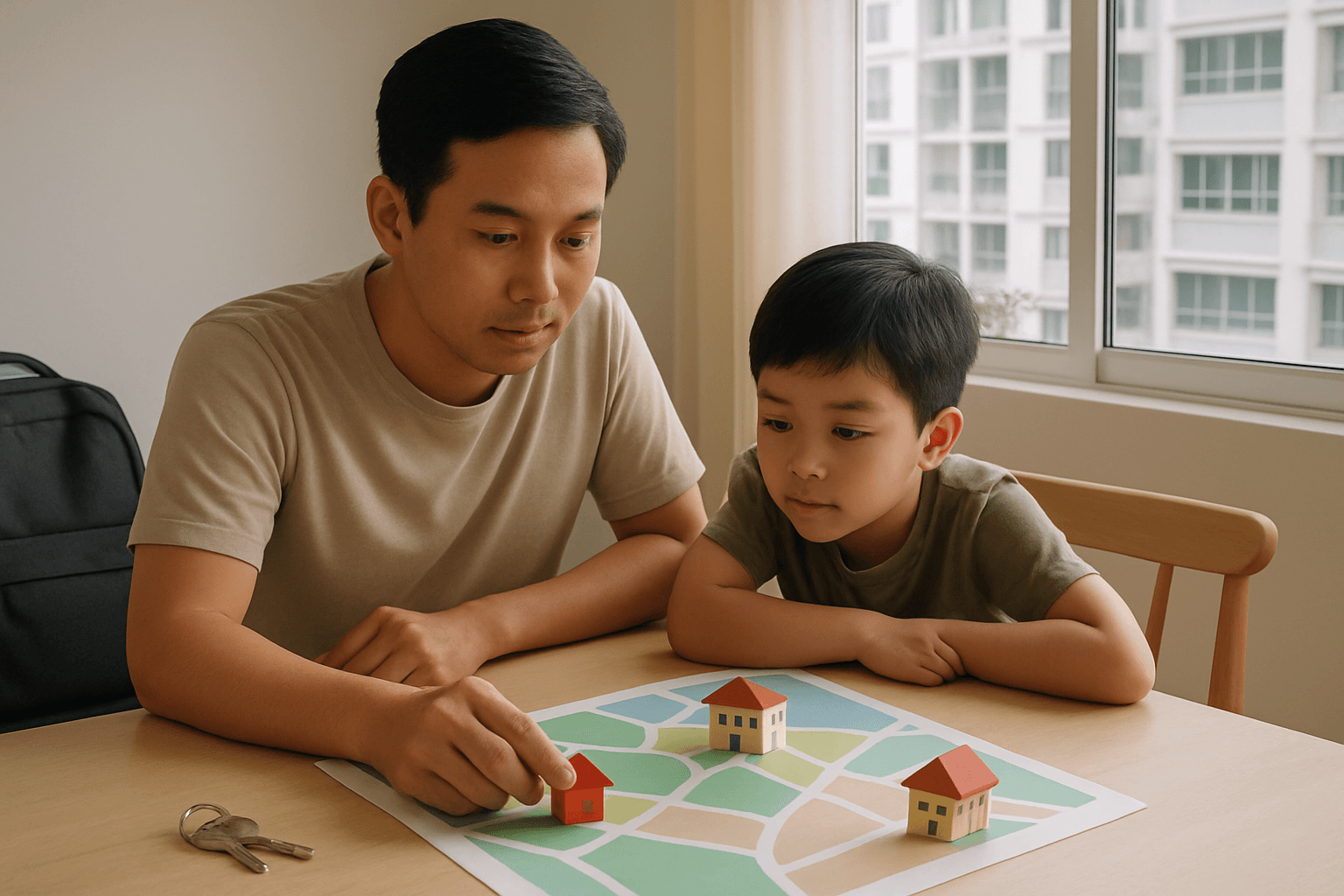
If you are asking which home address counts for Primary 1 registration, start with the practical rule: use the address where your child genuinely lives as a home. That is the safest way to think about grandparents' homes, rental units, second properties and recent moves. It also matters because the declared address can affect distance priority, and MOE verifies addresses under its proximity policy.
What address usually counts for Primary 1 registration?
Use the address where your child genuinely lives as a home, not the address that looks best on paper.
The practical rule is to use the child's genuine home address: the place where your child actually lives day to day as part of family life. Parents often get distracted by ownership, mailing records, or which address is closest to a popular school, but MOE's proximity policy is built around the declared home address, so the first question should always be: where does the child really live?
If your child lives with both parents in your current flat, that is usually the address to use. If the family has genuinely moved into a rental unit and is living there full time, that rental address may be the better answer even if you still own another property elsewhere. If your child is only staying with grandparents for convenience while the family home remains somewhere else, do not assume the grandparents' address is the right one.
MOE has said it verifies declared addresses and treats fraudulent declarations seriously, including after enrolment, in its parliamentary reply on address verification. For a broader view of how registration works, see our full Primary 1 registration guide.
Give citizens priority in Primary 1 registration
Ha.ha. maybe next time the P1 registration phase can propose like that, just a suggestion: Phase 1 – Existing siblings in the Primary school except PR siblings. Phase 2A(1) – No Change Phase 2A (2) – No Change Phase 2B – No change Phase 2C – Singapore Citizenship Only. Phase 2C Supplementary - Singapore Citizenship Only Phase 3A – Permanent Residents Phase 3A Supplementary - Permanent Residents Phase 4 – Non Citizen.
Questions on new rules of P1 registration
With the announcement of the new rules of P1 registration - that citizens now have advantage over PRs, I have 2 questions: 1. Does the living distance to the school matter (ie 1 km away)? 2. If the PR has an older child in the school already, is priority given to the child’s younger sibling? Thanks!
Does MOE look at where the child really lives, or just the address on official documents?
MOE is looking at the child's actual living arrangement. Documents support the address, but they do not override where the child really lives.
Actual residence comes first. Documents help support it, but they do not replace it. That is the part many parents mix up: an NRIC address, a utility bill, a bank letter or other paperwork can be useful, but paperwork by itself does not make a place the child's real home.
This matters in both directions. If your family has already moved but some records still show the old address, old paperwork does not automatically make the old home the better choice. If your new place is purchased and some records have started changing, but the family is still physically living at the old home during renovation, the new paperwork does not automatically make the new address the right one either. The anchor is still where the child is actually living.
MOE's FAQ also says parents can register using another address through an online form in the P1 Registration Portal if the portal does not show the address they want to use, as explained in this MOE FAQ on using another address. A simple way to think about it is: choose the home first, then make sure your documents match that reality. For a broader overview, see Primary 1 Registration Distance Priority: How Home-School Distance Works.
For Reference for P1 registration: MOE Official Letters
http://www.kiasuparents.com/kiasu/forum/viewtopic.php?p=293646#p293646 Dear Sir/Madam, Thank you for writing to us on 12 November 2010. We wish to clarify that parents using address of rented apartment will not be at a disadvantage if the school should conduct balloting. We would like to share with you that the registration is done based on the NRIC address that is reflected on the parents' NRIC at the time of registration and the address used for the registration of a child (assuming Singapore
[Ang Mo Kio] Primary Schools
@boyz Do take note that if you are using a caregiver's address to register, you will be considered to be in the 1 - 2 km category, even if the actual distance is within 1km. Taken from http://www.moe.edu.sg/education/admissions/primary-one-registration/statutory-declaration/ : If statutory declaration is used, children who are registered using either the grandparent’s or the parent’s sibling’s address and residing within 1 km or between 1 km and 2 km of the school of choice are balloted together
Have More Questions?
Get personalized guidance on schools, tuition, enrichment and education pathways with AskVaiser.
Try AskVaiser for Free →Can I use my parents' home, a rented flat, or another family property?
You may be able to use a grandparent's home, a rental unit or another property, but only if it is genuinely where your child lives.
Sometimes yes, but only if it is truly the child's home in practice. The key issue is not who owns the place. It is whether the child genuinely lives there in a stable, day-to-day way.
A grandparent's address is easier to justify if the child is really being raised there as part of a settled family arrangement, such as when the whole family is living there for the foreseeable future. It is much harder to justify if the child only stays over occasionally, or if the address is being used mainly because it is within a better distance band. A rented flat can absolutely be a real home address if the family has genuinely moved in and is living there. In fact, a rental unit where the child actually stays can be a stronger answer than an owned property where the child does not live.
Where parents get into trouble is with second homes and relatives' addresses. Owning a condo near a school does not automatically make it the correct P1 registration address if the family still lives elsewhere. The same caution applies to using an uncle's or grandparent's address simply because it improves the odds for a preferred school. Ownership helps only if it matches lived reality. For a broader overview, see Primary 1 Registration After Moving House: Should You Use Your Old or New Address?.
*** READ ME FIRST !!! - P1 Registration FAQ ***
For Singaporean - The child’s Singapore Birth Certificate - The child’s Singapore Citizenship Certificate for those who are not Singapore Citizens at the time of birth - Singapore NRIC of both parents or Entry / Re-entry Permits of parents if they do not possess Singapore NRIC - The child’s Immunisation Certificates For PR - The child’s Birth Certificate - The child’s Entry/Re-entry Permit - Singapore NRIC of both parents or Entry/Re-entry Permits of parents if they do not possess Singapore NRIC
*** READ ME FIRST !!! - P1 Registration FAQ ***
2A need to apply at school , so withdrawal also need to be at school. Then go over to school B for registration. Consider time for travel, withdrawal take 5-10min. Buffer 1.5 hours would be safe if driving. If you can let us know your 2C choice , we can tell you the risk. It might be worth just to go 2C
How does the address affect distance priority?
Address matters because it can affect distance priority, but only a genuine address helps, and only when the school is competitive enough for distance to matter.
Your declared home address can affect whether your child falls into a more favourable distance band for a school. In simple terms, if the address you use is genuinely closer to the school, that may improve your position when places are tight. If it is not closer, it will not help.
What many parents miss is that distance priority only matters when a school is oversubscribed in the phase you are registering for and distance becomes relevant to how places are allocated. If a school still has enough places after your likely phase, being very near may not change much. If a school is heavily contested, a genuine nearby address can matter more, but it still does not guarantee admission.
The best way to plan is to look at address and competition together. Read how home-school distance works, then pair that with how the registration phases affect your chances. A good parent rule is this: do not ask only whether an address is near the school. Ask whether that real address is near enough to matter in a school that is likely to be competitive in your phase. For a broader overview, see Primary 1 Registration Documents Checklist: What Singapore Parents Commonly Prepare.
*** READ ME FIRST !!! - P1 Registration FAQ ***
Can someone tell me if this rule is new starting from this year or was it around before? Extracted from MOE FAQ under Proximity to School FAQ 4. How long do we need to stay in the address used to register our child during the P1 Registration Exercise? In a small number of cases, there may be situations where the families are unable to remain at the address for the entire duration of the primary school studies. Even so, a child who gains priority admission into a school through his/her distance c
All About Getting Priority Registration
http://www.straitstimes.com/BreakingNews/Singapore/Story/STIStory_579675.html \"THE current Primary 1 registration process will not be changed to give higher priority to children living very near to their school of choice - even if they live right across the street from it.\" :stupid: :stupid: :stupid: :stupid: Sad lah....
What are the most common mistakes parents make when choosing an address?
The main mistake is choosing the address that gives the best school odds instead of the address that reflects the child's real home.
The biggest mistake is using the address parents hope will count instead of the address their child actually lives at. Other common errors are assuming a mailing address is enough, assuming property ownership proves residence, and building a school plan around a move that has not really happened yet. Another frequent trap is treating a temporary stay with grandparents as if it were the child's settled home.
These mistakes matter because MOE has said it verifies addresses and may take action on fraudulent declarations, as noted in its address verification reply and its reply on Primary 1 registration non-compliance. For P1 registration, the safest address is usually the one you would still be comfortable explaining a year later. For a broader overview, see How to Estimate Balloting Risk Before Primary 1 Registration.
*** READ ME FIRST !!! - P1 Registration FAQ ***
GENERAL 0. This Forum will only allow you to post REPLIES to existing threads. You will NOT be able to create New Topics. If you think you cannot find a relevant thread to post your query to, please use this http://www.kiasuparents.com/kiasu/forum/viewtopic.php?t=31485 . We seek your understanding on this matter. Thank you. 1. Bookmark this: http://www.moe.gov.sg/education/admissions/primary-one-registration/ . All you need to know about the P1 Registration Exercise for next year's P1 going chil
*** READ ME FIRST !!! - P1 Registration FAQ ***
Will you still be staying with your in-laws if your son is admitted to a school in Sengkang? You should only register using the address where you will be physically located. By the way, if your son fails to get into the school in P2C, you can only register him in P2CS. Those popular schools will have their places filled by P2C, so is there any point in changing your address back to Sengkang?
What kinds of proof of residence are commonly used in practice?
There is no single fixed checklist in the source material, but you should be ready with records that consistently tie your family to the address you declare.
The source material does not give one official universal checklist, so it is better to think in terms of supporting records rather than one magic document. In practice, parents often prepare documents that connect the family to the address, such as a tenancy agreement, utility bills or official correspondence showing the same home address. These are common examples, not guaranteed requirements.
What matters most is consistency. If your living arrangement is straightforward, a few records that all point to the same address are usually more helpful than a thick file showing different addresses. If your situation is less typical, such as a recent move, a rental arrangement or a split household, one isolated document may not explain the full picture very well. In that case, parents usually do better by preparing several records that tell the same story.
A useful mindset is to treat proof of residence as support for a real living arrangement, not a way to create one after the fact. If you want a practical preparation guide, see our P1 registration documents checklist.
Share with us your kid's P1 registration experience
Hi parents, I've gone through 2 rounds of registration for my kids - Phase 2B 5 years ago (2006) and Phase 2A2 (2010). For son's P1 registration at Pei Hwa then, there was just 1 stop - ie to submit documents for verification. No guarantee at Phase 2B, just a high chance of getting in. Today's registration for daughter is slightly longer - 3 'stops'. Station 1 is at ground floor where a lady will make sure we are eligible for Phase 2A2. If so, then we proceed to the hall on 2nd floor. Station 2
Give citizens priority in Primary 1 registration
Not sure if this has been mentioned in KSP forum? From 2010, Singapore Citizens (SCs) will be given an additional ballot slip (i.e. two chances instead of one), while Permanent Residents (PRs) will retain one ballot slip whenever balloting is conducted by any school during the P1 Registration Exercise. SCs will therefore have a higher chance of securing a place for their child in a school of choice when there is balloting. Giving Singaporeans two chances during balloting will retain the underlyi
What if we are moving house before P1 registration?
If you are moving, use the address where your child is actually living, not a home that is still only planned or temporary.
Use the address where your child is genuinely living, not the address that belongs to a future plan. If the move is real and settled, the new address may be the right one. If the move is still in progress, be careful about assuming the new home counts just because the purchase has completed or the lease has started.
For example, if the family has already moved into the rental unit and that is where your child now sleeps, studies and lives day to day, the new address may be the practical answer. If your new flat is still under renovation and everyone is still living at the old place, the old home is usually the more defensible address for now. If you are between homes and staying briefly with relatives, do not jump straight to the relative's address just because it improves school distance. First ask whether it is truly the child's present home or only a temporary stop.
MOE's FAQ says parents can register using another address through an online form in the P1 Registration Portal if the portal does not show the address they want to use, which you can read in this MOE FAQ. If this is your situation, it also helps to read our guide on using your old or new address after moving house.
*** READ ME FIRST !!! - P1 Registration FAQ ***
P1-IS is now offered for ALL participating Primary schools (see the http://www.moe.gov.sg/education/admissions/primary-one-registration/phases/ under \"Registration Procedures\" and \"Phase 2C/Phase 2C Supplementary\"). However, please note that 8 out of the past 9 years, Kong Hwa school required balloting for Singaporean Citizens under 1km in Phase 2C. I suggest that you work on an alternative school for Phase 2C instead, given that you are between 1km and 2km.
*** READ ME FIRST !!! - P1 Registration FAQ ***
We will move to Singapore in December 2015 (house-hunt scheduled by company in November) which means we won’t have a local address to specify during the Primary 1 registration scheduled on August 27. Can someone give us ideas on how to go about the registration? Can we specify an office address (which is going to be near where we plan to look for a house), or our intended location (without a specific address) ? Really need help with these questions as MoE simply responded with “you need to have
What if parents are separated or the child splits time between homes?
If your child lives across two homes, use the address that best reflects the child's main day-to-day residence, not simply the one nearer to school.
The practical starting point is to use the child's main real residence rather than whichever home gives better school distance. The source material does not provide a detailed official rule for every split-home arrangement, so parents need to anchor the decision in lived reality and what can reasonably be supported.
If a child spends most school nights with one parent and weekends with the other, the weekday home will often better reflect day-to-day residence. If the child alternates more evenly between homes, the answer may be less obvious. That is exactly when parents should slow down and ask which home best matches the child's routine, where daily care happens, and which address would still make sense if someone later asked for clarification. Choosing based mainly on the better map location creates avoidable risk.
This is one of those situations where parents often hope for a neat formula and do not get one. The safer approach is simpler: choose the address that matches the child's actual life, not the address that creates the strongest school strategy on paper. If your arrangement is genuinely hard to characterise, sort it out early rather than making a last-minute guess.
[Punggol] Primary Schools
Hi parents, I am originally staying in Tampines and am moving to Punggol this month. As I am planning to register my child in P1 at Punggol next year, what are the steps I need to do, in order to register? Is it just popping by the Police Station to update my address will do?
[Punggol] Primary Schools
hi hi my understanding is can use the new address, but i think must provide HDB documentation. It is good to check on during P1 registration. BTW Meetoh is a very popular sch. If u r the ex-student, it should not be a prob to get a seat. But if u r under phase 2C, please prepare for balloting. This sch practically every yr needs balloting.
I am still not sure which address to use. What should I do before I submit the registration?
Confirm where your child truly lives, make sure that is the address you will declare, and gather matching supporting records before registration opens. If the situation is unusual, sort it out early instead of relying on assumptions.
Start with one direct question: where is my child genuinely living now, or where will my child genuinely be living when registration happens? Once you answer that honestly, check whether that is the address you plan to declare, whether it appears correctly in the portal, and whether your supporting records point to the same home.
Do not choose an address just because it places you nearer to a popular school. If you are moving soon but are still living in the old home, plan around the old home unless the move is already real and settled. If you are thinking about using a grandparent's address, be honest about whether it is truly the child's home or only a convenient option. If your situation is unusual, sort it out early rather than assuming it will be fine later.
It also helps to step back and ask whether the address decision actually changes your school options in a meaningful way. Read our main P1 registration guide and how to estimate balloting risk before registration, because a stronger address only helps if it fits the rest of your registration strategy. A weak address choice can create stress long after the form is submitted.
*** READ ME FIRST !!! - P1 Registration FAQ ***
Hi! This is extracted from MOE's website: \"Under the Compulsory Education Act, Singapore Citizens born after 1 January 1996 and residing in Singapore are required to attend national primary schools regularly. Thus, a child who is at least 6 years old on 1 January of the year of admission to Primary One has to register at the Primary One Registration Exercise the preceding year. If a child is assessed as being not ready or suitable for Primary One on medical grounds, a parent may seek approval f
*** READ ME FIRST !!! - P1 Registration FAQ ***
All P1 registration phases are held consecutively, ie. one after the other. So Phase 2A(2) is held after Phase 2A(1), and not simultaneously. You are allowed to participate in any Phase, and apply for any school in any Phase, subject only to citizenship, distance, and other Phase-specific criteria (eg. PV, alumni, etc). You can always apply to the same school in later Phases even if you failed in earlier Phases. As for your address, there is no requirement on the length of time you stay at the a
Have More Questions?
Get personalized guidance on schools, tuition, enrichment and education pathways with AskVaiser.
Try AskVaiser for Free →