
Primary 1 Registration After Moving House: Old Address or New Address?
A practical Singapore parent guide to actual residence, renovation delays, temporary stays, and proof of address during P1 registration.
For Primary 1 registration, the practical rule is to use your child's actual residential address. If your family has already moved in and your child’s daily routine is now based at the new home, the new address is usually the right one to use. If you are still living at the old place and the new home is not yet occupied, the old address is usually the safer choice. In short: use the address that reflects real residence, not a future plan, mailing address, or paperwork that has not caught up yet.
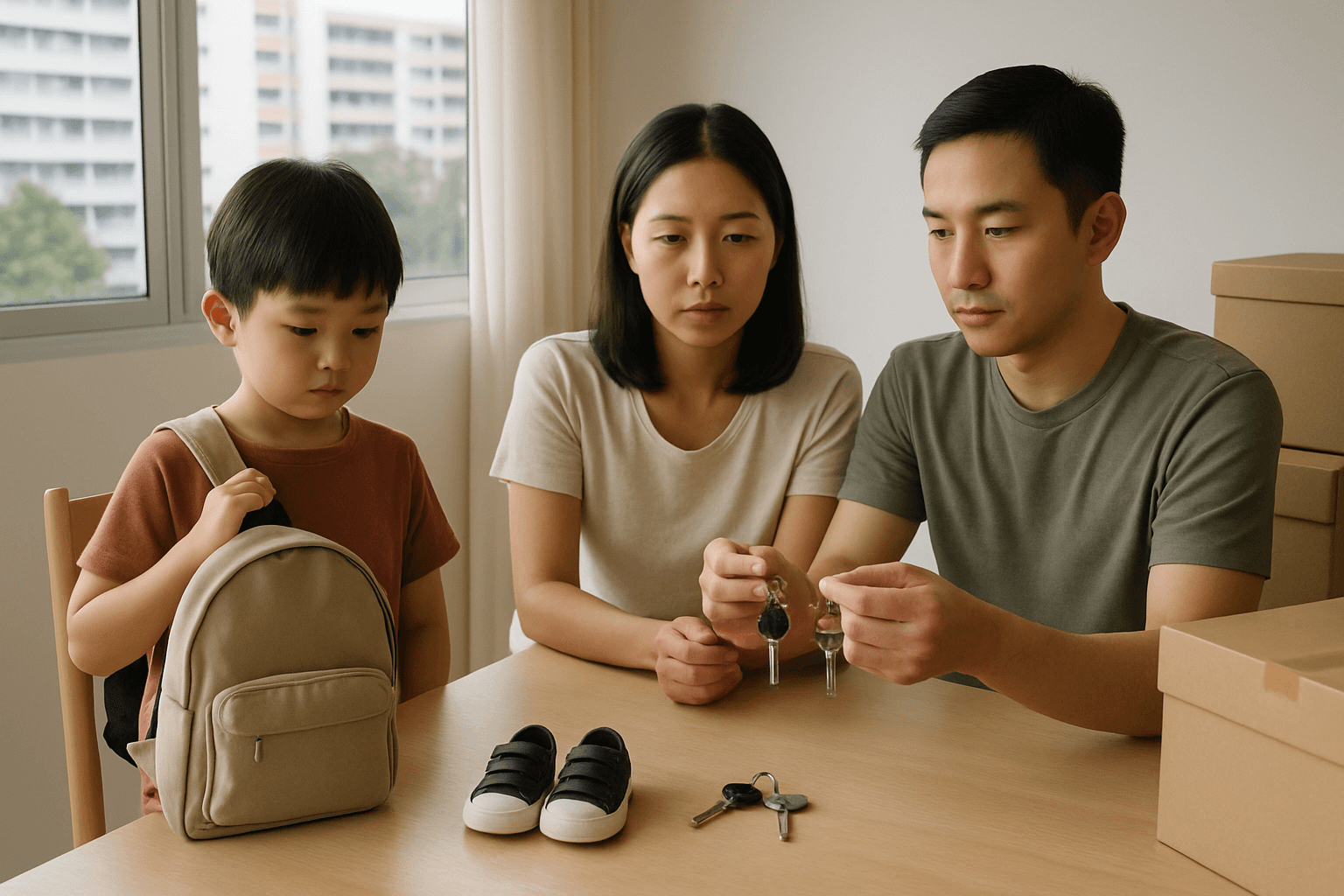
When Primary 1 registration overlaps with a move, the key question is not which address looks better. It is which address reflects where your child is actually living day to day when you submit the registration.
Short answer: should you use your old address or new address for Primary 1 registration?
Use the address that reflects where your child really lives now. If the move is already real, the new address usually fits; if not, the old address is usually safer.
Use the address where your child is actually living when you register. If your family has already moved into the new home and that is now your child’s real day-to-day base, the new address is usually the one to rely on. If you are still living at the old home and the move has not truly happened yet, the old address is usually the safer and more defensible choice.
The easiest way to think about it is this: the address should describe your child’s real home now, not the home you hope to occupy soon. A place you have bought, rented, or planned to move into later is not the same as a place your child is already waking up in, sleeping in, and leaving for school from. If you want the broader registration context, see our Primary 1 Registration in Singapore guide.
All about Transferring to Other Primary Schools
Hi hennaoh, Please refer to the FAQ below. Does it address your situation? https://va.ecitizen.gov.sg/cfp/customerPages/moe/ExploreFaq.aspx?Category=3645&Mesid=422335 Q:- I am in the midst of purchasing a new resale property. The transaction will be completed soon and I will be able to move in prior to the commencement of the academic year. Can I make use of this new address to register my child? Answer: The resale Housing & Development Board (HDB) flat's/ private property’s address can be used
All about Transferring to Other Primary Schools
To add, In this link https://va.ecitizen.gov.sg/cfp/customerPages/moe/explorefaq.aspx?Category=3645&utm_source=moe-corp-site&utm_medium=referral Look for Q. I have purchased a yet-to-be completed property and should be moving in after the property is completed. Can I make use of the new home address for Primary One (P1) registration?
What address matters for P1 registration when your family is moving?
What matters is where your child actually lives, not where the mail goes.
The address that matters is your child’s actual residential address, not just the place where mail still arrives. Parents often mix up mailing, correspondence, and residence during a move because different records update at different speeds.
A simple check is usually enough: where does your child usually sleep, keep their school things, and start and end the day? If the school bag, uniforms, bedtime routine, and weekday mornings are now all based at the new flat, that is a stronger sign of residence than an old utility bill. For a more detailed explanation of this distinction, read which home address counts for Primary 1 registration.
Memorable rule: for P1, home address should mean home, not just an address on paper.
*** READ ME FIRST !!! - P1 Registration FAQ ***
Can someone tell me if this rule is new starting from this year or was it around before? Extracted from MOE FAQ under Proximity to School FAQ 4. How long do we need to stay in the address used to register our child during the P1 Registration Exercise? In a small number of cases, there may be situations where the families are unable to remain at the address for the entire duration of the primary school studies. Even so, a child who gains priority admission into a school through his/her distance c
*** READ ME FIRST !!! - P1 Registration FAQ ***
Will you still be staying with your in-laws if your son is admitted to a school in Sengkang? You should only register using the address where you will be physically located. By the way, if your son fails to get into the school in P2C, you can only register him in P2CS. Those popular schools will have their places filled by P2C, so is there any point in changing your address back to Sengkang?
Have More Questions?
Get personalized guidance on schools, tuition, enrichment and education pathways with AskVaiser.
Try AskVaiser for Free →If you have already moved in but your paperwork is still catching up, what should you do?
If your child already lives at the new home, treat that as the starting point and gather documents that support it, even if some paperwork is still lagging.
Start from the living arrangement, not the admin delay. Families often move in before every record is updated, especially when utilities have just been transferred, some correspondence still goes to the old address, or identity records are still being refreshed.
If your child is already genuinely living at the new home, that is the main fact that matters. A family that has shifted beds, school items, and weekday routines into a new flat is in a very different position from a family that only has keys but is still sleeping elsewhere. The practical goal is to make your documents tell one clear story about the move.
One outdated document does not cancel a real move, but several conflicting records can create avoidable confusion. Keep digital copies of what you have, make sure names and unit numbers match, and be ready to explain the move in one clear sentence. Since Primary 1 registration is conducted online, it helps to organise your records early. You can also use our documents checklist for P1 registration as a practical prep guide. For a broader overview, see Primary 1 Registration Distance Priority: How Home-School Distance Works.
2B Primary one registration question
Hi, Hope all is well. I have been serving as an active community leader in one GRC for over 2 years. Just before primary one registration, if we move to a new address, are we able to register the child in 2B phase for schools within 2km in the new address?
All about Transferring to Other Primary Schools
https://www.moe.gov.sg/primary/transfers “You can apply to transfer your child to a primary school nearer to your new residential address if your child is: - A Singapore Citizen (SC) or Permanent Resident (PR). - Currently in Primary 1 to 5. We will offer your child a school nearer to your new residential address which has available vacancies. Your child will have to report to the new school by the end of the reporting period to complete the school transfer. Your NRIC must be updated with your n
If your new home is still under renovation or not ready, can you use that address?
Usually not. A home you plan to move into later is not the same as a home your child already lives in now.
Usually, no. A future home is not the same as a current home. If the new place is still under renovation, not handed over, or not ready to live in, it is hard to treat it as your child’s actual residence yet.
A simple test is useful here: could your child realistically sleep there tonight and leave for school from there tomorrow morning? If the answer is no, the new place is probably not the child’s real home yet. This applies to common scenarios such as a condo still undergoing carpentry, a flat with flooring works in progress, or a lease that starts only after registration.
This is one of the biggest misunderstandings parents have. Many families plan around where they want to be by the time school starts, but registration should reflect where the child is living at the time of registration. If you are still staying at the old address while the new home is being prepared, the old address is usually the more realistic one to rely on for now. For a broader overview, see Primary 1 Registration Documents Checklist: What Singapore Parents Commonly Prepare.
All about Transferring to Other Primary Schools
hi may i check what are the procedures like for changing primary school ? because change of address
All about Transferring to Other Primary Schools
Huh? If you are going to move to Seletar area this year end, why are you registering in Tampines / Tampines area? You could have registered with a school in the Seletar area during Phase 2C or 2CS using your new address. As it stands, you are in breach of the 30 months rule if you have registered at Tampines Primary in Phase 2C and have no intention of staying at your place for 30 months. It’s best if you start to request for a transfer before MOE commence Phase 3 and before you start school.
What if you are temporarily staying with grandparents or in a short-term rental?
Not always. A short stay may be temporary housing, while a longer settled stay can look more like your child’s real residential address.
A temporary stay is not automatically the same as your child’s residential address. This matters because many moving-house cases are not neat one-step moves. Parents may stay with grandparents during renovation, spend a few months in a rental while waiting for keys, or move into serviced accommodation between sale and purchase dates.
The useful question is whether the arrangement is a short stop or the child’s settled home for that period. A few weeks with grandparents because renovation overran usually looks temporary. A six-month rental unit where the family now sleeps, eats, and lives normally looks much more like an actual residence. If a child splits time between two homes because of family arrangements, use the address that best reflects where the child is genuinely based and be ready to explain that arrangement clearly.
The most defensible address is usually the one that matches ordinary daily life. If the situation is awkward to explain in one sentence, that is a sign to verify it before submitting.
All about Transferring to Other Primary Schools
That's a tricky question. From MOE's website, it says: \"30-month stay requirement MOE recognises that some families are unable to remain at the address used for registration for the entire duration of the child's primary school studies. Even so, a child who gains priority admission through their distance category is required to reside at the address used for registration for at least 30 months from the start of the P1 Registration Exercise. For reference, the 2021 P1 Registration Exercise start
All about Transferring to Other Primary Schools
Yes, you are allowed to move to a further location. No min occupation for your current house. The by distance requirement is only applicable for p1 registration.
What proof of address documents do parents commonly prepare?
Prepare documents that help show your child really lives at the address, but treat these as common examples rather than a fixed official checklist.
- ✓These are common examples parents often prepare, not an official or guaranteed acceptance list.
- ✓A recent utility or service bill showing the parent name and address.
- ✓A tenancy agreement if the family is renting the home.
- ✓Sale, purchase, completion, handover, or move-in records that help show the family has already occupied the address.
- ✓Recent official correspondence sent to the parent at that address.
- ✓Childcare, preschool, or other family records that already reflect the same home address.
- ✓A small set of documents that tells one clear timeline is usually more useful than one document that conflicts with everything else.
- ✓Keep digital copies ready and check that names, unit numbers, and spellings are consistent across what you submit.
How should you think about school distance and priority when moving house?
Address can affect school options, so base your plan on your real home, not the address that gives the nicest distance result on paper.
This is usually why the address question feels so high-stakes. Parents know that the home address can affect which schools look realistic, especially when distance-based priority comes into play. But that still does not mean the address should be treated like a paper strategy.
The better approach is to plan from your real home situation. If your family has genuinely moved, assess your school options from the new address. If the move is not complete, do not build your strategy around the new address just because it makes a preferred school look closer. A school that seems comfortably near from your future home may be a much riskier choice from where your child actually lives now.
Think of distance as something that follows residence, not something that defines it. If you are still deciding how ambitious to be, our guide on how home-school distance works for P1 registration and our article on whether to pick a popular dream school or a safer nearby school can help you make a more realistic shortlist.
All about Transferring to Other Primary Schools
You don't get to decide when you can transfer. It depends on whether there's vacancy in the school you want, and whether the school accepts your child. You can start by waitlisting your child in the school you want after P1 registration closes. If you are lucky, transfer can happen before P1 starts, or you can wait indefinitely.
All about Transferring to Other Primary Schools
Hi, i am moving house at early 2021. So will need to relocate my children school to new location. By Jan 2021, my eldest will start her first year of secondary school. Whereby my second daughter will be in P3. Would like to know when should i start to approach/register future school? Or am i being too kiasu in asking this question too early? Can i start to approach the future school to chop a seat? Any idea what is the procedure?
What should you do if your address changes after you submit the registration?
If your child’s real home changes after submission, clarify it early instead of leaving an outdated address on record.
Do not ignore it if the address you submitted no longer reflects where your child actually lives. Moves are often delayed, brought forward, or complicated by renovation overruns, lease timing, or family arrangements. If the facts change, the practical step is to clarify the change promptly with MOE or the school rather than assume the earlier submission will sort itself out.
Keep a simple timeline of what happened: when you registered, when the move became real, and which records support the updated address. If the move happened after submission, say that clearly. If the move you expected did not happen and you are still at the old address, say that clearly too. Parents sometimes wait because they hope the issue will not matter, but that usually makes later explanations harder.
An address change is easier to explain when you raise it early than when you explain it only after questions are asked.
*** READ ME FIRST !!! - P1 Registration FAQ ***
All P1 registration phases are held consecutively, ie. one after the other. So Phase 2A(2) is held after Phase 2A(1), and not simultaneously. You are allowed to participate in any Phase, and apply for any school in any Phase, subject only to citizenship, distance, and other Phase-specific criteria (eg. PV, alumni, etc). You can always apply to the same school in later Phases even if you failed in earlier Phases. As for your address, there is no requirement on the length of time you stay at the a
*** READ ME FIRST !!! - P1 Registration FAQ ***
2A need to apply at school , so withdrawal also need to be at school. Then go over to school B for registration. Consider time for travel, withdrawal take 5-10min. Buffer 1.5 hours would be safe if driving. If you can let us know your 2C choice , we can tell you the risk. It might be worth just to go 2C
Can I use my mailing address for Primary 1 registration if my bills still go there?
No. A mailing address is not the same as your child’s residential address, especially if your family has already moved.
Usually, no. A mailing address is simply where letters are sent. It is not automatically the same as the place where your child actually lives.
This matters most during a move. For example, a parent may still receive bank statements or insurance letters at the old flat, or may use a grandparent’s address for convenience while records are being updated. That does not automatically make that address the child’s home for P1 registration. A better question is: where is my child genuinely based right now?
If your bills still point to one address but your family is already living somewhere else, do not let the paperwork alone decide the answer. Use the address that best reflects actual residence, then prepare documents that help explain the transition. If your situation is unusual, clarify it before you submit rather than hoping the mismatch will not matter.
Questions on new rules of P1 registration
With the announcement of the new rules of P1 registration - that citizens now have advantage over PRs, I have 2 questions: 1. Does the living distance to the school matter (ie 1 km away)? 2. If the PR has an older child in the school already, is priority given to the child’s younger sibling? Thanks!
Address for P1 Registration (Phase 2B)
Hi Parents, May I check if anyone has encountered this situation and managed to register successfully under Phase 2B? I am currently an active GRL (Grassroots Leader) in the Punggol area, but I intend to shift to another area in June 2026. My questions are: Do I need to update my address before receiving the Phase 2B verification letter, or can I update it after receiving the letter? For Phase 2B registration, will MOE base eligibility on the residential address shown on my NRIC? is it ok if the
When should you verify with MOE or the school before submitting?
Check early if the move is recent, temporary, or complicated.
Verify before submitting if your move is recent, temporary, or hard to explain in one sentence. Common examples include staying with grandparents during renovation, living in a rental while waiting for your new home, having documents that still show two different addresses, or planning to move just after registration. The official MOE Primary 1 registration FAQ confirms that registration is online, but if your address situation is not straightforward, the safer move is to clarify it before you submit rather than after.
For Reference for P1 registration: MOE Official Letters
http://www.kiasuparents.com/kiasu/forum/viewtopic.php?p=293646#p293646 Dear Sir/Madam, Thank you for writing to us on 12 November 2010. We wish to clarify that parents using address of rented apartment will not be at a disadvantage if the school should conduct balloting. We would like to share with you that the registration is done based on the NRIC address that is reflected on the parents' NRIC at the time of registration and the address used for the registration of a child (assuming Singapore
All about Transferring to Other Primary Schools
Sorry, but it's getting kinda confusing. You are shifting house? Where to? I assume it's Toa Payoh since you are focusing on that area. If yes, that could legitimately be one of the reasons why you want to transfer. If not, you may want to consider schools nearer your new place. Whatever the case, it's good to register your interest with the schools now. You can call up the schools that you are interested in and ask for their school's procedures. Most will require you to fill up a form of some s
Have More Questions?
Get personalized guidance on schools, tuition, enrichment and education pathways with AskVaiser.
Try AskVaiser for Free →