
Can Your Child Start Primary 1 Early in Singapore?
Usually no. Here is what MOE's age-based framework means, what readiness does and does not prove, and what parents can do if a child seems ahead.
Usually not. Primary 1 entry in Singapore generally follows MOE's age-based eligibility framework, so academic ability alone does not create a normal early-entry route. If your child seems advanced but is still too young, the practical next step is to confirm eligibility, understand that MOE materials point to formal exemption or deferment processes rather than casual early admission, and use the extra time to build both challenge and independence.
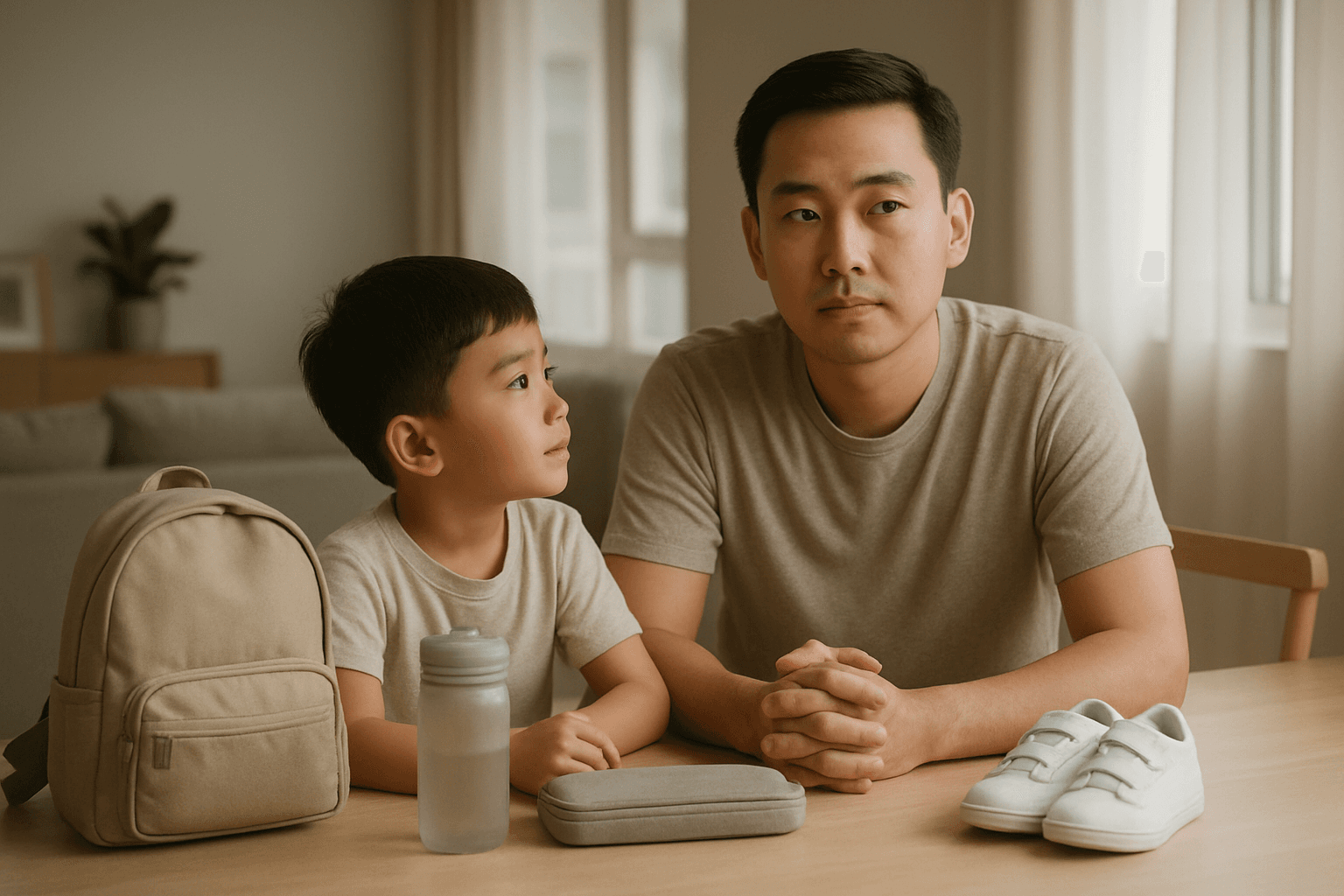
Usually, no. In Singapore, a child does not normally start Primary 1 early just because they read early, do advanced maths, or seem ahead of classmates. The first question is not whether your child can cope with some Primary 1 work. It is whether your child is actually eligible to enter under MOE's framework.
Can a child start Primary 1 early in Singapore?
Usually no. A child does not normally start Primary 1 early in Singapore just because they seem academically advanced.
In most cases, no. Singapore does not normally treat Primary 1 as a merit-based acceleration point where a younger child can move ahead just because they are bright. The practical distinction is simple: being able to do some Primary 1 work is one question, but being officially allowed to enter Primary 1 now is a separate one. MOE's framework is formal and age-based, not a case of parents showing that a child reads early or finishes harder worksheets. If you are planning ahead, start with your child's likely admission year and the broader Primary 1 registration guide, then compare that with your child's overall readiness instead of assuming ability alone opens the door.
All About Preparing For Primary One
Starting primary school? This is a big milestone. Do enjoy the journey with your child! :rahrah: https://www.straitstimes.com/singapore/education/the-st-guide-to-preparing-your-child-for-primary-1 Parents often confuse being ready for school with being academically capable in skills like reading and counting. Instead of focusing solely on academic progress, it is more important to make learning an enjoyable process, and help your child have a swift and happier adjustment to primary school. Here
All About Preparing For Primary One
Was surfing around on understanding if I am well prepared on behalf of my DD1 for Primary 1 Chanced upon a few websites, thought to share though it could have been mentioned before Tips For Parents ◦Work on independent reading skills. ◦Set up a study area and regular study times that are not interrupted. ◦Learn to follow a routine with a lot of sleep and early mornings. ◦Practice organisation and planning by packing a daily bag with essentials for the day. ◦Talk about social skills and communica
What is the usual Primary 1 registration age in Singapore?
Primary 1 registration in Singapore is based on MOE's age framework, not on how advanced your child seems.
Primary 1 registration follows MOE's age-based framework, not an ability-based one. That means parents should plan from the official eligibility year for that registration cycle, not from whether a child is already reading, writing, or doing Primary 1-level sums. A useful way to remember this is: ready to learn is not the same as old enough to register. It also helps to separate preschool from primary school in your mind. Preschool is not compulsory, and a child can still enter Primary 1 even without attending preschool, as this overview of preschool ages in Singapore notes. MOE Kindergarten registration is also a separate process from Primary 1 entry. If you want the most useful next step, check the current eligibility guidance first, then read Who Is Eligible for Primary 1 Registration in Singapore? so you are planning from eligibility, not guesswork.
Preparing Your Child for Primary School:Parent Seminar - MOE
Preparing Your Child for Primary School: A Parent Seminar by MOE Starting primary school is a big step in your child's life. To help you better understand primary school programmes and enable you to make key education decisions, the Ministry of Education will be conducting a seminar on Primary School Education. At the seminar, parents can look forward to sharing sessions by the school principal and a parent volunteer, as well as view the various programmes our primary schools provide. The Primar
All About Preparing For Primary One
the standard of kindergarten and child care centres in SG varies from one another. Some kindy prepare kids well for P1, but other kindy not sufficient. The standard varies. moreover, P1 standard is getting higher and higher, each year. that is why some parents still prefer to send kids for P1 Prep course. if you think you come from a kindy where then standard is reasonable, then ok.
Have More Questions?
Get personalized guidance on schools, tuition, enrichment and education pathways with AskVaiser.
Try AskVaiser for Free →What most parents get wrong about readiness and eligibility
Academic readiness does not automatically create Primary 1 eligibility.
The most common mistake is treating academic readiness as if it changes admission rules. It does not. A child may read fluently, count well, or finish K2 work easily and still be too young for formal entry. Able to do the work is not the same as ready for the school day. Some children look advanced on paper but still struggle to sit through a structured lesson, manage their belongings, separate calmly from parents, or cope with a busy classroom routine. For a broader overview, see Primary 1 Registration Phases in Singapore: What Each Phase Means for Your Chances.
How to Prepare For Primary School
You have to start teaching your child one to one and start from scratch. This is crucial year to prepare your child. Your child MUST be able to recognise high frequency words, can read, can spell some simple words, comprehend questions and answer logically, write neatly etc. please start preparing now before he goes P1. Share a personal experience with you. My friend has a son who enrolled in a new kindergarten in K2 this year. The boy's new teacher was shocked to discover that he could not reco
All About Preparing For Primary One
My girl is in P1 this year. Based on my experience, I think you are doing a fine job so far... As long as kids go to pre school, they are more or less ready for P1 because topics cover in first semester are very similar to what they will be learning in K2... I did buy some assessment books for my girl when she was in K2 because she had so much free time after school. Whether to draw up a time table is subjective... it definitely incultivate good habits which may be ideal when he starts P1. Prepa
Are there any exceptions for early Primary 1 admission?
The MOE sources provided do not show a normal ability-based early-entry shortcut. They point instead to formal processes such as exemption or deferment.
Parents should be careful not to assume there is a normal shortcut for younger advanced children. In the MOE materials provided, the formal pathways discussed are compulsory education, exemption, and deferment, as outlined on MOE's Compulsory Education page, rather than a standard ability-based early-admission route. That matters because it changes how you should approach the issue. Think of any exception as a formal case that would need official consideration, not as something a school can usually approve because a child seems ahead. In practical terms, a tuition portfolio, a preschool teacher's compliment, or early reading ability may help you understand your child better, but they should not be treated as proof that early entry will be granted. If your family has a genuinely unusual situation, prepare a clear explanation of why you are asking, note your child's date of birth, gather any relevant official records or professional reports if they exist, and seek guidance early rather than assuming there is an informal workaround.
[Ang Mo Kio] Primary Schools
CHIJ St Nicholas (SAP school) : P1 (Higher Chinese) Anderson primary : one parent (SOSmum) reported that school start Higher Chinese, from P1 http://www.kiasuparents.com/kiasu/forum ... start=1020 following Non-SAP schools in Ang Mo Kio, have Normal Chinese, for P1 Eg : Teck Ghee primary start HCL only from P5 Townsville primary also start HCL from P5 Mayflower primary : P1 (Normal Chinese) Ang Mo Kio primary : P1 (Normal Chinese) ================================= some schools in Toa Payoh area
International students applying to Singapore Pr schools
I'm pretty sure they cannot approach a school/MOE for a place mid-year at this point in time. If arriving March +/-, I think the two options are: a) Get kid and one parent temporarily here in Feb for S-AEIS. If pass, I assume entry starts in Term 3 (after June holidays). If unsuccessful, probably need to enroll in int'l school for Aug-Sept and can try AEIS again in Sept. b) Arrive in March +/- and take AEIS in Sept for entry the following year. Outcome probably won't be known until very late in
If my child is advanced, what signs matter beyond academics?
Look beyond reading and worksheets. Social, emotional, and practical readiness matter just as much.
Reading early is useful, but it is not the full picture. What matters just as much is whether your child can function well in a primary school environment. A child who can do subtraction but has a meltdown whenever plans change may still find Primary 1 very hard. A child who reads chapter books but needs constant adult help to use the toilet, pack a bag, or follow multi-step instructions is showing an academic strength without the same level of practical readiness. Parents should pay attention to stamina, emotional recovery after disappointment, comfort in group settings, ability to wait for turns, response to routine, and independence with everyday tasks. These are often the areas families overlook when they focus only on worksheets. The better question is not just, "Can my child do harder work?" but also, "Can my child handle a structured school day with less one-to-one support?"
All About Preparing For Primary One
:goodpost: Thanks so much for your great sharing! It really helps us as P1 parents from 2012! :lovesite:
Preschools prepared your kids well for Singapore primary?
For parents who have already been through the pre-school days and with kids now in primary schools (Singapore schools), can you share your comments on your kid's previous preschool and their curriculum - specifically if they have prepared your child properly for the Singapore education system ? (not discussing the international or foreign schools system here) Nowadays, there are so many pre-schools and childcare centres with many learning methods. Parents currently at the pre-school stage will b
What should parents do if a child seems ready but is still too young?
Assume you may need to wait, then use the time to stretch your child and build independence in practical ways.
Do not spend all your energy trying to force an early-entry outcome that may not exist. Use the extra time well instead. Start by confirming the formal side through the current eligibility framework and related guides such as Who Is Eligible for Primary 1 Registration in Singapore?. Then work on the two areas that help most advanced young children most: challenge and independence. In practice, that can mean asking the preschool teacher for stretch activities instead of more repetition, letting your child pack and unpack their own school bag, giving them short tasks to complete without hovering, and noticing how they cope when a teacher gives instructions once rather than several times. This is not about holding a bright child back. It is about making sure a bright child is also ready to manage the environment they will enter when the time comes.
All About Preparing For Primary One
Dear parents, I hope parents could share your experience regarding the preparation for primary school and time schedule spend with your kids everyday. I have a son of 6 this year going to P1 next year. I would like to find out with parents things that you are doing with your child prior going P1, cos I do not want to react too kan-jiong or too relax in front of my child. I am particularly concerned about the 3 main subjects being taught in P1 and wonder should I expect him to be able to do the a
At what age should you start to prepare for PSLE
I never believe in starting at P1 for PSLE. I am sorry I do not agreed with almost all parents here that said preparation starts at P1. Kids at P1 can’t even fathom what is exam like. Let alone ability to handle stress. At P1, kids can’t even express themselves clearly. At P1 and P2, getting used to primary school system, classroom management & discipline and social skills are more important. With this foundation, will lead to better behavior which is more important to later part of learning. Ba
What are realistic alternatives to starting Primary 1 early?
There are usually better ways to challenge an advanced child than trying to start Primary 1 early.
Most families get better results by challenging the child without trying to bypass the age rule. That may mean a preschool programme with more intentional extension, reading and maths enrichment that keeps pace with the child's ability, more open-ended projects at home, or simply richer conversations, library reading, and problem-solving activities rather than harder worksheets alone. For one child, the right move might be deeper reading and writing. For another, it might be science projects, music, coding, or social activities that build confidence and patience. The key idea is that acceleration is not only about moving up a grade. Often, it is about increasing depth while keeping the child's overall development balanced. If you are already thinking ahead to school planning, it also helps to understand the broader Primary 1 registration process so you can spend your energy on decisions that are more likely to matter.
All About Preparing For Primary One
hey hi everyone, my DD will be entering Primary 1 next year and it seems like more and more students are now enrolling in some form of preparations for primary education. It comes in the form of teaching maths and english in advance http://sg.mpmmath.com/ , cognitive improvements http://cce.education/p1prepclass/ , and some even learn things like packing bag and being organised https://www.thelearninglab.com.sg/programme/preschool/ The kindergarten my DD attends do teach them maths and english.
All About Preparing For Primary One
Here's the thing: most of them do not add any real value. Teaching in advance doesn't help in preparation, it's just... learning in advance. And when P1 comes, they get distracted or bored or worst, a disturbance in class because none of the lessons interest them (because they already know them). Notwithstanding, there are some courses / programmes that may be beneficial but they are not compulsory and may not benefit everyone equally. Examples of such programmes are English / Chinese reading /
How can parents judge whether waiting is actually better?
If academics are strong but routines, stamina, or self-management are shaky, waiting is usually the better call.
Use a simple trade-off test. If your child is clearly ahead academically but still weak in routines, self-regulation, stamina, or independence, waiting is often the safer choice. One extra year can make a big difference in confidence. For example, a child who finishes K2 work quickly but struggles with transitions may start Primary 1 feeling overwhelmed rather than proud. Another child may be advanced and independent, but even then the formal eligibility rules still matter, so the better question becomes how to use the remaining time well. It is also worth remembering that Primary 1 planning already involves enough moving parts, especially in a system where some schools are oversubscribed, as recent CNA reporting shows. In many families, the stronger decision is not to rush entry, but to aim for a smoother, more confident start when the child is actually eligible. If you are planning ahead, understanding the Primary 1 registration phases early can be more useful than trying to argue that a younger child is ready.
All About Preparing For Primary One
hi, for parents with kids in pre-nursery / nursery, these two initial years are “honeymoon” years, usually quite relaxed. But for parents with kids in k1, k2, where you are stepping on the final last lap accelerator for more oil to speed up momentum, help yr child prepare Pri 1, it is always good to attend - one year ahead in advance, the parents’ briefing on detailed Pri 1 curriculum. do not wait until the year when your child has started Pri 1, then come to attend such parents’ briefing. why ?
All About Preparing For Primary One
hi Celyw, your child is more than ready for P1 at least, he should be fine. a) Speech & drama whether English or Chinese Speech & drama - can help your child in P1 Show & Tell. Nowadays a high percentage of marks are allocated for P1 Show & Tell. i) for K2, some Montessori kindergarten set tests for K2 kids close to K2 Term 4, to assess readiness. Some minor non Montessori kindergarten also do this. However, most or majority of non Montessori kindergarten, church kindergarten do not set tests fo
My child can already do Primary 1 work. Can we skip the age rule?
No. Being able to do Primary 1 work does not by itself allow a child to skip the usual age framework.
No, not automatically. The MOE materials provided do not show a normal test, interview, or ability-based route that lets a younger child skip the usual age framework just because they can already do Primary 1 work. If your child is advanced, treat that as a signal to provide better challenge and to monitor broader readiness, not as proof that early entry will be approved. If you believe your case may involve a formal exception, approach it as an official MOE matter rather than a school-shopping strategy, and make sure you understand the wider registration context through guides such as Primary 1 Registration Phases in Singapore.
All About Preparing For Primary One
Isn’t pre-school and kindergarten is prep for P1? Or are there still many in SG who donch go to kindy?
All About Preparing For Primary One
I think depends on the school that your child goes to. I think for the branded ones, there's a need to be very prepared because other students will be as prepared. If you do not prepare your child, he/she will be left behind. For normal school, your child still need to know the basics like 1-100, addition, subtraction, write simple sentences (up to 5 sentences), recognise high frequency chinese charaters, hypy. Even in normal schools, assessment of the child's language and mathematical competenc
Have More Questions?
Get personalized guidance on schools, tuition, enrichment and education pathways with AskVaiser.
Try AskVaiser for Free →