
Does FSBB Mean One Class for All Subjects? A Parent Guide to FSBB Class Arrangement
Usually no. Your child may have a form class, but still move to different subject groups for different lessons.
FSBB is not a one-class-for-everything system. In most schools, your child still has a form class or base class, but may attend different subject classes depending on the level taken for each subject. The most useful things to check are how often students move, which lessons stay with the base class, and whether the subject plan keeps later O-Level and post-secondary options open.
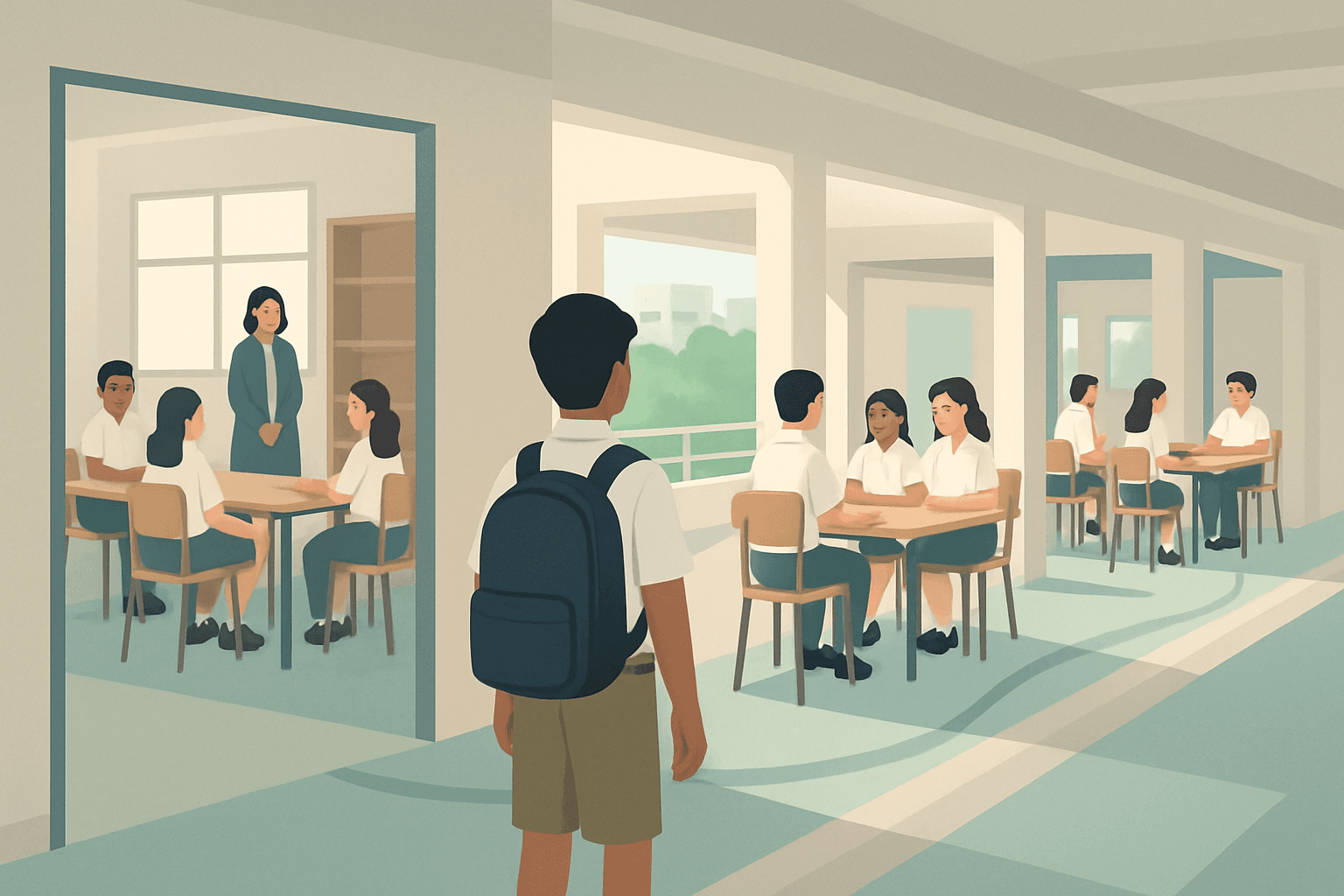
No. Under Full Subject-Based Banding, your child does not usually stay in one fixed class for every lesson. Many schools still keep a form class or base class for attendance, announcements, pastoral care, and daily routines, but students may move to different groups for subjects taken at different levels. The practical question for parents is not just “Will my child have one class?” but “How does this school organise the form class, subject classes, and timetable from Secondary 1 onward?”
What does FSBB actually mean in a secondary school?
FSBB means subjects can be taken at different levels. It does not mean one fixed class for everything.
FSBB stands for Full Subject-Based Banding. In plain English, it means a student can take different subjects at levels that better match their readiness, instead of being placed into one overall stream for everything. MOE describes FSBB as a system that gives students more flexibility to take subjects at more suitable levels, which you can see in this MOE FAQ.
The easiest way to think about FSBB is this: it changes subject grouping, not the basic need for school structure. A child may be stronger in Mathematics than in languages, or vice versa. FSBB is designed to reflect that uneven profile so students are not forced into one fixed label across every subject. If you want the bigger picture first, our guide on what Full Subject-Based Banding means in Singapore explains how the system fits together.
Time to ponder -- Subject-Based Banding (SBB)
Time to ponder -- Subject-Based Banding (SBB) Subject-Based Banding (SBB) will be implemented from the 2008 P5 cohort. It will replace the merged and EM3 stream. Depending on their performance in P4, students will be streamed into classes taking 4 standard classes with Higher Mother Tongue(HMT) , 4 standard subjects or a combination of standard and foundation subjects. Are these equivalents to the earlier EM1, EM2 and EM3? 4S + HMT --> EM1 4S --> EM2 Combination of standard and foundation subjec
FSBB (Full Subject-Based Banding)
During lower sec. my children school offers quite a wide spread of subjects at basic level. I suppose that is when students get to have a taste of different domains, and then decide their preferences at the end of Sec 2, before stream selection in Sec. 3? The subjects includes the basics like math, Chem, physics and bio; literature Eng and Chinese , Geo, history, basic music, art, Malay language, design technology. Not sure about other schools, but this is an existing model to expose students at
Does FSBB mean one class for all subjects?
No. Under FSBB, students usually have a main class but may move to different subject groups for some lessons.
No, usually not. In a typical FSBB class arrangement, your child may belong to one main class, but not attend every lesson with exactly the same group of classmates.
A common school-day pattern looks like this: your child starts the day with the form class for attendance or announcements, stays with that class for some lessons, moves to a different Mathematics group because of the level taken for Math, joins another group for Mother Tongue, and later returns to the form class for form teacher time or CCE. The exact timetable differs by school, but the main point is consistent.
FSBB changes lesson grouping more than class identity. So when parents hear “subject-based banding,” the right mental picture is not a child floating around without a class. It is a child with a main class anchor who may move for some subjects. That is the practical difference parents should look for in a school’s timetable. For a broader overview, see What Happens in Secondary 1 Under FSBB?.
Have More Questions?
Get personalized guidance on schools, tuition, enrichment and education pathways with AskVaiser.
Try AskVaiser for Free →What is a form class or base class under FSBB?
A form class or base class is your child’s main school anchor for routines, teacher support, and belonging.
A form class or base class is the student’s main anchor group in school. This is usually where attendance is taken, announcements are shared, teachers check in on students, and class-based activities happen. It is also the class most parents mean when they ask, “Who is my child’s form teacher?”
This matters because many parents assume mixed subject grouping means there is no stable class at all. In many schools, that is not the case. A student can still say, “This is my class,” even if they leave that class for some subject lessons.
For children who need routine, this anchor can make a big difference. If your child is anxious about the Secondary 1 transition, do not only ask whether the school has a base class. Ask how it works in daily life. For example, does the class stay together for morning routines, CCE, some common subjects, or regular form teacher periods? If you are preparing for the transition, our guide on what happens in Secondary 1 under FSBB can help you picture the day more clearly. For a broader overview, see Can Students Take Mixed Subject Levels Under FSBB?.
How do subject classes work when students are mixed by level?
Students may attend different classes for different subjects, depending on the level they take for each one.
Subject classes are usually arranged around the level a student is taking for that subject. That means the classmates in one lesson may not be the same as the classmates in the next lesson.
For example, a student might stay with the base class for Art, CCE, or some common lessons, but join a different English class if English is grouped by subject level. Another student may remain with the base class for most subjects and move only for Mathematics and Mother Tongue. In some schools, movement is limited. In others, it is more visible across the week.
What parents often miss is that this is not random mixing. It is planned through the timetable. Schools are balancing subject suitability, available teachers, room allocation, and the need to keep the school day manageable. So if your child has different groups for different subjects, that usually reflects deliberate placement rather than instability. For a broader overview, see How G1, G2 and G3 Subjects Work for O-Levels.
Secondary 1 Class Allocation
Hi, just to share with you, for most schools, they allocate students by their PSLE scores. However, I have heard from my students (yes, I am a tutor) that some schools (like Jurong Sec), have different kinds of classes, such as sports (for those strong in sports) and academic class. Hope this helps
Should twins be in the same class in secondary school?
Professionally, I’d say you should ask for them to be put them in different classes. They will probably get together after school and during recess anyway, and learn more than if they were both in the same class learning the same thing the same way twice over. In the end, they will have richer experiences separately while at least being in the same building!
Important nuance: FSBB is not organised exactly the same way in every school
Same policy, different school setups. Always ask how that specific school runs its FSBB class arrangement.
The MOE framework is shared, but the timetable on the ground can look quite different from school to school. One school may keep a strong base-class structure and move students only for selected subjects. Another may have more visible subject-based movement across the week. Cohort size, staffing, subject offerings, and timetable design all affect the final setup. Practical takeaway: ask the school how classes are actually organised, not just whether it “does FSBB.”. For a broader overview, see Can G1 or G2 Students Still Go to JC, Poly or ITE?.
Will my child mix with the same classmates every day?
Not always. Classmates can change by subject, but students still usually have a main class community.
Not necessarily. Under FSBB, your child may see one group of classmates during form-class routines and another group during certain subject lessons. That can feel unfamiliar, especially for children who are used to a fixed primary school class.
But mixed grouping does not usually mean school life becomes fragmented. Friendships often grow through a combination of form class, subject lessons, CCA, recess, and school activities. A child may have one close group from the base class and another familiar group from a subject they attend daily.
If your child is shy or slow to warm up, focus less on whether classmates change and more on whether the school has strong settling-in support. Useful questions include whether there are buddy systems, how form teachers monitor adjustment, and how quickly students are expected to move around independently in Term 1.
How does FSBB affect subject choices and movement between levels?
FSBB allows mixed subject levels, but placement and movement are still based on readiness and school decisions.
FSBB gives schools more room to place students in subject levels that match their learning profile, but it does not mean every combination is automatic or freely chosen. Schools still make decisions based on readiness, performance, available combinations, and timetable feasibility.
A typical example is a child who is stronger in Mathematics than in languages, or one who can handle a more demanding level in one subject but needs more support in another. That is the practical value of FSBB: it allows a more mixed profile instead of forcing one label across all subjects.
What parents often misunderstand is flexibility versus free choice. Flexibility means the school has more room to place a child appropriately. It does not mean every parent request can be fitted into the timetable. Ask when subject levels are reviewed, what evidence the school usually looks at before changing a subject level, and how quickly adjustments can happen if a child is clearly coping very well or struggling. For a fuller explanation, see our guide on whether students can take mixed subject levels under FSBB.
What does FSBB mean for O-Levels and subject eligibility?
FSBB does not block O-Levels. What matters is the subject combination, subject level, and your child’s performance.
FSBB does not remove the O-Level pathway. The more useful question is which subjects your child is taking, at what level, and how the school handles progression over time.
This is where parents sometimes focus too much on the label and too little on the subject plan. Two students may both be in an FSBB school, but their later options can look different because of the actual subjects they take and how they perform. In practice, subject combination matters more than whether the school timetable uses one fixed class or several subject groups.
If O-Levels are part of your longer-term thinking, ask the school which subject combinations are commonly available, how students are reviewed for progression, and what subject pathways students typically present later on. If terms like G1, G2, and G3 are still confusing, our guides on what G1, G2 and G3 mean in secondary school and how G1, G2 and G3 subjects work for O-Levels will make this much clearer.
How does FSBB affect post-secondary pathways like JC, polytechnic, and ITE?
FSBB does not shut these routes. Results, subjects taken, and admission requirements still decide the pathway.
FSBB by itself does not close off JC, polytechnic, or ITE routes. Admissions still depend on results, the subjects taken, and the entry requirements of the next institution or course. In other words, future pathways are shaped by academic outcomes and subject eligibility, not by whether your child sits in one fixed class all day.
That is why parents should not over-read the class arrangement. A school may have more movement between subject groups, but that does not automatically make a student more or less likely to reach a particular pathway. The better question is whether the child’s subject plan keeps suitable options open and whether the child is progressing well in those subjects.
MOE has consistently framed FSBB as part of a broader move away from rigid labels and toward more varied pathways, as reflected in speeches by Lawrence Wong and Chan Chun Sing. For the route-specific details parents usually ask about next, see our guides on whether G1 or G2 students can still go to JC, poly or ITE and whether FSBB students can go to junior college.
What should parents ask the school about FSBB class arrangements?
Ask about base class, subject movement, placement rules, and how today’s subject choices affect later options.
- ✓Does the school keep a form class or base class, and what is it used for each day?
- ✓Which subjects are usually taught within the base class, and which subjects usually require movement to another group?
- ✓How often do students move between classrooms or groups in a normal week?
- ✓Are subject classes mixed across several form classes, or mostly kept within the same class?
- ✓How does the school decide a student’s subject levels at the start of Secondary 1?
- ✓When are subject levels reviewed, and what signs of readiness does the school usually look for before changing a level?
- ✓If my child is strong in one subject but weaker in another, what mixed-level combinations are realistically available here?
- ✓How does the school support students who need more routine or who may find movement between classes stressful at first?
- ✓What subject combinations commonly support later O-Level opportunities?
- ✓If my child has a longer-term goal such as JC, polytechnic, or a specific course area, what should we keep in mind now when looking at subject planning?
Have More Questions?
Get personalized guidance on schools, tuition, enrichment and education pathways with AskVaiser.
Try AskVaiser for Free →