
What Happens in Secondary 1 Under FSBB in Singapore?
A practical parent guide to class routines, subject grouping, first-term adjustment and future pathways.
Secondary 1 under FSBB usually means a base class plus subject-based grouping, not one fixed stream for everything. Schools typically set a starting level for each subject using prior academic information and transition data, then observe how the child settles. The first term often feels messy because students are adjusting to a new timetable, new teachers and more movement, and while early subject placement can influence later subject combinations and post-secondary routes, it is best understood as a starting point rather than a final verdict.
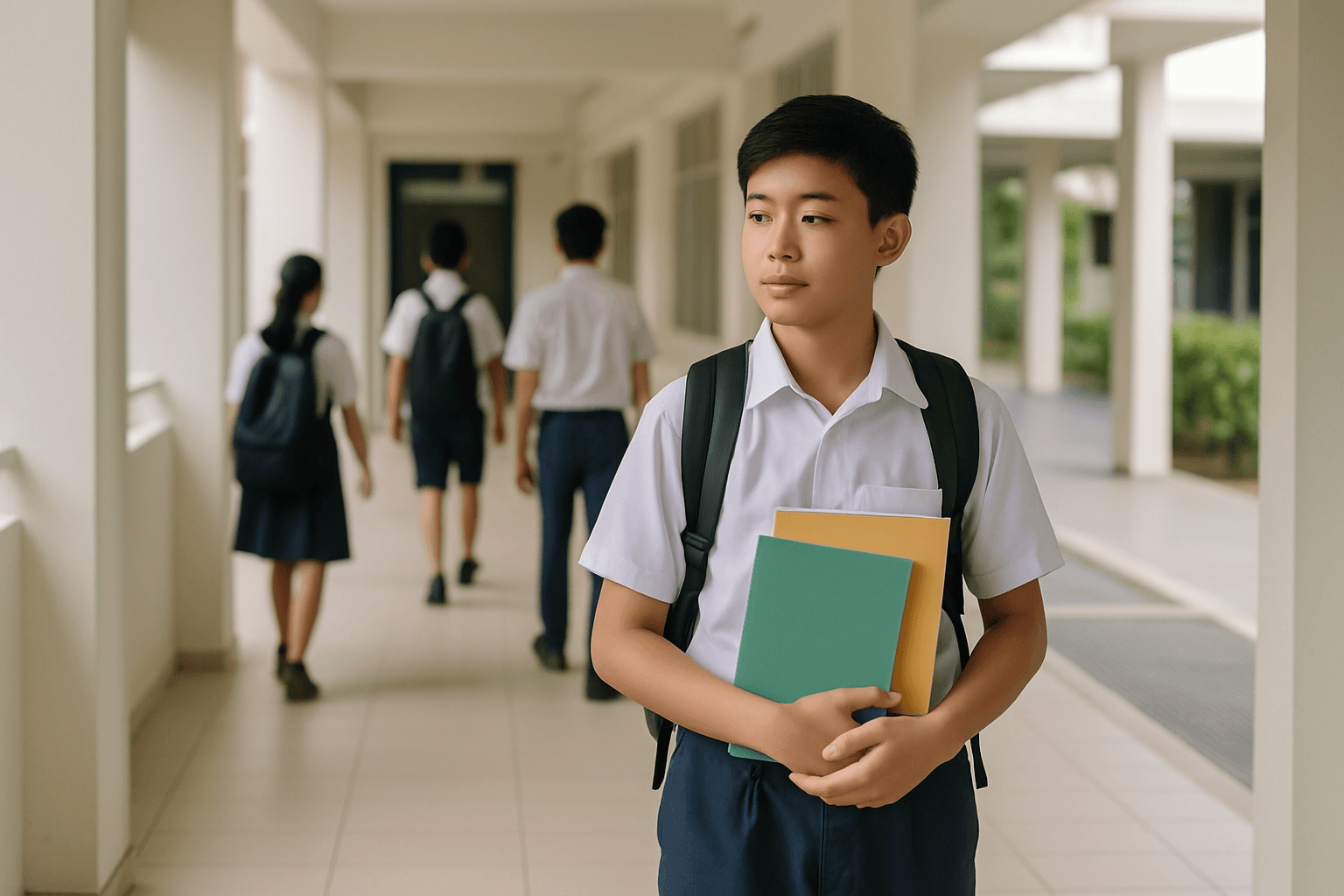
In Secondary 1 under Full Subject-Based Banding (FSBB), your child is usually not placed on one fixed track for every subject. Most students still belong to a form class, but they may join different groups for subjects such as English, Mathematics, Science or Mother Tongue based on their starting level. For parents, the practical questions are simple: what the school day looks like, how subject placement is decided, what adjustment problems are normal, and whether early placement affects later options. This guide answers those questions directly, in plain language, so you can focus on what to watch for and what to do next.
What is FSBB in Secondary 1, in simple terms?
FSBB in Secondary 1 means your child may be placed at different levels for different subjects, instead of being put on one fixed track for everything.
FSBB means your child can be placed at different learning levels for different subjects instead of being grouped into one fixed track for everything. A Secondary 1 student might take Mathematics at one level, English at another and Mother Tongue at another, depending on where the school thinks the child can learn best at that point. The main idea for parents is to think subject by subject, not label by label. For example, a child who is strong in Maths but less confident in writing may be stretched more in Maths while getting a steadier pace in English. Another child may do well in languages but need more support in Science once the content becomes more abstract. That is the practical difference between FSBB and the older stream-based mindset. If you want the wider picture first, start with our parent guide to Full Subject-Based Banding. If terms like G1, G2 and G3 are still unclear, this explainer on what G1, G2 and G3 mean in secondary school will help.
FSBB (Full Subject-Based Banding)
“Standard” secondary school subjects for lower sec in a typical government school: 1. English 2. Math 3. Science 4. Mother Tongue 5. Geography (physical geog & human geog) 6. History (Singapore from 1200s to 1970s) 7. English literature (poetry, drama/plays, and prose text) 8. Art 9. Music 10. Food and Consumer Education (FCE): includes cooking and kitchen cleanliness, as well as budget planning for ingredients and healthier meal choices 11. Design & Technology: includes workshop skills like car
All About Preparing For Secondary One
Entry to Secondary One can be quite challenging and tough to many kids out there. Kudos to all parents who continue to motivate and ensure that their children are healthy and happy during this transition. Actually, Secondary One can still be manageable if the student is able to ensure that all assignments are done painstakingly and prepare all the tests well (like duh, I am speaking the obvious right?). Many kids, based on what I heard and encountered, have a tough time in secondary one because
What does the Secondary 1 timetable usually look like under FSBB?
Most students still have a base class, but they may move to different groups for some subjects depending on their subject placement.
Most students still have a base class or form class for attendance, pastoral care and part of the daily routine. What changes is that for some subjects, your child may move to another classroom or teaching group based on subject level. One student may spend most of the day with the form class and leave only for Mathematics. Another may move for English and Science as well. Schools organise this differently, so there is no single FSBB timetable that applies everywhere. The practical takeaway is that Secondary 1 under FSBB often demands more self-management than parents expect. Your child may need to remember where each lesson is, pack the right materials for different teachers and settle quickly with different classmates across the day. In the first few weeks, organisation matters as much as academic ability. If your child gets flustered easily, go through the timetable together, mark the subjects that involve movement and build a simple routine for checking books, worksheets and homework before leaving home. For a broader overview, see What Do G1, G2 and G3 Mean in Secondary School?.
All About Preparing For Secondary One
Hi, Thanks so much. I wanted to know which subjects are examinable and if this varies from school to school. This information will help in selecting Secondary school. My kid will be in new AL scoring system and choice of school matters. So I want to make an informed choice. It may a bit too early but just wanted to have some information.[/quote]Most Secondary schools will have common (standard) subjects for O-Level and N-Level, with exception that some offer Higher Chinese or Third Language. The
All About Preparing For Secondary One
Things taught in secondary one are very basic, as long as the child listens in class, there should be no problem. This is the time where child should be enjoying their CCA time and time with friends. Encourage them to do more CIP to get CCA points.
Have More Questions?
Get personalized guidance on schools, tuition, enrichment and education pathways with AskVaiser.
Try AskVaiser for Free →How are subjects allocated in Secondary 1?
Schools usually use prior results and transition information to decide a starting level for each subject, then monitor how the child copes.
Schools usually decide a child’s starting subject levels using the child’s prior academic profile and transition information. In practice, that may include primary school results, information passed on by the primary school, school-level review and sometimes early checks after Secondary 1 begins. What parents should not assume is that there is one national formula used in exactly the same way by every school. A more useful way to think about it is this: the school is making a best-fit starting placement, not delivering a final verdict on your child’s long-term potential. For example, a child with a strong track record in Maths but uneven language performance may start at a more demanding level for Maths and a more supported level for English. Another child may look balanced on paper but struggle once the pace of secondary school becomes clear, which is why some schools need a settling-in period before reviewing fit. The best early question is often not just “Why was my child placed here?” but “When and how does the school review whether the placement is working?” If you are trying to understand the thinking behind subject fit, our guide on how to choose between G1, G2 and G3 for each subject can help frame that conversation.
Secondary 1 Class Allocation
Hi, Does anyone know how secondary schools allocate classes for new students. Do they rank them according to PSLE results? Or, do they randomly allocate the new students? Thanks.
Lower Secondary Science
Secondary One --- How to study science? ( http://www.moe.gov.sg/education/syllabu ... y-2008.pdf ) ( http://www.moe.gov.sg/education/syllabu ... t-2008.pdf ) 1)What are the techniques in answering open ended questions for secondary one science? Are students expected to put in much more information as compared to PSLE science? Take for example Q1 from sect C of this paper --- http://www.wendykoh.com/07/sec1-rivervalley-science.pdf 2)Any useful websites to download useful resources and past year p
Will my child still have different strengths and weaknesses under FSBB?
Yes. FSBB recognises that a child can be strong in one subject and need more support in another.
Yes, and that is exactly the point of FSBB. It does not assume that a child learns every subject equally well. It recognises that many students have uneven profiles and allows schools to reflect that more directly. A child may be confident in Science but need more support in English. Another may do well in languages but take longer to grasp abstract Maths concepts. FSBB is flexible by subject, not uniform by default. One common parent mistake is to replace the old stream label with a new overall label and start saying things like “my child is a G2 student” as if that describes everything. That usually oversimplifies the child’s real profile and can shape expectations in unhelpful ways. A better question is: where is my child coping well, where is my child being stretched appropriately, and where is extra support needed right now? If you are comparing this with the older system, our guides on G1, G2 and G3 vs the old streams and whether Full Subject-Based Banding is the same as streaming make that distinction clearer. For a broader overview, see How G1, G2 and G3 Subjects Work for O-Levels.
Using Secondary School material to prepare my PSLE kid
The Secondary English practice books in Popular vary considerably in style, content and quality. Secondary English is much tougher than Primary English. In Secondary English, students have to focus on comprehension and composition. A new aspect to comprehension is summary writing; this is something many students, especially in Secondary One, find enormously difficult. There is a large focus on vocabulary in comprehension. In compositional writing, there are many new genres and text types; studen
All About Preparing For Secondary One
My impression is that in general secondary kids get less practice (for the exams) than in primary school (probably just given the time constraints of the number of subjects doubling). The kids are much busier so they don’t have time to revise everything. Hence, the trick is for them to understand what they know and what they don’t know as well based on the hw and class time. For the former, no need to spend time practicing. For the latter, whether self-revise/study with school notes, assessment
What should parents expect in the first term of Secondary 1?
Expect a settling-in period with more movement, new teachers, faster lessons and a bigger need for self-management.
Expect adjustment, not instant smoothness. Even children who looked ready on paper often need time to adapt to a more complex timetable, different teachers for different subjects, faster lesson pace and less hand-holding with homework and organisation. Socially, they are also finding their place in a new environment while learning how to move between classes or groups confidently. Typical signs of adjustment strain include unusual tiredness, forgotten books, resistance toward one specific subject, or a sharp drop in confidence after the first few assignments or tests. Those signs do not automatically mean the subject placement is wrong. Very often they mean the child is still learning how secondary school works. The most useful parent response is usually practical. Help your child map the week, make sure homework is written down properly and ask narrower questions such as “Which lesson felt hardest today?” or “Was there a subject where you felt lost?” One bad test in Term 1 usually tells you less than parents think. In Secondary 1, organisation problems often show up before true academic fit becomes clear. For a broader overview, see Does Taking G1 or G2 Limit Future Options Later?.
All About Preparing For Secondary One
Hi! My boy is in Sec 1 this year and he says not to worry. In fact, you will enjoy S1 Orientation and the first week as both will be focused on getting to know one another, understanding teamwork and and getting to know your new school. So there will be fun and games during the orientation where you learn about teamwork, making friends, & perhaps a 2-day camp. THere is usually no lessons during the first week, just getting to know your classmates and teachers, learning how to communicate with te
PARENT SEMINAR 2012: Transition to Secondary One
The Secondary School Education System Mrs. Lucy Toh, Principal of St Andrew’s Secondary School, will share what your child will be learning in secondary school and the different learning routes available. Nurturing Your Child’s Aspirations through Education & Career Guidance Mr. Lim Cheng Yong, Guidance Officer from the Ministry of Education, will share on how parents can help children discover their interests and develop their strengths, and guide them to make informed education and career choi
How does FSBB affect O-Level preparation later on?
Early placement can influence later subject combinations and exam preparation, but it is still a starting point rather than a permanent lock on every future option.
Secondary 1 subject placement matters because it can shape later subject combinations and the route into national exam preparation, but it does not lock every option on day one. What happens over the next few years still matters a great deal. If a child starts at a more supported level in one subject and then shows consistent mastery, some schools may review whether a higher level is appropriate. If a child starts at a more demanding level but struggles to cope, the school may focus first on consolidation rather than pushing further. What schools usually want is sustained evidence, not one strong test or one anxious parent request. For families, the more useful question is not “How do we secure the highest level immediately?” but “Is my child building a realistic subject mix that keeps important options open later?” That is often the better way to think about future O-Level-related decisions. If you want that link explained in more detail, see our guide on how G1, G2 and G3 subjects work for O-Levels and our article on whether taking G1 or G2 limits future options later.
All About Preparing For Secondary One
Just to alert u, first. Inside some Sec classes, of the affliated Secondary school which your son's primary school is affliated to - there are some Sec classes, where boys teach (encourage) one another to ... smoke and .... stay alert Hope that your son can enter his dream school, via PSLE results. I wish him all the very best ! However, if this cannot be fulfilled, it is better to send him to SST (Yes, use his actual Psle results to apply to SST), than to remain stayed in his affliated Secondar
All About Preparing For Secondary One
Now PSLE is finally over. Gone are the days of model drawings and heuristics concepts but new Sec 1 Math topics may make students helpless and loss. As such, helps to engage students the concepts and methodology early. Sec 1 students who wish to prepare their Math early and ahead of their peers may consider to enrolled in a bridging programme. Featured in The Sunday Times & Shin Min News Daily, this preparatory programme designed for current Primary 6 student who wish to prepare themselves early
What progression pathways are still possible after Secondary 4 or 5 under FSBB?
JC, polytechnic and ITE routes can all remain possible under FSBB, but the eventual pathway depends on subject combination, results and later entry requirements.
FSBB is meant to make progression depend more on the student’s eventual subject combination and results than on one old stream label. For most parents, the practical question is whether junior college, polytechnic or ITE can still remain open. The honest answer is yes, these routes can remain possible, but not because Secondary 1 placement alone guarantees anything. What matters later is the mix of subjects the child takes, how well the child performs and what the receiving institution requires. A student who develops strong performance in the relevant subjects may still keep JC in view. A student with clearer applied interests may build more naturally toward a polytechnic route. Another may thrive through ITE if the learning style and future direction suit that pathway better. The most useful mindset is to keep options open while your child is still discovering strengths, but not to cling to an unrealistic pathway purely for prestige when the academic fit is clearly weak. If this is the part you are most concerned about, read Can G1 or G2 Students Still Go to JC, Poly or ITE?, Can FSBB Students Go to Junior College? and Can FSBB Students Go to Polytechnic?.
Fajar Secondary School
Fajar Secondary school merging https://www.straitstimes.com/singapore/parenting-education/18-primary-and-secondary-schools-to-be-merged-over-next-3-years-as
Choosing Secondary Sch
for Upper Secondary - which are some schools that still offer Principle of Accounts, besides CHIJ (Toa Payoh) ? Thanks for info!
What should parents watch for if their child is struggling or moving too quickly?
Watch for repeated, subject-specific signs early and speak to the school before a poor fit turns into a bigger learning or confidence problem.
Look for patterns, not isolated incidents. If your child is struggling, the signs are often subject-specific: repeated confusion in the same lesson, incomplete work from one subject week after week, anxiety before a particular class, or a child who has started avoiding that subject altogether. If your child is not being stretched enough, the signs may look like boredom, rushing through work with little effort, or disengagement that appears in one subject rather than across the board. In both cases, early conversations with the school are usually more useful than waiting for a major exam result. Go in with examples rather than general frustration. It is easier for a teacher to respond to “My child has been lost in Maths homework for three weeks” than “My child is not coping.” Ask what the school is seeing in class, whether there is a review point after the settling-in period and what support or adjustment is realistically possible. Secondary 1 is not just a placement year. It is also an observation year. Fit matters more than pride.
All About Preparing For Secondary One
Yes...after that stressful one year up till getting into secondary schools, next big headache is BGR. The kids' hormone levels seem to rage...son told me there have been several pairings not long after school started.
Transitioning to Secondary
With DD set to go Sec One next year - I am planning the transition of her role and my role. Parents who have been thru this, Please share your stories/tips/lessons learnt for us newbie Seccondary Parents (pun intented ) Some of the areas I can think of - 1. Old habits die hard. So what were the problems you faced in letting go of the hand holding? 2. How do you deal with it when you felt the child is not paying proper care for his work? 3. At what point do you intervene? 4. What are the issues y
What is the biggest thing parents misunderstand about FSBB?
FSBB is more flexible than old streaming, but it is not unlimited subject choice or automatic movement from the start.
Many parents assume FSBB means full freedom from day one. It does not. It is more flexible than the old streaming model, but schools still decide starting subject levels, not every subject option is automatically open, and movement usually depends on how the child performs after settling in. The practical takeaway is simple: do not panic over the first placement, but do not ignore it either. Give your child time to adjust, then look carefully at whether each subject seems manageable, too easy or consistently too hard.
Secondary 2 Streaming
Generally a lot of students n parents do not think so far ahead becos you wont know your true academic strengths and weaknesses at Sec 2. Subject interests can change at Sec 3 - 4.
Secondary 2 Streaming
My dd is having streaming next year . Can your kindly give a brief explanation on what and how is streaming like in sec 2 ? We are actually very clueless about it
Have More Questions?
Get personalized guidance on schools, tuition, enrichment and education pathways with AskVaiser.
Try AskVaiser for Free →