
Is Full Subject-Based Banding the Same as Streaming in Singapore?
A parent guide to what FSBB changed, what stayed structured, and why it is not just streaming with a new name
No. Full Subject-Based Banding is different from the old streaming model because it removes fixed Express, Normal (Academic), and Normal (Technical) course labels in mainstream secondary schools and shifts learning to subject levels instead. But students are still grouped, taught, and assessed with academic readiness in mind, so FSBB changes the structure rather than removing it.
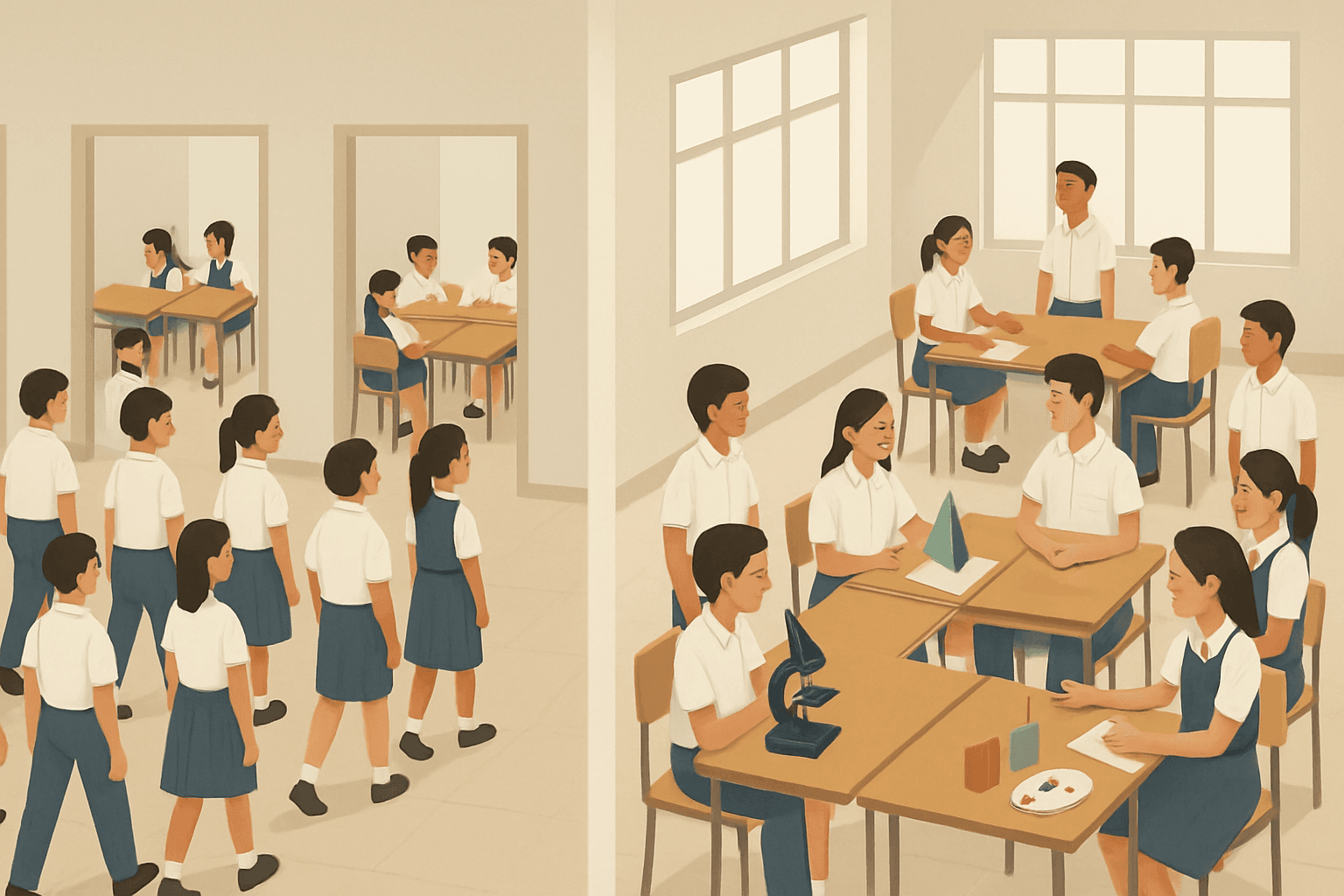
No. Full Subject-Based Banding, or FSBB, is not the same as the old streaming system in Singapore. Streaming placed students into one overall course such as Express, Normal (Academic), or Normal (Technical). FSBB removes those course labels in mainstream secondary schools and focuses instead on the level taken for each subject.
For parents, the key point is simple: FSBB gives more room for subject-by-subject fit, but it does not remove structure. Students still start from a school posting and subject profile, schools still group lessons by subject level, and results still affect later options. The real question is not whether structure disappeared. It is how the structure changed, and what that means for your child’s secondary school choices and later pathways.
What is Full Subject-Based Banding in simple terms?
FSBB means your child is not defined by one stream for all subjects. Each subject is taken at a level that better matches the child’s readiness and strengths.
Full Subject-Based Banding means your child is no longer defined by one overall stream for every subject. Instead, each subject is taken at a level that better matches the child’s strengths, interests, and learning needs, as MOE explains on its Full SBB overview.
In practical terms, one student may cope well with a more demanding level in English but need a different level in Mathematics. Another may be stronger in Math and Science but need more support in languages. That is the core shift: one child, different subject fits.
Parents often remember the old labels and miss the real change. FSBB is not about giving students a nicer stream name. It is about moving from one overall course to subject-by-subject placement. If you want the bigger picture first, our guide on what Full Subject-Based Banding means in Singapore explains the system step by step.
Time to ponder -- Subject-Based Banding (SBB)
Time to ponder -- Subject-Based Banding (SBB) Subject-Based Banding (SBB) will be implemented from the 2008 P5 cohort. It will replace the merged and EM3 stream. Depending on their performance in P4, students will be streamed into classes taking 4 standard classes with Higher Mother Tongue(HMT) , 4 standard subjects or a combination of standard and foundation subjects. Are these equivalents to the earlier EM1, EM2 and EM3? 4S + HMT --> EM1 4S --> EM2 Combination of standard and foundation subjec
Subject Based Banding
Hi, Anybody knows what is Subject Based Banding? My boy is in P4 Maris Stella. Any parents who has done this option thingy before in Maris Stella? Pls share… Thanks.
Is FSBB the same as streaming?
No. FSBB removes fixed stream labels and shifts to subject-level learning, but it still uses academic readiness to organise teaching.
No. FSBB is not the old streaming system under a new name, although both systems still organise learning around readiness.
Under the old model, students were placed into overall courses such as Express, Normal (Academic), or Normal (Technical), and that course label shaped most of the student’s school experience. Under FSBB, those stream labels are removed in mainstream secondary schools, and the focus shifts to the level taken for each subject instead. MOE’s parent-facing explanation on Schoolbag shows this difference clearly.
A simple way to think about it is this: old streaming asked, “Which course is this child in?” FSBB asks, “What level should this child take for each subject?” That is a real change in how secondary schooling is organised.
At the same time, parents should not assume FSBB means no grouping at all. Students are still taught at subject levels, and starting placement still matters. For a side-by-side comparison of the new subject bands, our explainer on G1, G2 and G3 versus the old streams is a useful next read.
Implications of P5 Subject Banding on PSLE Aggregate Score
this is interesting. i have changed the heading to 'Subject Banding' for clearer reflection of the discussion. for those interested to read the 'pamphlet', i think it should be this... http://www.moe.edu.sg/education/primary/files/subject-based-banding.pdf astronomer, you can google for some information; some schools do have some slides explaining how the PSLE score will be calculated and i briefly read that 1. the foundation subject score will be lower than standard subject score during the cal
Petition to Review the Singapore Education System
Totally agree. Streaming is not without problems but is a practical option. subject banding practiced in some schools is better.
Have More Questions?
Get personalized guidance on schools, tuition, enrichment and education pathways with AskVaiser.
Try AskVaiser for Free →What changed from the old Express, Normal (Academic), and Normal (Technical) system?
The biggest changes are that old stream labels are removed, form classes are more mixed, and students have more flexibility to take subjects at different levels.
Three practical changes matter most. First, mainstream secondary schools no longer use the old Express, Normal (Academic), and Normal (Technical) stream labels for the Secondary 1 cohorts under Full SBB. Second, students are generally placed into mixed form classes instead of whole classes being separated by stream. Third, students have more flexibility to take subjects at different levels as they move through school. MOE summarises these changes on its PSLE and Full SBB information pages.
In daily school life, this means your child’s form class is no longer a shortcut for guessing every subject level they take. A child may sit in one form class for class activities, assembly, and pastoral care, but join different lesson groups for different subjects.
What many parents overlook is that flexibility does not mean open choice from day one. Children still begin with a starting placement and a subject profile influenced by their PSLE outcome. Schools then make adjustments within what the student can handle and what the timetable can support. If you want the practical comparison in more detail, our article on what changed from Express, Normal (Academic) and Normal (Technical) to FSBB goes deeper.
BANDING Of Secondary School.
Morn, Band'g of sch is based on English+ Best 5 subj (L1B5) scored in GCE 'O' Level. This L1R5 scores will group Sec Schs into the diff Bands. Band 9 is the lowest tier with L1R5 of scores 18-18.9. SKSS is not banded for its Exp, shows its performance of last yr Sec 4 cohort after comput'g L1R5 exceeded 19. Normal course is Banded fr Band 1-5 only. Band 5 is the lowest tier. Hope that helps.
BANDING Of Secondary School.
Banding of Sec schools have been scrapped. For the benefit of Pri 6 parents keen to know the LATEST Schools’ Banding thus year ( the lists are non-exhaustive ) Band 1: -XinMin -Bukit Panjang Gov High Tha rest of last yr Band 1 Sch more or less remain in Band 1… Band 2: -TKGS -Zhong Hua -Nan Chiau -Chung Cheng High (Main) Band 3: -Temasek Sec -Maris Stella -Kranji Sec -Dunman Sec Band 4: -CHIJ Toa Payoh Band 6: -Fairfield Methodist Sec -Paya Lebar Methodist Girls’ Band 7: -CHIJ St Joseph Convent
What stays the same under FSBB?
FSBB still keeps structure. Students are placed, taught, and assessed with subject levels in mind, and those levels still matter for progression.
FSBB still has academic structure. Students do not simply pick any level for any subject without limits. They start with a posting and subject profile influenced by their PSLE outcome, and subject levels still affect teaching pace, assessment, and later progression.
This is the point many parents misunderstand. Because the old stream names are gone, some assume the system is now label-free in every practical sense. It is not. The labels changed, but the expectations attached to each subject level still matter. A child taking a more demanding level in one subject still needs to cope with the speed, depth, and assessment standard of that subject.
A realistic example is more useful than a slogan. If a child is borderline for a higher Mathematics level but already stretched by overall workload, pushing upward may create more stress than benefit. If the same child is clearly strong in English and can sustain that level comfortably, taking the stronger level there may be the better move.
Choose for sustainability, not pride. If you need a quick primer on the subject levels themselves, our guide on what G1, G2 and G3 mean in secondary school is a useful next step. For a broader overview, see How G1, G2 and G3 Subjects Work for O-Levels.
Secondary 2 Streaming
IMO, Singapore has a harsh, quick-changing education system and there is no time for gradual change. Primary 3 - Streaming into different classes Primary 5 - PSLE next year; remedials and preparation begins Primary 6 - PSLE! A continuation of even more vigorous rounds of remedials Secondary 1 - In a new school. Time to prepare for streaming next yr also (Remedial and Preparations) Secondary 2 - Streaming into different classes (again) Secondary 3 - O Levels Next year; more remedial and preparati
P5 subject banding
My boy is in P5 this year...and will be facing subject banding this year. In my own view, P5 is the most tedious year in the Primary levels. And now with this subject banding adding in... :? ...oh my....more fuel to the stress. Different sch set different standard papers. If a child failed in the paper set by a high standard sch and that will land him to a foundation subject in P6. But what if he is in other sch?? The situation will be diff... :?
Are all secondary schools using Full SBB?
No. Some schools with specialised curricula do not use the standard Full SBB setup, so always check the specific school model.
No. Some schools with specialised curricula do not follow the standard Full SBB model. MOE notes that schools offering the Integrated Programme, as well as Crest Secondary School and Spectra Secondary School, operate differently, which you can confirm on its page about schools with specialised curriculum.
The parent takeaway is simple: do not assume every secondary school offers the same class structure or subject-level flexibility just because FSBB exists nationally. Check the school’s model before comparing options. For a broader overview, see Can G1 or G2 Students Still Go to JC, Poly or ITE?.
Removal of Secondary School Banding
School banding has got nothing to do with differentiated curriculum or how fast/slow the teachers teach. The bands were based on the value-addedness of the individual schools, derived from their O-Level results and the PSLE T-scores of the O-Level candidates.
BANDING Of Secondary School.
U mean based on latest Banding 2012? MOE has removed Banding of schools. If not, which Sec Schools are u keen to find out?
How does FSBB affect subject choices and class grouping?
FSBB gives more flexibility across subjects, but subject combinations are still shaped by school offerings, timetables, and your child’s starting placement.
FSBB makes subject choice more flexible, but that flexibility sits inside real school constraints such as subject offerings, timetabling, and the child’s starting placement. In practice, students may take different subjects at different levels, and schools organise lessons so they can join the right group for each subject.
For parents, this is the biggest day-to-day shift. Your child may belong to one mixed form class for school life, but move into different lesson groups depending on the subject. So a mixed form class does not mean every student studies the same version of every subject together.
A few examples make this clearer. One student may take a more demanding level for English while taking Mathematics at a different level. Another may cope well with Mathematics and Science but need more support in Mother Tongue. A third may begin Secondary 1 with one subject mix and later be considered for a change in one subject if results show readiness and the school can support it.
What most parents miss is the school-specific part. Two mainstream schools may both use Full SBB but timetable lessons differently and offer different amounts of practical flexibility. Our guides on what happens in Secondary 1 under FSBB and whether students can take mixed subject levels under FSBB can help you picture how this works in real school life.
Secondary 2 Streaming
@zac-s-mum said in Secondary 2 Streaming : Happy to report that my child got his preferred combi of 8 subjects (2L, 2M, 2S, and 2 humanities). Indeed the 12-subject calculation benefitted him (I asked him to give his best in all of them, not neglecting any, and he did). And also he had tuition for math & science (all along his weakest). I hate that the sg system is so heavily weighted on STEM, but looking back i have no regrets that i paid for the math & science tuition. Even if all we wanted wa
Secondary 2 Streaming
At my ds briefing session, the school mapped a entry requirements of the different courses at nus, ntu and some ivy league unis, as well as the subjects offering at ri and hci... Pretty informative
What does FSBB mean for O-Levels and academic progression?
O-Levels still matter under FSBB. Subject levels and results continue to affect progression even though the old stream labels are gone.
FSBB does not make exams less important. Subject levels and results still matter for progression. MOE’s secondary school experience page explains that results across different subject levels can be considered through grade mapping for post-secondary progression.
For parents, the practical point is straightforward: the old stream label matters less, but subject performance still matters a lot. Taking a more demanding level in a subject can help if your child can do well there. Taking a harder level and then struggling badly can also weaken overall outcomes.
This is where many families still think in old-stream terms. Under FSBB, it is usually better to ask, “Which subject levels can my child sustain well enough to keep options open?” rather than, “How do we get the strongest-sounding label?” If you want the exam side explained more clearly, our guide on how G1, G2 and G3 subjects work for O-Levels goes deeper.
2013 GCE 'O' Level Result and Banding
If anyone knows how secondary schools did for the ‘O’ Level exam, it would be helPful to share what are their Bandings. Although MOE has done away with Banding, if forumners could Provide with an unofficial one, the info would be helpful for parents and students to know how various schools perform and in selecting which school to enter after PSLE exam. Some schools still track such a rating BUT only for INTERNAL CONSUMPTION? I anyone one knows such info, please share. Better still, if you hav th
Secondary 2 Streaming
Hello, i am a student who graduated from jc last year, so my memory of sec 2 streaming is still fresh A thing to always note when it comes to streaming/selecting your combination is to firstly, look at the subjects you're interested in, and secondly, look at the subjects that you are good at, and have the potential to score well in. (BUT interest may not always mean that you'll score well) Judging from your dilemma, i'm curious to know which subjects you are keen in, and what do you intend to wo
How does FSBB affect routes to junior college, polytechnic, and ITE?
FSBB changes class organisation, but post-secondary options still depend on subject requirements and performance rather than old stream labels.
FSBB changes how students are grouped in secondary school, but it does not remove the need to meet post-secondary subject requirements and perform well. Routes to JC, polytechnic, ITE, and other pathways still depend on the subjects taken and the results achieved, not on whether a child would previously have been labelled Express, Normal (Academic), or Normal (Technical).
This is why backward planning matters. If a child hopes to keep the JC route realistic, parents should pay attention to whether the subject mix and performance are supporting that goal. If a child is more interested in a polytechnic pathway, the better question may be whether the overall subject profile is strong and sustainable. If ITE is likely to be a good fit, the aim should be to build confidence and competence, not to chase a label that does not match the child’s strengths.
A useful way to think about it is this: destination first, subject fit next. Start with the route your child may want to keep open, then work backwards to the subject levels they can realistically handle well. Our related guides on whether G1 or G2 students can still go to JC, poly or ITE, JC pathways under FSBB, and polytechnic pathways under FSBB cover those next-step questions in more detail.
Secondary 2 Streaming
I know different schools set different criteria for sec 2 streaming (it’s not regulated by MOE). But someone please tell me it’s not uncommon to have this in Express track: Students will be ranked on their total score of all 12 subjects: 1. English 2. Mother tongue 3. Math 4. Science 5. History 6. Geography 7. Literature 8. Art 9. Music 10. PE (including Napfa results) 11. FCE 12. D&T Furthermore, math & science are doubly-weighted aka doubly-counted in the overall total. Meaning: 13. Math 14. S
Secondary 2 Streaming
The criteria for streaming, the subjects to take, etc will depend on the principal, the standard of the students and the school resources. Most schools will conduct briefing to parents & students in Feb or Mar. Hence it is important for parents to attend the briefing session so as to understand more about the streaming process.
What are the most common misunderstandings parents have about FSBB?
The biggest myths are that FSBB is just a rename, that it removes all grouping, and that it guarantees any pathway regardless of subject performance.
The first myth is that FSBB is just streaming with better branding. That misses the biggest change, which is the move from one overall course label to subject-level learning. The second myth is the opposite extreme: that FSBB removes all grouping and lets every child freely mix any subjects at any level from the start. That is also wrong. Schools still organise learning around readiness, feasible combinations, and timetable realities.
The third myth is that once the old stream labels disappear, all future pathways become automatically open. They do not. Subject levels and subject performance still shape progression. A mixed class does not mean identical academic demands for every child, and a more flexible system does not guarantee every route regardless of results.
Parents also sometimes assume that taking one subject at a lower level immediately closes many doors. That can be too simplistic. One subject choice has to be read together with the rest of the subject mix, the child’s strengths, and the route being considered.
FSBB widens routes; it does not replace planning.
Petition to Review the Singapore Education System
Reducing class size is really not possible cos MOE provides a public education which is very different from a private one. 90% of Singaporean kids study in public schs, to reduce class size, MOE will have to employ many many many more teachers. Now, education is highly subsidised by the govt. It's very high cost running a sch. I remember the operation manager from my previous sch (I was an ex MOE teacher) mentioned once that the monthly electrical bill was more than $30,000 a mth and that did no
Petition to Review the Singapore Education System
hi ksi, it's \"scary\" if it's 50+ for the cohort. But is this just a particular test? or SA1? If most kids are attending enrichment/ tuition as we have been discussing here ... then do you understand why the average is so low? The school is setting a standard that even enrichments did not cover? Is this \"common\" in Singapore? Or just a few schools in Singapore? If it's a few schools, then it's something to do with these schools than the entire education system. But without data, we will proba
How should parents think about FSBB when helping a child choose subjects?
Parents should use a simple framework: strength, workload, and pathway. The best choice is usually the level your child can sustain well, not the one that sounds most ambitious.
A useful parent framework is strength, workload, and pathway. Strength means being honest about where your child is already coping well and where support is still needed. Workload means asking whether a more demanding level in one subject will remain manageable alongside the rest of the timetable. Pathway means thinking ahead to the post-secondary routes your child may want to keep open.
That leads to better questions. Is my child genuinely strong in this subject, or just less weak than in others? If we push one subject upward, will overall performance improve or worsen? Are we choosing this level because it fits the child, or because the old stream mindset still makes one option sound safer or more prestigious?
A realistic example is a child who is clearly capable in English but stretched in Mathematics and Science. In that case, taking the stronger level for English may be sensible while keeping a more manageable level elsewhere. Another child may be evenly balanced across subjects and be better served by a stable load rather than one ambitious stretch subject.
Choose for fit, not for label. If you want a more detailed decision guide, see our article on how to choose between G1, G2 and G3 for each subject and our explainer on whether taking G1 or G2 limits future options later.
FSBB (Full Subject-Based Banding)
During lower sec. my children school offers quite a wide spread of subjects at basic level. I suppose that is when students get to have a taste of different domains, and then decide their preferences at the end of Sec 2, before stream selection in Sec. 3? The subjects includes the basics like math, Chem, physics and bio; literature Eng and Chinese , Geo, history, basic music, art, Malay language, design technology. Not sure about other schools, but this is an existing model to expose students at
Secondary 2 Streaming
If your child is academically above average, having one subject (out of 8 or more) for testing isn’t much of a problem (I remember during our time when RK was compulsory for Sec 3, I had 10 subjects so I had plenty of options to play with ). If your child is struggling to cope with 8 subjects or has only 7 subjects to contend with, the margin of error is very small. AFAIK, school can be flexible but it also depend on the individual child’s capability. There’s really no point in insisting if it’s
Have More Questions?
Get personalized guidance on schools, tuition, enrichment and education pathways with AskVaiser.
Try AskVaiser for Free →