
FSBB vs Express, Normal (Academic) and Normal (Technical): What Changed in Singapore?
A plain-English guide to how Singapore moved from old secondary school streams to Full Subject-Based Banding, and what parents should pay attention to now.
FSBB replaced the old habit of treating every student as one overall stream such as Express, Normal (Academic) or Normal (Technical). Under FSBB, students can take subjects at different levels based on their strengths and learning needs, so parents should focus less on old stream labels and more on subject fit, school offerings, O-Level preparation and the post-secondary routes they want to keep open.
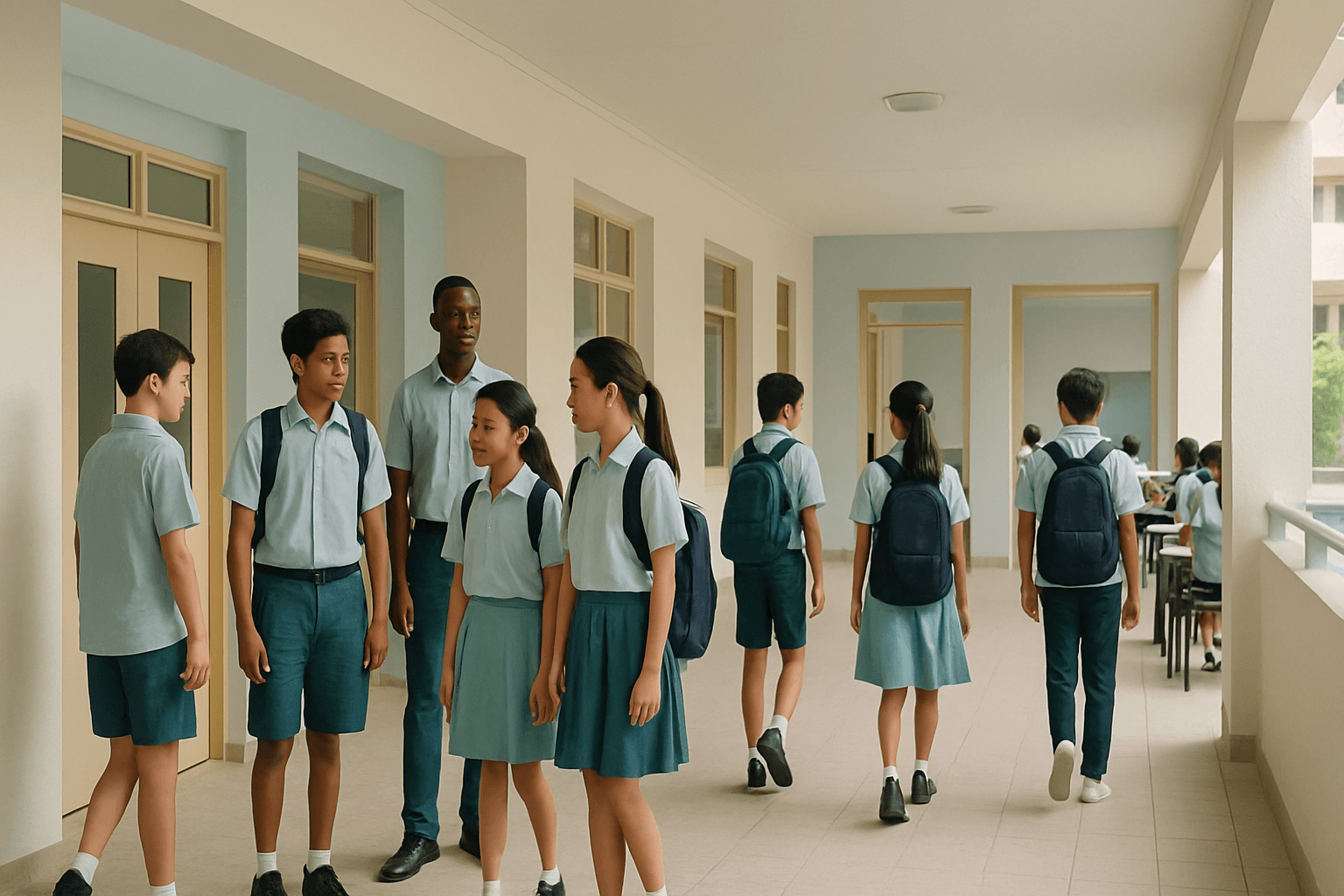
In short, FSBB changed how secondary school students are grouped and taught, but it did not make academic differences disappear and it did not remove O-Levels, JC, polytechnic or ITE pathways. The biggest shift is this: instead of placing a child into one fixed stream for almost everything, schools now place more emphasis on the level that fits the child for each subject.
If you are trying to translate old terms into the current system, this guide will help. It is especially useful if relatives still talk about "Express" or "N(A)", while school materials now talk about posting groups, G1, G2 and G3 subject levels, and FSBB.
What were Express, Normal (Academic), and Normal (Technical) under the old system?
The old labels were broad streams that grouped students by overall academic pace, not mainly by subject-specific strengths.
Under the old secondary school streaming system, Express, Normal (Academic) and Normal (Technical) were broad whole-stream labels. In practical terms, a child was usually placed into one overall track, and that track shaped the pace and level of learning across most subjects.
That is why parents used to describe a student simply as "Express" or "N(A)" as if it summarised the whole secondary school journey. It was a convenient shortcut, but it also encouraged families to think of the child as one label. A student could be very strong in English but need more support in Mathematics, yet the overall stream still influenced most of the school experience.
The simplest way to understand the old model is this: it grouped students mainly by overall learning pace. That is the key difference from FSBB, which looks more closely at subject-by-subject strengths. For a broader overview, see What Is Full Subject-Based Banding in Singapore? A Parent's Guide to Secondary School Subject Levels.
Express or Normal stream
All the 6 choices in the form must be for the same stream, ie. Either all Express, or all NA stream. So sometimes there are very limited choices of schools for Express especially if you want near your house. Worthwhile to consider those pilot FSBB schools, pick NA stream instead, especially if only 1 subject (Eg CL) dragged down the total PSLE score. Child still has chance to do the other subjects at Express level.
Express or Normal stream
Yes, they may use the same textbooks but Express students will cover everything in the textbook while the Normal students may not. This is usually clearly indicated in the book itself. Also, even for topics where the Express and Normal students cover the same things, the workbooks and assessments will be designed differently. Teachers cannot set the exact same question for an Express student and a Normal student. The concept being tested may be the same but the way the question is phrased and wh
What is FSBB in plain English?
FSBB means one child can take different subjects at different levels instead of being defined by one overall stream.
FSBB stands for Full Subject-Based Banding. In plain English, it means a child is no longer boxed into one stream label for every subject. Instead, the child may take different subjects at different levels based on strengths, interests and learning needs.
MOE describes Full SBB as giving students more customisation and flexibility, and this has applied from the 2024 Secondary 1 cohort onwards. If you want the fuller system overview, start with our guide on what Full Subject-Based Banding means in Singapore.
The easiest parent shorthand is this: one child, different subject levels. A student may cope well with a more demanding level in English or Science while taking another subject at a level that gives more support. So the main question has changed from "Which stream is my child in?" to "Which subject levels fit my child best?". For a broader overview, see G1, G2 and G3 vs the Old Streams: What Parents Need to Know.
Possibility to enter Express Stream?
Yes, it seems that if doing foundation subjects, then child will be posted to Normal (Academic) or Normal (Technical) stream, depending on the T-score. I feel what is important now is to ask child to focus on PSLE and do as best as he/she can. Then there is a higher chance of being accepted into the Normal (Academic) stream in a \"better\" school. There has been alot of changes in the secondary school landscape. There are some students in N(A) who are also doing subjects that were previously off
Express or Normal Academic
Nice to hear from the teachers’ point of view. DS is enjoying his FSBB class so far. There’s lots of shuffling around to various classrooms during the 7 core subjects, but they have gotten the hang of it by now. Not supposed to leave their stuff under their (homeroom) desks or it may go missing. Either take with them to next classroom or keep in locker. Bonding-wise, they had a fantastic 3D2N Orientation camp where activities were grouped by form class. He sees no difference between Exp/NA/NT ki
Have More Questions?
Get personalized guidance on schools, tuition, enrichment and education pathways with AskVaiser.
Try AskVaiser for Free →What actually changed in day-to-day secondary school life under FSBB?
Under FSBB, students can be grouped more by subject fit than by one overall stream, which helps children with mixed strengths.
The biggest day-to-day change is that grouping can be more flexible by subject. FSBB does not mean every child studies the same content in the same class at the same pace. It means schools can organise learning more around subject-level fit than one overall stream label.
This matters most for children with uneven strengths. For example, a student who is strong in English but weaker in Mathematics may be stretched more in English while getting more support in Mathematics. Another student may do well in Math and Science but need a different level for languages. Under the old stream mindset, parents often thought in all-or-nothing terms. Under FSBB, the school has more room to respond to the child's actual subject profile.
What many parents overlook is that school implementation still matters. Schools do not all timetable, group or review subject levels in exactly the same way. Earlier Subject-Based Banding models in prototype schools were designed to create that flexibility, and Schoolbag's pieces on early SBB experiences and how one school organised it give a useful sense of the practical goal. When you compare schools, ask how mixed subject levels work in real life, not just whether the school says it offers FSBB. For a broader overview, see How G1, G2 and G3 Subjects Work for O-Levels.
Secondary 2 Streaming
I know different schools set different criteria for sec 2 streaming (it’s not regulated by MOE). But someone please tell me it’s not uncommon to have this in Express track: Students will be ranked on their total score of all 12 subjects: 1. English 2. Mother tongue 3. Math 4. Science 5. History 6. Geography 7. Literature 8. Art 9. Music 10. PE (including Napfa results) 11. FCE 12. D&T Furthermore, math & science are doubly-weighted aka doubly-counted in the overall total. Meaning: 13. Math 14. S
FSBB (Full Subject-Based Banding)
“Standard” secondary school subjects for lower sec in a typical government school: 1. English 2. Math 3. Science 4. Mother Tongue 5. Geography (physical geog & human geog) 6. History (Singapore from 1200s to 1970s) 7. English literature (poetry, drama/plays, and prose text) 8. Art 9. Music 10. Food and Consumer Education (FCE): includes cooking and kitchen cleanliness, as well as budget planning for ingredients and healthier meal choices 11. Design & Technology: includes workshop skills like car
Are Express, Normal (Academic), and Normal (Technical) still relevant today?
They still appear in conversation, but they are mostly legacy labels and are not the best way to judge a current Secondary 1 experience.
They are still useful as legacy terms, but they are no longer the best way to understand a current Secondary 1 student's experience. Parents may still hear them from older siblings, relatives, tutors or even school alumni because those labels were used for many years. That does not make them the right framework for today's new cohorts.
For current planning, it is more useful to think in terms of posting groups, subject levels and the child's strengths by subject. If you keep translating everything back into old stream labels, you may miss the real decision now, which is whether the school can support the right mix of subject levels for your child.
A good rule of thumb is this: old labels help with historical comparison, but they should not drive present-day school choice. If you want a direct translation guide, our article on G1, G2 and G3 vs the old streams is the most useful next read. You may also find whether FSBB is the same as streaming helpful if you are trying to make sense of the terminology. For a broader overview, see Can G1 or G2 Students Still Go to JC, Poly or ITE?.
express or normal stream
Understand that if the kids did well in Normal stream, they can still be promoted to Express stream. I have friend who DS went to N stream due to PSLE result but was recommended to go E stream after his did well in Sec Two. He rejected the offer as he was more comfortable with Normal stream’s pace.
express or normal stream
I agreed with u. But when I look through the booklet to choose secondary school, I hv no idea what to choose. The choice is so limited. Anyone has any suggestion which schools can I choose ard hougang, amk and serangoon areas?
How does FSBB affect school choice and school placement?
Under FSBB, parents should compare posting groups, actual subject offerings and school support, not rely mainly on old stream reputation.
School placement is still real, but the practical question is no longer just whether a school used to be known as an "Express school" or an "N(A) school." Parents now need to look at the school's current posting groups and subject offerings.
The most useful starting point is MOE SchoolFinder. School pages such as Mayflower Secondary School, Temasek Secondary School and Tampines Secondary School show posting groups and the subjects offered for that school's current setup. That gives you a more realistic picture than old reputation alone.
This is where many parents get caught by outdated assumptions. A school's older image may not tell you enough about whether it suits your child now. For example, if your child is stronger in languages than in Math, or may need a mixed subject-level profile, a school that handles subject-level flexibility well may be a better fit than one chosen mainly because someone says it was historically strong in an old stream.
The practical takeaway is simple: compare schools by your child's likely subject profile. Ask whether the school serves the relevant posting group, offers the subjects your child is likely to take, and seems able to support a realistic level mix. If mixed levels may matter for your child, our guide on whether students can take mixed subject levels under FSBB will help you ask better questions.
Express or Normal stream
The cut off point to opt for express course is 188. If your child scores 187, he can’t opt for express course. However, I understand that some schools are willing to put the child in the express course if it’s only 1 or 2 points difference upon parents’ request. Whether it’s better to put your child in the good school but normal stream depends on your child. If he’s good but due to his poor performance in the PSLE, which may not be a fair estimate of his ability, I’ll strongly recommend that he
Express or Normal stream
imagine you scoring 238 and your parents enrol you into BPHS when you could have got into another school and doing express, how would you feel? yes, if work hard, one can get from normal to express stream, but what if the kid gets dishardened or prefers to slow down and take normal academic route?
What happens to O-Levels under FSBB?
O-Levels did not disappear under FSBB; what changed is how students build toward them through their subject levels.
The O-Level pathway still exists. FSBB changes how students are prepared and grouped in secondary school, not the fact that national exam routes still matter.
For parents, this means exam planning becomes more about the child's subject combination and level mix than about one old stream label. A student taking stronger academic subject levels in some areas may be building toward options that depend on that foundation. Another student may need a more supported pace in some subjects first. In both cases, the school still has to prepare the child for the level and combination they are taking.
A common misunderstanding is to assume that once old stream names fade, exam consequences fade too. They do not. Subject levels still matter because they affect readiness, workload and confidence. Pushing for the highest level in every subject is not always the smartest move if it weakens the child's overall performance. If you want the next layer of detail, read how G1, G2 and G3 subjects work for O-Levels and what G1, G2 and G3 mean in secondary school.
[SS/Geog Online Tuition] by O level SS marker.
Did you know that O level SS papers are marked in Singapore? Hi, I am an experienced tutor specialising in Social Studies and Geography for Lower Secondary, O-Level and N-Level students. As an O-Level Social Studies National Marker, I am very clear of the marking standards and expectations of students to do well. I have access to a wide range of past examination papers and official marking schemes, which allows me to prepare students thoroughly for different examination formats and question type
Rough gauge of PSLE grades to get into Express Stream
Express stream is 188 in some schools, 200 in others. You don’t need to score all As to get into Express. There’s still time for your dd to work for her PSLE. Encourage her and maybe find her a good tutor for Math.
How does FSBB affect progression to JC, polytechnic, and ITE?
FSBB does not remove JC, polytechnic or ITE pathways; it changes the subject foundation students build before those routes.
FSBB does not replace post-secondary pathways. Junior college, polytechnic and ITE are still the main routes after secondary school. What FSBB changes is the subject foundation a child builds before reaching those decision points.
For a family thinking about JC, the main issue is whether the child is building a strong enough academic base in the subjects that matter for that route. For a family leaning toward polytechnic, the better question is whether the subject mix fits the child's strengths and interests while keeping the workload manageable. For a child who may benefit from a more applied or skills-based progression, ITE remains a valid pathway, and FSBB does not make that route any less meaningful.
The key insight is this: FSBB changes preparation, not the existence of the destination. A child who takes stronger levels in some subjects may keep more options open, but that does not mean every child should chase the highest level in every subject. Fit still matters more than prestige. For route-specific guidance, see Can G1 or G2 students still go to JC, poly or ITE?, Can FSBB students go to Junior College? and Can FSBB students go to Polytechnic?.
moving from express to normal (acad) stream
Check with the school what is the criteria to move from Express to NA. Usually the school will monitor the student in 2nd semester if the results are bad in Semester 1. My colleague's son managed to promote to Sec 2 Express although he did quite badly for Sem 1 in Sec 1. His teacher started to monitor him closely and always call my colleague to update her on the son's progress. I suggest that you talk to the school teacher and ask them what can you and the school do to help your child.
What are the Good( not Great like ACS) IB course in SG
The fees at SJI are around $550 for Singaporeans. http://www.sji.edu.sg/subpage.php?id=110 Also if your child got L1R5 of 8 points (raw) and below, there is a chance to get the ESIP even for JC 1 and 2, which would offset the fees by $2400 per year, which would be $200 monthly. http://www.moe.gov.sg/education/admissions/jae/faqs/#what-esip The Edusave Scholarships for Integrated Programme Schools (ESIP) subsidises academically outstanding Singaporean students for the higher school fees charged b
What should parents focus on now instead of stream labels?
The better question now is not "Which stream?" but "Which subjects, levels and school fit my child best, and which options do we want to keep open?"
Parents should focus on three things: the child's subject strengths, the school's current setup, and the future options they may want to keep open. That is more useful than asking whether a child is the modern equivalent of Express or N(A).
Start with your child's pattern, not the school's reputation. If your child is consistently stronger in languages than in Math, or better with applied learning than a heavy academic load, that should shape your school questions. Next, look at the school's current reality. SchoolFinder pages and school briefings usually tell you more than family hearsay because they show what the school offers now, not what it offered years ago. Finally, link present choices to future routes. You do not need to lock in JC, poly or ITE at Secondary 1, but you should know which options you are trying to preserve.
A useful mindset is this: under FSBB, the strongest planning starts with the child's subject profile, not the old stream label. If you are making actual subject-level decisions, our guide on how to choose between G1, G2 and G3 for each subject is the practical next step. If your child is just entering secondary school, what happens in Secondary 1 under FSBB can also help you picture the first year more clearly.
Express or Normal stream
I was from N(T) but went to NUS anyway and have gotten a Degree in IT. Although I must admit that if there was some life coach at that time, I could have done better? Being admitted to Normal stream is not end of the road. I have seen many Express students not making it to Uni. From my personal experience, the most important thing is to motivate your child enough to want to progress academically. Encourage but do not force your child. Having a degree is no big deal too as there are many of my ex
Express or Normal stream
I was in a comparatively lousy express class. True, the environment wasn't conducive for learning. My classmates played one practical joke on a teacher and we were condemned as 'the class that plays practical jokes on teachers' since the class was already identified as 'naughty' and 'does not want to study' by most teachers. What I've benefitted from the stream was that it exposed me to the content that's appropriate for O levels for those 4 years. I didn't feel the need to do a big jump to adju
What is the biggest misunderstanding parents have about FSBB?
FSBB does not mean everyone studies the same thing at the same level; it means subject-level differences are handled more flexibly than before.
The biggest misunderstanding is thinking FSBB means streaming has disappeared in every meaningful sense. It has not. Academic differences still exist, and students still take subjects at different levels.
What changed is the structure. Schools are moving away from one fixed label for the whole child and toward a more flexible subject-by-subject approach. The clearest way to think about it is this: FSBB is not "everyone learns the same way now." It is "subject level should match the child more closely than before."
Express or Normal stream
:? Express or Normal???? My son got 2A and 2B but the T-score is only 192, should I choose good school NA or average school Express. Is Kent Ridge, Tanglin, Fuchun, Teck Whye, Boon Lay ok school? :?:
Express or Normal stream
hi as a tutor I have encountered many NA and Express students. I strongly think Express will be a better choice. In NA, only combined science is offered. However, if your child works very hard for the first 2 years, it is possible for him to do Pure sciences. At least if he opts for Express, he has that chance to try to qualify for Pure Science class. Secondly, if your child does not do well in ‘O’ Levels, student can retake ‘O’ levels ( so that will be 5 years in Seconday School), which is simi
Have More Questions?
Get personalized guidance on schools, tuition, enrichment and education pathways with AskVaiser.
Try AskVaiser for Free →