
Does Olympiad Training Help with GEP in Singapore? The Real Answer for Parents
What Olympiad classes can build, where they fall short, and how to decide if they are worth your child’s time
Olympiad training may support GEP readiness by strengthening reasoning, pattern spotting, and persistence, but it is not a shortcut, a requirement, or a reliable predictor of selection. GEP is designed to identify broader learning potential, so Olympiad classes are most useful when the child genuinely enjoys that kind of challenge and can handle the extra load well.
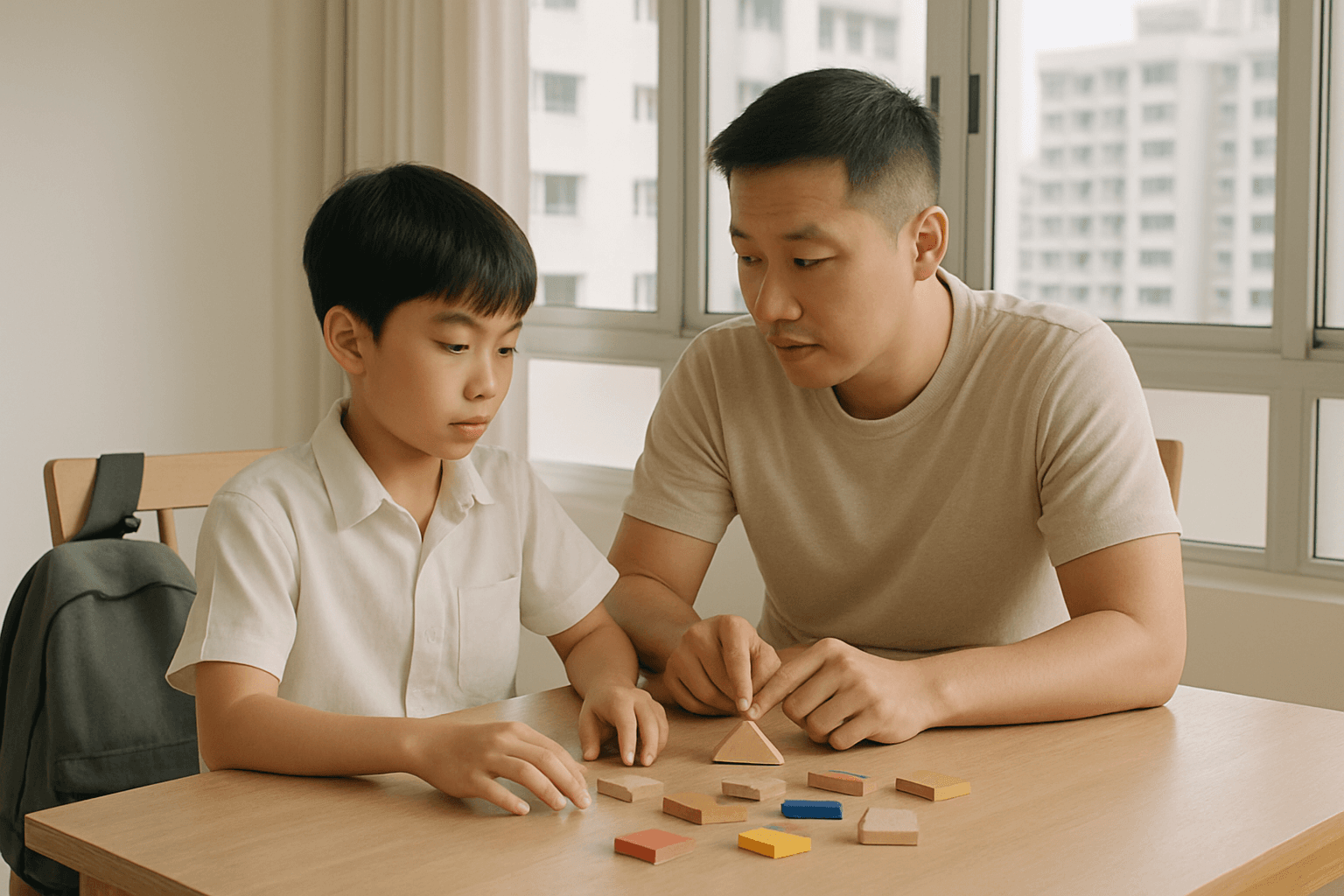
Yes, Olympiad training can help with GEP in Singapore, but only indirectly. It may build persistence, pattern recognition, and comfort with difficult questions, yet it is not a requirement and should not be treated as a reliable route into selection. A better parent question is this: does this class help my child think better and enjoy challenge, or is it mainly adding pressure?
Short answer: does Olympiad training help with GEP?
Yes, but only indirectly. Olympiad training can build useful thinking habits, but it is not a shortcut, a requirement, or a reliable predictor of GEP selection.
Yes, but only indirectly. Olympiad training can help some children become more comfortable with unfamiliar questions, multi-step reasoning, and the frustration of not seeing an answer immediately. Those habits can overlap with the kind of thinking many parents associate with GEP readiness.
What Olympiad training does not do is create a clean shortcut into GEP selection. A child may become strong at coached question styles without showing the broader flexibility, comprehension, and learning responsiveness that gifted education is meant to support. Just as importantly, a child with no Olympiad background is not automatically behind. Some children show strong reasoning and reading ability without ever attending a contest class.
The simplest parent test is this: if you removed the word “GEP” from the decision, would this class still make sense for your child? If the answer is no, that is a useful warning sign. Enrichment that only makes sense as a gamble is usually not the best starting point. For a broader overview, see Gifted Education Programme (GEP) in Singapore: A Parent's Guide.
All About GEP
I think Olympiad math training is sufficient. My son attended the Math Kangaroo Competition training at \"The Math Classroom\" and it did help him get through the first round of the GEP test.
GEP Preparatory Program
No preparation is required. The child must in the first place enjoys solving Math questions, then he/she will be able to benefit from the program. If just want to get into GEP by going for many preparation classes, but the child does not like to do challenging questions, he/she will not enjoy the process.
What is GEP in Singapore, in plain parent language?
GEP is MOE’s programme for intellectually gifted primary pupils. It is designed to meet stronger learning needs through enriched learning, not simply move children through mainstream work faster.
MOE describes the Gifted Education Programme as a programme for intellectually gifted students. On its GEP overview page, MOE says pupils are identified through a Primary 3 selection exercise, with selected pupils entering the programme in Primary 4. MOE also explains that the curriculum follows an enrichment model, not simple acceleration.
That distinction matters for parents. GEP is not just faster work or more worksheets. It is meant to offer more depth, more complexity, more inquiry, and more independence. A child who fits GEP is not always the child who finishes normal work fastest. Often it is the child who sees patterns quickly, asks unusual questions, or wants to keep exploring an idea after the basic answer is done.
It also helps to see GEP in context. Singapore is broadening support for higher-ability learners across schools, so GEP is one pathway within a wider landscape, not the only route to challenge. If you want the full overview first, start with our Gifted Education Programme (GEP) in Singapore: A Parent's Guide.
Insight line: GEP is for children who need different learning conditions, not just harder worksheets. For a broader overview, see GEP Selection Process in Singapore: Stage 1 and Stage 2 Explained.
GEP Preparatory Program
Good morning Angelight, Gifted Education Programme (GEP) is not a PSLE preparatory program. As stated in MOE’s website that Ministry has recognized that children have varying abilities, it’s not a sound practice to give every child the same education and to expect him/her to move at the same pace as his/her peers. Those intellectually gifted children need high degree of mental stimulation. Normally, intellectually gifted children are very inquisitive, fast learners and with very high level of re
All About GEP
Hi folks, I was browsing reddit, and came across this today: https://www.reddit.com/r/singapore/comments/qlplx5/getting_into_a_primary_school/?sort=confidence On reddit, several students who went through GEP said that they were \"trained\" by enrichment for GEP, and they got in. However, once they were in the GEP programme, they struggled to stay on par with their really gifted peers, who just breezed through difficult tests. Can any parent who went through this with their children or similar, h
Have More Questions?
Get personalized guidance on schools, tuition, enrichment and education pathways with AskVaiser.
Try AskVaiser for Free →What does GEP selection actually assess?
GEP selection is meant to identify broader reasoning and learning potential, not just coached content or test tricks.
At a practical level, GEP selection is meant to look beyond coached content knowledge. Parents often focus on advanced worksheets and mock papers, but the bigger question is how a child thinks when a task is new, slightly strange, or not obviously solvable by one memorised method. That usually points to reasoning, comprehension, pattern recognition, and the ability to keep working when the answer is not immediate.
Older descriptions of the exercise often refer to an initial English and Maths screening, followed by a later round for shortlisted pupils that includes broader general ability components as well. That background is useful, but parents should treat it as context rather than a fixed script for every cohort, especially as the broader higher-ability landscape is changing. If you want the historical process explained carefully, our guide to the GEP selection process in Singapore gives the fuller picture.
The most common misunderstanding is this: parents assume that seeing more advanced content automatically means better preparation. Often the more important difference is transfer. One child may solve a problem only because it looks familiar from tuition. Another may never have seen it before but can still break it down logically. GEP-style selection is generally closer to the second case. For a broader overview, see GEP vs High Ability Programme in Singapore: What’s the Difference?.
All About GEP
Parents that pay thousands of dollars to try to get their children into GEP: Yes, GEP is a coveted programme. Yes, GEP allows your dd/ds to be able to have a higher chance of getting into an IP school. But bear in mind that the programme is immensely challenging. Your child will have to juggle tonnes of projects and lots of HW and at the same time prepare for the all-important PSLE. And if you PUSH for your child to get into GEP by loads of tuition classes, ask yourself: Will he/she be cope? Wil
All About GEP
The GEP selection round include English, Maths and General Ability. Maths alone is not sufficient. NHPS last year only 11 selected for GEP. The Maths teacher did not teach them Maths Olympiad either. They get vendor to conduct Maths Olympiad from P3 to P6 to anyone who is interested. Many top scorers who are hardworking type in the P3 HA class did not get selected, though, and are now in their twining class. They attend Social Studies, HCL and others except Maths/eng/Science with the GEP pupils.
Where Olympiad training overlaps with GEP readiness
Olympiad work overlaps with GEP readiness mainly in reasoning-heavy habits such as persistence, pattern spotting, and comfort with unfamiliar problems.
The overlap is real, but narrower than many parents assume. Good Olympiad training often develops persistence, pattern spotting, and comfort with questions that cannot be solved by routine school methods. A child may learn to hold several ideas in mind, test different approaches, and explain why one path works better than another. Those are useful habits in any advanced learning setting.
In real life, this can look quite ordinary. A child who used to give up after two minutes may now stay with a hard maths puzzle and try a drawing, a table, and a simpler version of the problem before asking for help. Another child may become better at explaining each step clearly instead of saying only, “I know the answer.” A third may grow more comfortable with getting the first attempt wrong and revising it.
This is why some parents feel Olympiad classes helped. Sometimes they did help, but by strengthening thinking habits rather than by training directly for GEP. The benefit is strongest when the class teaches reasoning, discussion, and multiple methods. It is much weaker when the class mainly rewards speed and memorised tricks.
Insight line: useful overlap in habits is not the same as direct selection advantage. For a broader overview, see How Do I Know If GEP Is a Good Fit for My Child?.
All About GEP
My son is in P3 and his school will be conducting Maths Olympiad later this month, just 2 weeks before the GEP Screening Test. According to him, only better Maths students are selected to sit for this programme while the weaker ones will sit for another Maths programme (can't remember what's the name). Any idea what is this Maths Olympiad programme is about and will it help them for their GEP test?
How to prepare child for next week's Selection Test GEP ?
For GEP preparation i think the best is to -for math practice i recommend math Olympiad questions. for english , i would recommend the kids to read widely gep quite hard to get in . really nid a lot of preparation…sigh
Where Olympiad training does not help much
Olympiad success may show strength in a contest setting, but it does not automatically translate into GEP readiness or selection advantage.
Olympiad training does not replace broad reading, verbal reasoning, or flexible learning. Contest coaching can make a child faster on familiar problem types, but GEP is not a medal count. A child may perform well in Olympiad settings and still not show the broader profile that gifted education is trying to identify.
The reverse is also true. A child with no Olympiad background is not automatically less suitable for GEP. Some children are naturally strong reasoners, readers, or abstract thinkers without ever attending a competition class. Prestige is not a profile.
How to prepare child for next week's Selection Test GEP ?
I don't think parents should prepare the kids for GEP. GEP programme is very tough and if the child is prepared just to get into GEP, they may eventually suffer and not be able to cope with the syllabus.
All About GEP
Those who are not naturally gifted and somehow get into GEP through extensive training will suffer doing the GEP syllabus. My child was in GEP and from what I saw of her classmates, the ones who entered via GEP prep courses struggled throughout their three years and were always bottom of the cohort. These were also the ones who weren’t offered DSA. And while they did well at the PSLE compared to mainstream students, they were still the bottom few among the GEP students. So really, what’s the poi
GEP vs High Ability Programme: what parents commonly mix up
They are related, but not the same. GEP is the more selective primary gifted pathway, while newer higher-ability support is broader and school-based.
Parents often use GEP, HAP, and Olympiad enrichment as if they are interchangeable. They are not. GEP has been the more selective primary gifted pathway, while the newer direction in Singapore is to broaden support for higher-ability learners across schools. In its August 2024 press release, MOE said that pupils can be identified at multiple junctures from Primary 3 to Primary 6, with school-based programmes and after-school modules. Coverage from Channel NewsAsia also helps parents see the bigger shift: challenge and stretch are no longer tied only to one old pathway.
Why does this matter for Olympiad decisions? Because some families are chasing a label when what they really want is more challenge, better fit, or richer learning in a mainstream school. If that is the actual goal, contest training may be one option, but it is not the only one and often not the best first one.
A better parent question is this: are you looking for a selective gifted programme, broader school-based support, or simply richer enrichment outside school? If you want the distinction unpacked more fully, read GEP vs High Ability Programme in Singapore: What’s the Difference? and Why Singapore Is Moving from GEP to HAP.
GEP and IQ
To me GEP is about if you have it, you nurture it. There is a certain advantage in putting a child in GEP, if she has what it takes. First, you have more resources in the education system dedicated to educating the child. Second, the academic road is somehow smoother. The GEP label helps somehow. I once asked one of my GEP students to ask her teacher how GEPPers do traditionally in PSLE. She came back with the report that they have had people who got B in PSLE math so far. While most do get A*,
GEP Preparatory Program
Having checked with parent chatgroups, here is my humble assessment of the TOP 3 GEP Preparatory Program specialists . EduCHAMPS academy https://www.theeduchamps.com/gep-preparation-class-2/ • 2 branches – Novena and Katong. • 6 to 10 students per class • Known for following a patented Advanced Brain Training and 5 ‘A’s Method to bring out the full intellectual potential in students • 100% passed the GEP Screening test (1st round). 68% passed the GEP Selection test (2nd round) and got into the P
How GEP compares with mainstream primary school, and what happens after Primary 6
GEP usually offers more depth, more open-ended learning, and more independence than mainstream, but it is a different fit, not a universal upgrade.
Compared with mainstream primary school, GEP usually means more depth, more open-ended tasks, and more independent thinking. Because MOE frames GEP as enrichment rather than acceleration, the difference is not just pace. It is also the kind of work students do. Parents often notice richer discussion, more inquiry-based tasks, and classmates who are comfortable moving quickly through ideas.
That does not make GEP automatically better. Some children thrive in mainstream school because they already have enough room to explore through strong teachers, school opportunities, outside reading, and manageable enrichment. Others are bright but do not enjoy the intensity, independence, or social feel of a more selective setting. If your child is happy, curious, and still growing in mainstream, that is not a problem that must be fixed. Our guides on GEP vs Mainstream Primary School, Is GEP Better Than Mainstream Primary School?, and What Is the GEP Workload Like? can help you think through that tradeoff.
Parents should also remember that there is no simple “GEP forever” pipeline after Primary 6. Children move into different secondary schools and pathways, so the smarter question is whether the fit is right now, not whether the label sounds impressive later. As the system evolves, that long-term label-chasing mindset is becoming even less useful.
Insight line: choose for fit at age nine or ten, not for bragging rights at sixteen.
All About GEP
I read many interesting concerns on the GEP ... Let me share some of my thoughts on these ... Why force your kids to a GEP if she /he is meant for it. Don't believe those crap training centre ..Let nature take it course My daughter is in P6 GEP at RGPS and had just completed her PSLE like all other 50K kids in her cohort. She is now enjoying herself with her fellow P6 GEP at the Sentosa UnderWater World. She was posted to RGPS from CHIJ Pri (Toa Payoh) in 2008. As a child , she was always more s
GEP Preparatory Program
When investing parent’s money and child’s time in prep classes, why go for GEP prep instead of regular mainstream syllabus prep? The child’s education path and “their future” is determine by the performance in the latter and not the formal. Which make a better investment? Some parents may say being selected for GEP enhances a child portfolio. But the academics achievement still matter more than curriculum the child went through. If the child is already very steady in exam results in P1 and P2 an
What kind of child is usually suited to Olympiad training?
Children who enjoy puzzles, challenge, and repeated problem-solving usually benefit most. Children who feel tense under competition pressure often do not.
The children who usually benefit most are the ones who genuinely enjoy difficult puzzles, tolerate frustration reasonably well, and are willing to try several approaches before getting an answer. They often like challenge for its own sake. They may not always be the fastest students in school, but they tend to enjoy patterns, unusual questions, and the satisfaction of finally cracking something hard.
The children who struggle are not necessarily less able. Some simply dislike competition pressure, need more recovery time, or learn better through wider reading and open exploration than through contest-style training. A child who freezes when every worksheet feels like a ranking exercise may gain very little from being pushed into Olympiad class “just in case it helps with GEP.”
A practical parent check is to watch what happens after the novelty wears off. Does your child still talk about the puzzles, ask for extra problems, or proudly explain a clever idea at dinner? Or do they drag themselves to class and only continue because they know you care about the result? That difference often tells you more than the class brand name. If you are unsure what you are seeing, our article on Is My Child Gifted or Just Advanced? can help frame it more clearly.
All About GEP
Hi Mei Ling, could you share with us the reasons why you feel your son need to be trained for GEP?
All About GEP
Sigh. There are lots of \"GEP preparatory courses\" out there but they are merely preying on the parents' inherently yearning that their kids are out to do \"big\" things. We regularly monitor these threads to ban anyone that tries to promote such services. Such courses are bad because they may actually cause the GEP team to upscale their questions to really find truly gifted children! If your child is really gifted, her natural curiosities and talents should stand out clearly. There should be n
How can I support GEP readiness without over-coaching?
Build thinking habits, not just test habits. The goal is curiosity, flexibility, and healthy challenge, not a home coaching centre.
The best support is usually broader and calmer than parents expect. Read widely with your child, including stories, non-fiction, and materials slightly above their comfort zone. Ask open questions such as “How do you know?”, “What else could be true?”, or “Can you think of another way to solve it?” Let your child explain their reasoning aloud, even when the answer is wrong. That often builds more than rushing straight to the correct method.
At home, helpful practice does not need to look like formal prep. Logic games, puzzle books, estimation, wordplay, and everyday conversations about patterns or causes can build flexible thinking without turning the house into a coaching centre. If your child enjoys Olympiad work, keep it as one part of a balanced week rather than the centre of family life. Sleep, play, and emotional bandwidth still matter. A bright child who is constantly tired or tense is not being well prepared.
Parents also commonly overdo three things: too many classes too early, too much emphasis on hard worksheets, and too much adult ambition disguised as preparation. Train thinking, not just technique. And if the current load is already making your child resent learning, reducing one class is often the more mature decision, not the less ambitious one. If you are deciding whether GEP itself is the right fit, How Do I Know If GEP Is a Good Fit for My Child? is a useful next read.
All About GEP
Extract from The Sunday Times 3 June 2012 Should you prepare for the GEP test? But is preparing for the GEP test necessary or beneficial to the child? The Education Ministry, schools and experts say no. A ministry spokesman advised parents against sending their children for special preparatory classes. 'A child who gains admission into the GEP through intensive coaching may not be able to cope with the programme's demands, and this could cause the child unnecessary stress and could lead to loss
All About GEP
Hi Atan, First and foremost, you need to understand what the gep programme involves. If, after you have found this out, you think your child is cut out for it, can benefit from it and will thrive in it, you can next ask yourself whether you want to leave it to effectiveness of the testing or \"help\" your child along in getting selected. Having said this, please remember that we live in an imperfect world where testing is not 100% accurate. If you do not know what the programme entails, my sugge
Have More Questions?
Get personalized guidance on schools, tuition, enrichment and education pathways with AskVaiser.
Try AskVaiser for Free →