
Does Primary School Prestige Matter in Singapore for PSLE?
What a popular school can help with, what it cannot guarantee, and how parents should judge fit over brand.
Primary school prestige in Singapore matters mainly as an environment factor, not as a guaranteed pathway to better PSLE or secondary school outcomes. For most families, the bigger drivers are child fit, manageable routines, home support, and whether the school helps the child learn steadily over time.
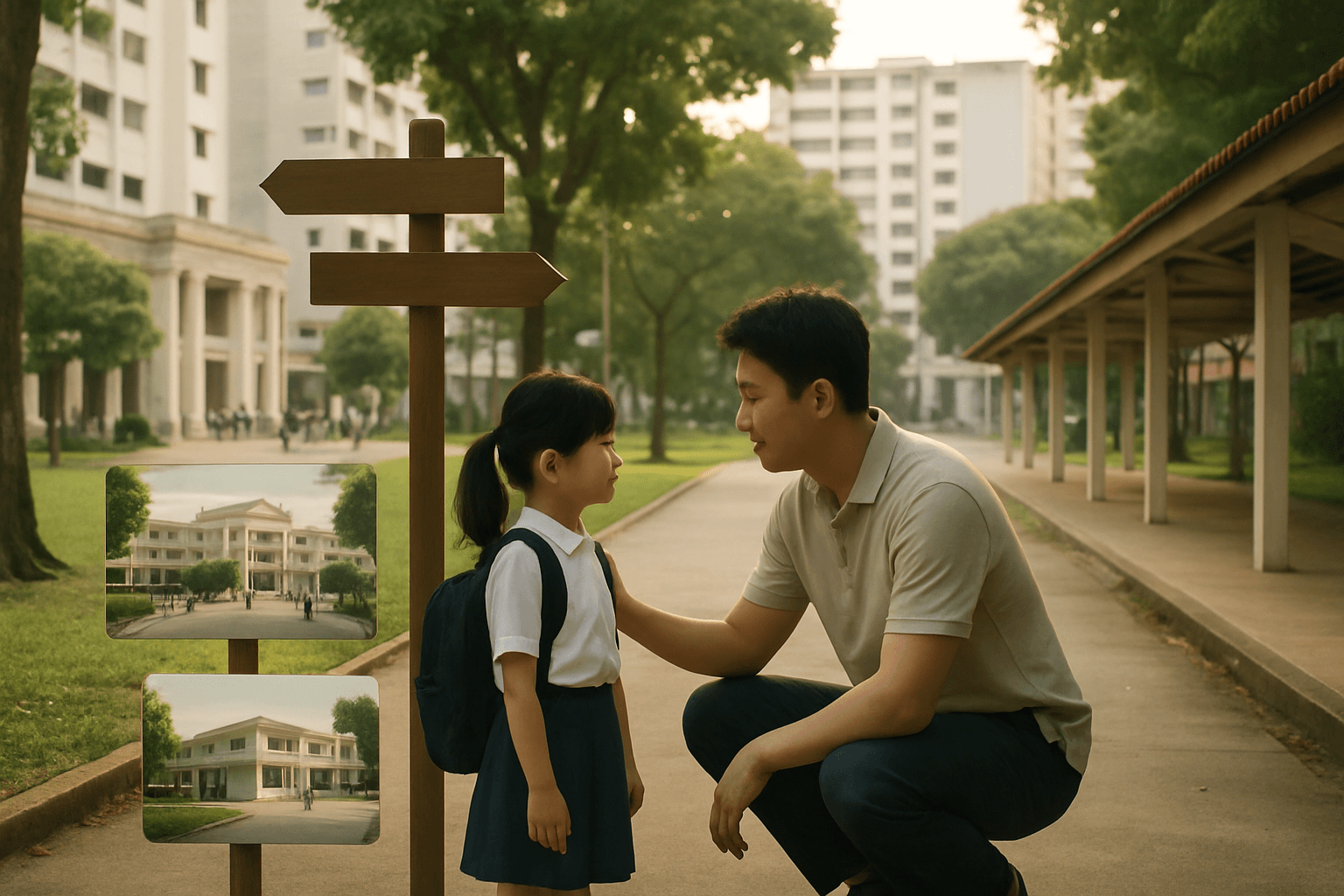
Short answer: yes, primary school prestige can matter in Singapore, but mostly through environment, not by automatically producing better results.
A well-known school may offer strong peers, clearer routines, visible programmes, or a more active parent network. Those things can help. But they only help when the school suits the child and the family can sustain the daily routine. Over six years, PSLE outcomes are usually shaped more by fit, sleep, commute, confidence, and consistent support than by the brand on the uniform.
A useful way to think about it is this: school name can be an advantage, but it is not a substitute for child-school fit.
Short answer: does primary school prestige matter for PSLE in Singapore?
Yes, but mostly through peer environment, culture, and opportunities. It does not by itself guarantee stronger PSLE results.
Yes, but only indirectly. A prestigious or popular primary school can shape the environment around your child, but it does not guarantee better PSLE results or stronger long-term outcomes.
What prestige may change is the context. A school may have a motivated cohort, clearer routines, active parents, or visible programmes. Those can be useful advantages. But they only become real advantages if your child responds well to that environment. One child may feel stretched in a healthy way. Another may feel tired, anxious, or constantly behind.
That is why two children in the same school can have very different outcomes. The child with enough sleep, a manageable commute, steady home support, and confidence often does better than the child who is overwhelmed by pace or logistics. School name can amplify what is already working. It rarely fixes a poor fit.
The practical takeaway is simple: treat prestige as a possible environment boost, not as a result by itself. For a broader overview, see Primary 1 Registration in Singapore: How It Works, Balloting Risk, and How to Choose a Realistic School Plan.
Importance of PSLE
Here are just my two-cents worth: Why is PSLE so important? It assess how much you have learnt over the six years in primary school and then allocates you to a secondary school according to your abilities and/or choice. What is the significance of it? Well, employers of Singapore-based companies are particularly focussed on PSLE, GCE ‘O’ and ‘A’ levels score for recruitment, so a high PSLE T-score could get you a better job next time. What is PSLE all about? (see first question) Why ppl so kanch
Is PSLE so important?
PSLE are only the first major exam Singapore students take. What you can achieve later in life has very little to do with PSLE. Take me for example, I was a marginal case in PSLE (during my primary school days, there were no PSLE scores, we were told pass or fail). I made it to ACS (There was only one ACS in those days). I was placed in the middle of the cohort. (The top student went to “A” class while i was in “H” class). I failed several subjects in my first semester (oops!!). Subsequently, I
What do parents usually mean by a "prestigious" or "popular" primary school?
In practice, prestige usually means some mix of brand name, registration demand, reputation, alumni pull, or parent network. Parents should not assume those all mean the same thing.
Parents often use "prestige" as shorthand for several different things at once. They may mean a famous school name, very high Primary 1 demand, a strong academic reputation, an active alumni base, an affiliated pathway, or a parent community that is especially involved.
Those are related, but they are not the same. A school can be highly sought after because of location or alumni demand, not because it is the best learning fit for every child. Another school may have a long-standing reputation, but the day-to-day experience still depends on the cohort, teachers, class dynamics, and how the child responds to the school culture.
Lists of heavily searched schools, such as this KiasuParents roundup, are useful for understanding demand. They are not proof that one school is better for every child.
A useful reset for parents is this: popularity is a signal of demand, not a verdict on fit. For a broader overview, see Popular Primary School vs Neighbourhood School in Singapore: Which Is Better for Your Child?.
Importance of PSLE
Having a DD who completed her PSLE last year, now I realise why the fuss over this first national exam taken by school going kids. My DD, together with her 2 cousins, took their PSLE last year and the 3 of them got very different results. DD and another cousin, who were ranked higher in terms of PSLE t-score, were given their first choice secondary schools which are quite popular in Singapore. The remaining cousin, though still qualified for Express stream, was posted her 4th choice school. On R
Importance of PSLE
Hi, In such cases, is a Normal academic route in a more popular secondary school, a much better choice than an Express stream in a neighbourhood school? Oops...just read this...Thanks. :oops:
Have More Questions?
Get personalized guidance on schools, tuition, enrichment and education pathways with AskVaiser.
Try AskVaiser for Free →What can a popular primary school actually offer?
Popular schools may offer stronger peer effects, structure, parent networks, and attractive programmes. These are genuine strengths, but only if your child is likely to thrive there.
A popular school can offer real advantages, and parents should not dismiss them. Some schools have a very structured culture, clear expectations, and a strong sense of routine. Some have active parent or alumni communities. Some may offer programmes, CCAs, or school experiences that families find attractive. In certain cohorts, your child may also be surrounded by classmates who already have stronger reading, language, or numeracy foundations.
For some children, that environment is energising. A child who likes challenge may rise to stronger peer norms. A child who responds well to structure may settle quickly in a school with clear systems and expectations. Families with stable routines at home may also be better able to make full use of what the school offers.
But every advantage has a trade-off. Strong peers can motivate, but they can also create constant comparison. A faster class pace can stretch a ready child, but it can also leave another child feeling behind by Primary 2 or 3. More visible opportunities sound good, but they matter only if the child has the interest and bandwidth to benefit from them.
The better way to read school prestige is this: it can offer a stronger environment for some children, not a universal advantage for all children. For a broader overview, see Primary 1 Registration: Should You Pick a Popular Dream School or a Safer Nearby School?.
Is PSLE so important?
Despite whatever the ministers can tell us, PSLE is important because it is one of the key stepping stones in the long journey towards a university education. Only http://www.moe.gov.sg/feedback/2011/committee-on-university-education-pathways-beyond-2015/singapore-university-landscape/ will get a place in the local universities. To be part of this minority, students must demonstrate consistent performance to get to a good secondary school which can maximise their chance of making it to and past
Is PSLE really needed in Singapore?
If children have to continue in the same primary school, it will likely increase the pressure on the parents to ensure that the children are admitted into specific schools. PSLE is also necessary to sieve out children who may not be academically inclinded so that they may be given an opportunity at something else.
Do not confuse school brand with better teaching or guaranteed pathways
Brand name is not the same as consistently better teaching, and not every popular primary school offers an affiliated secondary route.
A well-known school is not automatically a better-teaching school. Teacher quality can vary across schools, levels, and years, so parents should be careful about assuming that a branded school always teaches better. The same goes for future pathways. Some primary schools have affiliated secondary routes, but that is a specific school feature, not a general benefit of popularity. If affiliation matters to your decision, verify that feature directly instead of assuming the school name covers it. For a broader overview, see How to Read Past Balloting Data Before Chasing a Popular Primary School.
Importance of PSLE
Good thing the parents managed to find another school for the kid. Yes, the teenage years are very important, as friends they make at this age are ones they keep for a long time.
Is PSLE really needed in Singapore?
:goodpost: I don't subscribe to the \"escalator theory\" and I agree with your theory! Just for the sake of discussion and to get the parents thinking, if we switch all the students from a \"branded\" school to another non-branded school, which group of students will perform better at O/A level, and have higher university entry rate? Like you, I am not saying good teachers don't matter. But I think the difference between teachers and facilities in branded and non-branded schools are not that muc
Why school brand does not automatically lead to better PSLE results
A popular school's results may reflect cohort profile and family support as much as school brand. PSLE still depends mainly on the child's habits, support, and ability to cope with the environment.
PSLE performance builds over years, and school name is only one small part of that picture. When a popular school's results look strong, part of that may reflect the profile of the cohort going in. Some students may already have stronger preschool exposure, home reading habits, or outside academic support before Primary 1 even starts. That does not mean the school brand itself caused the result.
What usually matters more is whether the child can keep up with the school's pace and stay steady over time. For example, a child with a long commute may lose sleep, arrive tired, and have less energy for homework. Another child in a less famous school may have a shorter day, more regular routines, and enough mental space to revise consistently. Over six years, that can matter more than reputation.
This is where many parents overestimate school name. They assume the school will somehow pull the child upward. In reality, the environment helps only when the child can use it well. PSLE outcomes are cumulative. Sleep, feedback, confidence, regular practice, and manageable stress usually matter more than the badge on the uniform.
That broader emphasis on student growth over school labels also fits MOE's public messaging about looking beyond narrow status signals, as seen in Minister Chan Chun Sing's FY2023 Committee of Supply response.
Importance of PSLE
Getting back to the main issue started by ppnqq WHY is PSLE so important? A good PSLE score opens doors to a good schools ( dream schools, schools of choice) What is the significance of it? A good school leads often to better environment and learning leading to hopefully better prospects in life. What is PSLE all about? It is about insense pressure felt from schools and peers by both the child and parents. :scared: It is about worying that child too sensitive abt results or about child doesnt ca
All About Preparing For PSLE
do not allow the child to be burnt out by SA/prelim exam results...most schools set killer papers. remember the BIG picture which is PSLE. ्
What matters more than prestige for PSLE performance?
Child fit, sleep, commute, confidence, and steady support at home usually matter more for PSLE than school reputation alone.
For most families, the main drivers of PSLE performance are more ordinary and more controllable than school branding. They include whether your child gets enough sleep, whether the commute is sustainable, whether the school's pace matches your child's readiness, and whether your family can maintain a steady homework and revision routine over six years.
Child fit matters more than many parents expect. A child who likes fast pace and competition may benefit from a demanding environment. Another child may learn better in a calmer school where they feel comfortable asking questions and building foundations properly. If your child is still strengthening literacy, numeracy, organisation, or confidence, the better school may be the one that allows steady progress rather than constant catching up.
Home support matters too, but not in a dramatic way. It can be simple and practical: reading regularly, checking whether homework is understood, noticing weak areas early, and protecting sleep and after-school routine. Small habits done consistently matter more than a famous school name.
If you are comparing options, our Primary 1 Registration in Singapore guide and this breakdown of popular primary school versus neighbourhood school can help you assess fit more realistically.
A useful rule for parents: a school that fits your child well often beats a school that looks impressive on paper.
All About Preparing For PSLE
The PSLE results are based on the T-score and not the Raw Score. So weightage of subject is a consideration, but the relativity of how a child performs compared to others is probably more important. The child’s final PSLE score is calculated by reference to how he or she performs relative to his/her peers, and the standard deviation or spread of marks around the average mark of the cohort. So the final psle score aims to show how the pupil stands relative to his or her peers. So where you are in
Is PSLE so important?
Down the road, does the potential employer care whether interviewee ever scored 4A*s ? Some ministers may not even be top PSLE scorers, but through sheer hard work, they did well to become what they are today. It is a wise move not to name top scorers. PSLE is needed and is here to stay. Kids who did not do well will feel inferior when there is so much fanfare given to top student like what Louis mentioned. We should be sensitive to the feelings of those kids.
Will a non-brand primary school hurt secondary school chances?
No. A non-brand primary school does not usually hurt secondary school chances because placement depends mainly on PSLE performance and school choice, not primary school prestige.
Usually, no. Secondary school placement is driven mainly by the child's PSLE performance and the choices made after that, not by whether the primary school has a famous name.
This is one of the biggest parent fears, and it is often overstated. A child from a lower-profile or neighbourhood primary school can still move on to a strong secondary school if their PSLE results support those options. The primary school label is not the main sorting tool. In practical terms, a child from a non-brand school who scores within the right range can still access the same secondary options as other students.
The main nuance is affiliation. Some primary schools have affiliated secondary pathways, but this is school-specific and should not be confused with prestige in general. If that feature matters to your family, verify it as a separate consideration rather than assuming every popular school has it.
When you later evaluate secondary schools, fit continues to matter too. This KiasuParents piece on choosing secondary schools beyond grades is a useful reminder that school choice after PSLE should not be reduced to branding alone either.
Is PSLE really needed in Singapore?
http://www.todayonline.com/Hotnews/EDC120927-0000144/PSLE-is-needed-in-Singapore--PM-Lee Not a new question actually! But when I read the article about PSLE on Today and saw PM Lee's saying, I really disagree with it. He said \"There are many points in life where you have to prove yourself and demonstrate what you can do. You don't have to get into the right school and thereafter think that you are on an escalator ... So really it's your own ability and effort you have put in, the dedication of
Is PSLE so important?
And just when I'm getting into the mood of school hols, reading this makes me :nailbite: :nosebleed:
When might primary school prestige matter more than parents expect?
Prestige tends to matter more when the child is ready for a faster or more competitive environment and the family can support the routine that comes with it.
Prestige can matter more when the child is already ready for that environment. A child with solid foundations, good independence, and a temperament that responds well to strong peers may genuinely benefit from a high-demand school culture. The same can be true for children who enjoy challenge, like structure, and are not easily discouraged by comparison.
Family capacity matters just as much. A more demanding school setup may involve earlier mornings, longer travel, busier schedules, or more pressure to stay organised. If the household can support that routine calmly and consistently, the school environment may become a useful multiplier rather than a daily strain.
A realistic example is a child who is self-directed, enjoys competition, and has parents who can maintain routines without turning every school day into a battle. In that case, a stronger peer environment may sharpen habits and motivation. But if either the child or the family cannot sustain the pace, the same environment may create friction instead of growth.
A simple way to judge this is to ask: will this school stretch my child productively, or exhaust my child early?
Preschools prepared your kids well for Singapore primary?
For parents who have already been through the pre-school days and with kids now in primary schools (Singapore schools), can you share your comments on your kid's previous preschool and their curriculum - specifically if they have prepared your child properly for the Singapore education system ? (not discussing the international or foreign schools system here) Nowadays, there are so many pre-schools and childcare centres with many learning methods. Parents currently at the pre-school stage will b
Is PSLE so important?
Thanks, Wonderm. After reading the link you posted, I found another reader's letter from the same newspaper forum. Would like to share it here. Managing expectations is the real challenge IT IS understandable that parents are anxious about their children not securing places in brand-name schools, and put excessive pressure on them during Primary School Leaving Examination preparations (\"PSLE not the be-all and end-all: PM\"; last Saturday). It is also not uncommon to read that Singapore has an
When is a less prestigious school the better choice?
A less prestigious school can be the better choice when it gives your child shorter travel, steadier confidence, lower stress, and a routine your family can sustain.
A lower-profile school may be the better choice when it supports steadier learning and a healthier day-to-day routine. This is often true for children who are easily overwhelmed, need more time to build confidence, or simply function much better with a shorter commute and a more predictable day.
For example, one child may spend so much energy on travel that little is left for homework or revision after school. Another may be academically capable but emotionally sensitive, so constant comparison quietly erodes confidence. A third may still be strengthening reading or maths basics and benefit from a setting where they feel safe asking questions and making mistakes.
Less prestigious does not mean less effective. Sometimes the better school is the one that leaves enough energy for sleep, after-school revision, and a calmer family routine. Over six years, that kind of stability can produce stronger real-world outcomes than a more famous school that creates daily stress.
If you are balancing ambition against practicality, this guide on whether to pick a popular dream school or a safer nearby school is a useful next step. It also helps to remember the point highlighted in Today's reporting on what parents value in a good school: growth and wellbeing are part of the outcome too.
Importance of PSLE
The PSLE is the \"new O levels\", where the top 5% to 10% of students in the PSLE go on to do the Integrated Program which provides an almost assured chance to get into the affiliated top Junior Colleges. That's why PSLE is so important. Miss this important PSLE opportunity, the O levels taking student subsequently needs to get 2 pt to 3pt for L1R5 (6 subjects) in order to get to the top Junior Colleges.
Is PSLE so important?
Yes. Once they go on to secondary school, PSLE results don't matter. Since we have kids in the same age group, I had to go through what you are going through. Infact my mother commented last year that I am partial to my elder daughter. But today, I spend most of my time outside my office hours with my younger kid. Just remember to give your son an assurance on the day of PSLE results that his parents will always be there to support him irrespective of how the results are. I saw many parents with
How should Singapore parents choose a primary school without overvaluing brand?
Choose by fit, routine, support, and practicality first. Treat prestige as a secondary factor, not the main filter.
- ✓Start with daily life, not school name. Ask whether your child can handle the commute without losing sleep, mood, or homework energy.
- ✓Judge fit honestly. A child who likes challenge may do well in a high-pressure environment, while another may learn better in a calmer one.
- ✓Look at current support needs. If your child still needs help with reading, writing, numeracy, organisation, or confidence, prioritise the school environment that can support steady growth.
- ✓Think in six-year terms. A school only works if your family can sustain mornings, transport, homework, and after-school logistics over time.
- ✓Assess peer environment carefully. Strong peers can motivate, but they can also create stress if your child is easily discouraged by comparison.
- ✓Check whether the school's visible opportunities are actually relevant to your child instead of assuming every programme matters.
- ✓Treat prestige as a tie-breaker after fit, routine, and support needs are clear.
- ✓If the school is popular, review admission risk realistically through our guide on [how to read past balloting data](/blog/how-to-read-past-balloting-data-before-chasing-a-popular-primary-school) and the full [Primary 1 registration guide](/primary-1-registration-singapore-guide).
- ✓Keep the simplest rule in mind: the better school is often the one your child can attend consistently, confidently, and sustainably for six years.
Have More Questions?
Get personalized guidance on schools, tuition, enrichment and education pathways with AskVaiser.
Try AskVaiser for Free →