
How Parents Should Help with DSA Preparation: Practical Support Without Over-Coaching
Practical DSA parent support for school research, portfolios, interviews, and healthy coaching boundaries.
The right parent role in DSA preparation is to support structure, logistics, and reflection while letting the child own the story. Help with school research, evidence, routines, and calm practice, but do not script answers, ghostwrite reflections, or push a school your child cannot honestly explain.
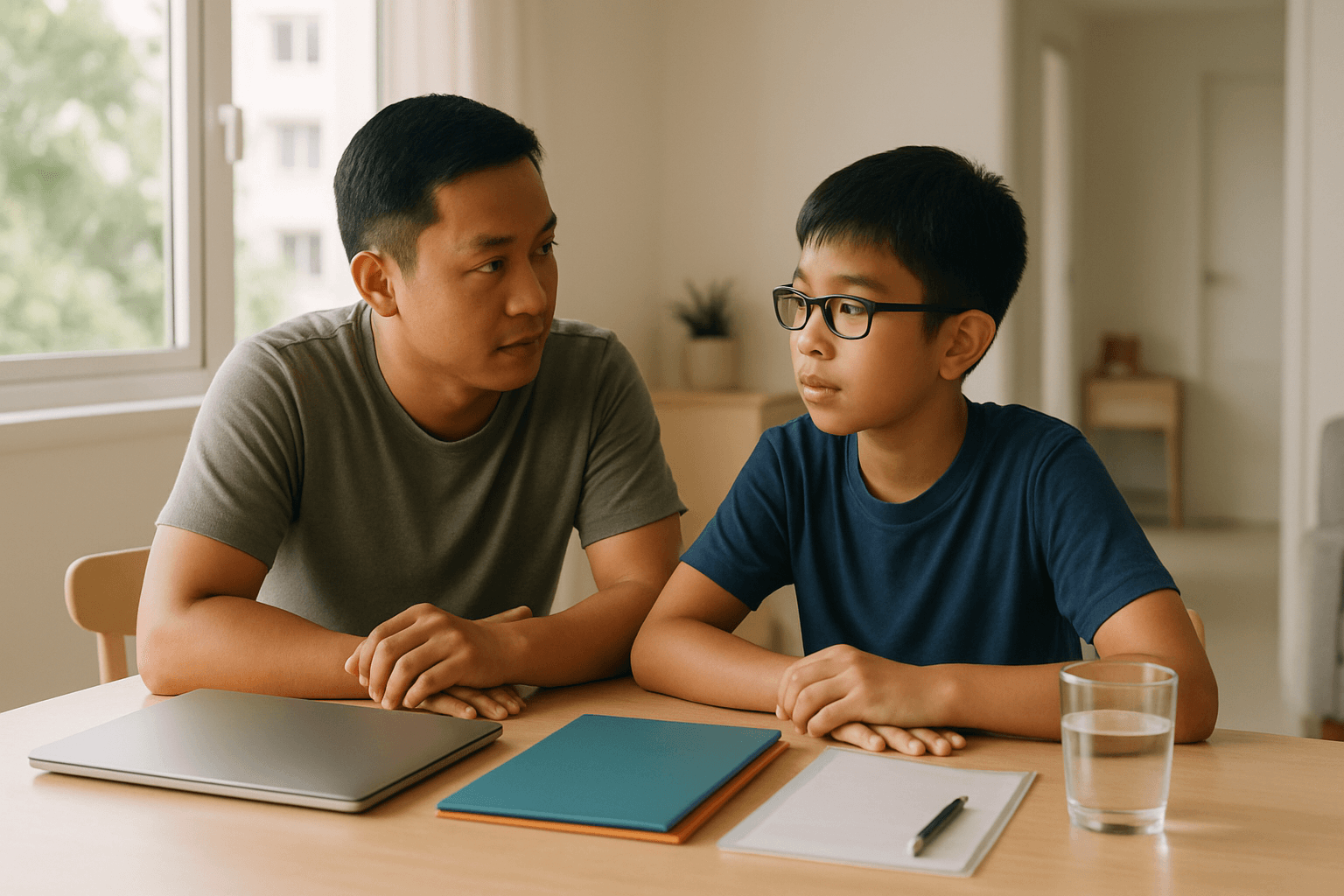
Parents should help with DSA preparation by managing the process, not performing the application. In practical terms, that means helping with school research, deadlines, documents, transport, and light interview practice, while your child explains their own interests, effort, and reasons for applying.
That boundary matters. DSA is meant to assess a student’s interests, aptitude, potential, and suitability, not how polished a parent can make the application. The strongest applications usually sound organised and genuine, not overly rehearsed.
What is the right role for parents in DSA preparation?
Parents should handle structure and logistics, while the child should own the reasons, examples, and voice behind the application.
The right role is to support the process without taking over the application. DSA-Sec gives Primary 6 students a route into certain secondary schools based on interests, aptitude, and potential beyond PSLE results, so schools are trying to understand the child, not the parent. Your job is to provide structure. Your child’s job is to provide the substance.
In practice, parents can shortlist schools, track deadlines, read school websites, prepare documents, arrange transport, and help a child reflect on past experiences. The child should still be able to explain why they enjoy the talent area, what they have learned, and why a school fits them. MOE’s overview of DSA-Sec and its FAQ on school selection factors make clear that schools consider talent area, achievements, personal qualities, and academic suitability. There is no official parent formula for how much polishing is enough.
A simple test helps. If your child cannot answer basic questions such as why they want this school or what they enjoy about the activity without heavy prompting, you are probably carrying too much of the application. Insight line: parents manage the process, children own the story.
If you are still deciding whether DSA is even the right route, start with our guide to Direct School Admission Singapore and then read Is Direct School Admission Worth It For My Child?.
Should DSA be scrapped?
Ykiasu.. What makes you think that DSA does not involve hardwork? Have you or your DS/DD been through DSA before?[/quote]DSA is just a different acceptance into the school. For PSLE, you study hard and you do well in your academic performance. But some pupils may not do well in exams but excel in competitions, Olympiads, Sports, Aesthetics, which DSA provides as a platform to enter the school. Plus, to go through DSA is not an easy process, you have to sort out the necessary certs etc. and prepa
Are STEM DSA preparation programs really useful?
Been hearing quite a bit about STEM DSA preparation programs lately and how some parents managed to get their kids into top schools through the STEM DSA route. These days, many enrichment schools (in3labs, School Of Robotics, Empire Code, Logic Coders etc) offer courses to help students build their DSA portfolios through coding or robotics projects, but I’m wondering if they actually make a real difference compared to learning independently. Would love to hear from parents whose kids have gone t
What should parents help with first?
Help with school fit first: compare the programme, the child’s motivation, and the family’s willingness to commit before doing any heavy preparation.
Start with fit, not preparation drills. Before anyone practises interview answers or tidies a portfolio, parents should read each school’s DSA page carefully and compare the programme with the child’s actual strengths, interest, and willingness to commit. This matters because DSA criteria are school-specific. A school may value sustained participation, another may place more weight on trials or auditions, and another may pay closer attention to personal qualities or academic suitability.
Open houses can be especially useful here because they turn a vague school name into a concrete picture. A better parent question is not just whether the school is popular, but what the training load looks like, how the programme supports students over time, and what kind of student usually thrives there. This open house guide for DSA families is a useful supplementary reference for the kinds of practical questions parents often prepare.
This is also the stage to talk honestly about commitment. A successful DSA admission is not a loose option you can casually compare later. Families should understand early that the DSA route affects the Secondary 1 posting process and should only be pursued if the school is a real fit. If your child is hesitant, only applying because adults want it, or cannot say why the school appeals to them beyond reputation, pause before spending more time on coaching. That is usually a fit issue, not a rehearsal issue. For a broader overview, see Is Direct School Admission Worth It For My Child?.
All about DSA into Junior Colleges
I think at upper secondary, most kids eyeing DSA already know where they want to go…they are checking reddit forums and discuss over there. Or they ask their seniors. And they usually manage the application process on their own (dont think they need parent’s Singpass). But, still welcome to have a discussion thread on KSP for parents who want to support their kids.
Re: DSA 2025
Improving school-based talent programs, collaborating with community centers to provide reasonably priced training, and emphasizing assessments on potential rather than polished abilities are some ways to make DSA more accessible. https://www.straitstimes.com/singapore/direct-school-admission-must-be-accessible-to-all-students-chan-chun-sing bitlife @trulyarise said in Re: DSA 2025 :
Have More Questions?
Get personalized guidance on schools, tuition, enrichment and education pathways with AskVaiser.
Try AskVaiser for Free →How can parents support DSA without over-coaching?
Use open-ended prompts and short practice sessions so your child learns to explain real experiences in their own words.
The best support usually sounds like a calm conversation, not a drill session. Instead of feeding model answers, ask open questions that help your child think clearly. Questions such as what they enjoy most about the activity, what a setback taught them, or why a particular school feels suitable help them build answers they can actually own.
That approach matters because interviews often expose over-coaching very quickly. A Schoolbag article highlights authenticity as a key point, and that is a good parent rule too. If a child sounds memorised, overly formal, or lost when a follow-up question changes the direction slightly, the preparation has probably gone too far.
Short, spaced practice usually works better than long correction-heavy sessions. For example, a ten-minute chat after dinner about one competition, one project, or one difficult training period is often more useful than an hour of mock interviews with constant interruptions. If your child can explain the same experience in simple language to a relative or family friend, that is a stronger sign of readiness than a polished speech. Insight line: confidence grows from clarity, not scripting. For a broader overview, see What Happens During a DSA Interview in Singapore?.
Should DSA be scrapped?
and for those who dsa, they may be the head or leader straight away without testing the others (those who did not dsa) abilities. they can perform and enter more competitions than a student who did not dsa but their abilities are about the same. is it very stressful to dsa? do you think that i should dsa into jc/ poly next time?
Should DSA be scrapped?
My incident happened many years ago. There may well be some guidelines now. There was a charity drive 1 week after competitions which required the children's CCA skills. The CCA hours after exams were set down by the Teacher and 2 parent volunteers. The Principal stepped in to make these more reasonable. No... the contract did not state hours of training. As for academic KPIs, CCA awards are also very important. Schools must deliver holistically on all the measurables. Hence, the school is very
What can parents do to help with portfolios, write-ups, and evidence?
Organise evidence clearly and help with structure, but do not ghostwrite the child’s reflections or pad the portfolio with weak material.
Parents are often most helpful in the organising stage. Younger students may need support gathering certificates, CCA records, competition participation, leadership roles, project photos, or a simple timeline showing how long they have been involved. These are common examples, not official requirements, and schools can differ in what they ask for or what they value.
Where parents need restraint is voice. If a school asks for a write-up, reflection, or personal statement, your child should still be the one explaining what the experience meant, why they stayed committed, or what they learned. You can help them brainstorm, tighten the structure, and remove obvious mistakes, but the final wording should still sound like a capable child. A useful check is this: if an interviewer points to one line in the portfolio, can your child explain it comfortably without looking surprised?
The most common mistake is not having too little, but including too much. Some parents submit everything the child has ever done, even when half the items are weak, old, or unrelated to the talent area. Another mistake is presenting evidence without context, so the portfolio becomes a stack of certificates with no clear story of growth or commitment. A better aim is relevance and coherence. Show what the child has done, how consistently they have done it, and what it says about fit. If you need a broader view of what schools may consider, see What Talents Count for DSA Eligibility?. For a broader overview, see Is a DSA Offer Binding? What Parents Commit To.
🎨 Free eBook: How to Build a Strong DSA Visual Arts Portfolio – A Parent’s Guide from Experience
Hi Everyone I’m a parent who has guided both my daughters through the DSA Visual Arts process over the past few years — one of the most meaningful (and sometimes confusing!) experiences we’ve gone through together. Along the way, I realised that many parents like us often have the same questions: What kind of artworks should go into the portfolio? How do schools really evaluate DSA Visual Arts applicants? How early should we start preparing? So I’ve compiled what I learned into a free eBook — wr
General Observation about DSA
Hi Lizawa, How about selecting just one school which your dd is keen on to try for DSA? The process isn't taxing if it's just for one school. There's no harm trying. Aside from preparing her portfolio and the online application, you really only need to go through a test and interview, depending on the school you apply for.
How should parents prepare a child for interviews or auditions?
Help your child get used to the format and stay calm, but do not chase perfect lines or over-rehearse every possible question.
Prepare for format and steadiness, not perfect wording. For interviews, it is usually enough to practise a small set of likely topics: why the child likes the talent area, why they are interested in the school, what they learned from one setback, and what else they do beyond that main activity. The goal is not a polished script. It is clear, specific answers that sound natural.
For auditions, trials, or practical assessments, parents often help most by getting the basics right. Confirm reporting details, plan transport early, prepare any required attire or materials, and protect sleep the night before. These simple steps reduce preventable stress much more than last-minute coaching in the car.
One common mistake is correcting every answer after every mock round. Another is assuming that more practice always means better performance. Some children improve with a few short rehearsals. Others start sounding flat when they are drilled too much. If your child begins giving the same answer to every question, stop and reset. Ask them to explain the same point differently or use a real example from training, performance, leadership, or school life. For a closer look at this stage, read What Happens During a DSA Interview in Singapore?. This practical DSA interview guide is also a helpful supplementary read. For a broader overview, see How to Build a Backup Secondary School List When Applying for DSA.
Dsa
I think you may have been mistaken. It is not 1 parent for 1 child. The NSG rule states only 1 Legal Guardian / parent of 1 of the student athletes can be appointed as School Adult Representative (Parent) (SAR(P)). Hence, if there are 2 kids who are competing, only 1 of the parents / legal guardian will be appointed by the school (assuming the school doesn't want to send in a teacher representative). Refer to Annex E of the https://nsg.moe.edu.sg/Public/rules_and_regulations/8573/%5BGYMNASTICS .
General Observation about DSA
Hi Lizawa, I would like to share with you my experience. My daughter is not an outstanding student, just above average and has no special sports talent. Inconsistent results during exam too. She just loves to read and does not want any tuition except for MT. However she was very keen to try DSA for a certain institution after the principal went for a talk / presentation. She went for the GAT test and I was extremely surprised when she was offered a place. Now I am a firm believer that doing well
What coaching boundaries should parents keep?
Do not script, compare, pressure, or inflate the child’s story.
Keep four boundaries clear. Do not script answers in your child’s voice. Do not compare them constantly with siblings, classmates, or another family’s so-called successful DSA child. Do not exaggerate weak evidence or dress up ordinary participation as something larger. And do not turn DSA into a family status project.
Over-coaching usually shows itself in obvious ways. The child uses adult phrases they cannot explain, freezes when the interviewer asks a follow-up, or looks tense because they are trying to remember the approved version. Insight line: if your child is performing a script, the school is not meeting the real child.
If your child needs you to supply the reason for applying, the meaning of an achievement, or the lesson from a setback, do not coach harder first. Reassess fit first.
Leadership dsa to Sji Year 5
Hi my daughter will be doing her o levels next year. We are keen to let her try dsa into Sji year 5 She is currently captain for school tennis team. Was also team captain during sec 2 for the team. She is also a senior peer leader in school. Got nominated by teachers and friends to be prefect as well but she decided to choose senior peer leader instead as she preferred the activities and interactions she would have with school mates and also visitors. She actively leads her class in inter class
Dsa
Yes, but if the purpose is to DSA with NSG participation, the parent should just ask the secondary school teacher. And I would advise to be very specific - because if the student pri school doesn't participate in NSG for the sport anyway, there are already limits to what the student can get out of NSG, for example, only participating in individual categories and perhaps only the lower categories which might not be useful in the first place (hence need to ask the secondary school what are they lo
How can parents help a child stay calm and resilient during DSA prep?
Keep routines simple, protect sleep, and lower the emotional temperature so DSA prep feels manageable rather than all-consuming.
The most effective support is usually stability. DSA prep often sits on top of schoolwork, CCA commitments, and, for many Primary 6 students, PSLE pressure. A simple routine helps more than an ambitious one. Keep practice sessions short, avoid adding new tasks every week, and protect sleep before interviews or trials. A tired child can easily come across as less confident than they really are.
Parents also set the emotional tone. If your child is nervous, treat that as normal rather than as a crisis that needs fixing. A calm line such as it is normal to feel nervous, just focus on showing what you usually do is more helpful than repeated checking or last-minute lectures. When children feel watched too closely, they often become more self-conscious, not more prepared.
Two situations come up often. One is the interested child who gets tense before every interview. That child usually benefits from brief rehearsal, predictable routines, and fewer post-practice debriefs. The other is the child who is already stretched by school and CCA. That child may need less DSA practice, not more. Insight line: calm is a preparation strategy, not just a personality trait.
Coping with PSLE for parents
Ruohoo97 Sailing in the same boat as u ... Is there Something I should be doing for DS and i m not doing Something she should not be doing and is doing; is it too much , or too little And cant wait to get over with it. Ok now i have calmed down OK- this is just PSLE - first major milestone not an end in itself What is the worst thing that can happen? She will go to Sec school anyway - may be not a top one. I dont want that to happen, but its still livable. we will get thru this But parents who h
Coping with PSLE for parents
:goodpost: Thanks for sharing and you have highlighted the very important key points for us to learn and take notes. :celebrate:
How should parents talk about expectations and outcomes?
Set expectations around honest effort and fit, not prestige or guaranteed success.
Talk about DSA as one pathway, not the definition of your child’s future. That framing matters because children often hear adult excitement as pressure. A parent may mean this is a good opportunity, but a child may hear this school matters too much to lose. A healthier message is simpler: prepare seriously, present yourself honestly, and remember there are other routes if this one does not work out.
Realism also matters here. DSA is not just about getting an offer. It is about whether the child genuinely suits the school’s programme and is willing to commit if admitted. A successful DSA admission affects the Secondary 1 posting process, so families should think beyond the application itself. If you need a fuller explanation, see How DSA Fits Into the Secondary 1 Posting Process and Is a DSA Offer Binding? What Parents Commit To.
Parents should also be honest about motivation. If your child is half-hearted and repeatedly needs to be pushed to continue, more coaching usually will not solve the deeper problem. In some cases, the wiser move is to scale back DSA effort and focus on PSLE and normal posting instead. Our guide to DSA vs PSLE: Which Route Should Parents Prioritise? can help with that judgment.
Will my son accept the DSA offer?
I know I'm gonna get \"spank\" by people who insisted \"must keep promise once you accepted school's offer\". :spank: However, I have my personal opinion and I believe in choosing in the best interest of the child. To me, accepting a DSA offer is also a form of providing a \"safety net\" for the child (should the results be unexpected). Assume no exceptionally good results, the child will still want to go to this school. If the child is really against going to this school whatever, then should n
How to help P1 children prepare for CA & SA
Dear All Would greatly appreciate it if any parent can share on how they help their kids prepare for the P1 CAs/SAs for the various subjects like English, Maths, Chinese Understand that for English Stellar programme - there is no specific syllabus & different schools use different materials as such there is no specific guideline/assessement books that one can use. Any tips/sharing/recommendations on materials/strategies to use would be most welcomed eg how early in advance should we help them re
What should parents do after submission or interviews?
After submission, stop revising, support the waiting period calmly, and keep the backup plan in view.
Once the application is in, stop tinkering unless a school asks for something else. Many parents keep replaying answers, second-guessing school choices, or wishing they had added one more item to the portfolio. In most cases, that only transfers anxiety to the child. After submission, your role shifts from preparation to emotional containment.
If your child is shortlisted, focus only on the next concrete step. Confirm logistics, do one or two light practice rounds if needed, and then return to normal routines. If your child is not shortlisted or not selected, keep your response steady and factual. A calm response such as you prepared seriously and this was one possible outcome helps more than dramatic consolation, blame, or immediate comparison with other children.
This is also the moment to keep perspective. DSA is only one route into secondary school, and a rejection does not cancel the normal posting pathway. If your family needs a clear next step, read Does a DSA Rejection Affect Normal Posting? and How to Build a Backup Secondary School List When Applying for DSA. The key takeaway is simple: after submission, protect your child’s confidence and focus on the next decision that still matters.
2010 DSA(Direct School Admission)
How are you going to prepare for DSA,what schools are you going to apply for?Write your plans here
2010 DSA(Direct School Admission)
I know enough of DSA (having done 3 times), P4 is definitely not too early to start preparing. I'm dealing with a special needs child (high order autism), so I will need to spend more time, to be fair to him.
Have More Questions?
Get personalized guidance on schools, tuition, enrichment and education pathways with AskVaiser.
Try AskVaiser for Free →