
How to Balance GEP Prep with Schoolwork and Rest in Singapore
A practical guide for Singapore parents who want steady GEP preparation without overloading a primary school child.
Balance GEP prep by protecting schoolwork, sleep, and downtime first. For most primary school children, regular reading plus one or two short, low-pressure reasoning or familiarisation sessions is enough; if homework quality, mood, or bedtime starts slipping, reduce or pause prep.
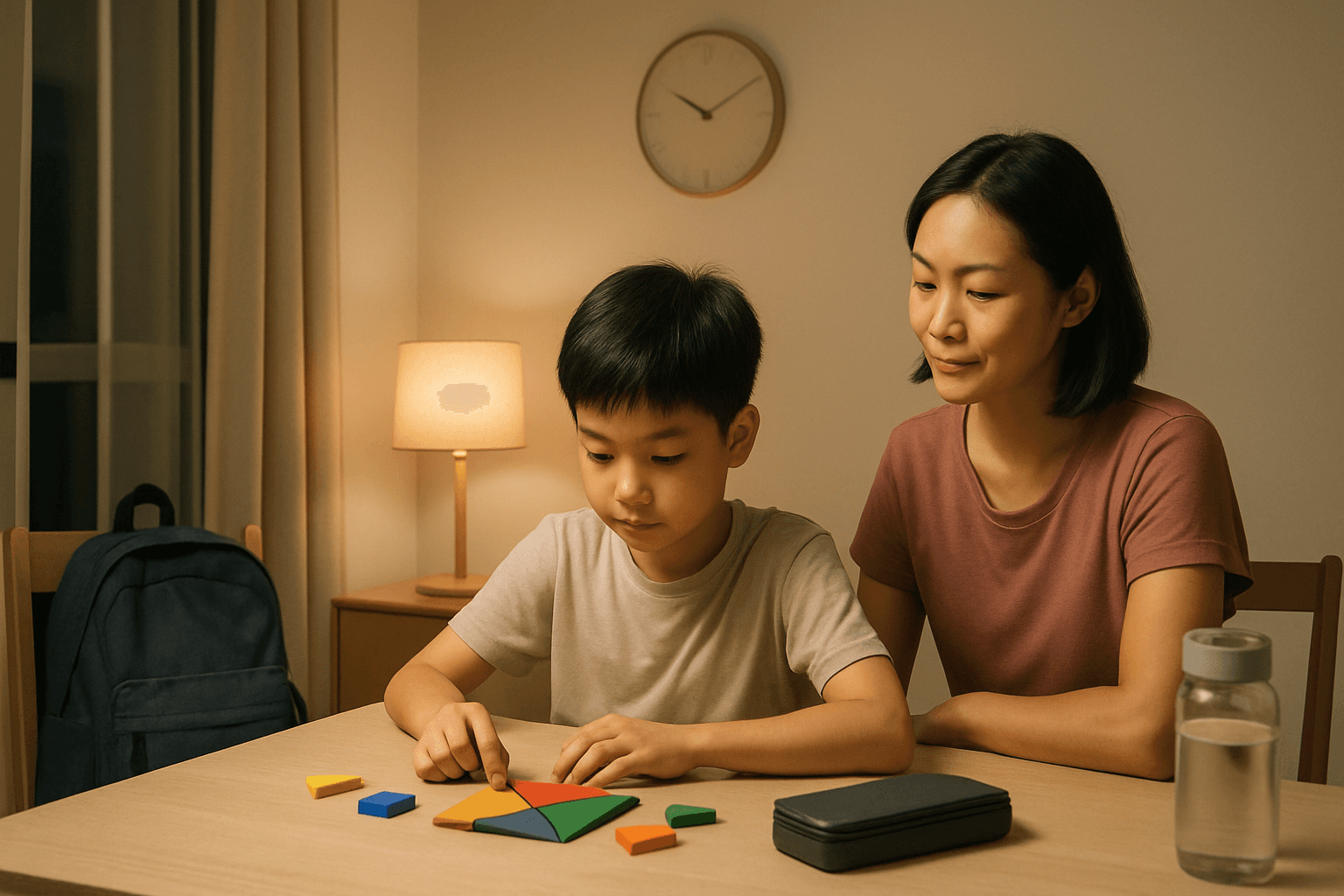
The best GEP study balance is simple: schoolwork, sleep, and family routines come first, and GEP prep fits around them. If preparation is leading to rushed homework, later bedtimes, or regular resistance, the load is no longer helping.
Most primary school children do not need a packed schedule. They usually benefit more from regular reading, short reasoning practice, and a calm routine than from doing paper after paper when tired. This guide explains what a healthy balance looks like, how much prep is usually enough, and how to tell when it is time to cut back.
What does a healthy GEP study balance look like?
Healthy balance means schoolwork, sleep, and family routines stay steady, while GEP prep remains small, predictable, and secondary.
A healthy GEP study balance means your child is still coping well with normal school life, while GEP prep stays small, predictable, and secondary. Homework is done with normal care, bedtime stays sensible, and there is still room for reading, play, and ordinary family time.
In real life, that may look like a child reading widely during the week, doing one short reasoning or familiarisation session on a lighter day, and perhaps another calm session on the weekend if energy is still good. It does not mean turning every evening into a second school day. Small and repeatable usually beats ambitious and fragile.
A simple test is this: if preparation is making homework sloppy, causing regular arguments, or pushing sleep later, the balance is already off. Parents often worry that "light" means "not serious enough," but for this kind of preparation, a fresh child usually gets more from one short session than a tired child gets from three. For a broader overview, see Gifted Education Programme (GEP) in Singapore: A Parent's Guide.
GEP Preparatory Program
When investing parent’s money and child’s time in prep classes, why go for GEP prep instead of regular mainstream syllabus prep? The child’s education path and “their future” is determine by the performance in the latter and not the formal. Which make a better investment? Some parents may say being selected for GEP enhances a child portfolio. But the academics achievement still matter more than curriculum the child went through. If the child is already very steady in exam results in P1 and P2 an
GEP Preparatory Program
Having checked with parent chatgroups, here is my humble assessment of the TOP 3 GEP Preparatory Program specialists . EduCHAMPS academy https://www.theeduchamps.com/gep-preparation-class-2/ • 2 branches – Novena and Katong. • 6 to 10 students per class • Known for following a patented Advanced Brain Training and 5 ‘A’s Method to bring out the full intellectual potential in students • 100% passed the GEP Screening test (1st round). 68% passed the GEP Selection test (2nd round) and got into the P
How much GEP preparation is enough for most primary school children?
For most children, enough is a light routine they can sustain without affecting sleep, mood, or schoolwork.
Usually less than parents expect. There is no official weekly hour target, so the better question is whether the child can do the prep without paying for it in sleep, mood, or school performance.
For a busy Primary 3 child with tuition, CCA, and regular homework, enough may simply be regular reading and one short weekend familiarisation session. For a child who is coping well and genuinely enjoys this kind of challenge, one short weekday session plus one weekend session can be reasonable. During heavy school weeks, enough may be no formal GEP work at all.
These are examples, not rules. The main mistake is treating volume as progress. More papers completed does not automatically mean better readiness. A child who reads broadly, thinks carefully, and comes to practice fresh is often building stronger readiness than a child who is grinding through worksheets while exhausted. For a broader overview, see GEP vs High Ability Programme in Singapore: What’s the Difference?.
All About GEP
In my opinion, preparing your child to be selected for GEP is not advisable. In order to maintain his/her GEP status, the child has to achieve an average overall score of 70% for his subjects. Individual subject has to be at least 70% for Math, Science and Social Studies, 65% for English and 50% for Chinese. However, more than 90% of the GEP students are able to go to their school of choice through DSA.
GEP Preparatory Program
Advisory from MOE on preparation for GEP selection test: https://postimg.cc/Wdvkv3jy Assuming prep class (and not innate talents) works for getting selected into the GEP. But to handle the demands of the programme does it mean the child has to continue GEP enrichment classes? Or any parent can share of significant numbers of cases where students got into GEP due to prep school and still managing demands of GEP well without continuing GEP enrichment classes? Or could it be those students that asp
Have More Questions?
Get personalized guidance on schools, tuition, enrichment and education pathways with AskVaiser.
Try AskVaiser for Free →How should GEP prep fit around homework, enrichment, and rest?
Protect homework and sleep first, then place GEP prep into small fixed blocks on lighter days instead of filling every free slot.
Build the week in the right order. Protect the non-negotiables first: homework done properly, dinner, wind-down time, and a sensible bedtime. Only after that should you decide where GEP prep can fit.
For many families, the most workable pattern is one short block on a lighter weekday after homework, and a second short block on a weekend morning when the child is fresher. That is usually better than trying to squeeze practice into every spare pocket of time. A calm 20-minute session that ends well is more useful than a long session done late at night.
What parents often overlook is that balance usually requires subtraction, not just addition. If you add GEP prep, something else may need to shrink for that period: extra worksheets, a lower-priority enrichment task, or the expectation that every free evening must be productive. If you are not willing to remove anything, the prep often ends up eating into rest. For a broader overview, see What Is the GEP Workload Like?.
All About GEP
My DD's in P5 GEP. Just to share about workload and staying back, though it might differ from school to school. For P4 and P5, DD has to stay back once a week for either CL or HCL (until 3.30pm). DD stays back on another day for CEP (Computer Enrichment Programme) and IRS (Individual Research Study) - both held on the same day (ends at 4pm). So she needs to stay back only two times a week on weekdays. Her CCA's on Saturday. As far as I know, her school doesn't conduct supplementary/remedial clas
Is GEP really necessary?
Does taking away the so called 'DSA advantage' for the GEP students and solely based on PSLE score for the admission to the secondary school mean a fair and square game for all the P6 students. To get into the few TOP secondary schools, all P6 students must do extremely well for all 4 subjects. The GEP students must have the time to work on their weaker subjects too. The GEP students spent quite a lot of time doing the projects ( at least 2 projects on social studies - a non PSLE subjects per ye
What should parents prioritise: schoolwork, reading, or GEP practice?
Prioritise sound school habits and broad reading first, then use GEP practice sparingly and purposefully.
Start with school habits, then broad reading, then limited GEP-specific practice. Schoolwork matters because it shows whether your child's routines, focus, and stamina are still healthy. Reading matters because it builds vocabulary, comprehension, background knowledge, and curiosity in a way that drilling alone usually cannot.
GEP-specific practice is still useful, but mainly as a smaller add-on to reduce unfamiliarity with question styles. If time is tight and you can only protect one thing beyond homework, protect reading before adding another worksheet. That approach fits MOE's description of GEP as enrichment rather than acceleration.
A practical way to think about it is this: readiness for GEP is closer to a thinking habit than a worksheet count. If you want more background, our overview of GEP and guide to GEP workload explain why depth and breadth matter more than simply racing ahead. For a broader overview, see How Do I Know If GEP Is a Good Fit for My Child?.
All About GEP
Parents that pay thousands of dollars to try to get their children into GEP: Yes, GEP is a coveted programme. Yes, GEP allows your dd/ds to be able to have a higher chance of getting into an IP school. But bear in mind that the programme is immensely challenging. Your child will have to juggle tonnes of projects and lots of HW and at the same time prepare for the all-important PSLE. And if you PUSH for your child to get into GEP by loads of tuition classes, ask yourself: Will he/she be cope? Wil
All About GEP
Extract from The Sunday Times 3 June 2012 Should you prepare for the GEP test? But is preparing for the GEP test necessary or beneficial to the child? The Education Ministry, schools and experts say no. A ministry spokesman advised parents against sending their children for special preparatory classes. 'A child who gains admission into the GEP through intensive coaching may not be able to cope with the programme's demands, and this could cause the child unnecessary stress and could lead to loss
How can parents support a child without adding pressure?
Support with routine, calm encouragement, and realistic expectations rather than constant checking, comparison, or pressure.
The most helpful support is usually structure plus tone. Set a predictable time, keep sessions short, sit nearby if needed, and stop before the child is mentally spent. Support sounds like, "Let's do one short session and end while you're still fresh," or, "Show me how you thought about this." Pressure sounds like, "You should have finished more," or, "Other children are already ahead."
Many parents assume support means constant supervision. It usually does not. Children often do better when the parent creates a calm routine, notices patterns, and keeps expectations realistic rather than hovering over every question. Compare less, debrief more.
It also helps to praise the right things. Praise careful thinking, persistence, and curiosity, not just speed or high scores. When a child gets something wrong, treat it as feedback about fit and readiness, not as proof that more drilling is needed. That keeps preparation emotionally safer and easier to sustain.
All About GEP
I read many interesting concerns on the GEP ... Let me share some of my thoughts on these ... Why force your kids to a GEP if she /he is meant for it. Don't believe those crap training centre ..Let nature take it course My daughter is in P6 GEP at RGPS and had just completed her PSLE like all other 50K kids in her cohort. She is now enjoying herself with her fellow P6 GEP at the Sentosa UnderWater World. She was posted to RGPS from CHIJ Pri (Toa Payoh) in 2008. As a child , she was always more s
All About GEP
My child was P3 last yr and I did nothing about it. It has been advised not to prepare your child for it else they will suffer later even if they get in. As you can see the kind of Maths in GEP they have to be able to handle themselve later and even parents can't help. English is also demanding. They don't get to prepare much for their PSLE,.,.etc. We are always advised to leave it naturally.
How can I tell if the current GEP load is still sustainable?
Watch sleep, mood, homework quality, and willingness to start; when several of these slip, the load is too high.
- ✓Bedtime is still steady and GEP prep is not regularly pushing sleep later.
- ✓Homework quality and care are still normal, not suddenly rushed or careless.
- ✓The child can begin a short GEP session without major resistance most of the time.
- ✓Mood after practice is usually calm, not regularly tearful, angry, or withdrawn.
- ✓There is still time for reading, play, or ordinary family downtime.
- ✓You are not constantly reshuffling the whole week just to fit in more prep.
- ✓If two or more of these start slipping, reduce or pause formal GEP prep before adding anything else.
How do GEP, High Ability Programme, and mainstream school differ in workload and expectations?
The main difference is the type of stretch, not simply more work: GEP is deeper enrichment for selected pupils, while broader high-ability support now exists across more schools.
Mainstream primary school is the standard base curriculum most children follow. Traditional GEP is a selected programme for intellectually gifted pupils, with MOE describing it as an enriched curriculum that covers the same content areas as mainstream but with greater breadth and depth, as explained in its programme overview. That matters because it means GEP is not just "more work" or "earlier work." The stretch is meant to come from depth, discussion, and more complex thinking.
High Ability Programme is broader. MOE has been expanding support for higher-ability learners across more schools through school-based approaches and after-school modules, with the stated goal of cultivating curiosity and love for learning rather than turning it into exam coaching, as set out in its 2024 announcement. In other words, not every higher-ability pathway should feel equally intense, and not every child needs the same type of stretch.
For parents, the practical lens is fit, not label. Ask which setting gives your child challenge without draining them. Our GEP vs High Ability Programme comparison and GEP vs mainstream guide can help if you are comparing pathways rather than just preparing for the next test.
All About GEP
Well to me, GEP is a programme to further stretch and nurture the 'higher ability' kids. It is a programme to see how far can these group of students be stretched and of course those kids who are able to cope well will be those that are able to benefit from this programme the most. As at for Primary School Leaving Exam, it is to test how well P6 students have understand the school education syllabus and how well they have prepared for it.. ..nevertheless also the student academic ability..
All About GEP
GEP curriculum covers the same content areas as those in mainstream but is extended in breath and depth. And GEP students will sit for the same PSLE and proceed to IP or O level, just like mainstream students. Sounds quite like IP, where students are exposed to an enriched curriculum but also learn the same syllabus and sit for the same A level exam as mainstream students. Or A level students taking H3 subject with extended contents but only the standard syllabus H2 content results will count to
What are the most common myths about GEP preparation?
The main myth is that more pressure, more tuition, or more worksheets automatically leads to better GEP outcomes.
The biggest myth is that more tuition or more worksheets automatically improves a child's chances. It does not. Practice can help a child feel less unfamiliar with question styles, but overload can just as easily reduce attention, patience, and clear thinking.
Another myth is that bright children need less rest. In practice, tired children often make careless errors, rush reading, and lose interest in the very kind of thinking they would normally enjoy. Protecting sleep is not a soft option. It is part of keeping the child mentally ready.
A third myth is that GEP is simply a harder or better version of mainstream school. It is different, not automatically better for every child. That matters even more now that Singapore is broadening how higher-ability learners are supported, a shift covered in CNA's reporting on the revamp. A better parent question is not "How do we push harder?" but "What kind of challenge helps my child stay engaged and well?" If you are unsure, compare fit with real advantages before chasing the label.
All About GEP
Personally I think if your child qualify for GEP, then why not? I am skeptical about the effectiveness of the prep program for GEP but let’s say your child qualify for GEP without any prep program, the more you should let he or she undergo the GEP program. My reason is simple and straightforward. I think the ability and potential of each child is different. That is why not everyone can achieve the same results in any given examination. Some will score better than the rest no matter how. The GEP
GEP Preparatory Program
In SG, how many can truly say the kid is never prepped at all. Just because a kid has zero tuition also does not mean the child is not prepared at all for GEP. If you start at age 2, nurturing with the right method consistently… up till 9, the kid cannot be too lousy either. But whether top 1% or not, hard to say. Depends what you do. Some real cases I know - A P4 GEP kid’s mum is English teacher at a GEP centre. A 27 year old boy GEP graduate admitted his mum used to make him do very difficult
What should families do if the child is already busy or easily tired?
If your child is already stretched, use a lighter plan or pause temporarily instead of forcing a full GEP routine.
Use the child's energy as a real planning factor, not as something to push through. A child with CCA, tuition, and school assignments may only cope well with regular reading and the occasional short reasoning session. A child who becomes flat after a long school day may do better with a weekend morning discussion, a puzzle, or language play instead of another formal paper.
When a child is already stretched, the best move is often to lighten the plan rather than copy what another family is doing. During test-heavy weeks, many parents do better by keeping bedtime stable, dropping formal papers for a while, and returning to prep once the child is fresher. That is not a lack of discipline. It is good load management.
If your child is often tired, ask not just whether they can prepare for GEP, but whether they would actually thrive in a more demanding learning environment. Our guide to suitability and gifted or just advanced can help you think about that more clearly. When energy is low, the best study plan is the one your child can sustain without losing sleep, confidence, or interest in learning.
All About GEP
Speaking from a GEP parents, my boy is in GEP P4 this year, however, he struggle very badly as he is not the top student since P1-3, he is just a middle range student who scores around 80s for most subject. GEP has a minimum passing mark of 70% and their paper are much much harder compared to mainstream. Somehow, this year is very stressful for myself and my boy. He has officially failed his 2 subject (with not meeting the 70%) mark, I am waiting for teacher’s advise, what is going to happen to
All About GEP
Anyone at P3 can take the screening test for GEP. The top 6% (previously 3000, this year 4000) will be invited to take the selection test. Among them, only the top 1% (around 500 plus) will qualify for the GEP programme. I have one child who successfully cleared both rounds and one who was among the top 3000 but not the top 500. Both of them did not receive any preparation at all. Both took the tests without any expectation or pressure. I do not believe in preparing the child for it. If one is g
Have More Questions?
Get personalized guidance on schools, tuition, enrichment and education pathways with AskVaiser.
Try AskVaiser for Free →