
How to Build Thinking Skills for GEP at Home in Singapore
Practical, low-pressure ways to strengthen reasoning, pattern-spotting, and problem-solving through everyday family routines.
Good GEP preparation at home is usually low-pressure and skill-based. Help your child compare, predict, justify, and explain ideas during normal routines, and focus more on reasoning and resilience than on drilling for a test format.
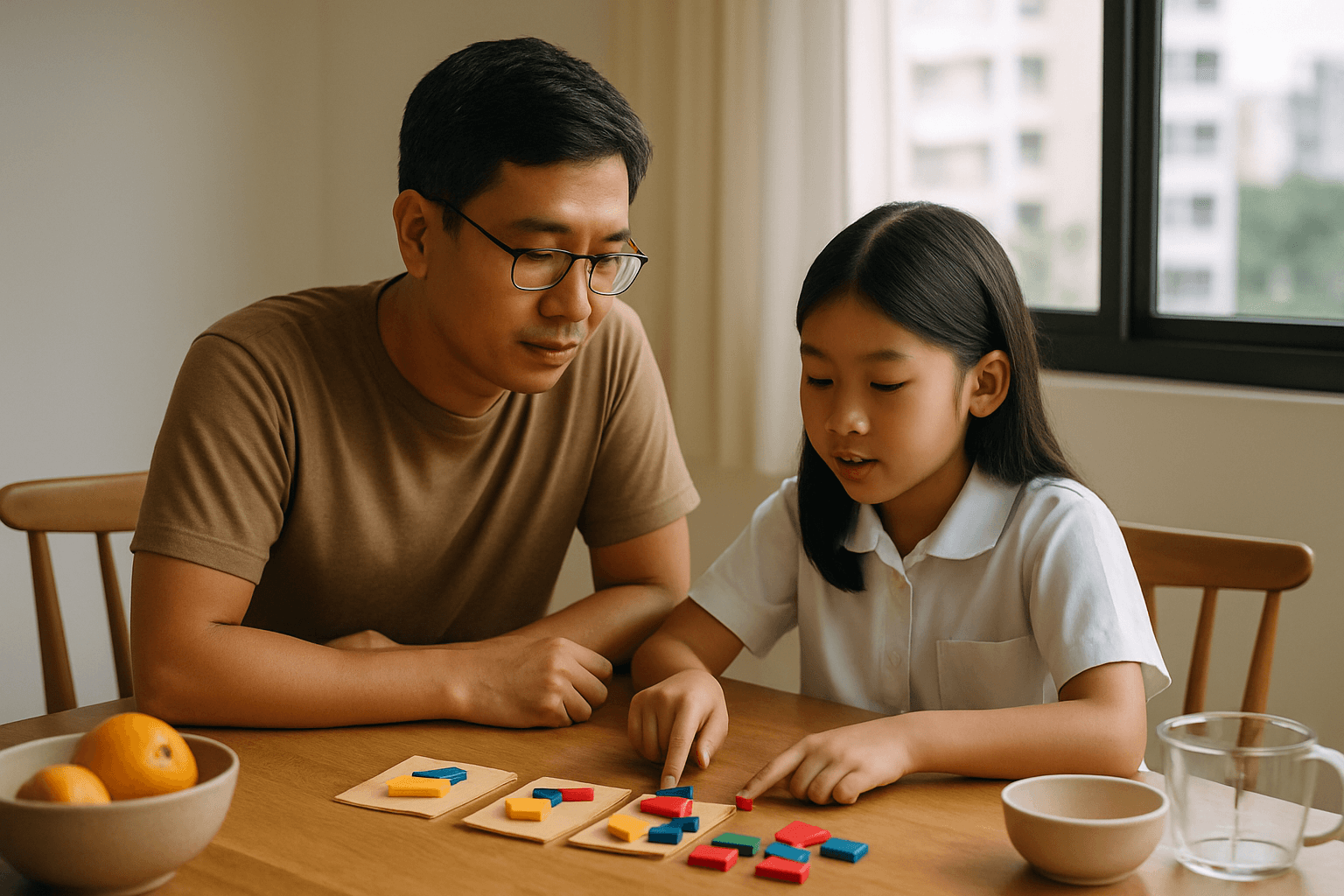
If you are wondering how to build thinking skills for GEP at home, start here: focus on habits, not hacks. Useful preparation usually looks like reading together, discussing how an answer was reached, comparing options at the supermarket, or talking through a puzzle without rushing to rescue your child.
These routines can strengthen reasoning and problem-solving, but they do not guarantee GEP selection. A better mindset is this: build the kind of thinking that helps your child in any setting, whether or not GEP is eventually the right pathway.
What is GEP, and what kind of thinking does it usually reward?
GEP is generally linked to strong reasoning, pattern recognition, problem-solving, and independent thinking, not just fast answers or high marks.
In plain English, the Gifted Education Programme is associated with children who are likely to need more depth, pace, or complexity than the regular classroom usually provides. Parents often reduce this to "very smart" or "very fast," but that misses the more useful signs. In practice, the children who seem suited to this kind of environment often show strong reasoning, quick pattern recognition, flexible problem-solving, and the ability to explain how they got to an answer.
Think of it as depth of thinking, not just speed of answering. A child who notices the rule in a number pattern, spots an exception, suggests a second way to solve a problem, or explains why one answer makes more sense than another is showing the kind of thinking parents should pay attention to. That is why good GEP preparation at home is usually less about drilling and more about helping a child observe, compare, infer, and reason aloud.
MOE now speaks more broadly about programmes for students with academic strengths, so it helps to focus on the learning needs behind the label. If you want a fuller overview first, our Gifted Education Programme (GEP) in Singapore: A Parent's Guide gives the bigger picture.
GEP Preparatory Program
Having checked with parent chatgroups, here is my humble assessment of the TOP 3 GEP Preparatory Program specialists . EduCHAMPS academy https://www.theeduchamps.com/gep-preparation-class-2/ • 2 branches – Novena and Katong. • 6 to 10 students per class • Known for following a patented Advanced Brain Training and 5 ‘A’s Method to bring out the full intellectual potential in students • 100% passed the GEP Screening test (1st round). 68% passed the GEP Selection test (2nd round) and got into the P
GEP and IQ
To me GEP is about if you have it, you nurture it. There is a certain advantage in putting a child in GEP, if she has what it takes. First, you have more resources in the education system dedicated to educating the child. Second, the academic road is somehow smoother. The GEP label helps somehow. I once asked one of my GEP students to ask her teacher how GEPPers do traditionally in PSLE. She came back with the report that they have had people who got B in PSLE math so far. While most do get A*,
What does GEP readiness look like at home and in school?
Look for curiosity, clear reasoning, and resilience with challenge, not just strong grades or fast work.
The clearest signs are usually curiosity, depth of thought, and comfort with challenge. At home, that might look like a child asking why a rule works, noticing patterns in books or numbers, arguing for a different method, or wanting to test whether an answer still holds when one detail changes. In school, it may show up as strong grades, but grades alone do not tell you whether the child thinks deeply or simply handles familiar work efficiently.
One of the biggest parent misunderstandings is treating quick work as proof of advanced thinking. Sometimes speed just means the task is easy or repetitive. A more useful signal is whether your child can deal with something less familiar. For example, if the question is slightly reworded, can they still reason through it? If they get stuck, do they try another approach or shut down immediately?
Resilience matters too. A child who is suited to more challenge does not need to enjoy every difficult task, but they should usually be able to stay with a problem, recover from being wrong, and try again. If your child is bright but often melts down when work becomes unfamiliar, the next step may be confidence-building before extra stretch. If you are trying to separate true need for challenge from simple academic advancement, How Do I Know If GEP Is a Good Fit for My Child? and Is My Child Gifted or Just Advanced? can help you read the signs more calmly.
GEP Preparatory Program
Some parents have the time and resources to expose their kids at home to prepare for gep. Other parents prefer to put their kids in gep preparation classes and let them blossom on their own or etc. From my own observation, I realized many kids who constantly do very well in Eng and Math at schools and also attended short/long duration preparation classes were not selected for Gep. Some were shocked they did not even pass round one. Some of my friends' children did not attend any of these prepara
All About GEP
Sigh. There are lots of \"GEP preparatory courses\" out there but they are merely preying on the parents' inherently yearning that their kids are out to do \"big\" things. We regularly monitor these threads to ban anyone that tries to promote such services. Such courses are bad because they may actually cause the GEP team to upscale their questions to really find truly gifted children! If your child is really gifted, her natural curiosities and talents should stand out clearly. There should be n
Have More Questions?
Get personalized guidance on schools, tuition, enrichment and education pathways with AskVaiser.
Try AskVaiser for Free →How can parents build thinking skills at home through daily routines?
Turn normal routines into thinking practice by asking your child to compare, predict, explain, and justify ideas.
Use ordinary moments to ask better questions and give your child time to think aloud. At the supermarket, you can ask, "This one costs less, but is it really better value if the pack is smaller?" On the way to school, you can discuss which route might be faster today and what clues support that guess. During reading time, you can pause and ask what might happen next, which detail feels important, or what made a character choose one action over another.
The goal is not to quiz your child all day. The goal is to move from answer-checking to reasoning. Questions such as "How did you know?", "What made you choose that?", "What would change your mind?", and "What if we changed one part?" help children practise explanation, comparison, and flexible thinking. If your child gives a correct answer quickly, ask for a second method. If they give a weak answer, ask for one clue that supports it before correcting them.
Short and natural beats long and forced. One thoughtful conversation a day is more useful than a stack of rushed extra work. This questioning style is close to what educators use to deepen classroom thinking, as shown in Schoolbag's look at 21st-century classrooms. For a broader overview, see GEP Selection Process in Singapore: Stage 1 and Stage 2 Explained.
All About GEP
Extract from The Sunday Times 3 June 2012 Should you prepare for the GEP test? But is preparing for the GEP test necessary or beneficial to the child? The Education Ministry, schools and experts say no. A ministry spokesman advised parents against sending their children for special preparatory classes. 'A child who gains admission into the GEP through intensive coaching may not be able to cope with the programme's demands, and this could cause the child unnecessary stress and could lead to loss
GEP Preparatory Program
In SG, how many can truly say the kid is never prepped at all. Just because a kid has zero tuition also does not mean the child is not prepared at all for GEP. If you start at age 2, nurturing with the right method consistently… up till 9, the kid cannot be too lousy either. But whether top 1% or not, hard to say. Depends what you do. Some real cases I know - A P4 GEP kid’s mum is English teacher at a GEP centre. A 27 year old boy GEP graduate admitted his mum used to make him do very difficult
What simple activities build reasoning and problem-solving without worksheets?
Board games, puzzles, cooking, story retelling, and simple planning tasks can build reasoning when your child is asked to explain their thinking.
A few everyday activities can do a lot when you use them well. Board games help with planning, strategy, and adjusting when things do not go your way. Jigsaw and pattern puzzles build visual reasoning and persistence. Cooking and baking develop sequencing, estimation, and careful attention to instructions. Story retelling strengthens memory, structure, and inference because your child has to decide what mattered most and how events connect.
Even simple household tasks can work. Sorting laundry by more than one rule, estimating how many plates are needed before dinner, or planning the order of errands can all build flexible thinking. These are examples, not official GEP preparation methods. What matters is the thinking inside the activity.
That means the follow-up question is often more important than the activity itself. If your child plays a game, ask why they made one move instead of another. If they help in the kitchen, ask what might happen if a step is skipped or the quantity is doubled. If they retell a story, ask which clue first suggested the ending. The best activity is usually not the fanciest one. It is the one that gets your child to notice patterns, test ideas, and explain their thinking without feeling coached. For a broader overview, see GEP vs High Ability Programme in Singapore: What’s the Difference?.
How to prepare child for next week's Selection Test GEP ?
For GEP preparation i think the best is to -for math practice i recommend math Olympiad questions. for english , i would recommend the kids to read widely gep quite hard to get in . really nid a lot of preparation…sigh
How to prepare child for next week's Selection Test GEP ?
How to prepare? Actually I would only recommend that you teach the child what to do when he / she faces questions that stump them. Some of these smart kids are so used to ‘easy’ questions that they may be shocked to see questions that they have not seen before. My 2 cents worth: 1. Read the questions carefully 2. Do not linger too long on the question if you do not understand it. Move on to the next question. Come back to it only after you have completed the rest of the paper. 3. Answer to the b
How does GEP differ from HAP and mainstream primary school?
Mainstream serves the broad cohort, while GEP and HAP-style support usually offer more depth, challenge, and high-ability peer interaction. The real question is fit, not status.
For most parents, the practical comparison is about pace, depth, and peer group. Mainstream primary school is built for a broad range of learners. High-ability provisions are meant to stretch students who can handle more complexity, greater abstraction, or faster conceptual movement. In many parent discussions, GEP refers to a more formal gifted pathway, while HAP is used for school-based high-ability support. The exact landscape is evolving, so it is smarter to compare learning experience than to focus only on the acronym, especially in light of MOE's broader direction signalled in the 2024 Schools Work Plan speech.
In practical terms, a higher-ability setting usually means more open-ended work, more discussion of why an answer works, and more expectation that students can cope with challenge independently. For some children, that is energising. For others, it is tiring or emotionally heavy, even if they are academically strong.
The key parent takeaway is simple: do not choose by label alone. Ask what the day-to-day learning actually looks like. Will your child enjoy richer discussion, faster movement, and less routine repetition, or would a mainstream setting with the right school support be a better fit? If you want a deeper comparison, see GEP vs High Ability Programme in Singapore: What’s the Difference? and GEP vs Mainstream Primary School: What Is Different?. For a broader overview, see Why Singapore Is Moving from GEP to HAP.
All About GEP
GEP Status in Secondary Levels 1.What happens after the primary GEP? After Primary 6, retention of the GEP status and promotion to the next level of gifted education is based on: ■performance in the GEP from Primary 4 to 6, including a pass in Social Studies ■attitude towards work and the enrichment programme ■performance at the PSLE 2.What percentage of the Primary 6 GEP pupils meets the criteria for retaining the GEP status? Each year approximately 99% of the pupils meet the criteria. For more
GEP Preparatory Program
When investing parent’s money and child’s time in prep classes, why go for GEP prep instead of regular mainstream syllabus prep? The child’s education path and “their future” is determine by the performance in the latter and not the formal. Which make a better investment? Some parents may say being selected for GEP enhances a child portfolio. But the academics achievement still matter more than curriculum the child went through. If the child is already very steady in exam results in P1 and P2 an
How does GEP selection work in broad terms, and what can parents realistically do?
GEP selection is a formal identification process, so parents should build broad thinking habits and emotional readiness rather than try to game the system.
At a high level, GEP selection is a formal identification process run through MOE. It is not something parents can secure through good school marks alone, extra worksheets, or a fixed stack of practice papers. That matters because it changes what useful preparation looks like. Your job is not to manufacture a profile. Your job is to help your child think clearly, read widely, handle unfamiliar questions, and stay steady when the answer is not obvious.
Most parents can influence habits more than outcomes. Strong reading routines, regular exposure to non-routine problems, healthy sleep, and calm discussion all help. If your child reads fluently but cannot explain what was implied in a passage, spend more time on inference and discussion. If they do well on routine maths but freeze when a question is unfamiliar, add more open-ended puzzles instead of more of the same practice. If they already seem overloaded, reducing pressure may help more than adding another worksheet pack.
Think of this as readiness, not rehearsal. If you want a more detailed explainer of the process, GEP Selection Process in Singapore: Stage 1 and Stage 2 Explained is the next useful read, but it should still be treated as a guide to the process, not a coaching formula.
2009 GEP Screening And Selection
I’ve been following the discussions here and see that a number of parents are keen to know the questions asked at the GEP tests, perhaps to prepare their kids for the GEP tests. Some have also sent their kids to the so-called GEP preparatory training classes in the hope of getting their kids into GEP. I have to sound a word of caution here. As highligted by previous posters, the GEP curriculum is a very rigorous one. If your child is successful at getting into GEP through extensive prepping, be
All About GEP
In my opinion, preparing your child to be selected for GEP is not advisable. In order to maintain his/her GEP status, the child has to achieve an average overall score of 70% for his subjects. Individual subject has to be at least 70% for Math, Science and Social Studies, 65% for English and 50% for Chinese. However, more than 90% of the GEP students are able to go to their school of choice through DSA.
What should parents avoid when supporting GEP readiness?
Build habits, not pressure.
Do not turn home into test prep. Nightly drilling, timed trick questions, constant comparison with classmates, and treating every mistake like a warning sign usually make children more tense, not more thoughtful.
A child who is tired or anxious often thinks less clearly. Protect sleep, downtime, and ordinary play. If every hard question ends with immediate correction, your child may learn to avoid risk instead of building resilience. The bigger win is a child who stays curious and willing to try again. Even the way adults speak matters, which is why Schoolbag's piece on how words can affect a child's learning ability is worth keeping in mind.
All About GEP
I read many interesting concerns on the GEP ... Let me share some of my thoughts on these ... Why force your kids to a GEP if she /he is meant for it. Don't believe those crap training centre ..Let nature take it course My daughter is in P6 GEP at RGPS and had just completed her PSLE like all other 50K kids in her cohort. She is now enjoying herself with her fellow P6 GEP at the Sentosa UnderWater World. She was posted to RGPS from CHIJ Pri (Toa Payoh) in 2008. As a child , she was always more s
All About GEP
Anyone at P3 can take the screening test for GEP. The top 6% (previously 3000, this year 4000) will be invited to take the selection test. Among them, only the top 1% (around 500 plus) will qualify for the GEP programme. I have one child who successfully cleared both rounds and one who was among the top 3000 but not the top 500. Both of them did not receive any preparation at all. Both took the tests without any expectation or pressure. I do not believe in preparing the child for it. If one is g
Which schools offer GEP, and how should parents think about fit, workload, and commute?
Check the current official school list, then weigh fit, workload, and commute before assuming a GEP school is automatically the best choice.
GEP is offered in selected primary schools, and parents should rely on current official MOE information when checking which schools currently offer it rather than old blog lists, forum screenshots, or tuition flyers. Once you know the available options, the real decision is not prestige alone. It is whether the daily experience will suit your child and your family.
The main advantages usually relate to depth, pace, and peer environment. Some children become more engaged when class discussion goes further, tasks are less routine, and classmates think at a similar level. The tradeoff is that the workload can feel heavier because the work is often more demanding, more open-ended, and less easily completed by memorising steps. Some children also need time to adjust to no longer being effortlessly ahead of the class.
Commute is one of the most overlooked factors. A child may cope well with challenge in class but struggle if every day starts with a long, tiring journey. A school that looks strong on paper can still be the wrong fit if the travel, pace, and homework load together leave your child drained. A practical comparison should include classroom style, emotional fit, and daily logistics, not just reputation. For a more grounded view, see What Is the GEP Workload Like?, How Do I Know If GEP Is a Good Fit for My Child?, and GEP vs Mainstream: What Is the Real Advantage?.
All About GEP
Parents that pay thousands of dollars to try to get their children into GEP: Yes, GEP is a coveted programme. Yes, GEP allows your dd/ds to be able to have a higher chance of getting into an IP school. But bear in mind that the programme is immensely challenging. Your child will have to juggle tonnes of projects and lots of HW and at the same time prepare for the all-important PSLE. And if you PUSH for your child to get into GEP by loads of tuition classes, ask yourself: Will he/she be cope? Wil
GEP Preparatory Program
Advisory from MOE on preparation for GEP selection test: https://postimg.cc/Wdvkv3jy Assuming prep class (and not innate talents) works for getting selected into the GEP. But to handle the demands of the programme does it mean the child has to continue GEP enrichment classes? Or any parent can share of significant numbers of cases where students got into GEP due to prep school and still managing demands of GEP well without continuing GEP enrichment classes? Or could it be those students that asp
Do worksheets, tuition, and top grades guarantee GEP readiness?
No. They may help with familiarity or school performance, but they do not by themselves show the depth of thinking linked to GEP readiness.
No. Worksheets can build familiarity, tuition can provide structure, and top grades can show strong academic habits, but none of these by themselves prove the kind of reasoning, independence, or resilience usually associated with GEP readiness.
This is where many parents get misled. A child can be top of class because they are excellent at familiar school formats, yet still struggle when a question is ambiguous or when there is no obvious method. Another child may be less tidy in routine work but stronger at spotting patterns, making connections, or trying unusual approaches. Tuition may help some children organise their learning, but it cannot reliably manufacture curiosity, persistence, or comfort with challenge.
The most useful way to think about preparation is to ask what the child is actually building. Are they becoming more thoughtful, more flexible, and better at explaining their reasoning, or are they just getting faster at similar question types? If this question keeps coming up at home, Is My Child Gifted or Just Advanced? may help you assess your child more realistically.
GEP Preparatory Program
no. screening tests are only held once in the child's time in primary school. getting through the screening tests is one thing, remember there is another 2.5yrs of gep work and the inevitable psle for which they only start preparation after june of p6.
All About GEP
Perhaps you have missed out alot of discussion on this. Most people will not advocate training for GEP tests. Reason being if they can prepare themselves to get into the program, they may not be prepared to stay on in the program. Most times, getting in is a smaller issue than staying inside the program. So if you are confident about your kid, then don’t prepare your kid. But if you really want to, there are a few schools in SG touting that they trained children for GEP and they charge a premium
What happens after primary school if a child is in GEP?
There is no single post-primary path for GEP students, so parents should focus on long-term fit and continued growth rather than assume one label determines the future.
There is no single fixed outcome, and parents should be careful not to treat a primary-school programme as a guaranteed long-term track. What happens next depends on the child's profile, interests, later school options, and how Singapore's high-ability landscape continues to evolve. In other words, GEP is one part of the education journey, not the final verdict on a child's future.
A practical way to think about the post-primary question is this: if your child continues to need stretch, there may be later opportunities through school-based programmes and MOE-supported options such as Gifted Education Branch special programmes. If your child does not enter GEP or later chooses a different environment, that does not close off future growth either. Strong readers, independent thinkers, and motivated learners can still develop deeply across many pathways.
Choose for the child in front of you, not the imagined child five years from now. If you want more context on the broader direction of high-ability education, Why Singapore Is Moving from GEP to HAP is a useful next read.
All About GEP
Personally I think if your child qualify for GEP, then why not? I am skeptical about the effectiveness of the prep program for GEP but let’s say your child qualify for GEP without any prep program, the more you should let he or she undergo the GEP program. My reason is simple and straightforward. I think the ability and potential of each child is different. That is why not everyone can achieve the same results in any given examination. Some will score better than the rest no matter how. The GEP
All About GEP
Hi folks, I was browsing reddit, and came across this today: https://www.reddit.com/r/singapore/comments/qlplx5/getting_into_a_primary_school/?sort=confidence On reddit, several students who went through GEP said that they were \"trained\" by enrichment for GEP, and they got in. However, once they were in the GEP programme, they struggled to stay on par with their really gifted peers, who just breezed through difficult tests. Can any parent who went through this with their children or similar, h
Have More Questions?
Get personalized guidance on schools, tuition, enrichment and education pathways with AskVaiser.
Try AskVaiser for Free →