
Moving House After Primary 1 Posting: Can You Change Schools?
What Singapore parents should realistically expect when a move affects school travel, caregiving, or daily routine.
Yes, a child may be able to change schools after moving house after Primary 1 posting, but only through MOE’s transfer route and only if there is a nearer school with vacancies. A house move does not automatically trigger a school change, so parents should compare the new commute, prepare proof of the new address and living arrangement, and plan for the possibility that staying in the posted school remains the most realistic outcome.
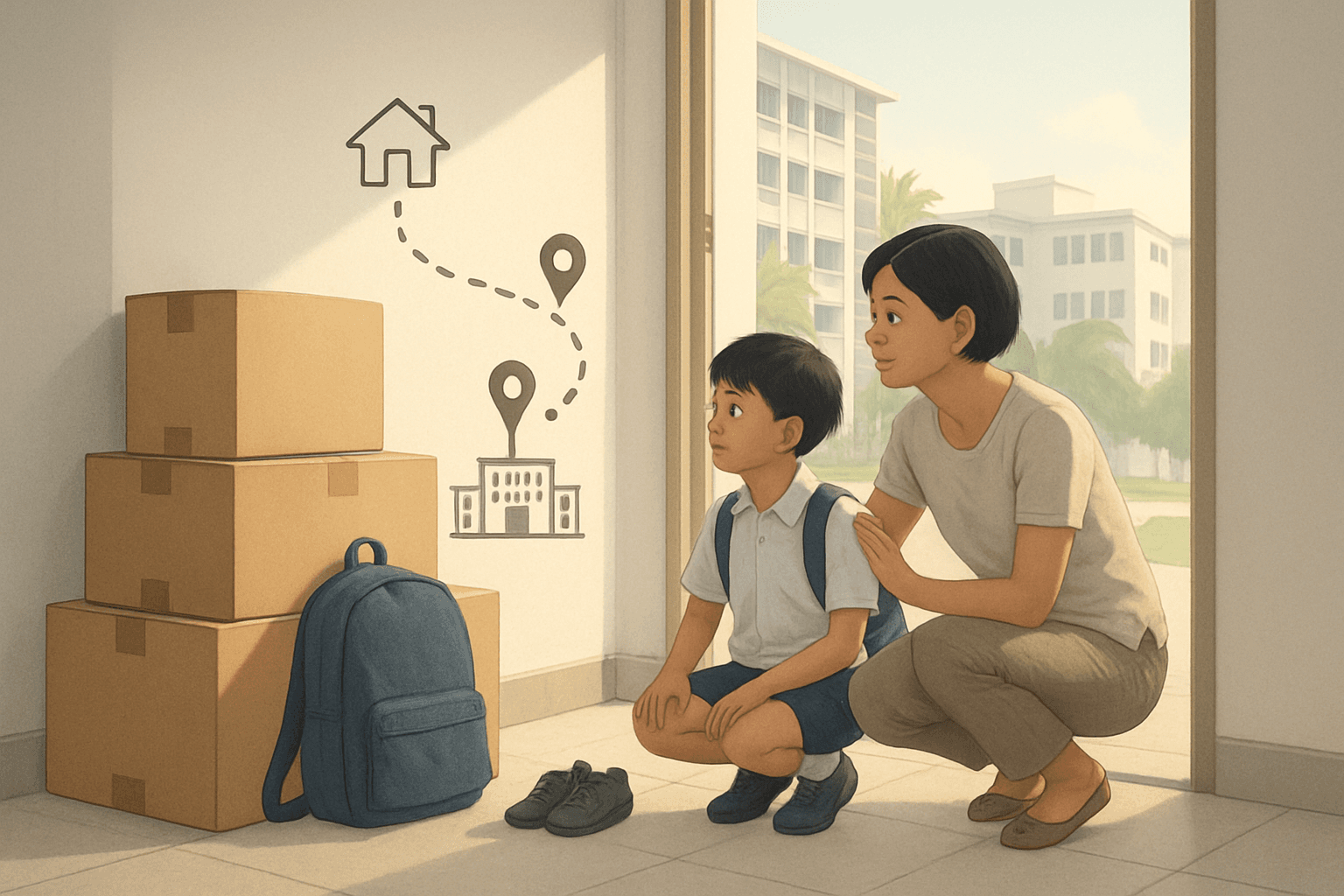
Yes, you can ask about changing schools after moving house after Primary 1 posting, but the move itself does not guarantee a new school.
The practical question is simple: is there a school nearer to the new home, does it have vacancies, and is the current posted school still workable for daily travel and caregiving? For most parents, this is a transfer request with limits, not a school reset.
Can you change schools if you move house after Primary 1 posting?
Yes, but only through MOE’s transfer process, and only if there is a nearer school with vacancies.
Yes, you may be able to apply for a transfer, but moving house after Primary 1 posting does not automatically change your child’s school. The official route is MOE’s Primary School Transfer Service, which covers Primary 1 to 5 students who are Singapore Citizens or Permanent Residents and need a school nearer to a new residential address.
The key limit is easy to miss. A move gives you a reason to ask, but it does not give you free choice of schools. MOE looks at schools with vacancies that are nearer to the new home, and it will not offer a school that is farther from the new address than the current school. In other words, this is a nearer-school request, not a second round of Primary 1 posting.
That distinction matters in real life. If your family moves from Pasir Ris to Jurong and the posted school becomes a long daily trip, a transfer request is worth exploring. If you move within the same area and the current school is still manageable, staying put may be the more practical outcome. If the issue is caregiving rather than the address itself, explain the real daily arrangement clearly, but do not assume it will be treated the same way as an address-based move. For a broader overview, see Primary 1 Registration in Singapore: How It Works, Balloting Risk, and How to Choose a Realistic School Plan.
All about Transferring to Other Primary Schools
https://www.moe.gov.sg/primary/transfers “You can apply to transfer your child to a primary school nearer to your new residential address if your child is: - A Singapore Citizen (SC) or Permanent Resident (PR). - Currently in Primary 1 to 5. We will offer your child a school nearer to your new residential address which has available vacancies. Your child will have to report to the new school by the end of the reporting period to complete the school transfer. Your NRIC must be updated with your n
All about Transferring to Other Primary Schools
Within 6 years of primary school education, from (P1 to P6), note that u can only Transfer schools from (P1 to end of P4). Reason being, after end of P4, there is streaming, into P5 classes. End of P4 is the last whistle calling (blowing), for Transfer students to board (hop onto) another new train journey. Schools do not allow Transfer once start P5, in Upper primary years (P5 / P6). Schools consider these last 2 years as key PSLE preparatory years, won't allow Transfer. At what level, is your
What will MOE usually look at after you move?
MOE mainly looks at the new address, whether a nearer school exists, and whether that school has vacancies.
MOE will mainly look at the new residential address, whether there is a school nearer to that address, and whether that nearer school has vacancies. That is the frame parents should use from the start.
What many parents miss is that MOE is not re-running Primary 1 registration because your family moved. The question is narrower: from the new home, is there an available school that is closer than the current one? If the answer is no, the move alone does not create a new placement.
Practical details still matter because they show whether the arrangement is sustainable. A 40-minute direct commute is very different from a route that now needs an early start, multiple handoffs, and no reliable pickup plan. If you want context on how address matters in P1 decisions, MOE’s home address guidance is useful. After posting, though, the transfer outcome still turns mainly on distance from the new home and vacancy at a nearer school.
A simple way to think about it: relocation matters most when it changes feasibility, not just convenience. For a broader overview, see Primary 1 Registration After Moving House: Should You Use Your Old or New Address?.
All about Transferring to Other Primary Schools
Actually, if u only want a specific primary school that is directly behind your hdb block for your own convenience, AFTER shifting to your new house, then u should have just approached or call up the school directly, ask them whether got vacancies or not. If got vacancy, then apply. If No vacancy, then move on to the 2nd next school near your house, to inquire. But all these query, u need to do personally, as homework basic checking first. Because The moment u go through MOE STEPS, then it is up
All about Transferring to Other Primary Schools
hi may i check what are the procedures like for changing primary school ? because change of address
Have More Questions?
Get personalized guidance on schools, tuition, enrichment and education pathways with AskVaiser.
Try AskVaiser for Free →If the move changes caregiving or daily travel, what should you do first?
Confirm the new living arrangement, compare the real commute, then speak to the school or MOE about transfer options early.
Start by pinning down the real living arrangement. Is this a permanent move, a temporary housing transition, or a weekday setup where your child will stay with grandparents or another caregiver? Parents often ask about changing schools before they have worked out who will actually handle drop-off, pickup, and after-school care.
Next, compare the school run from the new arrangement in plain terms. Check the morning trip, the afternoon return, who is available every school day, and whether the route is reliable without last-minute handoffs. A short written comparison is usually more useful than saying only that the school is now too far.
Then raise the issue early with the current school and review the MOE transfer process. If school has not started yet, do this before the year begins if you can. If your child has already started, do it as soon as the new arrangement is confirmed. Parents who explain the actual daily problem usually present a clearer case than parents who simply say, "We moved house."
For example, saying that both parents work in the west while the child will now stay with grandparents in Sengkang on weekdays gives a clearer picture than just naming the new address. The more concrete the daily impact, the easier it is to judge whether a transfer is worth pursuing. For a broader overview, see Primary 1 Registration Distance Priority: How Home-School Distance Works.
All about Transferring to Other Primary Schools
I suppose before august, u will still be living in Punggol? Perhaps you still need some time to renovate, move/pack or settle down. Think it’s easier to transfer to TPY schools when your new premise is ready and settled.. perhaps register your child where your p2 is first and apply for transfer later. Better to start in a fresh year, say p3 and p1. If you have a caregiver for your p1 near TPY, u can try register p1 under that address...
All about Transferring to Other Primary Schools
I do not think MOE permit students to Transfer school so fast, so quickly within such a short time frame. One minute, transfer to a school in the West. Next minute, next change - Less than 1 year later, transfer to another school in the east. Moe will sure question you : why are you Transfering schools, so shortly ? Where is your final destination? If your permanent house purchased is in the east, then stick to schools in the east. That should be your guide. Those primary schools that often have
What should you prepare before asking about a transfer?
Prepare a clear picture of the new home, the move timing, and why the current school no longer works day to day.
- ✓These are common examples parents prepare, not an official or guaranteed MOE checklist.
- ✓The new residential address and the expected or actual move date.
- ✓A short explanation of whether the move is permanent, temporary, or mainly affects weekday caregiving.
- ✓A simple comparison of the current commute against the commute from the new address, including who will handle drop-off and pickup.
- ✓Address documents you already have or expect to have, such as tenancy, sale, purchase, or completion papers where relevant.
- ✓A brief note on any caregiving change, such as grandparents taking over weekday care or work schedules making pickup difficult.
- ✓A short explanation of why the current school is no longer practical from the new arrangement.
- ✓If the move has already happened, any updated address records you already have.
What if the new home is still within a manageable commute?
If the current school still works reliably from the new home, staying put is often the more practical choice.
If the current school is still workable, a transfer may not be necessary. This is where many parents benefit from slowing down and separating stress from actual unsustainability.
A manageable commute is not the same as a convenient one, but that difference matters. If your child can still get to school in a predictable way with one stable caregiver arrangement, keeping the posted school may be the better choice. If the new routine now depends on several adults, repeated transport changes, or uncertain pickup every afternoon, that is a stronger sign the placement may no longer fit.
A useful rule of thumb is this: pursue a transfer when the current setup is hard to sustain, not just when another school looks better on paper. A confirmed place that still works is often more valuable than a nearby option with no vacancy.
If you are rethinking how much convenience should matter, our guide to Primary 1 Registration in Singapore: How It Works, Balloting Risk, and How to Choose a Realistic School Plan and our article on Primary 1 Registration Distance Priority: How Home-School Distance Works can help you weigh the trade-offs more clearly. For a broader overview, see Primary 1 Registration Documents Checklist: What Singapore Parents Commonly Prepare.
All about Transferring to Other Primary Schools
Yes, you are allowed to move to a further location. No min occupation for your current house. The by distance requirement is only applicable for p1 registration.
All about Transferring to Other Primary Schools
Hello all Can anyone advise me how to go about with transferring of schools other than the reason of shifting house? I read online that some parents managed to transfer schools due to other reasons like classmates/teachers… Can transfers be done in the middle of an academic year? How do I proceed with it? What are the steps involved? Appreciate any kind advise. Thank you!
What if your child has already started Primary 1?
Yes, but once Primary 1 has started, timing, vacancies, and disruption matter more.
You can still explore transfer options, but vacancy and timing matter even more once school has started. At that stage, you are no longer only weighing convenience. You are also weighing disruption, new routines, and whether a school change will actually solve the family’s problem.
The official transfer route still covers Primary 1 to 5 students, so starting school does not automatically close the door. But parents should move early if they want to explore it. Under MOE’s transfer guidance and related FAQ, a successful transfer requires the child to report to the new school by the end of the reporting period, and the child’s NRIC address should be updated to the new residential address when reporting.
In practice, this means parents should not wait until the current arrangement becomes chaotic. If the move is confirmed and you already know the school run will be difficult, prepare your explanation and address documents early. If your child has settled well and the commute is still workable, continuity may be the better answer.
[Central] Primary Schools
normally after all dust had settled after P1 registration Phases had ended, if vacancie(s) arise in the event a child withdraw from school before P1 Term 1 commence, transfer may take place. After 2B end, you may fill up the Transfer form, state down your reason(s) for Transfer that you were a PV before - so that P is aware, take notice of your unique application. However, it's up to individual school Principal (P) decision - who she want to take in. It is up to P whether or not she prefer to gi
All about Transferring to Other Primary Schools
Not sure what nationality your child is, because u didn't tell us. Take note. 1) if your child of \"foreign\" status had sat for the AEIS test conducted by MOE, and if MOE had successfully posted your kid into a primary school, then No, you are NOT allowed to transfer to another primary school. MOE will put a stop, to students who attempt to seek Transfer, out of their AEIS been assigned school. This fact, u must know. If u don't know, now u know. 2) assuming that your kid is currently studying
If a transfer is not approved, what are the realistic alternatives?
If a transfer does not happen, the usual fallback is to keep the current school and redesign transport or caregiving.
The most common fallback is to keep the current school and change the family logistics instead. That may feel disappointing, but it is often the most stable outcome, especially if your child has already begun settling in.
In practice, the solution is usually operational rather than administrative. One parent may take mornings while another handles pickup. A grandparent or helper may take over the weekday routine. Some families shift weekday care closer to the current school instead of closer to the new home. Others keep the same school because the travel is tiring but still manageable, while a school move would create a bigger emotional reset.
The useful mindset is this: a transfer request is one possible solution, not the only one. If there is no nearer vacancy, the next question is not whether you argued hard enough. It is what routine your family can sustain consistently for the next school term or year. Parents who want community context sometimes read KiasuParents discussions on school transfers, but the decision itself should still be anchored in the official process and your child’s daily reality.
All about Transferring to Other Primary Schools
For primary schools, it can be very difficult to transfer into the popular primary schools. There is a waiting list and transfer will only happen if there is a vacancy. The school has the discretion of who to select. It's like a job application. Different schools will likely have different criteria.
All about Transferring to Other Primary Schools
Just call up those schools that u are interested in to transfer your kid to, ask them to send you the \"Transfer Application \" form by email, assuming that the form is not found available on the school website. ( If the Form is already available on website, then no need to call lah ) Fill up the Transfer Application form and submit to the school Admin, after Admin tell you that got vacancies arise for your P3 level. If Admin say Sorry, no vacancy arise for P3 currently at this time of the year,
Key mistake parents make: treating a house move as an automatic school-switch trigger
A move may open the door to transfer, but it never guarantees a new school.
A move can give you grounds to ask for a transfer, but it does not guarantee one. Do not make housing, transport, or caregiving plans on the assumption that a preferred new school will definitely be offered. Vacancy and nearer-school rules still decide the outcome.
All about Transferring to Other Primary Schools
Sorry for the confusion. This is the first time my kid try to transfer school. I applied 10+ school this year, not transferred 10+ times. The kid has not gone to the new school yet. The only question is whether it is ok to transfer again if we get another offer from a better school later before the new term starts. Called MOE. I was told as long as both principals are ok, it should be fine.
All about Transferring to Other Primary Schools
Refer to https://www.moe.gov.sg/primary/transfers “ If you decide not to accept the school offered, or miss the reporting deadline, your child will remain in their current school.” Also, “We will offer your child a school nearer to your new residential address which has available vacancies .” There is no guarantee that the school (< 500m) nearest your house has available vacancies, and if it’s a popular primary school, it’s unlikely to have any available vacancies. Use STEPS if you don’t mind an
Should we move first and ask about transfer later, or ask before we move?
If you can, check the school implications before the move. If the move is already happening, ask early and plan for the possibility that your child may still remain in the posted school.
If possible, understand the school implications before you finalise the move. That does not mean every housing decision can wait, but it does mean you should not assume the school side will sort itself out afterward.
If the move is still being planned, compare the likely commute from the new address, think through weekday caregiving, and read the MOE transfer information before committing. If the move is already happening, start the conversation as soon as the new living arrangement is settled and you have the address details ready. That gives you time to explore transfer options while still keeping a workable plan for the current school.
A good parent rule is to plan for both outcomes. Prepare as though your child may stay in the posted school even while you ask whether a nearer vacancy exists. If you also need to sort out how address rules work during registration, our article on Primary 1 Registration After Moving House: Should You Use Your Old or New Address? can help you avoid mixing up registration rules with transfer expectations.
All about Transferring to Other Primary Schools
You don't get to decide when you can transfer. It depends on whether there's vacancy in the school you want, and whether the school accepts your child. You can start by waitlisting your child in the school you want after P1 registration closes. If you are lucky, transfer can happen before P1 starts, or you can wait indefinitely.
All about Transferring to Other Primary Schools
Different primary schools may have different policy. Only if u are shortlisted, then u receive phone call to come down for an interview. 1) Some schools have already accepted your child, when they ask you to go down for an interview. The Transfer offer, is immediate on the spot. Meeting up both the child and parents, is just a usual formality, greeting practice. After the interview have ended, if you have already decided in your heart to accept the offer, then just go to General Admin office, si
Have More Questions?
Get personalized guidance on schools, tuition, enrichment and education pathways with AskVaiser.
Try AskVaiser for Free →