
P1 Registration With Joint Custody: Which Home Address Can You Use in Singapore?
A practical guide to choosing the child’s registration address, understanding distance priority, and avoiding disputes before Primary 1 registration starts.
If there is joint custody, do not assume both parents’ addresses are equally usable for P1 registration. Start with the child’s real day-to-day home base, especially the home that supports the school-week routine, and make sure both parents can stand behind that choice if MOE asks questions. If parents disagree, resolve it early: MOE’s joint custody FAQ makes clear that unresolved disputes can affect placement.
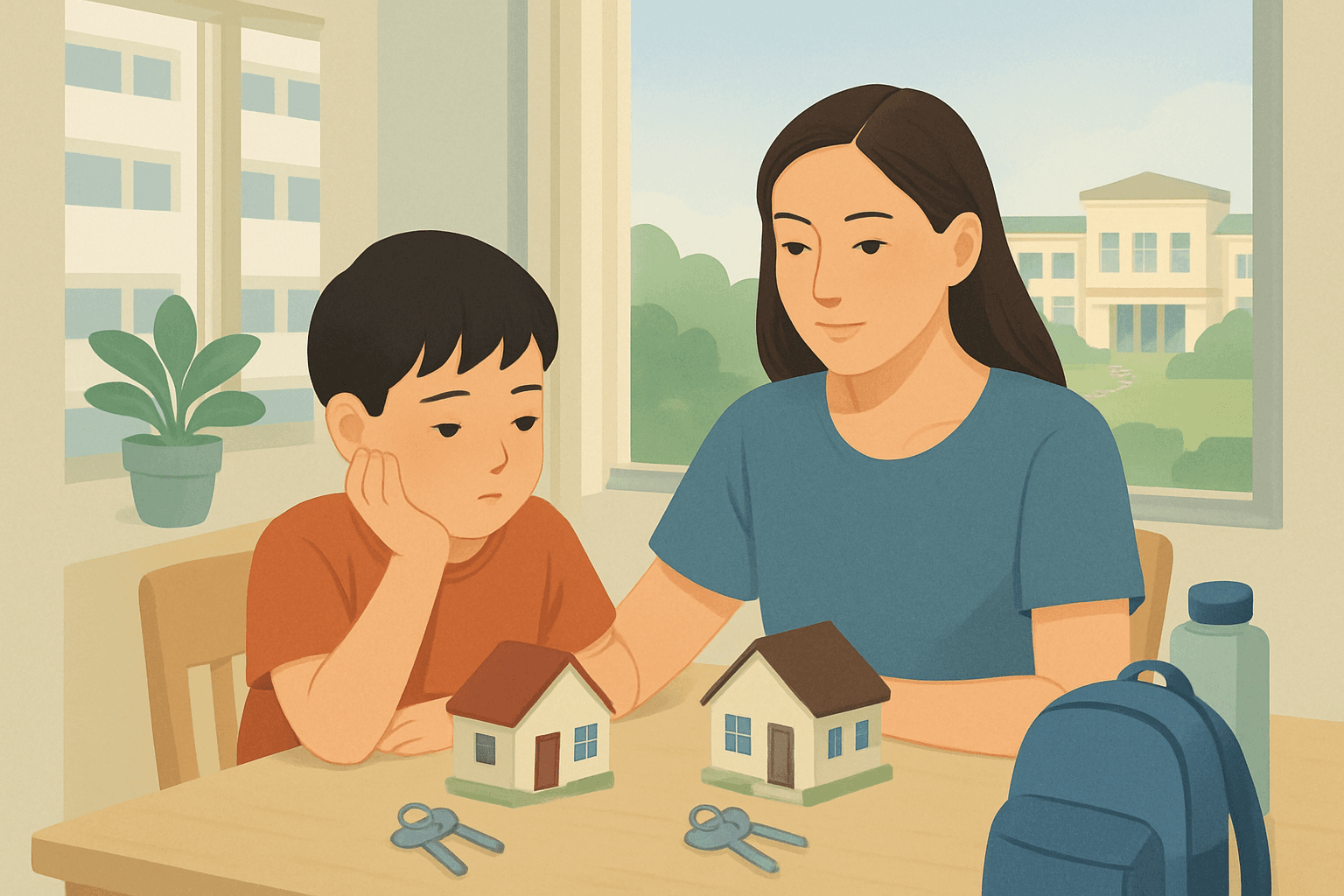
Many parents mix up legal custody and the home address used for Primary 1 registration. For P1, the useful question is usually not who has custody on paper, but which home genuinely reflects the child’s normal living arrangement during the school week. This guide explains how to think about that address, how it can affect distance priority and balloting risk, and what to do when a child lives mainly with one parent or splits time between two homes.
Short answer: which home address should you use for P1 registration if there is joint custody?
Joint custody does not automatically let parents choose any address. Use the home that genuinely reflects your child’s school-week routine and that both parents can support if questioned.
Do not assume joint custody means you can freely pick whichever parent’s address gives a better school distance. The safer address is the one that actually reflects your child’s school-week home base and can be explained consistently if MOE or the school asks.
MOE has specific guidance for separated or divorced parents, and its FAQ on joint custody situations shows that unresolved disputes are taken seriously. In practical terms, the address should match real life: where the child sleeps most school nights, where mornings begin, and where school items are usually kept.
A simple way to think about it: the registration address is not just a planning tool. It needs to line up with the child’s actual routine well enough that both parents can support it if asked. For a broader overview, see Primary 1 Registration in Singapore: How It Works, Balloting Risk, and How to Choose a Realistic School Plan.
For Reference for P1 registration: MOE Official Letters
Question With regards to the P1 registration exercise, is it necessary to produce NRICs of both parents even if the parents are divorced? Will it be sufficient to produce the NRIC of the parent who has custody of the child, along with any document proving the divorce? MOE's reply Dear Mr xXx, Thank you for your email on 16 July 2012. We would like to share that as you did not provide further information, you may wish to know that the parent who has sole custody of the child will need to produce
*** READ ME FIRST !!! - P1 Registration FAQ ***
2A need to apply at school , so withdrawal also need to be at school. Then go over to school B for registration. Consider time for travel, withdrawal take 5-10min. Buffer 1.5 hours would be safe if driving. If you can let us know your 2C choice , we can tell you the risk. It might be worth just to go 2C
What matters more for P1 planning: custody papers or where your child actually lives?
For P1 planning, custody and address are not the same thing. The stronger question is which home actually functions as your child’s normal school-week residence.
For school planning, the child’s actual living arrangement is usually the more useful starting point. Custody papers set out parental rights and responsibilities, but they do not automatically answer which address is the most defensible for P1 registration.
The source material here confirms that MOE has separate guidance for divorced or separated parents, but it does not give a simple rule such as “always use Parent A” or “either address is fine.” So the practical test is: where does your child usually sleep on school nights, where do weekday mornings begin, and which home functions as the term-time base?
If those answers point clearly to one home, that is the address parents should treat as the main planning option. If you want the broader registration context, AskVaiser’s Primary 1 Registration in Singapore guide explains phases, distance, and balloting in one place. For a broader overview, see Primary 1 Registration Distance Priority: How Home-School Distance Works.
Questions on new rules of P1 registration
With the announcement of the new rules of P1 registration - that citizens now have advantage over PRs, I have 2 questions: 1. Does the living distance to the school matter (ie 1 km away)? 2. If the PR has an older child in the school already, is priority given to the child’s younger sibling? Thanks!
Address for P1 Registration (Phase 2B)
Hi Parents, May I check if anyone has encountered this situation and managed to register successfully under Phase 2B? I am currently an active GRL (Grassroots Leader) in the Punggol area, but I intend to shift to another area in June 2026. My questions are: Do I need to update my address before receiving the Phase 2B verification letter, or can I update it after receiving the letter? For Phase 2B registration, will MOE base eligibility on the residential address shown on my NRIC? is it ok if the
Have More Questions?
Get personalized guidance on schools, tuition, enrichment and education pathways with AskVaiser.
Try AskVaiser for Free →If my child lives mainly with one parent, can that address usually be used?
Yes, if that home is your child’s genuine school-week base, it is usually the first address to consider for P1 registration.
If one parent’s home is clearly the child’s main weekday base, that is usually the first address parents should plan around. This is the most common arrangement after separation or divorce, and it is usually the easiest to explain because the child’s routine is straightforward.
For example, if your child stays with the mother from Sunday to Thursday, does homework there, and leaves for school from there most mornings, that home is the stronger starting point. If the child stays with the father during the school week because childcare, grandparents’ support, or work schedules are built around that address, then the father’s home may be the more realistic one, even if weekends are spent elsewhere.
What parents often miss is that regular weekend access does not automatically make both homes equally strong for registration. If one home clearly carries the weekday routine, that is usually the more credible address to plan from. For a broader overview, see Which Home Address Counts for Primary 1 Registration in Singapore?.
*** READ ME FIRST !!! - P1 Registration FAQ ***
Can someone tell me if this rule is new starting from this year or was it around before? Extracted from MOE FAQ under Proximity to School FAQ 4. How long do we need to stay in the address used to register our child during the P1 Registration Exercise? In a small number of cases, there may be situations where the families are unable to remain at the address for the entire duration of the primary school studies. Even so, a child who gains priority admission into a school through his/her distance c
*** READ ME FIRST !!! - P1 Registration FAQ ***
Will you still be staying with your in-laws if your son is admitted to a school in Sengkang? You should only register using the address where you will be physically located. By the way, if your son fails to get into the school in P2C, you can only register him in P2CS. Those popular schools will have their places filled by P2C, so is there any point in changing your address back to Sengkang?
If my child spends time at both homes, which address is safer to use?
Use the address that is most credible as your child’s main school-week home and easiest to explain consistently.
When a child spends meaningful time at both homes, the safer address is usually the one that is easiest to defend as the main home for schooling purposes. In most families, that comes down to the weekday pattern rather than the total number of nights in a month.
Start with the practical anchors. Where does your child sleep before school days? Where are the uniform, books, and homework materials kept? Which home do morning drop-offs, bus routes, or grandparents’ help revolve around? If one address keeps showing up as the school-week base, that is usually the safer one to use.
Shared care can look equal on paper while still being uneven in daily life. A child may alternate between homes but still rely on one address for school mornings, after-school care, and most term-time routines. For school registration, the strongest address is the one you can honestly explain, not the one that merely looks better on a map. For a broader overview, see Primary 1 Registration Documents Checklist: What Singapore Parents Commonly Prepare.
Share with us your kid's P1 registration experience
Pardon me if this question has been answer before. If we registered in P2B and given a place, can we still withdraw at P2C to register at the 1st choice school if chances are very high? :?
Share with us your kid's P1 registration experience
Hi Spies, Er...did you know your son is due for P1 registration ? In any case, you are lucky to have a hubby to attend to this VERY important matter. Congrats, your child confirmed a place.
What parents often misunderstand about using the “better” address
Do not choose an address only because it gives better distance priority if it does not also match the child’s real living arrangement.
A closer address is not automatically the safer address. The common mistake is to treat the registration address as a distance advantage first and a factual question second. That can backfire if the address does not match the child’s real living arrangement or if the other parent disputes it.
MOE’s joint custody FAQ says that if a dispute cannot be resolved, MOE reserves the right to place the child in another school with vacancy. The practical lesson is simple: do not build your plan around the “better” address unless it is also the more supportable one.
*** READ ME FIRST !!! - P1 Registration FAQ ***
We will move to Singapore in December 2015 (house-hunt scheduled by company in November) which means we won’t have a local address to specify during the Primary 1 registration scheduled on August 27. Can someone give us ideas on how to go about the registration? Can we specify an office address (which is going to be near where we plan to look for a house), or our intended location (without a specific address) ? Really need help with these questions as MoE simply responded with “you need to have
*** READ ME FIRST !!! - P1 Registration FAQ ***
For Singaporean - The child’s Singapore Birth Certificate - The child’s Singapore Citizenship Certificate for those who are not Singapore Citizens at the time of birth - Singapore NRIC of both parents or Entry / Re-entry Permits of parents if they do not possess Singapore NRIC - The child’s Immunisation Certificates For PR - The child’s Birth Certificate - The child’s Entry/Re-entry Permit - Singapore NRIC of both parents or Entry/Re-entry Permits of parents if they do not possess Singapore NRIC
How does address choice affect distance priority, balloting risk, and your school shortlist?
Your address affects distance banding, so it changes both priority assumptions and how risky your school shortlist really is.
The address matters because it affects how close your child appears to the school, and that can change distance priority and balloting risk. A school may look realistic when measured from one parent’s home but much less realistic when assessed from the address that is actually easier to support.
A practical way to plan is to separate hopeful options from defensible options. First, map schools from the address that best matches your child’s real living arrangement. Then ask whether your preferred schools still make sense from that address. If a target school only looks viable when measured from a weaker or disputed address, treat it as a higher-risk option, not your baseline plan.
If you are unsure, it helps to build two lists: a main shortlist based on the address you are most likely to be able to support, and a backup list based on a less favourable distance scenario. That avoids the common mistake of planning as if the best-case address is already settled. AskVaiser’s guides on how home-school distance works, which home address counts for P1 registration, and how to read past balloting data before chasing a popular primary school can help you stress-test the shortlist more realistically.
Do not plan from the most favourable address. Plan from the most supportable one.
*** READ ME FIRST !!! - P1 Registration FAQ ***
P1-IS is now offered for ALL participating Primary schools (see the http://www.moe.gov.sg/education/admissions/primary-one-registration/phases/ under \"Registration Procedures\" and \"Phase 2C/Phase 2C Supplementary\"). However, please note that 8 out of the past 9 years, Kong Hwa school required balloting for Singaporean Citizens under 1km in Phase 2C. I suggest that you work on an alternative school for Phase 2C instead, given that you are between 1km and 2km.
*** READ ME FIRST !!! - P1 Registration FAQ ***
Yes. You and your spouse need to be stationed in the two schools - one in the P2A1 school and the other at the P2C school. Once you have decided to register with the P2C school, the one who is at the P2A1 school needs to withdraw your child's application before the one at the P2C school is able to proceed with the registration. Depends. If the school traditionally has balloting in the distance category you are in, you will only know the result of your application on the day of balloting. Please
What documents are commonly useful if the school asks for proof of the address?
Prepare documents that support the address you plan to use, such as proof of residence and records that show your child’s normal home base.
There is no fixed official checklist in the source material here for every joint-custody address situation, so parents should not expect one perfect set of documents that fits all cases. The practical goal is to prepare documents that tell one coherent story about where the child actually lives.
Common examples parents often keep ready include proof of residence for the address being used, court orders or parenting-plan documents where relevant, and everyday records that support the child’s normal home base. Depending on the family’s situation, that might include official letters sent to that home, preschool or childcare correspondence, clinic records, or other papers that show the child is actually based there during the school week.
These are examples, not guaranteed requirements and not an official MOE list. The useful test is consistency: if you are saying the child mainly lives at one home on school nights, the papers you keep ready should broadly support that explanation rather than point in different directions. For a broader view of what parents commonly prepare, AskVaiser’s P1 registration documents checklist is a useful companion guide.
Share with us your kid's P1 registration experience
Hi parents, I've gone through 2 rounds of registration for my kids - Phase 2B 5 years ago (2006) and Phase 2A2 (2010). For son's P1 registration at Pei Hwa then, there was just 1 stop - ie to submit documents for verification. No guarantee at Phase 2B, just a high chance of getting in. Today's registration for daughter is slightly longer - 3 'stops'. Station 1 is at ground floor where a lady will make sure we are eligible for Phase 2A2. If so, then we proceed to the hall on 2nd floor. Station 2
Share with us your kid's P1 registration experience
My P1 registration story.... My dd was due for P1 registration 4 yrs ago and since I also have a ds (2 yrs apart), it makes sense to choose a co-ed school. The best co-ed sch around my neighbourhood (1-2km) is Rulang Pri Sch. Cos dd is the 1st born and having no experience whatsoever with the pre-P1 registration exercise, I was too late in being a PV for the school. Then i started to pull all strings (my great grandfather helped to start the sch during the pre-war, kampung days, my late father h
What if my ex-spouse and I disagree on which address to use?
Resolve the address issue before registration if you can. If you cannot agree, do not assume a disputed address will safely hold up just because one parent prefers it.
Try to resolve the disagreement before registration starts. If parents with joint custody cannot agree, it is risky to assume one parent can simply proceed on a preferred address and school choice without consequences.
This is where MOE’s wording matters. In its FAQ for joint custody situations, MOE says that if a parent cannot contact the current or former spouse to obtain consent, and there is a dispute that cannot be resolved, MOE reserves the right to place the child in another school with vacancy. The practical lesson is to align early on the child’s main residence, the address to be used, and the documents that support it.
If the disagreement is fundamental, for example each parent insists on a different “main” home for school purposes, treat that as a planning risk rather than a small paperwork issue. Build a backup shortlist and avoid relying on a fragile distance advantage. If you are also thinking about what happens when a preferred school does not work out, AskVaiser’s guide on what happens if you do not get your preferred school is a useful next read.
*** READ ME FIRST !!! - P1 Registration FAQ ***
Hi everyone, just to double triple confirm that the 30 months means we have to stay at the registered address for 30 months upon the P1 registration and NOT stay there for 30 months before we can register our child right?
*** READ ME FIRST !!! - P1 Registration FAQ ***
All P1 registration phases are held consecutively, ie. one after the other. So Phase 2A(2) is held after Phase 2A(1), and not simultaneously. You are allowed to participate in any Phase, and apply for any school in any Phase, subject only to citizenship, distance, and other Phase-specific criteria (eg. PV, alumni, etc). You can always apply to the same school in later Phases even if you failed in earlier Phases. As for your address, there is no requirement on the length of time you stay at the a
What should you do before registration day to avoid mistakes?
Confirm the child’s main residence, align on the address early, prepare supporting papers, and plan schools from the address you can realistically support.
- ✓Confirm where your child usually sleeps on school nights and which home functions as the real weekday base.
- ✓Agree early, if possible, on the address both parents will rely on for registration and school planning.
- ✓Read MOE’s guidance for divorced or separated parents before submitting any details.
- ✓Gather example documents that support the address you plan to use, such as proof of residence or custody-related papers.
- ✓Build your school shortlist from the address you can realistically defend, not the one you merely hope to use.
- ✓Prepare a backup school plan if your preferred schools are competitive or your distance advantage is uncertain.
- ✓If there is an active disagreement between parents, sort that out before treating any school-distance assumption as reliable.
Have More Questions?
Get personalized guidance on schools, tuition, enrichment and education pathways with AskVaiser.
Try AskVaiser for Free →