
Primary 1 Registration for an Adopted Child in Singapore: Documents Parents Usually Need
What to prepare if names, parent details, or adoption records are still being updated before P1 registration.
For a Primary 1 registration adopted child case in Singapore, the school process is usually the standard one. The main difference is the paperwork trail. Parents should check that the child's current legal name is used consistently, keep official papers that show the adoptive parent-child relationship, and prepare a simple explanation for any old-versus-new record mismatch. There is no adoption-only checklist in the source material reviewed, so the safest approach is to prepare a practical folder rather than wait for a perfect official list.
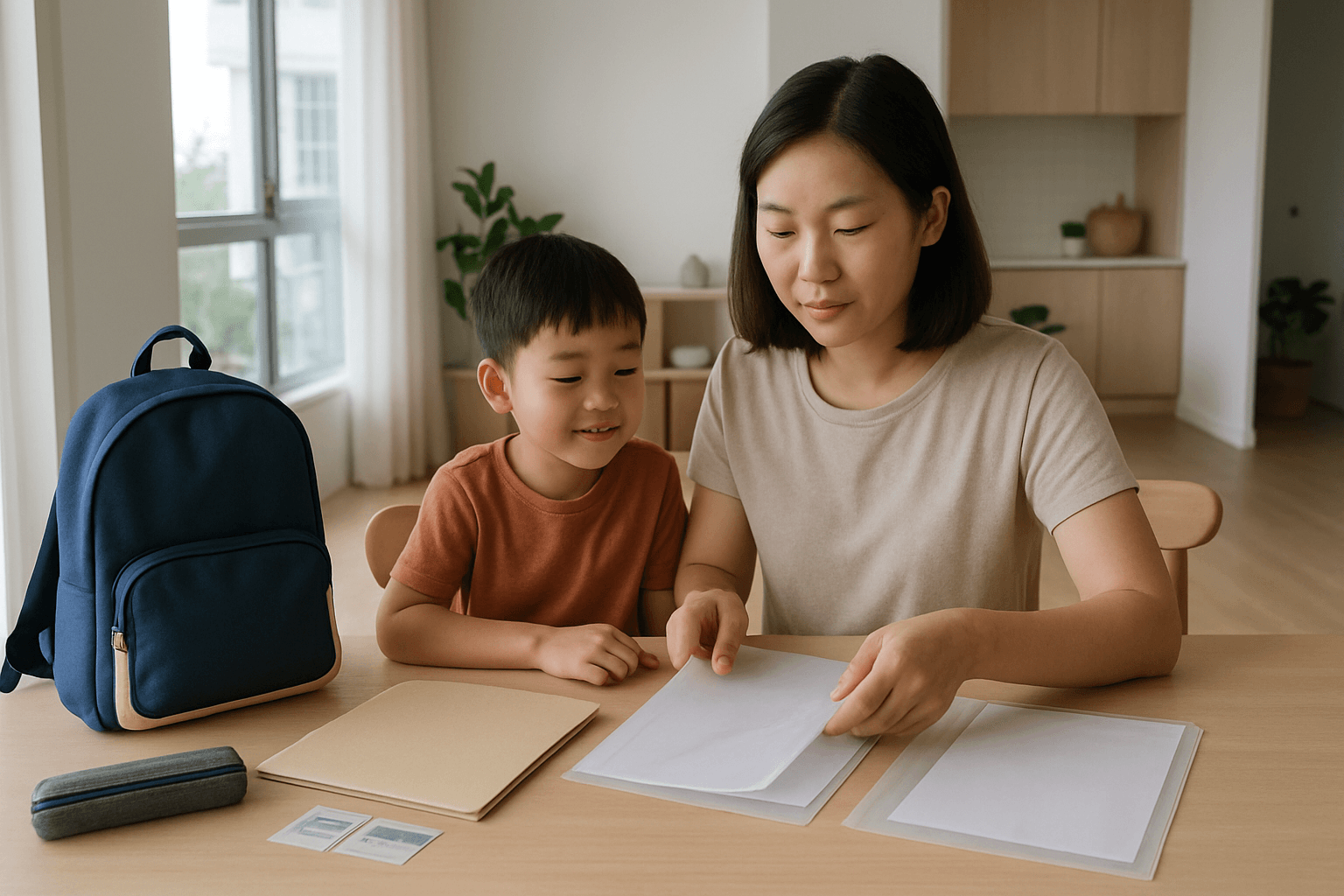
If you are registering an adopted child for Primary 1, the main question is usually not which admissions route to use. It is whether the child's name, identity records, and parent details line up clearly enough for the school to process the registration smoothly. In practice, parents usually do best when they check for mismatches early, keep adoption-related documents together, and resolve any recent record updates before registration begins. For the wider process, timelines, and school-choice strategy, see our Primary 1 registration guide.
What changes for Primary 1 registration when a child is adopted?
Usually, the admissions process stays the same. The difference is that adopted-child cases often need cleaner paperwork, especially where names or parent details have changed.
Usually, the registration route does not change. What changes is the paperwork. The school still needs to understand who the child is, what name should be used, and how the adoptive parent-child relationship is shown in the documents.
A useful way to think about it is this: adoption changes the admin, not the admissions path. If the adoption was completed some time ago and the child's official records already show the current legal name and parent details, the process may look very similar to any other family's case. If the adoption was only recently finalised, the school may need a clearer document trail to connect older records with the current ones.
Typical situations include a child whose updated records already match the adoptive family details, which is usually straightforward, or a child whose school form uses the current name while an older record still shows the birth name. Another common scenario is that one parent submits the registration, but the school later asks for both parents' particulars because the adoption papers refer to both. For the broader P1 process, MOE's general FAQ and our full Primary 1 guide are good starting points.
Give citizens priority in Primary 1 registration
Ha.ha. maybe next time the P1 registration phase can propose like that, just a suggestion: Phase 1 – Existing siblings in the Primary school except PR siblings. Phase 2A(1) – No Change Phase 2A (2) – No Change Phase 2B – No change Phase 2C – Singapore Citizenship Only. Phase 2C Supplementary - Singapore Citizenship Only Phase 3A – Permanent Residents Phase 3A Supplementary - Permanent Residents Phase 4 – Non Citizen.
All About Preparing For Primary One
Starting primary school? This is a big milestone. Do enjoy the journey with your child! :rahrah: https://www.straitstimes.com/singapore/education/the-st-guide-to-preparing-your-child-for-primary-1 Parents often confuse being ready for school with being academically capable in skills like reading and counting. Instead of focusing solely on academic progress, it is more important to make learning an enjoyable process, and help your child have a swift and happier adjustment to primary school. Here
Which adoption-related documents do parents commonly prepare?
Parents often prepare adoption papers, the child's current identity or birth records, both parents' NRICs, and any document that explains an old-versus-new mismatch.
There is no adoption-only Primary 1 checklist in the source material reviewed, so it is better to prepare a practical working folder than to search for one perfect official list.
In real cases, families commonly keep ready the child's current identity or birth-related records, adoption-related court or official papers, and both adoptive parents' identification. Examples may include an adoption order or other official adoption papers, the child's birth record or updated birth record if available, the child's identity document if one has already been issued or updated, and both parents' NRICs. Some parents also keep documents that connect older records to newer ones, especially if the child's name or parent details changed during the adoption process.
The key question is simple: if the school notices a mismatch, can you explain it immediately with documents in hand? That is usually more useful than trying to memorise a long list. If you want the wider set of paperwork many families prepare for P1, our Primary 1 registration documents checklist can help you build a practical folder.
Share with us your kid's P1 registration experience
Hi parents, I've gone through 2 rounds of registration for my kids - Phase 2B 5 years ago (2006) and Phase 2A2 (2010). For son's P1 registration at Pei Hwa then, there was just 1 stop - ie to submit documents for verification. No guarantee at Phase 2B, just a high chance of getting in. Today's registration for daughter is slightly longer - 3 'stops'. Station 1 is at ground floor where a lady will make sure we are eligible for Phase 2A2. If so, then we proceed to the hall on 2nd floor. Station 2
Preparing Your Child for Primary School:Parent Seminar - MOE
Preparing Your Child for Primary School: A Parent Seminar by MOE Starting primary school is a big step in your child's life. To help you better understand primary school programmes and enable you to make key education decisions, the Ministry of Education will be conducting a seminar on Primary School Education. At the seminar, parents can look forward to sharing sessions by the school principal and a parent volunteer, as well as view the various programmes our primary schools provide. The Primar
Have More Questions?
Get personalized guidance on schools, tuition, enrichment and education pathways with AskVaiser.
Try AskVaiser for Free →How should the child's name appear across school and identity documents?
Use the child's current legal name consistently where possible, and keep a clear document trail if any older record still shows a previous name.
The safest approach is to use the child's current legal name consistently across the registration form and the main supporting documents you expect the school to rely on.
Name mismatches are one of the easiest ways to create avoidable delays. A child may already be using the adopted name at home and on newer records, while an older birth-related document still shows the birth name. Or a parent may fill in the school form using the current surname, but one supporting paper still reflects the pre-adoption name. These situations do not automatically stop registration, but they are much easier to handle when you bring documents that clearly connect the two names.
Before registration, compare every document side by side. Check the child's full name, spelling, order of names, and surname. If one record still shows older details, keep it available, but also keep the document trail that explains the change. The goal is not to pretend the earlier name never existed. The goal is to make the transition from old record to current record obvious to the school. For a broader overview, see Who Is Eligible for Primary 1 Registration in Singapore?.
School Placement Exercise for returning S'porean children
Singaporean children returning from overseas and wishing to join secondary schools and junior colleges at the start of the academic year in 2010 can register for the School Placement Exercise from August 3. http://www.moe.gov.sg/education/admissions/returning-singaporeans/
Help for little girl with no birth cert - P1 registration
Her uncle can adopt her and get the lawyers to do legal papers for her BC to be issued again? In the long run, she will need her BC for many matters so I think it is only right to get her BC replaced. just my 2cts worth. And in Singapore, primary education is compulsory right? So she should be admitted to school.
What proof of parent-child relationship may help during registration?
Keep official documents that clearly link you to the child, especially if names or parent details do not yet match across all records.
If the school needs clarification, parents should be ready to show official documents that make the legal parent-child relationship easy to understand. This matters most when parent details differ across records, when the child's surname has changed, or when the adoption was only recently completed.
In practice, families often rely on adoption-related court or official papers, updated birth-related records if available, and both parents' identification documents. The useful test is whether a person looking at the file can quickly see how the child on one document connects to the parents on another.
Many parents overcomplicate this step. You are usually not being asked to retell the family's whole legal history. You are trying to bridge gaps between documents. For example, if an older record still shows earlier parent details but a later official paper shows the adoptive relationship, keep both ready so the school can follow the paperwork trail. If you are also checking whether your child fits the standard intake conditions, our guide on who is eligible for Primary 1 registration in Singapore is a useful companion read. For a broader overview, see Primary 1 Registration Phases in Singapore: What Each Phase Means for Your Chances.
All About Preparing For Primary One
You should have seen the way the mum drilled the poor child, depriving him of food till he completed his revision. Obviously, an uninterested child will only retain the information into his short term memory. Preparing a child for primary 1 is more than just the academics. There are several areas that parents have to take note of. Does your child know how to clean up after himself if he does a big business in the toilet? Does your child know how to wash his hands correctly and rinsed his hands p
Give citizens priority in Primary 1 registration
http://www.guidemesingapore.com/permanent-residence/singapore-pr-pros-and-cons.htm Quote from above : If your children are school-aged, they are high on the priority list, behind citizens, to enter public schools of your own choosing. Non PRs are at the bottom of the list and are often left with no choice when it comes to schools.
If the adoption is recent, what should you sort out before registration opens?
Start with what is already finalised, then identify every mismatch or pending update before registration week.
- ✓Check which name appears on the child's current identity or birth documents and compare it with the name you plan to use on the school form.
- ✓Gather the adoption papers you already have, such as court or other official adoption documents, even if some other records are still being updated.
- ✓Keep both adoptive parents' NRICs and contact details in the same folder so they are easy to produce if the school asks.
- ✓Identify any document that still shows an older name or earlier parent details so you are not surprised during registration.
- ✓Prepare a short plain-language note to explain any mismatch between old and new records.
- ✓If some updates are still pending, contact the school early and ask which supporting documents they would like to see for clarification.
Which documents should both adoptive parents keep ready, if relevant?
If both adoptive parents are part of the child's records, prepare both sets of identification and contact details from the start.
If both parents are part of the child's legal and household records, both should keep their identification and contact details ready, even if only one parent actually handles the registration.
A common mistake is preparing only the submitting parent's details and assuming the rest can wait. In practice, schools may later need the other parent's particulars as well, especially if the supporting documents refer to both adoptive parents or if the records are still being aligned.
A practical setup is simple. Keep both NRICs accessible, make sure both parents' phone and email details are current, and place any adoption-related papers in the same folder so they can be shown quickly if the school asks. This matters most in real-life situations where one parent submits the application while the other is at work, overseas, or unavailable at that moment.
All About Preparing For Primary One
Dear parents, I hope parents could share your experience regarding the preparation for primary school and time schedule spend with your kids everyday. I have a son of 6 this year going to P1 next year. I would like to find out with parents things that you are doing with your child prior going P1, cos I do not want to react too kan-jiong or too relax in front of my child. I am particularly concerned about the 3 main subjects being taught in P1 and wonder should I expect him to be able to do the a
All About Preparing For Primary One
Was surfing around on understanding if I am well prepared on behalf of my DD1 for Primary 1 Chanced upon a few websites, thought to share though it could have been mentioned before Tips For Parents ◦Work on independent reading skills. ◦Set up a study area and regular study times that are not interrupted. ◦Learn to follow a routine with a lot of sleep and early mornings. ◦Practice organisation and planning by packing a daily bag with essentials for the day. ◦Talk about social skills and communica
What is the most common mistake parents make with adopted-child registration?
The biggest mistake is not checking for name and parent-detail mismatches until registration week.
The most common mistake is leaving document mismatches until the last minute.
The issue is usually not the school place. It is the paperwork trail. Parents often use the child's current name on the form, then realise too late that the supporting record still shows an older name or earlier parent details. Another mistake is assuming the school will automatically infer the adoptive relationship from incomplete papers. Small gaps are much easier to handle when you spot them early and have the documents organised.
All About Preparing For Primary One
hi, for parents with kids in pre-nursery / nursery, these two initial years are “honeymoon” years, usually quite relaxed. But for parents with kids in k1, k2, where you are stepping on the final last lap accelerator for more oil to speed up momentum, help yr child prepare Pri 1, it is always good to attend - one year ahead in advance, the parents’ briefing on detailed Pri 1 curriculum. do not wait until the year when your child has started Pri 1, then come to attend such parents’ briefing. why ?
Give citizens priority in Primary 1 registration
BTW I wrote ths to ST but it never got posted: In her letter, Mrs Agawal have hit the gist of why PR students should not be given equal chance for Primary 1 registration. She says that if her children were unable to secure a place in a good public school, why would her family to stay? A Singpore citizen will never be able to say that. We are here to stay and as such deserve the right to choose before a permanent resident. My son, a 4th generation Singaporean, was not able to secure a place in a
How can parents prepare early so registration goes smoothly?
Create one organised folder, check every name and parent detail in advance, and note any mismatch before you apply.
Start by making one simple registration folder, whether digital or physical, before you start comparing schools. Put the child's identity records in one group, the parents' identification in another, and the adoption-related papers in a third. Then compare the details across them.
The most useful early check is basic but often missed: does the child's name match across the records you are actually planning to use? If not, which document explains the difference? Parents usually save time when they write a short note to themselves stating which records are current, which still show older details, and which updates are still pending. That note does not need legal wording. It just needs to help you answer questions clearly if the school asks.
Many parents spend more energy analysing school popularity than stress-testing their paperwork. For adopted-child cases, the paperwork review often matters more. If you are still planning the rest of your application, our Primary 1 registration guide, documents checklist, and phases explainer can help you prepare the wider process.
All About Preparing For Primary One
My girl is in P1 this year. Based on my experience, I think you are doing a fine job so far... As long as kids go to pre school, they are more or less ready for P1 because topics cover in first semester are very similar to what they will be learning in K2... I did buy some assessment books for my girl when she was in K2 because she had so much free time after school. Whether to draw up a time table is subjective... it definitely incultivate good habits which may be ideal when he starts P1. Prepa
How to Prepare For Primary School
You have to start teaching your child one to one and start from scratch. This is crucial year to prepare your child. Your child MUST be able to recognise high frequency words, can read, can spell some simple words, comprehend questions and answer logically, write neatly etc. please start preparing now before he goes P1. Share a personal experience with you. My friend has a son who enrolled in a new kindergarten in K2 this year. The boy's new teacher was shocked to discover that he could not reco
Can I register my adopted child for Primary 1 if the adoption is not fully reflected in all documents yet?
Possibly, yes. The key is whether you can show enough current and supporting documents for the school to verify the child's details and your relationship clearly.
Possibly, but do not assume a mismatch will be ignored or automatically block the registration. The practical question is whether the school can clearly verify the child's identity and your relationship to the child from the documents you can show now.
If some records are already updated and others are still pending, bring the documents that are finalised, keep any adoption-related papers that explain the relationship, and be ready to point out exactly which details are still being updated. For example, you may already have an adoption-related court document and current parent details, but one older birth-related record may still show an earlier name. In that situation, parents usually do better when they explain the mismatch upfront rather than waiting for the school to discover it later.
If your case is recent or the paperwork is not fully aligned, contact the school early and ask what supporting documents they would like to see for clarification. That does not create a separate admission route, but it can reduce last-minute confusion and help you register with a cleaner document trail.
All About Preparing For Primary One
the standard of kindergarten and child care centres in SG varies from one another. Some kindy prepare kids well for P1, but other kindy not sufficient. The standard varies. moreover, P1 standard is getting higher and higher, each year. that is why some parents still prefer to send kids for P1 Prep course. if you think you come from a kindy where then standard is reasonable, then ok.
Preschools prepared your kids well for Singapore primary?
For parents who have already been through the pre-school days and with kids now in primary schools (Singapore schools), can you share your comments on your kid's previous preschool and their curriculum - specifically if they have prepared your child properly for the Singapore education system ? (not discussing the international or foreign schools system here) Nowadays, there are so many pre-schools and childcare centres with many learning methods. Parents currently at the pre-school stage will b
Have More Questions?
Get personalized guidance on schools, tuition, enrichment and education pathways with AskVaiser.
Try AskVaiser for Free →