
Primary 1 Registration When Parent and Child Have Different Surnames
A different surname usually is not the issue. The practical question is whether the adult registering the child can show the relationship or legal authority if asked.
No. A different surname between parent and child does not automatically affect Primary 1 registration in Singapore. The key issue is whether the adult registering the child can show the parent-child relationship or legal authority if verification is needed, so it is sensible to prepare the child's birth certificate, the registering adult's ID, and any supporting family or legal documents that help explain the relationship.
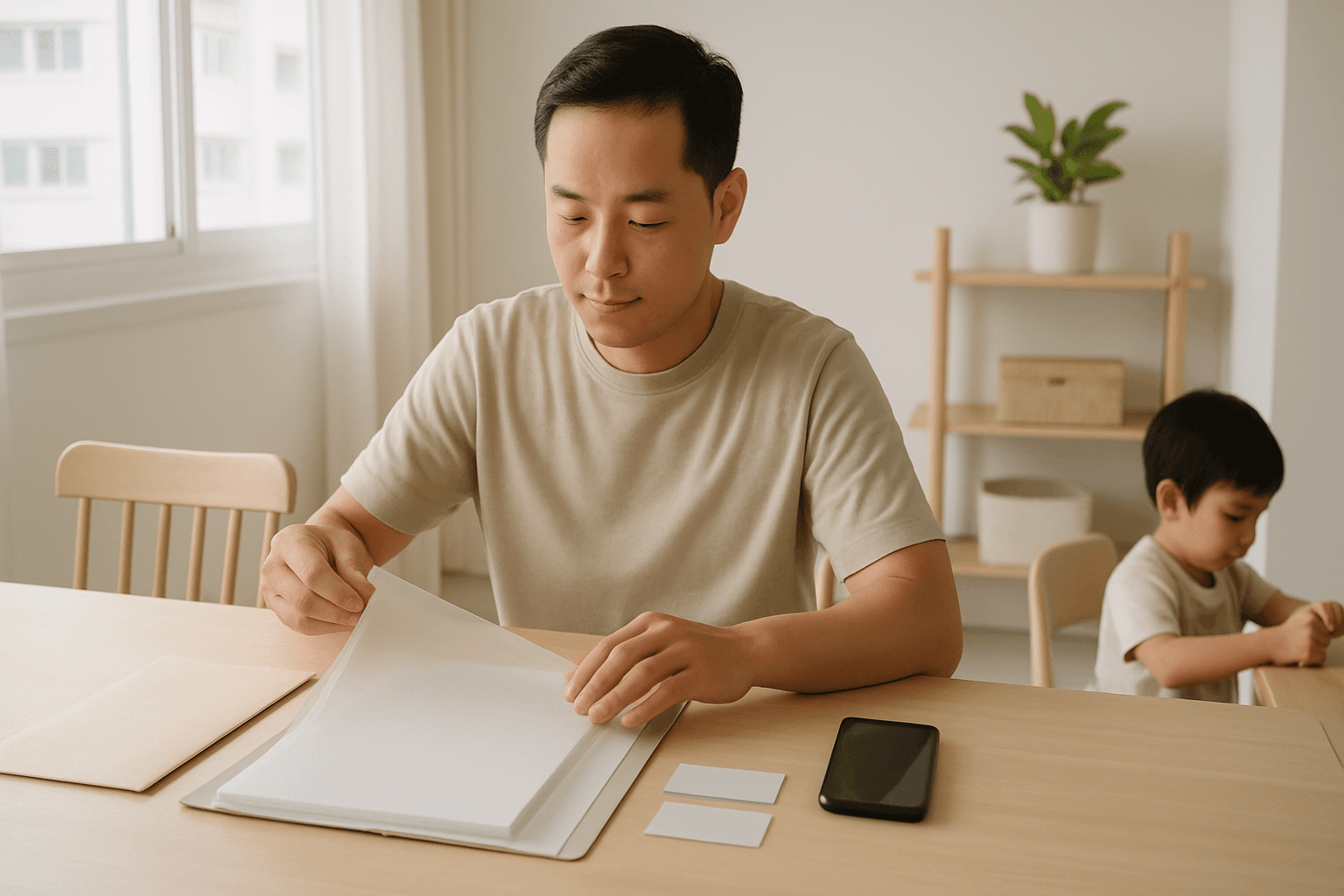
If your surname is different from your child's, the first thing to know is simple: it usually does not stop Primary 1 registration. The real question is whether the adult handling registration can show who they are and how they are connected to the child.
In most families, the documents already make this clear. In less straightforward situations, such as guardianship, adoption, or step-parent involvement, it helps to prepare supporting papers early instead of trying to explain everything on the spot.
That matters because Primary 1 registration is not optional for Singaporean children, and MOE has said it follows up when a child is not registered. So the useful move is not to worry about the surname itself. It is to get the right documents ready before the registration window opens.
Will a different surname stop my child’s Primary 1 registration?
Usually no. A surname difference by itself should not block registration.
Usually, no. In the MOE materials reviewed for this topic, there is no surname-matching rule saying a parent and child must share the same surname for Primary 1 registration. What matters in practice is whether the adult registering the child can show the parent-child relationship or legal authority if the school needs to verify it.
Think proof, not surname. A mother may keep her maiden name after marriage. A child may use the father's surname. Families may also have different spellings or transliterations across documents. These are ordinary situations. The avoidable problem is not the name difference itself. It is arriving without clear documents when the school needs to confirm the family link.
If you want the wider process first, start with our guide to Primary 1 registration in Singapore and MOE's Primary 1 registration FAQ.
Give citizens priority in Primary 1 registration
Ha.ha. maybe next time the P1 registration phase can propose like that, just a suggestion: Phase 1 – Existing siblings in the Primary school except PR siblings. Phase 2A(1) – No Change Phase 2A (2) – No Change Phase 2B – No change Phase 2C – Singapore Citizenship Only. Phase 2C Supplementary - Singapore Citizenship Only Phase 3A – Permanent Residents Phase 3A Supplementary - Permanent Residents Phase 4 – Non Citizen.
Are All Primary Schools The Same?
Are All Primary Schools The Same? U can tell from the P1 registration statistics. If all schools are the same then we should see a well evenly distributed of applicants for all schools. But we are definitely not seeing that happening.
What does MOE or the school usually need to verify?
They usually need to confirm who the adult is and whether that adult is authorised to register the child.
They usually need to confirm two things: who the adult is, and whether that adult is authorised to register the child. That is why the real issue is identity and authority, not whether the surnames match.
A straightforward case is a biological parent whose details are already clear from the child's core documents. A less straightforward case is a guardian registering the child, or a step-parent helping with the paperwork because they handle daily school matters. In those situations, the school may ask for documents that show how that adult is connected to the child or why they are allowed to act.
Parents sometimes read a document request as a sign that something is wrong. Usually it is just a normal verification step. For the bigger registration structure, our guide on Primary 1 registration phases explains where document checks can come up. For a broader overview, see Primary 1 Registration Documents Checklist: What Singapore Parents Commonly Prepare.
For Reference for P1 registration: MOE Official Letters
Question With regards to the P1 registration exercise, is it necessary to produce NRICs of both parents even if the parents are divorced? Will it be sufficient to produce the NRIC of the parent who has custody of the child, along with any document proving the divorce? MOE's reply Dear Mr xXx, Thank you for your email on 16 July 2012. We would like to share that as you did not provide further information, you may wish to know that the parent who has sole custody of the child will need to produce
All about Transferring to Other Primary Schools
Hi hennaoh, Please refer to the FAQ below. Does it address your situation? https://va.ecitizen.gov.sg/cfp/customerPages/moe/ExploreFaq.aspx?Category=3645&Mesid=422335 Q:- I am in the midst of purchasing a new resale property. The transaction will be completed soon and I will be able to move in prior to the commencement of the academic year. Can I make use of this new address to register my child? Answer: The resale Housing & Development Board (HDB) flat's/ private property’s address can be used
Have More Questions?
Get personalized guidance on schools, tuition, enrichment and education pathways with AskVaiser.
Try AskVaiser for Free →What documents should parents prepare in advance?
Prepare likely identity and relationship documents early, even if the school may not need all of them.
- ✓These are common examples parents often prepare, not an official or guaranteed MOE checklist.
- ✓The child's birth certificate or another core identity document that helps show the parent-child relationship.
- ✓The registering adult's NRIC, passport, or other identification document.
- ✓A marriage certificate if it helps connect the names appearing across the family's documents.
- ✓Any legal papers relating to guardianship, adoption, custody, or other authority to act for the child, if relevant.
- ✓Any document that helps link different names across records, such as old and new names, maiden names, or differing transliterations.
- ✓Clear photocopies and phone scans of the same documents in case the school asks for a follow-up copy.
- ✓A short note for yourself showing which document explains each surname difference, especially if several adults are involved.
What if the parents are married but have different surnames?
This is normal. Clear documents matter more than matching surnames.
That is common and usually not a problem. Many married couples in Singapore do not share the same surname, so a parent and child having different surnames is not unusual on its own.
What helps is making the family link easy to follow from the documents. For example, a mother may keep her birth surname after marriage while the child uses the father's surname. In another family, both parents may use different surname orders or transliterations across documents. In those cases, keep the child's birth certificate and both parents' identity documents ready, and keep the marriage certificate nearby if it helps connect the names.
The useful mindset is this: if the paperwork tells a clear story, most parents do not need a special explanation. For a broader overview, see Who Is Eligible for Primary 1 Registration in Singapore?.
Share with us your kid's P1 registration experience
Hi parents, I've gone through 2 rounds of registration for my kids - Phase 2B 5 years ago (2006) and Phase 2A2 (2010). For son's P1 registration at Pei Hwa then, there was just 1 stop - ie to submit documents for verification. No guarantee at Phase 2B, just a high chance of getting in. Today's registration for daughter is slightly longer - 3 'stops'. Station 1 is at ground floor where a lady will make sure we are eligible for Phase 2A2. If so, then we proceed to the hall on 2nd floor. Station 2
Questions on new rules of P1 registration
With the announcement of the new rules of P1 registration - that citizens now have advantage over PRs, I have 2 questions: 1. Does the living distance to the school matter (ie 1 km away)? 2. If the PR has an older child in the school already, is priority given to the child’s younger sibling? Thanks!
What if the parents are unmarried?
A surname difference still does not decide the case. Clear proof of the adult's role matters more.
An unmarried parent does not automatically face a registration problem just because the surnames differ. The more useful question is whether the documents clearly show that the adult registering the child is the parent or otherwise has the authority to handle the process.
A common example is a mother registering a child who uses the father's surname. That may still be straightforward if the child's documents clearly show the link. Another example is a father handling the registration when the available records do not make the relationship obvious at first glance. In that situation, it helps to prepare extra supporting documents early rather than assume a verbal explanation will be enough.
The key takeaway is simple: the school is not judging the family structure. It is trying to verify the correct adult quickly. If your documents do that clearly, surname differences usually become a minor detail. For a broader eligibility overview, see our guide on who is eligible for Primary 1 registration. For a broader overview, see Primary 1 Registration Phases in Singapore: What Each Phase Means for Your Chances.
What if a step-parent, adoptive parent, or guardian is handling registration?
For step-parents, adoptive parents, and guardians, legal authority usually matters more than surname matching.
In these cases, legal authority matters more than surname matching. A step-parent, adoptive parent, or guardian may have a different surname from the child, but the school is more likely to care about whether the documents clearly show that adult's legal role.
This is where parents should be especially organised. An adoptive parent should keep adoption-related papers ready if those documents help explain the legal relationship. A guardian should keep the documents that show guardianship or custody. A step-parent may handle the child's daily routines and school communications, but daily caregiving and legal authority are not always the same thing for registration purposes.
If your role is not obvious from the child's basic documents, do not rely on assumptions. Prepare the strongest papers you have and decide early who should handle the registration. In sensitive cases, a clear legal document usually matters far more than whether the names happen to match.
*** READ ME FIRST !!! - P1 Registration FAQ ***
if one can't turn up : the spouse that turn up still have to produce the other spouse IC. Schools need to check the address, appearing on both ICs (father & mother) in the event the P1 Registration Officer find that the address of father / mother differ from each other on both IC: the parent have to explain the reason(s) behind. if for any reason the Registration Officer find the address(es) on both parents' IC differ, or the reason / explaination provided make them feel suspicious / fishy about
*** READ ME FIRST !!! - P1 Registration FAQ ***
Hi all, Anyone knows how does registration work for unmarried parents? Checked on MOE Website and it mentioned that one parent may register if child’s birth cert only had the name of one parent. My child’s birth cert has both my and his father’s name. We were unmarried and not on good terms now.
What is the biggest mistake parents make about surname differences?
They focus on the names instead of preparing proof of relationship or authority.
They treat it as a surname problem when it is usually a paperwork problem. A different surname is not the red flag. Unclear proof is. Parents who bring a tidy set of identity and relationship documents usually have a much easier time than parents who expect to explain everything verbally. If you want a broader prep list, our guide on Primary 1 registration documents parents commonly prepare is a useful companion.
How should parents organise their documents before registration day?
Keep originals, copies, and clear digital scans together so you can show proof quickly if asked.
Keep everything in one place and make it readable in under a minute. Put the child's core documents, the registering adult's ID, and any supporting family or legal papers into one physical folder. Then keep clear scans on your phone, email, or cloud storage so you can respond quickly if the school asks for a copy while you are at work or if another caregiver is helping.
A small amount of organisation can prevent a lot of stress. If several surnames appear across the family's documents, write yourself a one-line note showing how the names connect. If one parent is registering but the other parent holds key papers, settle that before the registration period starts. If the family situation changed recently, check that you are bringing the latest relevant documents rather than an older set that creates more confusion.
A good test is this: if a staff member can understand your family link quickly from the folder, you have prepared well.
2B Primary one registration question
Hi, Hope all is well. I have been serving as an active community leader in one GRC for over 2 years. Just before primary one registration, if we move to a new address, are we able to register the child in 2B phase for schools within 2km in the new address?
Share with us your kid's P1 registration experience
i went for 2B registration today & they kept my original grassroot letter. so if i want to withdraw to register at another school tomorrow, that will mean that i need to get the letter back first?[/quote]Hmm.... sounds like very MAFAN... cannot use photostat copy ah?
Should I contact the school or MOE in advance if my family situation is not straightforward?
Yes. If your documents do not make the relationship or authority obvious, ask early and explain the situation clearly.
Yes. Early clarification is the safer move if the relationship is not obvious from the usual documents or if a guardian, adoptive parent, or step-parent is involved.
Keep your message short and factual. Say who will be registering the child, how that adult is related to the child, which surnames appear on the documents, and which papers you already have. Then ask what they would want to see for verification. For example: "I will be registering my child for P1. My surname differs from my child's surname, and I have the birth certificate, my ID, and our marriage certificate. Are these sufficient, or should I prepare any other supporting documents?"
This is especially helpful if you have overseas-issued papers, missing records, a recent family change, or uncertainty about which adult should handle registration. You can start with MOE's Primary 1 registration FAQ. It also helps to remember that MOE follows up when children are not registered, so asking early is usually easier than sorting out a document issue late in the process. If you are also planning for backup options, our guide on what happens if you do not get your preferred school can help.
All about Transferring to Other Primary Schools
hi may i check what are the procedures like for changing primary school ? because change of address
All about Transferring to Other Primary Schools
To add, In this link https://va.ecitizen.gov.sg/cfp/customerPages/moe/explorefaq.aspx?Category=3645&utm_source=moe-corp-site&utm_medium=referral Look for Q. I have purchased a yet-to-be completed property and should be moving in after the property is completed. Can I make use of the new home address for Primary One (P1) registration?
Have More Questions?
Get personalized guidance on schools, tuition, enrichment and education pathways with AskVaiser.
Try AskVaiser for Free →