
Primary School Open House Checklist Singapore: What Parents Should Look For
A practical guide to judging school tone, daily logistics, and child fit beyond facilities and reputation.
At a primary school open house, look for clear routines, calm organisation, realistic commute and pickup logistics, and a school tone that matches your child’s temperament. The best visit is not the one with the nicest brochure. It is the one that helps you picture a normal Monday morning.
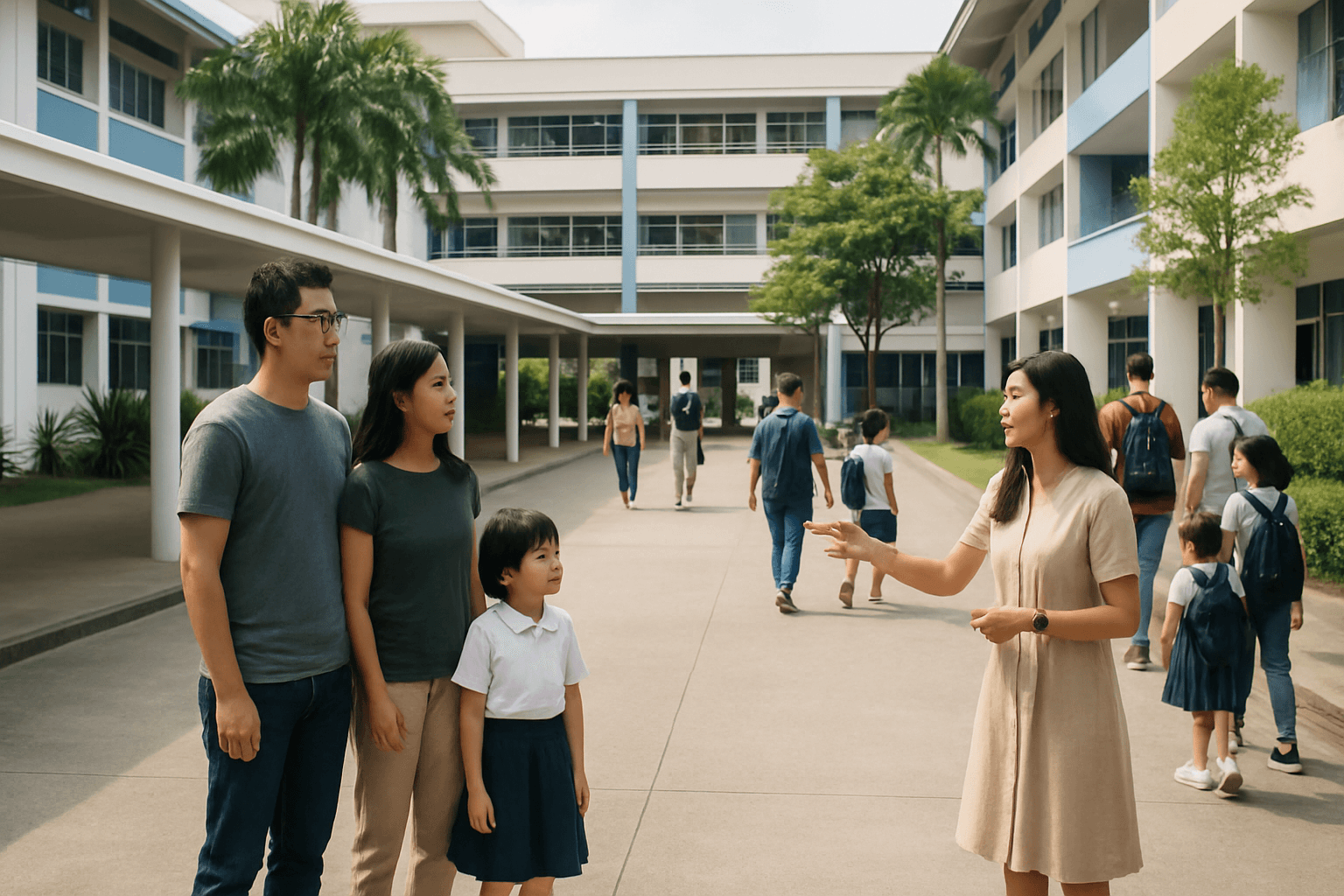
What should you look for at a primary school open house in Singapore? Focus on what daily school life will feel like, not just how polished the event looks. An open house is most useful when it helps you judge the school’s tone, routines, logistics, and fit for your child.
There is no single official open house checklist, and schools run these events differently. Some offer talks and tours. Others rely more on booths, student performances, or activity corners. That is normal. Instead of trying to see everything, use the visit to answer three practical questions: Does this school feel organised? Can my child cope well here? Can our family sustain the daily routine?
What is the real purpose of a primary school open house?
Use the open house to judge real-life fit: school tone, routines, logistics, and communication style.
The real purpose of a primary school open house is to help you judge fit. You are not mainly there to collect brochures or be impressed by a polished event. You are there to work out whether the school will function well for your child and your family in ordinary daily life.
That means paying attention to the school’s tone, routines, visitor flow, and communication style. A useful visit helps you picture a normal school day: arrival, recess, movement between spaces, teacher expectations, and how a Primary 1 child might settle in. If a school looks strong on paper but you still cannot imagine your child coping well there, that is useful information too.
Open house formats vary, so you may not get the same access everywhere. Do not treat that as a problem. Treat it as a reminder to gather signals, not perfection. A good open house helps you picture Monday morning, not just the school’s website. For official school pages and directories, start from MOE’s site map. For a broader overview, see Primary 1 Registration in Singapore: How It Works, Balloting Risk, and How to Choose a Realistic School Plan.
Secondary School Open House 2024
Secondary School Open House [ https://www.sgprimaryschool.com/2024/10/secondary-school-open-house-november-2024.html ](link url)
Secondary School Open House 2025
2025 Secondary School Open House https://www.sgprimaryschool.com/p/secondary-school-open-house.html
What should you notice in the first few minutes after you arrive?
Look for clear wayfinding, calm crowd flow, visible helpers, and a general sense of order.
Start at the entrance. The first few minutes often show how a school handles movement, uncertainty, and people. Look for clear signs, visible staff or student helpers, orderly registration, and whether visitors are being guided calmly instead of left to guess where to go.
These small details matter because they often reflect everyday school habits. If the event flow feels patient and organised, that usually suggests stronger routines. If the space feels confusing, noisy, or bottlenecked, imagine the same area on a wet school morning with young children, bags, umbrellas, and working adults trying to get to work.
Also watch your own child. Some children walk in and get curious. Others freeze when the environment is loud or crowded. One reaction does not decide the whole school, but it gives you useful information. The first five minutes are not about glamour. They are about whether the school feels manageable. For a broader overview, see Primary 1 Registration Distance Priority: How Home-School Distance Works.
Moving to Singapore and looking for a good Secondary School
Hi Singaporenew, First of all, let me welcome you to Singapore. Can I suggest you to attend the open house of all the independent schools such as ACS, RI, SJI? Maybe could just walk into the schools to talk to their principals to find out more about their curriculum and to clear your doubts. Do bring your boys along to take a look at the environment. Your kids should be able to fit in socially since they have lived in Asia for a period of time. Hope you find an idea school for your boys. All the
Secondary School Open House 2011
I would attend the Principal's talk and some of the other talks to get a sense of the school's ethos, philosophy etc. Then go visit the exhibitions, booths which are manned by students. Talk to the students and the teachers to get a sense of the school culture. Do you and your child get a positive vibe from the school? Is this where you would want your child to spend the next important 4 years of his/her school life? Take a look at the school's facilities and CCA offerings. Which schools are you
Have More Questions?
Get personalized guidance on schools, tuition, enrichment and education pathways with AskVaiser.
Try AskVaiser for Free →How can you assess the school culture and tone?
Listen for specific, practical answers about homework, discipline, support, and parent communication.
Listen to how teachers and school leaders answer practical questions. The most useful answers are usually plain and specific. You want to hear how the school handles homework, behaviour, settling in, parent communication, and support for children who need more time, reassurance, or challenge.
Broad phrases such as “we nurture every child” are fine, but they are only helpful if staff can explain what that looks like. For example, if you ask about Primary 1 adjustment, a practical answer may mention orientation activities, buddy arrangements, teacher check-ins, or clear routines in the first few weeks. If you ask about behaviour, useful answers explain expectations and follow-up, not just values.
Parents often miss one important point: the tone of the answer is part of the answer. If staff welcome follow-up questions and explain things without sounding defensive, family-school communication is more likely to feel workable later. If simple questions only get polished slogans, expect less clarity when real issues come up. For a broader overview, see Popular Primary School vs Neighbourhood School in Singapore: Which Is Better for Your Child?.
Preparing Your Child for Primary School:Parent Seminar - MOE
Preparing Your Child for Primary School: A Parent Seminar by MOE Starting primary school is a big step in your child's life. To help you better understand primary school programmes and enable you to make key education decisions, the Ministry of Education will be conducting a seminar on Primary School Education. At the seminar, parents can look forward to sharing sessions by the school principal and a parent volunteer, as well as view the various programmes our primary schools provide. The Primar
Schools - Open House dates for Primary Schools 2012
I am a member of Queenstown Primary School PSG. The school is having its Open House tomorrow, i.e. on 30th June 2012 from 9 a.m. to 12.30 p.m, on its premises. The theme for Open House is “Fun Fair”. Apart from showcasing of different learning experiences and CCAs, there will be dialogue sessions with Principal and Vice-Principal for interested parents. Ex-students of the school will also be available to share their experiences. You can also meet our Parent Support Group volunteers. Parents livi
What clues can the classroom and learning environment give you?
Check whether classrooms feel structured, age-appropriate, and not overly cluttered or overstimulating.
Look for a space that feels structured, child-friendly, and age-appropriate for younger children. Classroom displays, sample work, labels, seating layouts, and the overall level of visual clutter can tell you something about the school’s style. A neat room with purposeful displays often suggests clear routines. A room that feels crowded or overstimulating may be fine for some children, but tiring for others.
Do not overread one display board. An open house is only a snapshot, and decoration is not the same as teaching quality. Still, the environment does matter because children spend many hours in it. Parents of quieter or more sensitive children may want to notice whether the room feels calm and predictable. Parents of active children may want to see whether the space looks structured enough to support transitions and attention.
If there is a sample activity or lesson, watch how adults speak to children. Warm but clear instructions usually tell you more than flashy materials. A child-friendly school is not necessarily the most colourful one. It is the one where expectations seem understandable. For a broader overview, see How to Read Past Balloting Data Before Chasing a Popular Primary School.
Secondary School Open House 2011
Dear Parents and Primary 6 Pupils (Boys) Victoria School is pleased to invite you to our Open House 2011 themed “Wide I’d Wonder”. The details of Victoria School’s Open House 2011 are as follow: Date: 19 Nov 2011, Saturday Time: 9am to 1pm Location: Victoria School 2 Siglap Link Singapore 448880 Register for Open House 2011 here. https://docs.google.com/spreadsheet/viewform?formkey=dG9lMElZNTJuanlhYkQzdjBRamcyNEE6MQ http://vs.moe.edu.sg/public_images/openhouse2011banner.jpg Regards.
Schools - Open House dates for Primary Schools 2009
Ang Mo Kio Primary School & Canossa Convent Primary School cancelled their planned open house due to fear of H1N1 risk Zhenghua Primary School’s Open House and Arts Festival will be held in conjunction with Bukit Panjang Community Racial Harmony Day on Friday 24Jul. Xingnan Primary School’s Open House is on 18Jul, featuring concert items by CCAs and school tour. St Gabriels Primary School’s 11Jul open house programme is modified. The carnival portion is cancelled. School Tours & Principal’s Talk
What practical logistics should parents check during the visit?
Check whether the school will be manageable on an ordinary weekday, not just on open house day.
Practical logistics are where many parents under-check and later regret it. During the visit, stop thinking like an event guest and start thinking like a family doing this routine for years. How long would the morning journey really take? Does the road access look stressful? Can a caregiver or grandparent manage pickup? If you have another child in preschool, does the timing become unrealistic?
If possible, walk the route from the gate to key spaces and notice how children may move around. Look at the canteen setup, toilet access, and whether the campus seems easy for younger pupils to navigate. You do not need a perfect layout. You need one that feels sensible.
A simple test helps: can you imagine doing this on a rainy Tuesday when everyone is tired? Another useful test is your backup plan. If one parent is travelling, can someone else realistically handle drop-off or pickup without confusion? Prestige often hides this problem. A well-known school can still be a poor fit if the commute is punishing. Even though it is written about preschool choice, this practical piece on choosing a school near you makes the right bigger point: daily convenience is not a small detail. It becomes part of your child’s school experience.
Open House 2023 (Secondary schools)
here is an updated list of secondary school open house https://www.sgprimaryschool.com/2023/10/secondary-school-open-house-november.html
Secondary Schools OPEN HOUSE 2010
Based on info from the respective school websites: http://www.hci.sg/openhouse2010/index.htm - 15 May 2010 (Sat) 8.30 am to 1.30 pm http://www.nygh.moe.edu.sg/Open%20House%20Programme.pdf - 22 May 2010 (Sat) 8.00 am to 2.00 pm http://www.ri.edu.sg/main/announcementdetail/?id=47 - 22 May 2010 (Sat) 9.00 am to 4.00 pm http://www.rgs.edu.sg/newsite/news/2010_OpenHse.pdf - 22 May 2010 (Sat) 9.00 am to 4.00 pm http://www.scgs.edu.sg/index.php?option=com_content&task=view&id=48&Itemid=60 - 22 May 2010
What questions should you ask teachers or school leaders?
Ask about settling in, homework, parent communication, and how the school supports different learner profiles.
Ask a short set of practical questions that you can repeat at every school. That makes comparison much easier later. Good examples are: “How do Primary 1 children usually settle in here?” “What is homework typically like in the lower primary years?” “How do teachers update parents?” and “If a child is shy, active, or needs more support, what usually helps in the first few months?”
If relevant, you can also ask what support looks like for children who need more challenge, how recess or canteen routines are introduced to younger pupils, and who parents usually approach when concerns come up. The goal is not to test staff. It is to get a clearer picture of ordinary school life.
If an answer sounds too general, ask one follow-up: “What does that usually look like in Primary 1?” or “Can you give an example?” That small follow-up often tells you whether the school can explain its own routines clearly. A useful habit is to write down the same answers after each visit. Although it is aimed at DSA open houses, this open house tips article gets one thing right: you remember schools better when you compare them using the same few questions.
Secondary School Open House 2011
Hi parents, the updated listed as at 13 Nov 11, 12.10pm. Kindly help to feedback if there is any error. School Open House 19 Nov 2011 Anderson Sec School\t\t\t\t8.00 am - 12.00 pm Bukit Panjang Government High School 武中 Chung Cheng High (Main)\t\t\t10.00 am – 2.00 pm East Spring Secondary School / 东源中学 8.45 am - 12.00 pm Nan Chiau High school 8.00 am - 3.00 pm Naval Base Sec Sch\t\t\t\t11.00 am – 4.00 pm Ngee Ann Secondary School\t\t\t9.00 am - 2.00 pm Pasir Ris Secondary School\t\t\t9.00 am - 1
Secondary School Open House 2011
Hi parents, the updated listed as at 3 Nov 11, 10.20 am. Kindly help to feedback if there is any error. School Open House 12 Nov 2011 CHIJ St. Theresa's Convent\t\t\t9.00 am to 2.30 pm Holy Innocents' High School \t\t\t9.00 am – 1.00pm St. Joseph Institution / 圣若瑟书院 8.30 am - 12.30 pm Zhonghua Secondary school\t\t\t10.00am to 3.00pm 19 Nov 2011 Anderson Sec School\t\t\t\t8.00 am - 12.00 pm Chung Cheng High (Main)\t\t\t10.00 am – 2.00 pm East Spring Secondary School / 东源中学 8.45 am - 12.00 pm Nan
How do you tell whether the school suits your child’s personality?
Choose for child fit, not just school popularity: pace, tone, structure, and daily stamina all matter.
Match the school’s tone and pace to your child, not just to the school’s reputation. A shy child may cope better in an environment that feels calm, warm, and clearly structured. A very energetic child may benefit from a school that looks orderly, with firm routines and adults who give clear instructions. An independent child may be comfortable in a setting that expects self-management earlier. A child who needs more reassurance may need a school that speaks concretely about adjustment and support.
This is where many parents get distracted by popularity. Two schools can both be good schools, yet one may still suit your child much better. If your child gets overwhelmed easily, a very intense and bustling environment may become draining even if others praise it highly. If your child likes structure and challenge, a more brisk, demanding tone may feel normal rather than stressful.
Fit also includes the family routine. A child who is already tired by the end of the day may struggle more with a long commute than with academics. That is one reason the “popular school versus nearby school” decision is often more practical than parents expect, as we explain in our guide to popular primary schools versus neighbourhood schools. Children do not attend reputation. They attend a daily routine.
[Geylang] Primary Schools
For primary schools, I recommend going for convenience than popularity. Reason is the kids are still young, and travelling time should not be long enough to tire them out, even for those driving. Have you seen children dozing off in the parents car (some in an awkward position, especially straining their necks) because they have to wait up earlier than their peers to reach these “better” schools to feed their parents “ego”. Please note that the above is just my PERSONAL view as I have gone throu
Preschools prepared your kids well for Singapore primary?
For parents who have already been through the pre-school days and with kids now in primary schools (Singapore schools), can you share your comments on your kid's previous preschool and their curriculum - specifically if they have prepared your child properly for the Singapore education system ? (not discussing the international or foreign schools system here) Nowadays, there are so many pre-schools and childcare centres with many learning methods. Parents currently at the pre-school stage will b
What simple primary school open house checklist can parents use?
Use this quick comparison checklist to judge two or three schools on the same factors.
- ✓This is a parent comparison checklist, not an official school list
- ✓Entrance flow felt clear, calm, and easy to follow
- ✓Staff or student helpers were visible and approachable
- ✓The school felt orderly, welcoming, and age-appropriate for younger children
- ✓Answers about homework, discipline, and routines were specific rather than vague
- ✓Classrooms felt structured and child-friendly, not overly cluttered or overstimulating
- ✓I could picture my child feeling reasonably comfortable in this environment
- ✓The commute looked realistic for our weekday routine
- ✓Drop-off and pickup seemed manageable for parents or caregivers
- ✓Canteen and toilet arrangements looked sensible for younger pupils
- ✓Student movement between spaces seemed organised
- ✓The school explained how Primary 1 children settle in
- ✓The school explained how teachers communicate with parents
- ✓The school could describe support for children who need more help or more challenge
- ✓Overall, this school felt sustainable for our family, not just impressive for one visit
What do parents commonly overlook at primary school open houses?
Parents most often overlook daily logistics, communication clarity, and whether the school is a realistic registration option.
The biggest blind spots are usually the boring parts that later become daily stress. Parents often remember the hall, the student performances, and the campus feel, but forget to test the commute, pickup realism, caregiver backup plan, or whether staff gave clear answers about everyday expectations. Another common miss is child fit. A school can be excellent and still feel too loud, too rigid, or too demanding for one particular child.
One practical way to avoid this is to combine your open house notes with registration reality. After the visit, compare your shortlist against your likely admission options using our Primary 1 Registration Singapore guide, distance priority guide, and past balloting data guide. A school is only a real option if it fits both your child and your registration situation.
Secondary School Open House 2011
Hi, Does anyone knows if the following secondary schools' open house need to register? 1)Paya Lebar Methodist Girl's School 2)Cresent Girl's School 3)River Valley High 4)Anglican High 5)Gan Eng Seng Sec 6)Cedar Girl's School 7)Assumption English School And please kindly include when is the closing date for registeration for the open house!! Thanks!!
Secondary School Open House Dates 2021
https://www.schoolbag.edu.sg/story/online-open-house-for-secondary-schools-2021-v2
Have More Questions?
Get personalized guidance on schools, tuition, enrichment and education pathways with AskVaiser.
Try AskVaiser for Free →